There’s a quiet difference between people who eventually make it and those who stop along the way.
It’s not always about luck.
It’s not always about talent.
And it’s not always about having the perfect circumstances.
Very often, it comes down to how long you’re willing to keep going.
“A genius is the man who can do the average thing when everyone else around him is losing his mind.” — Napoleon
Read that again.
Because that single idea explains why most people fail.
⬥ Everyone wants the rewards.
Few want the repetitions.
The boring days.
The silent grind.
The work nobody applauds.
⬥ People overestimate what they can do in a month.
And underestimate what they can do in ten years.
A single skill.
A single connection.
A single opportunity.
Repeated long enough becomes a completely different life.
⬥ The world doesn't care about your potential.
Potential has never paid a bill.
Potential has never built a business.
Potential has never changed a life.
Execution does.
⬥ When things get difficult, most people panic.
They switch plans.
They chase shortcuts.
They abandon the process.
The rare few stay calm.
They keep showing up.
They keep building.
⬥ Every day you are becoming someone.
More disciplined or less disciplined.
More focused or more distracted.
More valuable or more replaceable.
You don't stay the same.
You compound.
⬥ Success isn't an event.
It's a collection of invisible decisions made daily.
The extra hour.
The difficult conversation.
The skill you chose to learn.
The excuse you refused to make.
One day people will call it luck.
They won't see the thousands of choices that created it.
The future belongs to people who can stay focused while everyone else is distracted.
Stay calm when others panic.
Stay patient when others quit.
Stay building when others complain.
Be one of them.
𝗔𝗗𝗢𝗣𝗧𝗜𝗢𝗡 𝗚𝗥𝗢𝗪𝗦 𝗪𝗛𝗘𝗡 𝗦𝗜𝗠𝗣𝗟𝗘 𝗔𝗖𝗧𝗜𝗢𝗡𝗦 𝗕𝗘𝗖𝗢𝗠𝗘 𝗘𝗔𝗦𝗜𝗘𝗥
Adoption isn't only about bringing new users into crypto.
Sometimes, the bigger opportunity is improving the experience for the people who are already here.
On #TRON, sending stablecoins such as $USDT and $USDD is one of the most common on-chain activities.
That makes transaction friction particularly important.
A user may understand exactly what they want to do—send a stablecoin from one wallet to another—but still have to think about network fees, maintaining enough TRX for transactions, and managing additional steps that have nothing to do with the actual transfer.
This is the type of friction #GasFree is designed to address.
The concept is straightforward:
The user wants to send a stablecoin.
The infrastructure should make that action as simple as possible.
That matters because good infrastructure isn't always about adding more features.
Sometimes it's about removing unnecessary steps.
For stablecoins, this becomes even more relevant as their use expands beyond trading.
USDT and USDD can be used for transfers, payments, DeFi activity, and other on-chain financial applications. As usage increases, even small sources of friction can become meaningful at scale.
GasFree's support for stablecoin transfers therefore fits into a broader trend:
Make blockchain transactions feel less like blockchain transactions.
The technology remains underneath.
The user simply completes the action.
That is how infrastructure can support adoption—not by convincing people to use crypto once, but by making the things they already do easier, faster, and more intuitive.
⚡ Less friction.
💵 More practical stablecoin transfers.
🌐 A smoother on-chain experience.
The next stage of adoption may not come from teaching users more blockchain terminology.
It may come from giving them fewer reasons to think about it.
@DeFi_JUST@USDDecentralize@justinsuntron
#TRONEcoStar
𝗨𝗦𝗗𝗗 𝗜𝗦 𝗡𝗢𝗪 𝗢𝗡 𝗚𝗔𝗦𝗙𝗥𝗘𝗘 🎉
GasFree now supports $USDD, creating another way for users to move USDD without dealing with the usual friction around network gas fees.
If you've already used GasFree to transfer USDD, this is your chance to share the experience with the community.
To celebrate the integration, the USDD community is launching a special giveaway with a 300 $USDD prize pool. 👀
𝗛𝗢𝗪 𝗧𝗢 𝗝𝗢𝗜𝗡:
1️⃣ Follow @USDDecentralize, @DeFi_JUST & @klever_io
2️⃣ ❤️ Like and repost the official campaign post
3️⃣ 🔁 Quote repost with #USDDonGasFree and share your experience using GasFree with $USDD—or explain how gasless USDD transfers could improve your on-chain experience.
The bigger story here is the reduction of transaction friction.
Gas fees can be a major barrier for users, especially when they are simply trying to transfer stablecoins.
By bringing USDD into GasFree, the experience can become more accessible for users who want to move stable-value assets without having to constantly manage the network's native token for transaction costs.
That matters because stablecoins are increasingly used for more than trading.
They are becoming part of payments, transfers, DeFi strategies, and everyday on-chain activity.
The easier those transactions become, the more practical stablecoin infrastructure can be.
And community campaigns like this provide an opportunity to move beyond announcements.
Use it.
Share your experience.
Show the community what changes when USDD meets GasFree.
🎁 300 $USDD prize pool
🏃 Join the campaign and share your #USDDonGasFree experience.
@USDDecentralize@DeFi_JUST@klever_io
#TRONEcoStar
USDD on GasFree. 🎉
If you’ve been using GasFree to move $USDD, this one’s for you.
Share your #USDDonGasFree experience for a chance to win from the 300 $USDD prize pool. 👀
Join in now 🏃
𝗧𝗨𝗥𝗡 𝗧𝗥𝗫 𝗜𝗡𝗧𝗢 𝗔 𝗪𝗢𝗥𝗞𝗜𝗡𝗚 𝗔𝗦𝗦𝗘𝗧 𝗪𝗜𝗧𝗛 $𝗦𝗧𝗥𝗫
What if your $TRX could continue working while giving you access to additional DeFi utility?
That is the idea behind $sTRX on @DeFi_JUST.
The process is straightforward:
Stake $TRX → Receive $sTRX → Put it to work
By staking TRX, users receive sTRX, which can then participate within the JustLend DAO ecosystem.
The current 7-day average APY is 4.07%, with yield coming from multiple sources:
✅ TRON governance rewards
✅ Energy Rental income
This creates an interesting structure because the asset isn't simply sitting idle.
Instead, the staking position can participate in an ecosystem where TRON resources and DeFi utility intersect.
Energy is particularly important within the TRON ecosystem because smart-contract interactions require network resources.
By incorporating Energy Rental income into the yield model, sTRX connects staking with an actual infrastructure demand within the network.
Of course, APY is variable and can change with network conditions, utilization, rewards, and other factors.
A 7-day average should therefore be viewed as a snapshot rather than a guaranteed future return.
The bigger idea is capital efficiency.
Rather than treating staking as the end of the process, liquid staking can give users an asset that remains useful across additional DeFi applications.
One underlying asset.
Multiple sources of utility.
More ways to put capital to work.
For TRX holders exploring DeFi, sTRX is worth understanding—not simply because of the current APY, but because of how it connects staking rewards with TRON's resource economy.
⬇️ Explore sTRX: https://t.co/4XX2e5tbWF
@DeFi_JUST@justinsuntron
#TRONEcoStar
𝗛𝗢𝗪 𝗨𝗦𝗗𝗗 𝗔𝗡𝗗 𝗝𝗨𝗦𝗧𝗟𝗘𝗡𝗗 𝗗𝗔𝗢 𝗙𝗜𝗧 𝗧𝗢𝗚𝗘𝗧𝗛𝗘𝗥
USDD is part of the broader JUST ecosystem, but that naturally raises an important question:
Where does JUST come in?
The answer becomes clearer when you look at the different layers of the ecosystem.
#USDD serves as the stablecoin layer.
It provides a stable-value asset that can be used across different on-chain financial activities.
#JustLendDAO provides the lending layer.
It gives users access to DeFi functionality around supported assets, including USDD, allowing those assets to participate in lending and other on-chain financial use cases.
That distinction matters.
A stablecoin and a lending protocol are not competing for the same role.
They can complement each other.
Think of it as different components working within the same financial architecture:
USDD → Stablecoin
JustLend DAO → Lending & DeFi infrastructure
JUST → Broader ecosystem
Each layer has its own function, but the pieces can interact to create a more complete on-chain financial environment.
This is also why ecosystem design matters in DeFi.
A strong ecosystem isn't necessarily built around one application doing everything.
It can be built through specialized protocols that provide different pieces of the financial stack while remaining interoperable.
For users, that can mean more ways to deploy capital.
For protocols, it can mean deeper utility.
And for the broader ecosystem, it creates more opportunities for liquidity to move between different applications rather than remaining isolated.
The important takeaway is simple:
USDD is the stablecoin layer.
JustLend DAO is the lending layer within JUST.
Different roles.
Different functions.
One interconnected ecosystem.
@USDDecentralize@DeFi_JUST@justinsuntron
#TRONEcoStar
𝗧𝗛𝗘 𝗕𝗘𝗦𝗧 𝗥𝗢𝗨𝗧𝗘 𝗦𝗛𝗢𝗨𝗟𝗗𝗡’𝗧 𝗥𝗘𝗤𝗨𝗜𝗥𝗘 𝗔 𝗠𝗔𝗡𝗨𝗔𝗟 𝗦𝗘𝗔𝗥𝗖
A swap can look simple on the surface while several possible liquidity paths exist underneath.
https://t.co/UN5j76iwDF’s Universal Router is built to handle that complexity by automatically seeking efficient routes across available liquidity.
That creates a better separation of responsibilities: users focus on the trade while the infrastructure handles the routing problem.
For DeFi on TRON, this kind of abstraction matters because better execution should become easier to access, not harder to understand.
@OfficialSUNio@justinsuntron
#TRONEcoStar
𝗟𝗜𝗤𝗨𝗜𝗗𝗜𝗧𝗬 𝗣𝗥𝗢𝗩𝗜𝗗𝗜𝗡𝗚 𝗜𝗦 𝗔𝗟𝗦𝗢 𝗔 𝗗𝗘𝗖𝗜𝗦𝗜𝗢𝗡 𝗔𝗕𝗢𝗨𝗧 𝗖𝗔𝗣𝗜𝗧𝗔𝗟 𝗣𝗟𝗔𝗖𝗘𝗠𝗘𝗡𝗧
Providing liquidity is not simply about putting assets into a pool.
With concentrated liquidity on SunSwap, LPs can position capital around specific price ranges, allowing them to take a more deliberate approach to where their liquidity becomes active.
That can improve capital efficiency, but it also makes understanding the position more important.
https://t.co/UN5j76iwDF gives liquidity providers more control over how their capital participates in markets, which is a meaningful step in the evolution of AMM design.
@OfficialSUNio@justinsuntron
#TRONEcoStar
𝗗𝗘𝗙𝗜 𝗚𝗢𝗩𝗘𝗥𝗡𝗔𝗡𝗖𝗘 𝗕𝗘𝗖𝗢𝗠𝗘𝗦 𝗠𝗢𝗥𝗘 𝗨𝗦𝗘𝗙𝗨𝗟 𝗪𝗛𝗘𝗡 𝗜𝗧 𝗖𝗛𝗔𝗡𝗚𝗘𝗦 𝗥𝗘𝗔𝗟 𝗜𝗡𝗖𝗘𝗡𝗧𝗜𝗩𝗘𝗦
Governance should not be limited to casting votes that have little connection to the protocol’s actual economy.
SUN DAO’s pool weight voting gives the community a mechanism to influence how liquidity incentives are allocated across pools.
That creates a direct connection between governance decisions and capital distribution.
It is a useful model because participants are not simply discussing the future of the protocol; their decisions can help shape where economic incentives are directed within the https://t.co/UN5j76iwDF ecosystem.
@OfficialSUNio@justinsuntron
#TRONEcoStar
𝗧𝗛𝗘 $𝗦𝗨𝗡 𝗩𝗔𝗟𝗨𝗘 𝗔𝗖𝗖𝗥𝗨𝗔𝗟 𝗟𝗢𝗢𝗣 𝗜𝗦 𝗕𝗨𝗜𝗟𝗧 𝗔𝗥𝗢𝗨𝗡𝗗 𝗥𝗘𝗔𝗟 𝗥𝗘𝗩𝗘𝗡𝗨𝗘 🔥
Token value accrual is often discussed in DeFi, but the more important question is how the mechanism actually works.
For $SUN, protocol revenues generated across the ecosystem—including SunSwap, SunPump, and SUNX—are routed into a programmatic buyback-and-burn model.
That creates a direct connection between ecosystem activity and token supply.
When the underlying products generate revenue, part of that economic activity feeds into the mechanism designed to acquire and permanently remove $SUN from circulation.
The latest on-chain execution figures show:
🔥 678,548,010 $SUN permanently burned
≈ $11.44M
⏳ 7,707,026 $SUN pending in the queue
These numbers are important because the mechanism can be observed on-chain rather than relying purely on narrative.
The broader concept is straightforward:
Protocol Activity → Revenue → Buyback → Permanent Burn
That creates a continuous supply sink tied to actual ecosystem cash flow.
But there is an important distinction worth keeping in mind.
A buyback-and-burn mechanism does not automatically guarantee price appreciation.
The economic value of the model ultimately depends on sustained protocol revenue, continued product usage, execution of the mechanism, and the relationship between token demand and circulating supply.
That is why the most important metric to watch isn't simply the number of tokens burned.
It is whether the ecosystem can consistently generate enough real economic activity to sustain the process.
If revenue grows alongside usage, the mechanism has a stronger foundation.
If usage declines, the strength of the value-accrual loop changes with it.
That makes on-chain execution worth monitoring over time.
Real revenue.
Programmatic execution.
Permanent supply reduction.
The next chapter is about sustainability.
@OfficialSUNio@justinsuntron
#TRONEcoStar
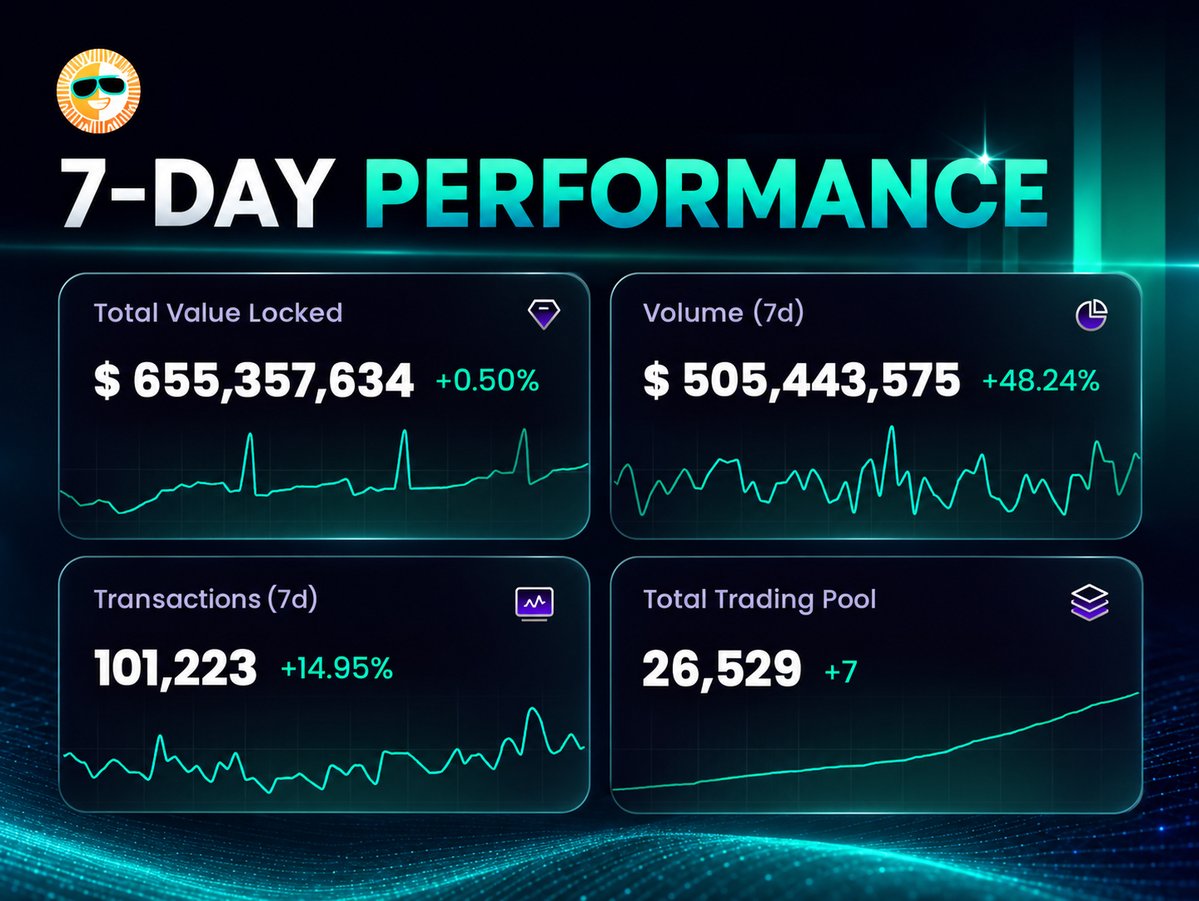
𝗦𝗨𝗡.𝗜𝗢 𝗝𝗨𝗦𝗧 𝗛𝗔𝗗 𝗔 𝗠𝗔𝗦𝗦𝗜𝗩𝗘 𝗪𝗘𝗘𝗞 📊☀️
The latest numbers from @OfficialSUNio show a clear increase in activity across the ecosystem.
📈 7-Day Trading Volume: $505.44M (+48.24%)
💧 TVL: $655.35M (+0.50%)
🔄 Transactions: 101,223 (+14.95%)
🌐 Trading Pools: 26,529 (+7)
The standout number is undoubtedly trading volume.
Crossing $505M in seven-day volume while growing 48.24% is a strong signal of increased market activity across https://t.co/UN5j76iwDF.
But volume becomes more meaningful when viewed alongside the other metrics.
More than 101,000 transactions were recorded over the same period, showing that the increase wasn't limited to a handful of large movements.
Meanwhile, TVL remained relatively stable while activity accelerated.
That combination is worth watching.
It suggests capital already sitting within the ecosystem is being utilized more actively rather than simply accumulating without corresponding transaction activity.
The growth in trading pools also adds another layer to the picture, with the total reaching 26,529.
Of course, one strong week does not establish a long-term trend.
The more important question is whether https://t.co/UN5j76iwDF can sustain this level of volume and transaction activity while maintaining liquidity quality and user participation over time.
That is where the next set of data becomes important.
For now, though, the numbers tell a straightforward story:
$505M+ in weekly volume.
101K+ transactions.
$655M+ TVL.
26K+ trading pools.
Liquidity isn't just sitting there.
It's being used.
And sustained utilization is one of the clearest metrics to watch when evaluating the health of a DeFi ecosystem.
☀️ The volume speaks for itself.
@OfficialSUNio@justinsuntron
#TRONEcoStar
𝗙𝗥𝗢𝗠 𝟰𝟬𝟬𝗠 𝗧𝗥𝗢𝗡 𝗔𝗖𝗖𝗢𝗨𝗡𝗧𝗦 𝗧𝗢 𝟭𝗕: 𝗪𝗛𝗔𝗧 𝗖𝗢𝗠𝗘𝗦 𝗡𝗘𝗫𝗧? 🚀
TRON has crossed 400 million total accounts.
That number is more than a headline milestone.
It reflects years of on-chain activity across stablecoins, payments, DeFi, liquidity, applications, and the infrastructure supporting millions of blockchain interactions.
But reaching 400 million also creates a more difficult question:
What will actually take crypto to its next billion users?
The answer probably won't be a single protocol or one killer application.
The next wave of adoption may depend on whether blockchain becomes easier to use without requiring users to understand the complexity underneath it.
Better user experience.
Lower friction.
Faster transactions.
Accessible financial applications.
Stablecoin-powered payments.
Deeper institutional participation.
And consumer applications that solve problems people already have.
This is where the conversation becomes much more interesting.
Crypto doesn't need another billion people simply creating wallets.
It needs another billion people finding reasons to use them.
That distinction matters.
The next billion could come from payments, savings, remittances, trading, gaming, social applications, AI, DeFi, or entirely new use cases that haven't reached scale yet.
https://t.co/UN5j76iwDF is bringing ecosystem builders together to explore exactly that question:
What will onboard the next billion?
The discussion brings together contributors from across the TRON and broader Web3 ecosystem, including @DeFi_JUST, @DCBK2LA, @trav_4211, @thecryptocoach, @Bridgersxyz, @EchobitExchange, @thenameisMufasa, @noma_network, @Matrix__Chain, and @DevLendProtocol.
The 400M milestone is worth celebrating.
But the more important challenge has already started:
How does crypto move from hundreds of millions of accounts to billions of meaningful users?
That will be decided by utility, accessibility, infrastructure, and execution—not just numbers.
@OfficialSUNio@trondao@DeFi_JUST@justinsuntron
#TRONEcoStar
TRON Surpassed 400M Users: What Will Bring Crypto Its Next Billion?🚀
Crossing 400M accounts isn't just a milestone—it's proof of real-world adoption powered by stablecoins, scalable infrastructure, and active DeFi liquidity. But scaling from 400 million to a billion requires a whole new playbook.
What unlocks the next wave? Seamless UX, deeper institutional integrations, or consumer-facing dApps?
Join https://t.co/E4QwBX9M8G as we bring together ecosystem builders to map out the road to 1B users.
🗓 Time: August 27, 1:00 PM UTC
📍 Space Link: https://t.co/HT6hdrQw0M
🎙 Co-hosts: @DeFi_JUST, @DCBK2LA
🗣 Guests: @trav_4211, @thecryptocoach, @Bridgersxyz, @EchobitExchange, @thenameisMufasa, @noma_network, @Matrix__Chain, @DevLendProtocol
Set your reminder below and tell us what you think will onboard the next billion 👇🔥
𝗧𝗥𝗢𝗡 𝗗𝗘𝗙𝗜 𝗦𝗨𝗠𝗠𝗘𝗥 𝗜𝗦 𝗦𝗧𝗜𝗟𝗟 𝗝𝗨𝗦𝗧 𝗚𝗘𝗧𝗧𝗜𝗡𝗚 𝗦𝗧𝗔𝗥𝗧𝗘𝗗 ☀️
There is still plenty of time to explore the opportunities coming with TRON DeFi Summer.
The current campaign runs for 60 days, with a total reward pool of $2.35 million dedicated to boosted APR opportunities across participating vaults.
Through JustLend DAO on Binance Wallet DeFi, users can subscribe to vaults featuring:
🔹 JST
🔹 SUN
🔹 TRX
🔹 USDD
The interesting part isn't simply the headline reward pool.
Campaigns like this can help bring more attention and liquidity toward the underlying DeFi infrastructure by making it easier for users to discover on-chain yield opportunities through a familiar wallet environment.
At the same time, users should look beyond the advertised APR.
Boosted APR is an opportunity, not a guaranteed return.
Rates can change as participation, liquidity, rewards, and campaign conditions evolve. Users should always review the current terms, supported assets, duration, risks, and actual yield before committing capital.
For the broader TRON ecosystem, the campaign is another example of how wallets, lending infrastructure, stablecoins, and DeFi protocols can connect into a more accessible on-chain financial experience.
More liquidity can create deeper markets.
More users can create greater activity.
And more activity can give DeFi applications additional opportunities to prove their utility beyond temporary incentives.
☀️ 60 days. $2.35M in rewards. Four participating assets.
The real question is what kind of sustained DeFi activity this incentive period can create after the rewards eventually end.
That is the metric worth watching.
@DeFi_JUST@trondao@OfficialSUNio@USDDecentralize@justinsuntron
#TRONEcoStar
#TRONDeFiSummer
Still plenty of Summer left. ☀️
60 days of boosted APR opportunities are underway, with a $2.35M reward pool up for grabs.
Subscribe to JST, SUN, TRX, and USDD vaults through JustLend DAO on #Binance Wallet DeFi and join the #TRONDeFiSummer. @trondao@OfficialSUNio@USDDecentralize
𝗧𝗛𝗘 𝗕𝗜𝗚𝗚𝗘𝗦𝗧 𝗧𝗢𝗡 𝗧𝗛𝗘𝗦𝗜𝗦 𝗜𝗦 𝗡𝗢𝗧 𝗔𝗕𝗢𝗨𝗧 𝗧𝗣𝗦
I wouldn't evaluate TON simply by asking whether it is faster than another blockchain.
That's too narrow.
I'd ask a harder question:
Can TON make decentralized applications feel native to everyday digital life?
Telegram provides distribution.
Mini Apps provide the interface.
TON Connect provides wallet connectivity.
Jettons provide programmable value.
Smart contracts provide application logic.
TON provides the settlement layer.
If those components reinforce each other, TON becomes more than a blockchain people transact on.
It becomes infrastructure developers can use to build digital experiences where ownership and settlement happen almost invisibly.
That's the thesis worth watching.
@ston_fi
𝗧𝗛𝗘 𝗡𝗘𝗫𝗧 𝗣𝗛𝗔𝗦𝗘 𝗢𝗙 𝗧𝗢𝗡 𝗦𝗛𝗢𝗨𝗟𝗗 𝗕𝗘 𝗔𝗕𝗢𝗨𝗧 𝗤𝗨𝗔𝗟𝗜𝗧𝗬
Early ecosystems benefit from experimentation.
Mature ecosystems benefit from execution.
Better applications.
Better UX.
Better security.
Better developer tooling.
Better liquidity.
Better payment experiences.
Better retention.
That's how attention becomes infrastructure.
TON already has an unusual distribution advantage.
The harder task is converting that advantage into products people repeatedly use.
More projects won't necessarily accomplish that.
Better products will.
That is where the next level of competition will happen.
@ston_fi
𝗧𝗢𝗡 𝗜𝗦 𝗔𝗡 𝗘𝗫𝗣𝗘𝗥𝗜𝗠𝗘𝗡𝗧 𝗜𝗡 𝗗𝗜𝗦𝗧𝗥𝗜𝗕𝗨𝗧𝗘𝗗 𝗔𝗣𝗣𝗟𝗜𝗖𝗔𝗧𝗜𝗢𝗡 𝗜𝗡𝗙𝗥𝗔𝗦𝗧𝗥𝗨𝗖𝗧𝗨𝗥𝗘
Telegram provides distribution.
Mini Apps provide an interface.
TON provides blockchain settlement.
Wallets provide authorization.
Jettons provide programmable assets.
Smart contracts provide application logic.
Each layer solves a different problem.
The interesting part is what happens when they become one coherent user experience.
If they remain fragmented, the opportunity is limited.
If they reinforce one another, TON could create a very different path into Web3.
That's the experiment worth watching.
@ston_fi
𝗪𝗔𝗟𝗟𝗘𝗧 𝗖𝗢𝗨𝗡𝗧𝗦 𝗔𝗥𝗘 𝗘𝗔𝗦𝗬 𝗧𝗢 𝗠𝗜𝗦𝗜𝗡𝗧𝗘𝗥𝗣𝗥𝗘𝗧
A wallet created once tells you very little.
A user repeatedly interacting with applications tells you much more.
I'd rather examine:
Recurring transactions.
Application retention.
Asset activity.
Payment usage.
Smart-contract interactions.
Developer activity.
Economic throughput.
Those signals tell you whether users found actual utility.
TON has a strong distribution story.
The next level is proving that users don't simply arrive.
They stay because the applications give them a reason to return.
@ston_fi
𝗕𝗟𝗢𝗖𝗞𝗖𝗛𝗔𝗜𝗡 𝗔𝗗𝗢𝗣𝗧𝗜𝗢𝗡 𝗪𝗢𝗡’𝗧 𝗡𝗘𝗖𝗘𝗦𝗦𝗔𝗥𝗜𝗟𝗬 𝗟𝗢𝗢𝗞 𝗟𝗜𝗞𝗘 𝗕𝗟𝗢𝗖𝗞𝗖𝗛𝗔𝗜𝗡 𝗔𝗗𝗢𝗣𝗧𝗜𝗢𝗡
A user might:
Buy something.
Play a game.
Receive a reward.
Collect an asset.
Send money.
Access a service.
They may never think:
“I am using TON.”
That's not failure.
That's the destination.
The internet became powerful when people stopped thinking about the underlying protocols every time they opened an application.
Blockchain should eventually reach the same level of abstraction.
TON has an interesting environment for testing that idea.
@ston_fi
𝗧𝗢𝗡 𝗛𝗔𝗦 𝗔 𝗨𝗫 𝗕𝗘𝗧 — 𝗕𝗨𝗧 𝗜𝗧 𝗠𝗨𝗦𝗧 𝗣𝗥𝗢𝗩𝗘 𝗜𝗧
The idea is straightforward:
Put decentralized infrastructure close to familiar applications and reduce the distance between users and blockchain functionality.
But there is an important condition.
The experience must actually improve.
If users encounter more clicks, confusing wallets, failed transactions, unclear fees or unnecessary complexity, distribution won't save the product.
TON therefore has to prove more than accessibility.
It has to prove that blockchain ownership and settlement can make applications better.
That's the real test of the Telegram + TON model.
@ston_fi
𝗗𝗘𝗩𝗘𝗟𝗢𝗣𝗘𝗥 𝗘𝗖𝗢𝗡𝗢𝗠𝗜𝗖𝗦 𝗔𝗥𝗘 𝗔𝗡 𝗨𝗡𝗗𝗘𝗥𝗥𝗔𝗧𝗘𝗗 𝗣𝗔𝗥𝗧 𝗢𝗙 𝗕𝗟𝗢𝗖𝗞𝗖𝗛𝗔𝗜𝗡 𝗖𝗢𝗠𝗣𝗘𝗧𝗜𝗧𝗜𝗢𝗡
Every fragmented integration creates maintenance costs.
Every unnecessary standard increases development time.
Every extra user step creates another opportunity for abandonment.
That means developer tooling isn't merely a technical concern.
It affects economics.
If TON makes it easier to build applications, connect wallets and interact with programmable assets, developers can experiment faster.
More experimentation creates more opportunities for successful products.
The ecosystem that makes builders more productive can eventually outperform the ecosystem with the loudest marketing.
@ston_fi
𝗧𝗛𝗘 𝗦𝗧𝗥𝗢𝗡𝗚𝗘𝗦𝗧 𝗧𝗢𝗡 𝗧𝗛𝗘𝗦𝗜𝗦 𝗜𝗦𝗡’𝗧 𝗝𝗨𝗦𝗧 “𝗧𝗘𝗟𝗘𝗚𝗥𝗔𝗠 𝗛𝗔𝗦 𝗔 𝗟𝗢𝗧 𝗢𝗙 𝗨𝗦𝗘𝗥𝗦”
A large audience doesn't automatically become blockchain users.
The stronger thesis is the infrastructure connecting that audience to on-chain utility.
Telegram → distribution.
Mini Apps → application interface.
TON → settlement.
Wallets → authorization.
Jettons → programmable value.
Smart contracts → application logic.
If these layers reinforce one another, TON can shorten the distance between discovering a product and using blockchain functionality.
That is much more interesting than a headline user number.
The infrastructure connecting people to useful applications is what matters.
@ston_fi
𝗗𝗢𝗡’𝗧 𝗥𝗘𝗗𝗨𝗖𝗘 𝗧𝗢𝗡 𝗧𝗢 𝗧𝗢𝗡𝗖𝗢𝗜𝗡
TONcoin is important.
But it is only one component of the broader network.
The ecosystem includes smart contracts, wallets, tokens, Mini Apps, payment infrastructure, developer tooling and decentralized services.
That distinction matters.
A token can attract liquidity.
An ecosystem has to earn sustained utility.
So the deeper question isn't:
“How valuable is TONcoin?”
It's:
“How much useful economic activity can developers and users create around TON?”
That question tells you much more about whether the network is becoming meaningful infrastructure.
@ston_fi