Seriously @SauravDassss there is no one dumber than you. If you think with a few days of media coverage you and your foreign funded joker pals @abhijeet_dipke and @AshutoshRanka can pose a challenge to the incumbent leadership, despite your foster father @ArvindKejriwal guiding you, you are mistaken. It is just a matter of time, before you are put in your place.
Mahmud of Ghazni invaded India. Then, almost 150 years later, came Muhammad Ghori. What happened in between? Your history textbook probably never told you.
Sanjeev Sanyal points to the Battle of Bahraich and Suheldev, where an invading force suffered a crushing defeat.
We were taught about the invasions. Why were we not taught about the resistance? @sanjeevsanyal
A Hero That Trusted His Intuition.
The problem wasn’t that Morgan Stanley didn’t believe him.
Rick Rescorla had already been right once. After the 1993 basement bombing of the World Trade Center, the firm’s security chief walked the towers, studied the site, and reached a conclusion most people preferred not to hear: the World Trade Center was still a target. Next time, he said, it would not be a truck. It would be an airplane.
An airplane. In a 1993 report.
Executives listened. Then they looked at the lease.
Morgan Stanley was the largest tenant in the complex—twenty-two floors of the South Tower, thousands of brokers, and a trading infrastructure that could not be packed into boxes and wheeled across the Hudson.
They literally made it a trading center.
The contract with the Port Authority ran until 2006. Walking away from premium Manhattan space of that scale would have meant penalties measured in the hundreds of millions, plus the operational chaos of relocating an entire downtown machine. So the company stayed.
Rescorla adjusted. If they could not leave the building, they would learn to escape it.
He built a protocol and treated it like doctrine. Unannounced drills. No exemptions. Brokers who billed by the minute were pulled off their desks and sent into the stairwells two by two, starting from the top floors, leaving a lane for firefighters coming the other way.
People complained. He did not care. Practice, he believed, was the only thing that would beat panic.
On the morning of September 11, 2001, American Airlines Flight 11 hit the North Tower. From the 44th floor of the South Tower, Rescorla could see the fire. Then the Port Authority came over the speakers: the South Tower was secure. Stay at your desks.
Rescorla grabbed a bullhorn and ignored them.
He started the drill his people already knew by heart. Floor by floor, two by two, down the stairs. He sang as he moved—Cornish songs from childhood, then “God Bless America”—keeping the line moving, refusing to let the stairwell become a stampede. Seventeen minutes later, the second plane struck the South Tower.
By then, most of Morgan Stanley was already on the way out.
Of the 2,687 employees in the building that morning, all but 13 survived.
It was stunning.
Rescorla could have been outside with them. He went back up instead. Colleagues told him to leave. He said he would, as soon as he was sure no one was left behind.
He was last seen around the 10th floor, heading higher.
The South Tower fell at 9:59 a.m. They never found him.
He was one of the 13.
He was a hero in every sense of the word.
Remember Rick Rescorla, he remembered for us.
तुमने कहा श्री कृष्ण यादव हैं - ब्राह्मण ने कहा भगवान है
तुमने कहा श्री राम क्षत्रिय हैं- ब्राह्मण ने कहा भगवान हैं
तुमने कहा बुद्ध शाक्य हैं - ब्राह्मण ने कहा भगवान है
तुमने कहा विश्वकर्मा बढ़ई हैं - ब्राह्मण ने कहा, भगवान हैं
तुमने कहा रावण ब्राह्मण हैं- ब्राह्मण ने कहा राक्षस हैं
फिर भी जातिवादी ब्राह्मण ही हैं ..!!
Obligatory #Janmashtami replug of this great Osho passage, from his discourse "Krishna, the Man and His Philosophy":
"Krishna alone seems to be relevant to the new awareness, to the new understanding that came to man in the wake of Freud and his findings. It is so because in the whole history of the old humanity Krishna alone is against repression.
He accepts life in all its facets, in all its climates and colors. He alone does not choose he accepts life unconditionally. He does not shun love; being a man he does not run away from women. As one who has known and experienced God, he alone does not turn his face from war. He is full of love and compassion, and yet he has the courage to accept and fight a war. His heart is utterly non violent, yet he plunges into the fire and fury of violence when it becomes unavoidable.
He accepts the nectar, and yet he is not afraid of poison. In fact, one who knows the deathless should be free of the fear of death. And of what worth is that nectar which is afraid of death? One who knows the secret of non-violence should cease to fear violence. What kind of non-violence is it that is scared of violence? And how can the spirit, the soul, fear the body and run away from it? And what is the meaning of God if he cannot take the whole of this world in his embrace?
Krishna accepts the duality, the dialectics of life altogether and therefore transcends duality. What we call transcendence is not possible so long as you are in conflict, so long as you choose one part and reject the other. Transcendence is only possible when you choicelessly accept both parts together, when you accept the whole.
That is why Krishna has great significance for the future. And his significance will continue to grow with the passage of time. When the glow and the glamor of all other godmen and messiahs has dimmed, when the suppressive religions of the world have been consigned to the wastebasket of history, Krishna’s flame will be heading towards its peak, moving towards the pinnacle of its brilliance. It will be so because, for the first time, man will be able to comprehend him, to understand him and to imbibe him. And it will be so because, for the first time, man will really deserve him and his blessings.
It is really arduous to understand Krishna. It is easy to understand that a man should run away from the world if he wants to find peace, but it is really difficult to accept that one can find peace in the thick of the marketplace. It is understandable that a man can attain to purity of mind if he breaks away from his attachments, but it is really difficult to realize that one can remain unattached and innocent in the very midst of relationships and attachments, that one can remain calm and still live at the very center of the cyclone. There is no difficulty in accepting that the flame of a candle will remain steady and still in a place well secluded from winds and storms, but how can you believe that a candle can keep burning steadily even in the midst of raging storms and hurricanes? So it is difficult even for those who are close to Krishna to understand him.
For the first time in his long history man has attempted a great and bold experiment through Krishna. For the first time, through Krishna, man has tested, and tested fully his own strength and intelligence. It has been tested and found that man can remain, like a lotus in water, untouched and unattached while living in the throes of relationship. It has been discovered that man can hold to his love and compassion even on the battlefield, that he can continue to love with his whole being while wielding a sword in his hand."
When 740 children died at sea and every country said "no," one man—who had reason to remain silent—said "yes."
The year was 1942.
The ship drifted in the Arabian Sea, like a floating coffin. There were 740 Polish children on board. Orphans. Survivors of Soviet labor camps, where their parents had died of the flu or starvation. They had escaped through Iran, but a more terrible punishment awaited them.
No one would accept them.
The British Empire—the most powerful power of its time—refused entry to port after port along the Indian coast. "It's not our responsibility. Sail away."
Almost finished with food. No medicine. Time was running out.
Twelve-year-old Maria held her six-year-old brother's hand. She had promised her dying mother to protect him. But how do you protect someone when the whole world turns on them?
And then news came to the small palace in Gujarat.
The ruler was Jam Sahib Digvijay Singhji, Maharaja of Navanagar. In the royal system, he was just a minor prince. The British controlled the ports, trade, and army. He had every reason to obey and remain silent.
When his advisors told him that 740 children were stranded at sea after the British refused to take them to any port in India, he asked one question:
"How many children are there?"
"Seven hundred and forty, Your Majesty."
He paused and calmly said:
"The British may control my ports. But they do not control my conscience. These children are docked at Navanagarh."
The advisors warned him:
"If you challenge the British—"
"So I will stop. "
He sent a message to the ship: You are welcome here.
When British officials protested, the Emperor remained firm.
"If the strong refuse to save the children," he said.
I, the weak, will do what you cannot.
In August 1942, the ship struggled to enter Navanagara harbor under the blazing summer sun.
The children walked like ghosts—exhausted, blank-eyed, many too weak to walk. They had learned to hope for good. Hope had turned dangerous.
The Maharaja was waiting for them on the dock.
Dressed simply in white, he knelt down to be at their eye level. Through interpreters, he spoke words they had not heard since their parents died.
"You are no longer orphans.
You are my children now.
I am your Bapu—your father."
Maria felt her brother's handshake. After months of rejection, these words seemed surreal.
But he was serious.
He didn't build a refugee camp.
He built a home.
In Balachadi, he created something amazing—a little Poland in India. Polish teachers who understand trauma. Polish food flavored with memory. Polish songs in an Indian garden. A Christmas tree under a tropical sky.
“Suffering tries to erase you,” he said. “But your language, culture, and traditions are sacred. Let's keep them here.” "
Children who were told they had no place in the world finally found a home.
They laughed again. They played again. They returned to school. Maria watched her brother chase a peacock in the palace garden, and her body remembered again what safety meant.
The Emperor used to visit them often. He remembered names. He celebrated birthdays. He watched high school plays. He comforted children crying for parents who would never return. He paid for doctors, teachers, clothing, and food—from his own wealth.
For four years, while the world was torn by war, 740 children lived not as refugees, but as a family.
When the war ended and it was time to leave, many wept. Balachadi became the only home they had ever truly known.
These children have grown and moved around the world—becoming doctors, teachers, engineers, parents, grandparents. And they have never forgotten.
Warsaw's Good Emperor Square appeared in Poland. Schools bear his name. He was awarded Poland's highest honor.
But the original monument wasn't made of stone.
It cost 740 lives.
Today, at 80 years old, they still gather. They tell their grandchildren about an Indian king who refused to turn compassion into political calculation.
#LestWeForgetIndia 🇮🇳
Neerja Bhanot
Ashoka Chakra (P)
Flight Attendant
@FlyPanAm#OnThisDay 05 September in 1986, Neerja laid down her life while saving the passengers aboard the hijacked Pan Am Flight 73 at Karachi, Pakistan.
Neerja was two days short of her 23rd birthday.
Her gallantry remains an eternal reminder of her bravery.🏵️
Mumbai’s skyline has lost one of its most iconic sights.
The famous Air India logo that stood atop the 23-storey Air India Building at Nariman Point has finally been taken down.
The 38 × 24 ft aluminium logo, a familiar part of Mumbai’s skyline for decades, was dismantled into 40 pieces by PWD workers after a week-long operation, braving strong winds and rain.
An iconic piece of Mumbai’s visual identity is gone.
On March 30, 1822, when the massacre in Chios began, the Muslim Turks had clear orders. The Sultan had commanded that all Greek Christians be slaughtered, except for boys aged 3-12 and women from 12 to 40. These would be captured and destined for the slave markets.
Young girls were raped publicly in the streets, and newlyweds in front of their husbands, who were then slaughtered. Others were raped in front of their parents, after which the men's genitals were cut off. Women over 40 were set on fire and left to burn alive. Pregnant women had their bellies ripped open and their fetuses pulled out, while small children were thrown forcefully against rocks. The frenzy of the Muslims was unprecedented.
Many Turkish soldiers cut off the heads of Greek Christians and then licked their swords. With this act, they believed they would earn a place in paradise. Others were hanged from the island's trees for deterrence. Severed human limbs and corpses were scattered on the streets, while the sea had turned red from the blood. The smoke from the burning houses had covered all of Chios, while the flames made the night look like day.Several women from Chios preferred death over dishonor and slavery.
They committed suicide by jumping off cliffs. Some were killed while defending their children, siblings, and husbands. Even among those who were captured, some died on hunger strike.Destitute women and children from the island were crammed into ships and transported to the markets of Smyrna and Constantinople, where they were sold as slaves at humiliating prices.
By May 1, 1822, over 41.000 slave ownership documents, known as "teskerés", had been issued in Chios. According to the French-language newspaper of Smyrna, Spectateur Oriental, by May 10, duties had been paid at the Smyrna customs for 40,000 slaves. The priest Welsh from the English embassy in Constantinople recorded what he saw in those days at the city's slave market:
"The Turks treated the women from Chios with utmost contempt. They examined them, groped them like butchers do lambs, and bought them for 100 grosia to 3 pounds per head. About 500 women from Chios were sold in the fish market."
The tragic events of Chios shocked Europe and America. For many weeks, the European press reported daily information and descriptions about the fate of the inhabitants, the massacres, the plunder, and the sale of women and children in the slave markets.
Korais writes in a letter to Varvakis:
"Imagine that you see Christ on the Cross, drenched in His blood, and calling out to you these paternal words: My son Varvakis, many thousands of captives baptized in my name are in danger at this hour of renouncing me and embracing the abominable religion of Mohammed. Behold the time, baptized in my name, beloved son, to save your baptized brothers from the Turkish defilement."
The horrific images of the crimes of the Muslims against the Greek Christians were never erased from the collective memory of Europeans. Great European artists were so shocked by the descriptions that they created important works inspired by Chios.
The famous painting by Delacroix is exhibited to this day in a prominent position at the Louvre. Victor Hugo's poem titled "The Greek Child" is a moving record. But the most famous sculpture of 19th-century America also stands out, named: the "Greek Slave." The sculptor Hiram Powers began carving it about twenty years after the tragic events. The statue depicts a young woman, nude, bound with chains. In one hand, she holds a small cross on a chain.
Powers himself describes the subject of his work as follows:
"The Slave has been abducted by the Turks from one of the Greek Islands during the Greek Revolution, the history of which is known to all. Her father and mother, and perhaps all her relatives, have been exterminated by her enemies, and she alone was kept alive, as a treasure that could not be thrown away. Now she is among barbarian strangers, under the pressure of the full recollection of the catastrophic events that led her to this state. She stands exposed to the gaze of people she abhors, and awaits her fate with intense anxiety, which is mitigated by her trust in the goodness of God. Gather all these sufferings together, and add to them the strength and resignation of a Christian, and there is no room left for shame."
As a Greek, I will use my weapon, the knowledge of my history, to warn as many as I can about the violent and barbaric invasion of Islam and the war we are experiencing today.
You might wonder why I repost the same stories once in a while. Repetition is the mother of learning. The only reason I have X is to educate people about Greek history. My purpose is to keep barbarians away.
- Homer Pavlos
आप सभी को जन्माष्टमी की अनेकानेक शुभकामनाएं। भगवान श्रीकृष्ण के दिव्य संदेशों में नि:स्वार्थ कर्म की अद्भुत प्रेरणा निहित है, जिसने मानवता का निरंतर मार्गदर्शन किया है। उनकी भक्ति और उपासना को समर्पित यह पावन अवसर हर किसी के जीवन में सकारात्मक ऊर्जा और शक्ति का संचार करे, यही कामना है। जय श्रीकृष्ण!
Grazie, caro @narendramodi, per le tue parole e per la tua amicizia.
Il rapporto tra Italia e India è oggi più forte che mai 🇮🇹🇮🇳
Il Partenariato Strategico Speciale che abbiamo lanciato durante il nostro ultimo incontro è il riconoscimento dell’importanza di questo legame e della volontà di unire le competenze delle nostre Nazioni per creare nuove occasioni di crescita, cogliendo le straordinarie opportunità di collaborazione che abbiamo davanti a noi.
Sono certa che Italia e India, insieme, continueranno a rafforzare anche il legame tra i nostri Continenti, lavorando fianco a fianco anche per sviluppare il Corridoio economico India-Medio Oriente-Europa.
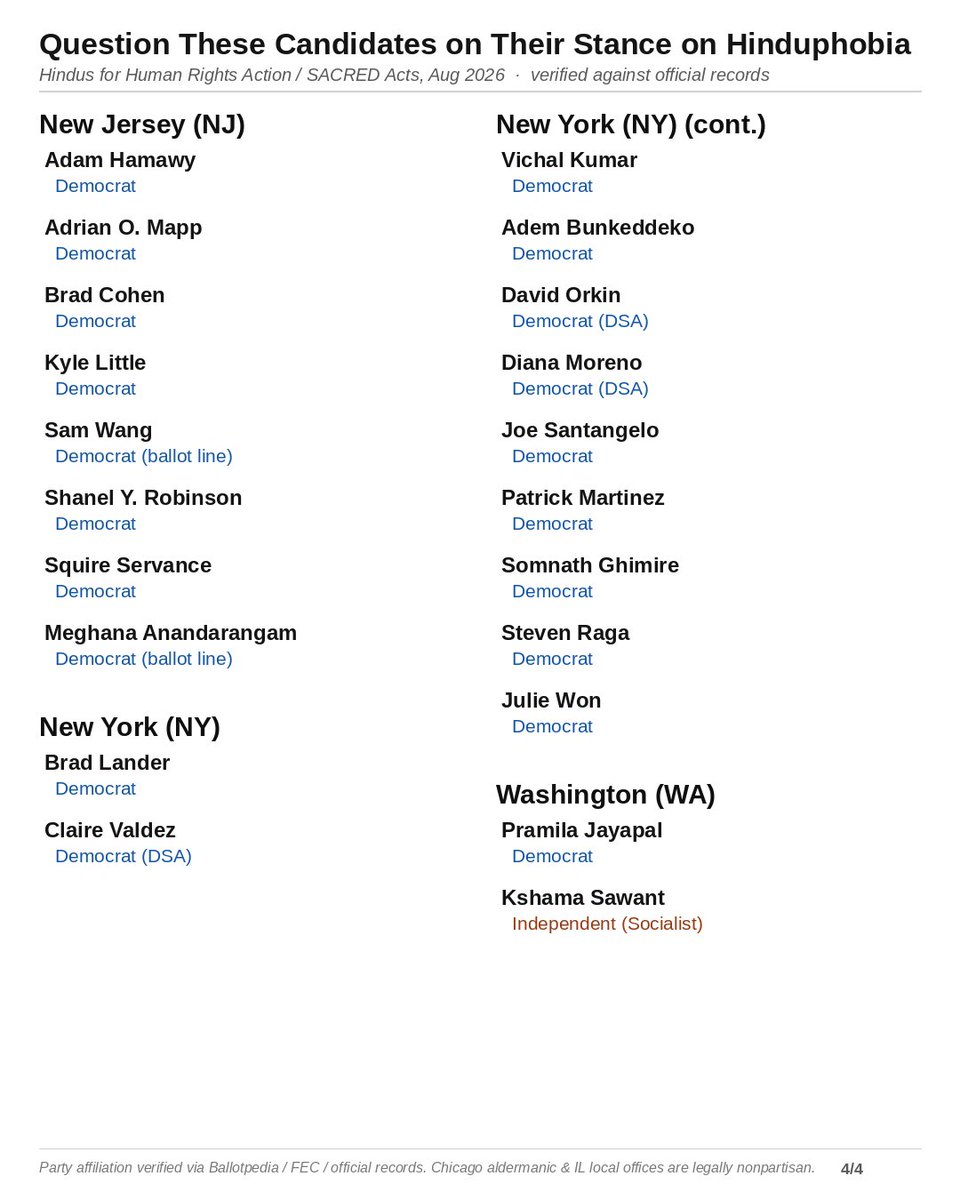
🚨 Nearly 100 politicians just signed a pledge to refuse donations from RSS supporters. Look at the list. Nearly every single one a Democrat.
Our message to these candidates: if you signed this pledge -
Do not come to our temples for photo opportunities.
Do not come to our Diwali celebrations for votes.
Do not send us fundraising emails.
You have already decided our community's institutions are the problem.
We have noted it.
You were either hood-winked by coordinated anti-Hindu propaganda, or you made a deliberate choice to treat Indian-American civil society as radioactive. Either way, the Hindu community now has its answer about where you stand.
The RSS runs schools for tribal children, disaster relief across India, and medical missions for the poor of every faith. While Dr. Bhagwat stood at Madison Square Garden and told 6,000 people about Universal Oneness, these politicians signed a pledge calling that organization anti-democratic.
Misguided or malicious, the result is the same. You have told us who you are.
When the next temple is shot at, when the next Hindu worshipper is harassed, when the next Hinduphobic attack goes viral, we will remember who signed this pledge and said nothing. We will remember who chose smear over service.
Zero dollars. Zero votes. Until you choose your constituents over your anti-Hindu allies.
#HinduVoterBlock #NoMoreSilence #HindusAreAmericans @UHC_Media
Uganda expelled the Gujaratis in the 1970s.
They were “too wealthy” and controlled too much of the economy. They left with almost nothing.
A few years later they were prosperous in England.
Uganda’s economy collapsed.
You can seize shops and inventory. You cannot seize the knowledge that built them.
Human capital walks out the door. The buildings stay empty.
Congratulations to my friend Prime Minister Meloni on becoming the longest continuously serving Prime Minister in Italy's postwar history. This milestone is a reflection of the trust and confidence of the Italian people in her leadership.
Her friendship has also been instrumental in strengthening the India-Italy Special Strategic Partnership and I look forward to continuing our close cooperation to build a prosperous future for the people of our countries.
My best wishes for her continued success in the years ahead.
@GiorgiaMeloni
Krishna Janmasthan must be legally reclaimed and rebuilt, its decapitated idols exhumed from the steps of the Jahanara mosque and reestablished and consecrated.
Here I recount its history and explain why, of all the disputed sites, Mathura is the easiest to adjudicate on:
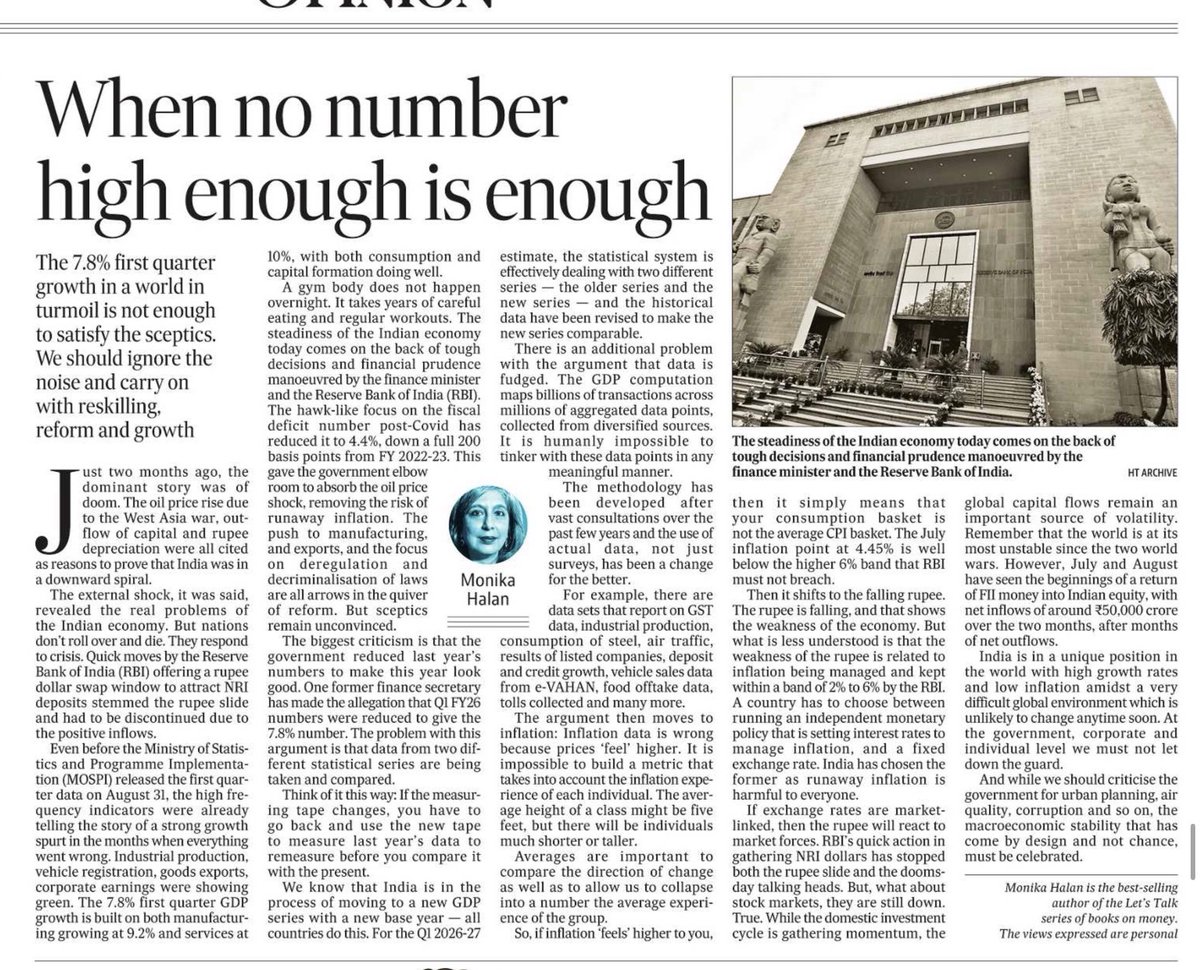
To use the result of an old measuring tape to compare with that of a new one is simply wrong.
The needless GDP number controversy, and the traction it had, hides a deeper faultline - a section of the population deeply wants to believe India is doing badly.
India's macro stability comes not as a chance but as policy decisions.
Certainly, a reason to celebrate that we remain the world's fastest growing economy despite a very unstable world.
My oped in @htTweets
https://t.co/D2dm0QaIuO