Money flows from the uninformed to the informed.
Welcome to The Swing.
We keep it simple:
• Stocks only — no futures, no options, No leverage.
• We look for strong stocks already in an uptrend.
• We wait for pullbacks into key levels.
• We enter with a clearly defined, tight stop-loss.
• Every entry, exit, and the reasoning, shared openly.
No chasing. No unnecessary complexity.
Just price action, risk management, and discipline.
We also share stock market knowledge, research, and insights for everyone from beginners to experienced traders and investors.
Follow + turn on notifications to catch trades live.
Last time we split AI into 5 layers.
Now the real question: which layer is actually getting the money?
We went through the latest earnings. The answer isn't what most people think. 👇
WHERE THE MONEY STARTS
4 giants (Amazon, Microsoft, Google, Meta) plan to spend about $730B on AI in 2026. That's "capex" (money spent on data centers and equipment). Last year it was about $400B.
Every dollar of that lands on someone else's income statement. Here's who's collecting:
LAYER 2: CHIPS
Nvidia ($NVDA)
Latest quarter: $96.2B in revenue, up 106% in a year. Next quarter guided to $108B. Still the biggest check in AI.
Broadcom ($AVGO)
AI chip sales: $16.7B, up 221%. Guided to $21.7B next quarter. (Custom chips are chips big tech designs in-house to rely less on Nvidia.)
Memory: Micron ($MU), Samsung, SK Hynix. This is the surprise.
Micron's latest quarter: $54.2B in revenue, up 379%.
Of every $1 it sold, about 70 cents became net profit. Nvidia kept about 56 cents.
Samsung just pre-announced about $80B of operating profit for ONE quarter. That's nearly 9x last year, and a record for any tech company, reportedly driven mostly by memory.
Why? AI chips are useless without HBM (high-bandwidth memory: ultra-fast memory stacked right next to the chip). Only 3 companies make it at scale. Demand is bigger than supply, so prices keep climbing.
Micron's CEO says supply will be even tighter in 2027-2028.
Amazon even raised its spending plan, citing higher memory prices. The biggest buyers are paying more just to get the same equipment.
LAYER 1: ENERGY
GE Vernova ($GEV) has a $176B backlog (orders booked but not yet delivered). Quarterly orders were up 88%. Data-center orders in the first half were already more than double all of 2025.
No electricity, no AI.
LAYER 5: APPLICATIONS
Software is the layer paying, not collecting. Fears that AI replaces it crushed software stocks earlier this year. The sector ETF fell about 37% from peak to its April low.
THE PATTERN
Money flows to whatever is scarce. First it was GPUs. Now it's memory and power.
BUT HERE'S THE CATCH ⚠️
- Memory is tech's most boom-and-bust industry: prices spike, factories get built, prices crash. Micron trades at about 6.6x next year's earnings (forward P/E: what you pay for $1 of expected yearly profit). That's cheap, which means the market doesn't believe this lasts. Morningstar sees a peak around early 2028.
- The giants now fund this with debt and new shares, not just cash. Alphabet raised $84.75B in stock in June, the largest stock offering in US history.
If spending slows, the whole chain feels it. Memory feels it first.
Our view: follow the bottleneck, but respect the cycle. Not financial advice.
If this was useful:
♻️ Repost it. Someone you know needs to read this.
👤 Follow me. We break down markets with real numbers, in plain English.
📌 Check my other posts on my page. You won't regret it.
🔔 We're sharing our trades publicly for a limited time. Turn on notifications so you don't miss them.
💬 Comment below: is memory a new supercycle (a long boom) or the classic top? Reply SUPER or TOP. We'll reply to as many as we can.
https://t.co/y02IEM8iah
Last time we split AI into 5 layers.
Now the real question: which layer is actually getting the money?
We went through the latest earnings. The answer isn't what most people think. 👇
WHERE THE MONEY STARTS
4 giants (Amazon, Microsoft, Google, Meta) plan to spend about $730B on AI in 2026. That's "capex" (money spent on data centers and equipment). Last year it was about $400B.
Every dollar of that lands on someone else's income statement. Here's who's collecting:
LAYER 2: CHIPS
Nvidia ($NVDA)
Latest quarter: $96.2B in revenue, up 106% in a year. Next quarter guided to $108B. Still the biggest check in AI.
Broadcom ($AVGO)
AI chip sales: $16.7B, up 221%. Guided to $21.7B next quarter. (Custom chips are chips big tech designs in-house to rely less on Nvidia.)
Memory: Micron ($MU), Samsung, SK Hynix. This is the surprise.
Micron's latest quarter: $54.2B in revenue, up 379%.
Of every $1 it sold, about 70 cents became net profit. Nvidia kept about 56 cents.
Samsung just pre-announced about $80B of operating profit for ONE quarter. That's nearly 9x last year, and a record for any tech company, reportedly driven mostly by memory.
Why? AI chips are useless without HBM (high-bandwidth memory: ultra-fast memory stacked right next to the chip). Only 3 companies make it at scale. Demand is bigger than supply, so prices keep climbing.
Micron's CEO says supply will be even tighter in 2027-2028.
Amazon even raised its spending plan, citing higher memory prices. The biggest buyers are paying more just to get the same equipment.
LAYER 1: ENERGY
GE Vernova ($GEV) has a $176B backlog (orders booked but not yet delivered). Quarterly orders were up 88%. Data-center orders in the first half were already more than double all of 2025.
No electricity, no AI.
LAYER 5: APPLICATIONS
Software is the layer paying, not collecting. Fears that AI replaces it crushed software stocks earlier this year. The sector ETF fell about 37% from peak to its April low.
THE PATTERN
Money flows to whatever is scarce. First it was GPUs. Now it's memory and power.
BUT HERE'S THE CATCH ⚠️
- Memory is tech's most boom-and-bust industry: prices spike, factories get built, prices crash. Micron trades at about 6.6x next year's earnings (forward P/E: what you pay for $1 of expected yearly profit). That's cheap, which means the market doesn't believe this lasts. Morningstar sees a peak around early 2028.
- The giants now fund this with debt and new shares, not just cash. Alphabet raised $84.75B in stock in June, the largest stock offering in US history.
If spending slows, the whole chain feels it. Memory feels it first.
Our view: follow the bottleneck, but respect the cycle. Not financial advice.
If this was useful:
♻️ Repost it. Someone you know needs to read this.
👤 Follow me. We break down markets with real numbers, in plain English.
📌 Check my other posts on my page. You won't regret it.
🔔 We're sharing our trades publicly for a limited time. Turn on notifications so you don't miss them.
💬 Comment below: is memory a new supercycle (a long boom) or the classic top? Reply SUPER or TOP. We'll reply to as many as we can.
https://t.co/y02IEM8iah
Interesting question. Both are Latin American telecom plays, so a proper side-by-side could be a great post.
One thought: a short breakdown (what each company does, valuation, debt) would pull in readers who haven’t heard of either ticker, and that’s where a lot of replies come from.
I write finance posts for X creators. Happy to draft this LILA vs TIGO one for free if you’re open to it. Want me to drop it in the replies?
“A deadline with no milestones is a wish with a date on it.” Great line. The “where SMART breaks down” section is the part most people skip, and it might be the best bit.
I write short finance posts that pull readers into long pieces like this. Happy to write one from this article for free if you’re open to it. Want me to drop it in the replies?
Hey, been going through your Quality Score posts. The per-stock breakdowns are really clean, and the no-guru-BS approach comes through.
One thing I noticed: the cards show what each score is, but not the story behind it. Take MU. It scores 82 overall, but 40 on cash flow multiple (47x) and 30 on dilution. That tension, great business but expensive on cash flow, is the kind of thing that gets people replying and quote-posting, which X rewards far more than likes.
I write finance posts for X creators, the “so what” that sits next to the data. I’d like to write one for you for free on a stock from your list, MU for example, in your voice.
Want me to send it over?
@mrs_btc_ Exactly. The real question is how long Micron can sustain those margins. Scarcity is driving profits today, but memory has always been cyclical. If supply catches up, that gap could close fast. That's what investors need to watch.
Last time we split AI into 5 layers.
Now the real question: which layer is actually getting the money?
We went through the latest earnings. The answer isn't what most people think. 👇
WHERE THE MONEY STARTS
4 giants (Amazon, Microsoft, Google, Meta) plan to spend about $730B on AI in 2026. That's "capex" (money spent on data centers and equipment). Last year it was about $400B.
Every dollar of that lands on someone else's income statement. Here's who's collecting:
LAYER 2: CHIPS
Nvidia ($NVDA)
Latest quarter: $96.2B in revenue, up 106% in a year. Next quarter guided to $108B. Still the biggest check in AI.
Broadcom ($AVGO)
AI chip sales: $16.7B, up 221%. Guided to $21.7B next quarter. (Custom chips are chips big tech designs in-house to rely less on Nvidia.)
Memory: Micron ($MU), Samsung, SK Hynix. This is the surprise.
Micron's latest quarter: $54.2B in revenue, up 379%.
Of every $1 it sold, about 70 cents became net profit. Nvidia kept about 56 cents.
Samsung just pre-announced about $80B of operating profit for ONE quarter. That's nearly 9x last year, and a record for any tech company, reportedly driven mostly by memory.
Why? AI chips are useless without HBM (high-bandwidth memory: ultra-fast memory stacked right next to the chip). Only 3 companies make it at scale. Demand is bigger than supply, so prices keep climbing.
Micron's CEO says supply will be even tighter in 2027-2028.
Amazon even raised its spending plan, citing higher memory prices. The biggest buyers are paying more just to get the same equipment.
LAYER 1: ENERGY
GE Vernova ($GEV) has a $176B backlog (orders booked but not yet delivered). Quarterly orders were up 88%. Data-center orders in the first half were already more than double all of 2025.
No electricity, no AI.
LAYER 5: APPLICATIONS
Software is the layer paying, not collecting. Fears that AI replaces it crushed software stocks earlier this year. The sector ETF fell about 37% from peak to its April low.
THE PATTERN
Money flows to whatever is scarce. First it was GPUs. Now it's memory and power.
BUT HERE'S THE CATCH ⚠️
- Memory is tech's most boom-and-bust industry: prices spike, factories get built, prices crash. Micron trades at about 6.6x next year's earnings (forward P/E: what you pay for $1 of expected yearly profit). That's cheap, which means the market doesn't believe this lasts. Morningstar sees a peak around early 2028.
- The giants now fund this with debt and new shares, not just cash. Alphabet raised $84.75B in stock in June, the largest stock offering in US history.
If spending slows, the whole chain feels it. Memory feels it first.
Our view: follow the bottleneck, but respect the cycle. Not financial advice.
If this was useful:
♻️ Repost it. Someone you know needs to read this.
👤 Follow me. We break down markets with real numbers, in plain English.
📌 Check my other posts on my page. You won't regret it.
🔔 We're sharing our trades publicly for a limited time. Turn on notifications so you don't miss them.
💬 Comment below: is memory a new supercycle (a long boom) or the classic top? Reply SUPER or TOP. We'll reply to as many as we can.
https://t.co/y02IEM8iah
The man who runs the most valuable company on Earth, told us something most people are missing.
Jensen Huang → Nvidia ($NVDA) → ~$5.7 TRILLION market cap (the total price tag of the whole company).
A $10,000 bet on Nvidia 10 years ago would be worth roughly $1.4 MILLION today. That's about 14,000%.
But Jensen says AI is NOT a one-winner game.
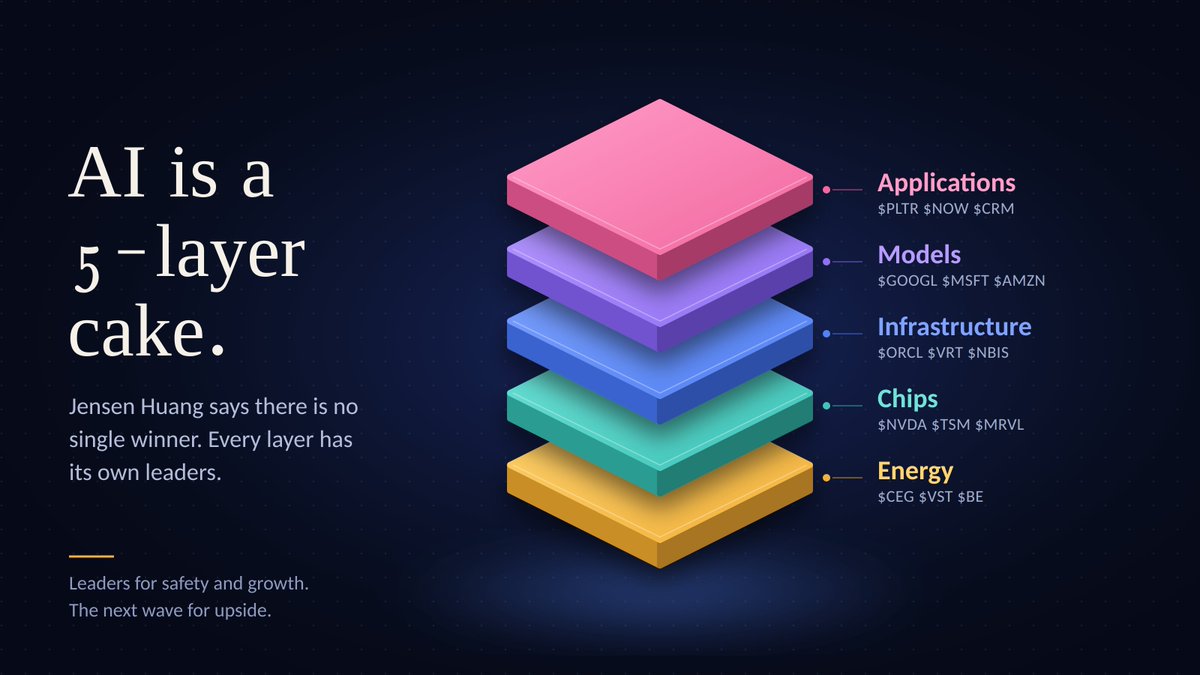
AI is a 5-layer cake
1️⃣ Energy
2️⃣ Chips
3️⃣ Infrastructure
4️⃣ Models
5️⃣ Applications
Every layer has its own winners. Most people only look at layer 2.
Let's break each one down 👇
Government money buys time. Only profit buys safety.
Intel and MP are both government-owned. Both still lose money. Government support is a tailwind, but business quality decides who wins.
Here are the ones on this list with real numbers behind them 👇
$AVGO: revenue +86%, AI chip sales +221%, and 46% of revenue becomes free cash flow (cash left after all costs and investments)
$GEV: $176B backlog (signed orders not yet delivered), $5.1B free cash flow in one quarter
$VRT: 22.6% operating margin (profit per $1 of sales after running costs), and it holds more cash than debt
$RTX: record $289B backlog, guiding $8.5B+ free cash flow
$AMZN: AWS growing 37% at a 39% margin
Be careful with:
$ORCL: $664B of contracts, but it burned $5.4B cash last quarter and is raising $20B by selling new shares
$CRWV: $104B backlog, but interest alone ($640M) almost equals its entire net loss ($626M)
A great company is not always a great price. Even quality stocks have sharp pullbacks (temporary dips), so we wait for pullbacks into key levels and use a stop-loss (a pre-set exit price that caps your loss).
Want more breakdowns like this? Follow us. We’re sharing our trades publicly for a limited time, so turn on notifications 🔔 and check my pinned post.
Which one of these would you buy first? Tell me below 👇
The S&P 500 is up ~12% this year. Sounds like a healthy market.
Look closer. Two sectors are doing almost all the heavy lifting while others fall behind. 👇
🟢 LEADING
⚡ Energy (oil & gas companies): up ~37%
💻 Technology: up ~38%
🔴 LAGGING
🏠 Utilities (power & water companies): down ~8%
🛍 Consumer Discretionary (things people want but don't need, like travel, cars, shopping): down ~7%
Why is this happening?
1️⃣ The AI boom. Big companies are spending huge money on chips and data centers. Tech is the one getting paid.
2️⃣ Oil above $90 a barrel. Great for energy companies. But pricey fuel eats into what families have left to spend on everything else.
3️⃣ High interest rates. The 10-year Treasury yield (the interest rate on US government loans, which sets borrowing costs across the whole economy) is above 5%. Sectors that rely on borrowing feel the squeeze.
So what does this say about the market?
It's narrow. (Narrow = a few sectors do all the work while the rest struggle.)
On the surface, the index looks calm. Underneath, it's split in two: one side betting on AI, the other side feeling the pain of expensive oil and high rates.
A rally carried by two sectors can keep running. But if those two stumble, there is very little left to catch the market.
Healthy markets are broad. This one isn't. Yet.
I share simple, no-fluff breakdowns like this so anyone can read the market with confidence. You won't regret checking my other posts on my page.
Follow The Swing and turn on notifications 🔔 We're also sharing our trades publicly for a limited time. You don't want to miss them.
Now your turn 👇
Will tech and energy keep leading, or will the rest catch up? Comment "LEADERS" or "CATCH-UP" and tell me why.
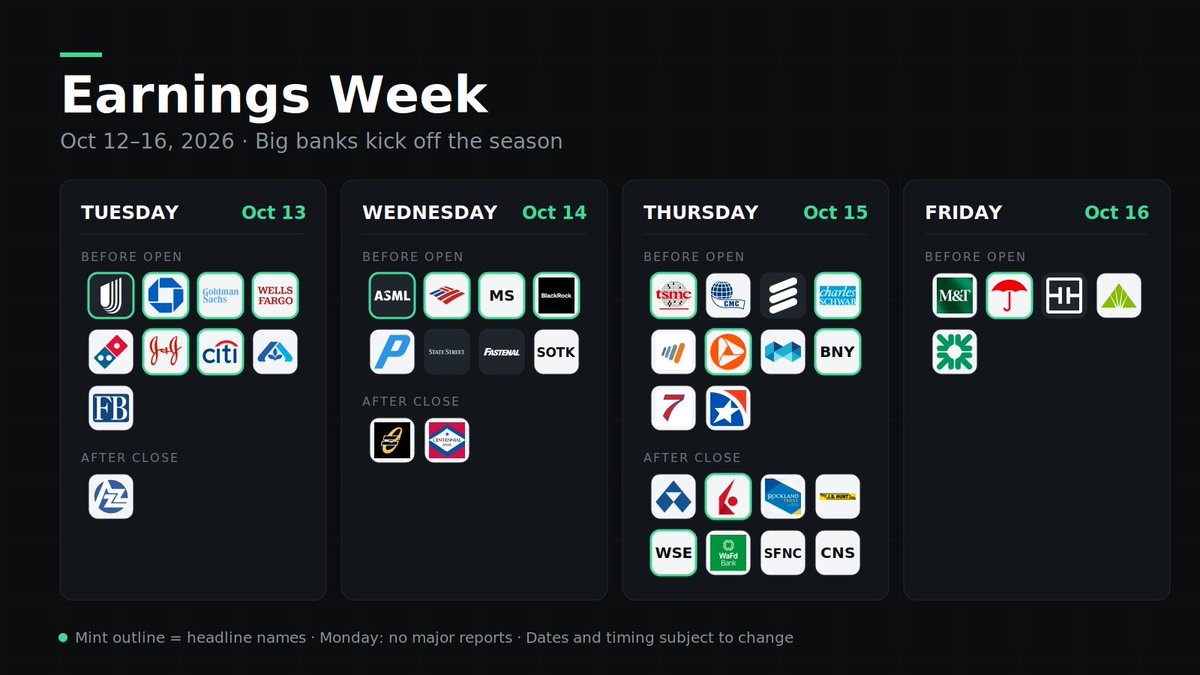
Earnings season starts this week. And the banks go first.
Over 40 companies report between Tuesday and Friday. Most of them are noise. A few of them tell you where the economy and the market are heading.
Here’s what we’re watching:
Tuesday: JPMorgan, Goldman, Citi, Wells Fargo, plus UnitedHealth and J&J. Banks are the economy’s report card. Consumer spending, loan losses, deal flow, all in one place.
Wednesday: Bank of America, Morgan Stanley, BlackRock, and ASML. BlackRock shows where investor money is moving. ASML shows how real the AI chip demand is.
Thursday: TSMC, Schwab, PNC, BNY, Interactive Brokers. TSMC is the cleanest read on the AI buildout. Schwab and IBKR show how active retail traders are.
Friday: Travelers, Truist, Regions, M&T and Citizens close out the regional banks.
One thing most people get wrong: the stock rarely moves on the headline EPS beat. It moves on guidance and tone. A company can beat and drop 8%. It can miss and rip.
So our plan stays the same. We don’t chase the first candle. We let the reaction settle, then wait for a pullback into a key level with a defined stop.
Which report are you watching most this week?
Follow The Swing for the setups, entries and exits.
📈 $SNDK | Sandisk Corporation
Just entered a long position in Sandisk, a leading NAND flash storage company benefiting from AI infrastructure expansion and rising data center demand.
📊 FY2026 Financial Highlights:
Revenue: $20.25B (+175% YoY)
Gross Margin: 71.5%
Net Income: $11.43B
Adjusted EPS: $70.88
Data Center Revenue: +437% YoY
Entry: ~$1,610
Watching for a rebound from the support zone toward previous highs.
No leverage. No options. No shorting.
Sounds boring. For most people, it’s the real edge.
The fastest way to blow up a trading account isn’t a bad stock. It’s borrowed money.
Leverage (trading with borrowed money), derivatives (contracts like Futures & Options whose value depends on a stock’s price) and shorting (betting a stock will fall) look like shortcuts to fast money. Here’s why skipping them works:
You can’t be forced out. With leverage, a small drop can trigger a margin call (your broker sells your position to get their loan back). Without it, you can be wrong for weeks and still stay in the game.
Time is on your side. Options expire (they become worthless on a set date). Stocks don’t. You can be right about a company and still lose money on an option.
Your risk is limited. Buy a stock and the most you can lose is what you put in. Short one and losses have no ceiling, because a price can keep rising.
You’re not fighting the market. Good businesses grow over time. Shorting bets against that.
A calm mind makes better decisions. No borrowed money means no panic.
We trade this way only: stocks, fully funded, no leverage of any kind.
Our score so far: 8 of 11 positions in profit. Best trade +35%. Biggest loss -5.8%.
Small losses, big winners. That’s the whole game.
We’re sharing every trade publicly (entry, exit and reasoning), free for a limited time.
Follow for simple, useful market posts and turn on notifications so you don’t miss the next trade.
Do you use leverage? Comment YES or NO and tell me why. We read every reply.
Not financial advice.
No leverage. No options. No shorting.
Sounds boring. For most people, it’s the real edge.
The fastest way to blow up a trading account isn’t a bad stock. It’s borrowed money.
Leverage (trading with borrowed money), derivatives (contracts like Futures & Options whose value depends on a stock’s price) and shorting (betting a stock will fall) look like shortcuts to fast money. Here’s why skipping them works:
You can’t be forced out. With leverage, a small drop can trigger a margin call (your broker sells your position to get their loan back). Without it, you can be wrong for weeks and still stay in the game.
Time is on your side. Options expire (they become worthless on a set date). Stocks don’t. You can be right about a company and still lose money on an option.
Your risk is limited. Buy a stock and the most you can lose is what you put in. Short one and losses have no ceiling, because a price can keep rising.
You’re not fighting the market. Good businesses grow over time. Shorting bets against that.
A calm mind makes better decisions. No borrowed money means no panic.
We trade this way only: stocks, fully funded, no leverage of any kind.
Our score so far: 8 of 11 positions in profit. Best trade +35%. Biggest loss -5.8%.
Small losses, big winners. That’s the whole game.
We’re sharing every trade publicly (entry, exit and reasoning), free for a limited time.
Follow for simple, useful market posts and turn on notifications so you don’t miss the next trade.
Do you use leverage? Comment YES or NO and tell me why. We read every reply.
Not financial advice.
SpaceX ($SPCX) 🚀
The stock everybody loves.
But do you know how it actually makes money?
Most people think it’s rockets. Wrong.
Here’s the real breakdown 👇
(2025 numbers, from its IPO filing [the official document a company publishes before it sells shares to the public])
💰 Total revenue: $18.7B
1️⃣ Starlink (satellite internet): $11.4B, about 61%
People pay a monthly fee for internet beamed from space. This is recurring revenue [money that keeps coming in every month, like a Netflix subscription].
It made $4.4B in operating profit [profit left after paying the costs of running the business].
It’s the only segment making real money.
2️⃣ Launch (rockets): $4.1B, about 22%
SpaceX sells rocket rides to NASA, governments and companies.
But this segment lost $657M. Why? Many of its launches carry its own Starlink satellites, and that earns no revenue.
3️⃣ AI (Grok): losing about $6.4B
A huge bet on the future. No profits yet.
📊 In Q1 2026, Starlink was 69% of all revenue ($3.3B of $4.7B).
The takeaway: SpaceX is a satellite internet company that also happens to own rockets.
Starlink pays the bills. Rockets and AI are the long-term bets.
So the real question isn’t “will rockets go to Mars?”
It’s “how fast can Starlink keep growing?”
━━━━━━━━━━
🔔 We post simple, well-researched breakdowns of the stocks everyone talks about.
✅ Follow so you don’t miss the next one.
✅ Turn on notifications (tap the 🔔 on our profile).
✅ For a limited time, we’re sharing our trades publicly. You’ll see what we buy, why, and how it plays out.
💬 Your turn: Would you buy SPCX at today’s price?
Comment BUY, WAIT or AVOID, plus one reason why 👇
Money flows from the uninformed to the informed.
Welcome to The Swing.
We keep it simple:
• Stocks only — no futures, no options, No leverage.
• We look for strong stocks already in an uptrend.
• We wait for pullbacks into key levels.
• We enter with a clearly defined, tight stop-loss.
• Every entry, exit, and the reasoning, shared openly.
No chasing. No unnecessary complexity.
Just price action, risk management, and discipline.
We also share stock market knowledge, research, and insights for everyone from beginners to experienced traders and investors.
Follow + turn on notifications to catch trades live.
Did you know that when a stock falls 50% from its all-time high (the highest price it has ever traded at) and then climbs back toward that level, the climb is not 50%?
It’s 100%. 🤯
Here’s why 👇
Say a stock is at its peak of $100.
📉 It falls 50% → now $50
📈 To get back to $100, it has to gain $50 on a base of only $50
That’s a 100% gain, not 50%.
It’s because the percentage is calculated on a smaller base after the fall.
Here’s how it scales:
Down 10% → needs +11% to recover
Down 20% → needs +25%
Down 33% → needs +50%
Down 50% → needs +100%
Down 75% → needs +300%
Down 90% → needs +900% 😳
This is why professionals obsess over protecting their capital (the money you invest) before chasing profits. A big loss (drawdown, which means the drop from a peak) is much harder to climb out of than most people realize.
The takeaway: avoiding one big loss is often worth more than finding one big winner.
If you’re new to the markets, save this. You’ll thank yourself later. 🔖
I share simple, useful market knowledge like this regularly, so follow me for more.
📢 For a limited time, I’m also sharing my trades publicly, so you can see exactly what I’m doing and why. Turn on notifications 🔔 so you don’t miss them.
💬 Comment ��GOT IT” if this was new to you, or tell me the biggest drop you’ve ever sat through on a stock. I’ll reply to the best ones.
Money flows from the uninformed to the informed.
Welcome to The Swing.
We keep it simple:
• Stocks only — no futures, no options, No leverage.
• We look for strong stocks already in an uptrend.
• We wait for pullbacks into key levels.
• We enter with a clearly defined, tight stop-loss.
• Every entry, exit, and the reasoning, shared openly.
No chasing. No unnecessary complexity.
Just price action, risk management, and discipline.
We also share stock market knowledge, research, and insights for everyone from beginners to experienced traders and investors.
Follow + turn on notifications to catch trades live.
📈 $SNDK | Sandisk Corporation
Just entered a long position in Sandisk, a leading NAND flash storage company benefiting from AI infrastructure expansion and rising data center demand.
📊 FY2026 Financial Highlights:
Revenue: $20.25B (+175% YoY)
Gross Margin: 71.5%
Net Income: $11.43B
Adjusted EPS: $70.88
Data Center Revenue: +437% YoY
Entry: ~$1,610
Watching for a rebound from the support zone toward previous highs.
SpaceX ($SPCX) 🚀
The stock everybody loves.
But do you know how it actually makes money?
Most people think it’s rockets. Wrong.
Here’s the real breakdown 👇
(2025 numbers, from its IPO filing [the official document a company publishes before it sells shares to the public])
💰 Total revenue: $18.7B
1️⃣ Starlink (satellite internet): $11.4B, about 61%
People pay a monthly fee for internet beamed from space. This is recurring revenue [money that keeps coming in every month, like a Netflix subscription].
It made $4.4B in operating profit [profit left after paying the costs of running the business].
It’s the only segment making real money.
2️⃣ Launch (rockets): $4.1B, about 22%
SpaceX sells rocket rides to NASA, governments and companies.
But this segment lost $657M. Why? Many of its launches carry its own Starlink satellites, and that earns no revenue.
3️⃣ AI (Grok): losing about $6.4B
A huge bet on the future. No profits yet.
📊 In Q1 2026, Starlink was 69% of all revenue ($3.3B of $4.7B).
The takeaway: SpaceX is a satellite internet company that also happens to own rockets.
Starlink pays the bills. Rockets and AI are the long-term bets.
So the real question isn’t “will rockets go to Mars?”
It’s “how fast can Starlink keep growing?”
━━━━━━━━━━
🔔 We post simple, well-researched breakdowns of the stocks everyone talks about.
✅ Follow so you don’t miss the next one.
✅ Turn on notifications (tap the 🔔 on our profile).
✅ For a limited time, we’re sharing our trades publicly. You’ll see what we buy, why, and how it plays out.
💬 Your turn: Would you buy SPCX at today’s price?
Comment BUY, WAIT or AVOID, plus one reason why 👇
Maps is free because you’re not the customer. Businesses are. 💰
Here’s how it makes money:
1️⃣ Ads: Restaurants, hotels and shops pay to show up first when you search “coffee near me.” They pay per click (CPC: a small fee each time someone taps their listing).
2️⃣ Maps API (a tool other apps rent to put Maps inside them): Delivery apps, ride apps and thousands of others pay Google every time they use it.
3️⃣ Data: Knowing where people go helps Google show better-targeted ads across all its other products.
The real play? Maps keeps billions of people inside Google’s ecosystem (its family of connected apps), which feeds the parent company, Alphabet ($GOOGL). A free product with a massive moat (an advantage that’s hard to copy).
Follow us for more breakdowns like this 📈
We’re also sharing our trades publicly for a limited time. Turn on notifications 🔔 so you don’t miss them.








![The_Sw1ng's tweet photo. SpaceX ($SPCX) 🚀
The stock everybody loves.
But do you know how it actually makes money?
Most people think it’s rockets. Wrong.
Here’s the real breakdown 👇
(2025 numbers, from its IPO filing [the official document a company publishes before it sells shares to the public])
💰 Total revenue: $18.7B
1️⃣ Starlink (satellite internet): $11.4B, about 61%
People pay a monthly fee for internet beamed from space. This is recurring revenue [money that keeps coming in every month, like a Netflix subscription].
It made $4.4B in operating profit [profit left after paying the costs of running the business].
It’s the only segment making real money.
2️⃣ Launch (rockets): $4.1B, about 22%
SpaceX sells rocket rides to NASA, governments and companies.
But this segment lost $657M. Why? Many of its launches carry its own Starlink satellites, and that earns no revenue.
3️⃣ AI (Grok): losing about $6.4B
A huge bet on the future. No profits yet.
📊 In Q1 2026, Starlink was 69% of all revenue ($3.3B of $4.7B).
The takeaway: SpaceX is a satellite internet company that also happens to own rockets.
Starlink pays the bills. Rockets and AI are the long-term bets.
So the real question isn’t “will rockets go to Mars?”
It’s “how fast can Starlink keep growing?”
━━━━━━━━━━
🔔 We post simple, well-researched breakdowns of the stocks everyone talks about.
✅ Follow so you don’t miss the next one.
✅ Turn on notifications (tap the 🔔 on our profile).
✅ For a limited time, we’re sharing our trades publicly. You’ll see what we buy, why, and how it plays out.
💬 Your turn: Would you buy SPCX at today’s price?
Comment BUY, WAIT or AVOID, plus one reason why 👇](https://pbs.twimg.com/media/HUMV8zYWYAAaVTR.jpg)


