One line from Rich Dad Poor Dad has stuck with me ever since I read it:
“The single most powerful asset we all have is our mind. If it is trained well, it can create enormous wealth.”
GTCO paid me dividend yesterday, so let me use this opportunity to teach you something.
A lot of you want to enter the stock market, but you don't know how to look at a company and decide if it's worth your money. Let me show you using GTCO's Q1 2026 results.
The first thing I look at is profit. Did the company make money? GTCO made N302.9 billion profit before tax in just January to March 2026. Three months. And that's even higher than the N300.3 billion they made in the same period last year. So the company is not slowing down; it's growing.
Next thing. Where is the money coming from? GTCO earned N467 billion from interest income alone this quarter. That means the bank is collecting money from you as deposits, lending it out to businesses and individuals, investing in government securities, and earning interest on all of it. That N467 billion is up from N397 billion same time last year. The engine is getting stronger.
Then I check deposits. Are more people trusting this bank with their money? Customer deposits moved from N12.55 trillion in December to N13.21 trillion by March. In 3 months, over N660 billion in new deposits came in. People are bringing more money to GTCO. That's fuel for the business.
Now here's one a lot of beginners miss. E-business income. This is the money GTCO makes every time you do a transfer, pay a bill online, buy something with your card, use the GTWorld app. That number went from N13 billion to N21.9 billion. 69% growth in one year. This is the future of banking and GTCO is eating well from it.
I also check how safe the bank is. The Capital Adequacy Ratio tells you how much capital the bank has to absorb losses. CBN says banks need at least 15%. GTCO is sitting at 43.8%. Almost 3 times the minimum. This bank is not going anywhere.
Total assets are now N18.75 trillion. This is a company that operates in Nigeria, Ghana, Kenya, UK, Cote d'Ivoire, Sierra Leone, Liberia, Gambia, and Tanzania. When you buy GTCO shares, you own a piece of all of that.
And the dividend? They paid N12.76 per share for 2025. That's the money that landed in my account yesterday without me doing anything. I held the shares, the company made profit, they shared part of it with me.
This is what I want you to understand. You don't need to be a genius to invest. You just need to learn how to ask 4 simple questions about any company.
Is it making profit? Yes.
Is the profit growing? Yes.
Are more people using it? Yes.
Is it financially safe? Yes.
When all four answers are yes, you're looking at a solid company.
Now go open a brokerage account and start learning. The stock market is not as scary as you think. You've just been looking at it from the outside.
“When we know that what we’re doing is the right thing, we don’t entertain any fear of being recorded, you can record us and we can record you too, all the members of Nigerian police have been warned not to ever search anybody’s phone again, just vehicles”
— The Lagos State Commissioner of Police, Tijani Fatai, says members of the public’s can now record police activities !!!
Neconde Energy Ltd v FBNQuest Bank Ltd & 4 ors (2026)
- Right of a Receivership
The Supreme Court set aside the judgment of the Court of Appeal on the basis that where the dispute concerns the legality, validity, or scope of the receivership, the company cannot be stripped of its residual authority to act through its directors in defence of its corporate existence and interests.
It further held that proceedings questioning the validity and scope of a receivership do not fall within the general powers granted to a receiver under Section 556(3) of the Companies and Allied Matters Act (CAMA) and its Eleventh Schedule.
In such circumstances, the court said that a company retains residual powers to defend itself through its board of directors and counsel of its choosing.
Therefore, the defence of the
action by the Company itself through its board of directors, and the counsel retained by them (previously suspended) , cannot be said to be incompetent merely because a receiver had been appointed over certain assets of the company.
65 solid pages 🪡
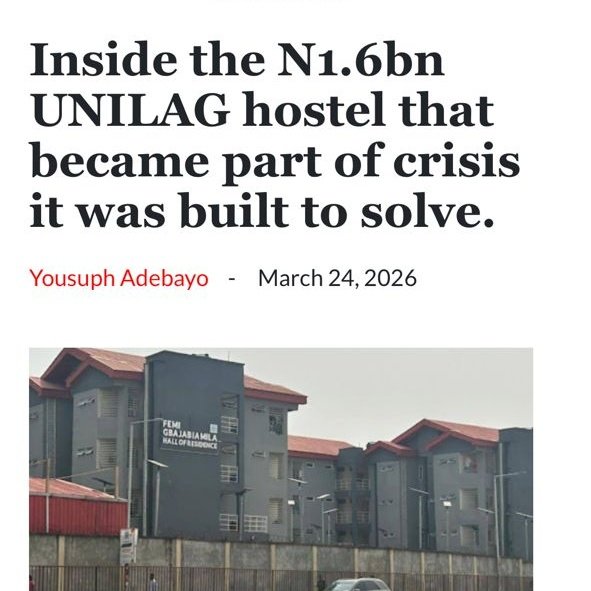
Officially titled the ‘Construction and Furnishing of a 484-bed Landmark Student Hostel at the University of Lagos’, it was included in the Zonal Intervention Project (ZIP) Appropriation Act of 2020, with a total allocation of N1.6 billion for its construction.
The hall was commissioned on January 3, 2024, by the Speaker of the House of Representatives, Tajudeen Abbas, who represented his predecessor, Gbajabiamila.
However, to the disappointment of many students, the newly constructed hostel did not function as a government-funded project; it was just another commercial enterprise.
“When they were commissioning it, I really thought this would be a huge relief, but that wasn’t the case. The cost of a bed space there is as expensive as other private hostels. We could even get some that are cheaper than what they are charging at Gbaja Hall,” says Jude Egbas, a Law student who has been squatting with his friends for two semesters.
Businessday Investigations found that students living in the Femi Gbajabiamila Hall of Residence pay N950,000 per session for a single-occupancy room while occupants in a four-man room each pay N710,000. This amounts to N2,840,000 for every four-man room in the facility.
"I'm not a creative person."
No, you are, everyone is, but your mind is just clogged by all of the podcasts and social media you ram into it without properly digesting it. You're conditioned to believe you can only take a certain path in life, and you don't daydream or entertain stupid ideas that could set you on an entirely new trajectory. You're so obsessed with being productive and efficient that you feel like you're always falling behind, and that stress prevents you from thinking outside the box.
You need to slow the fuck down, allow yourself to be bored (actually bored, not so overstimulated that you find enjoyable things boring), and pursue a life that you design, not one that was assigned to you.
This one is a football accounting gem. I promise you will love it.
In January 2023, Chelsea signed Mykhailo Mudryk from Shakhtar Donetsk for £88.5 million. The deal was jaw dropping on its own. But what really made the football world stop and stare was not the fee. It was the contract length. Eight and a half years. The longest contract in Premier League history at the time.
Journalists questioned it. Rival clubs complained about it. And most fans had absolutely no idea what Chelsea were actually doing.
But let me tell you. They were not being reckless. They were doing math. Very clever, very deliberate, very legal math. And the tool they were using is called amortisation.
This is part of what football insiders consider during transfers.
Are you with me? Good.
Here is the simplest way to understand amortization. When a club signs a player, they spread the accounting of the cost of the transfer fee over the period of the contract signed by the player.
So for example, when Harry Maguire signed for Manchester United in 2019 for £80 million on a six year deal, that did not show up as an £80 million expense in year one. It worked out as an annual amortisation cost of £13.3 million per year.
That is the entire concept.
Think of it the same way you think of a mortgage. You do not pay the full value of a house on the day you move in. You spread it. Football clubs do the exact same thing with players, and it is not a trick or a cheat. It is standard accounting practice used across every industry in the world. Check it. It's International Standard 38- used for accounting for intangible assets.
The reason it matters so much in football is because of Financial Fair Play and Profitability and Sustainability Rules, which regulate how much clubs can lose in any given period.
Amortisation costs are added to the profit and loss account each year, so the lower your annual amortisation figure, the healthier your books look. And here is where contract length becomes a weapon.
Now let us do the math together.
By using amortisation to complete Mudryk's transfer, Chelsea were able to record his £80 million fee as just £9.41 million per year for UEFA's FFP calculation. Had they signed Mudryk to a four year deal instead, his fee would have been recorded as £20 million per year. Same player. Same fee.
More than double the annual accounting cost just by changing the contract length. That is the power of what Chelsea figured out. They did the same with Enzo Fernandez, signed for a then-British record of £106.8 million on an eight and a half year deal, which translated to an annual amortisation expense of approximately £13.4 million.
And Moises Caicedo for £115 million on eight and a half years. And Wesley Fofana for £70 million on seven years. Repeat this across an entire squad and a billion pounds of spending starts to look manageable on paper.
Did you get that?
Now let's look at another part of amortization- the book value piece, because this changes how you think about every transfer you have ever watched.
Book value is the difference between the transfer fee spent on a player minus what has already been amortised.
For example, after two years, a £50 million player signed on a five year deal has a book value of £30 million. Any sale above £30 million is recorded as a profit. Anything below is a loss. This is why clubs can sell a player for what looks like a loss and still report a gain in their accounts.
Take this example: a player is signed for £40 million on a five year contract. He is not a success and is sold two years later for £26 million. At the point of sale, his book value is £24 million, meaning the club actually books a £2 million profit on the deal. Fans see terrible business. The accountants see a gain. Same transaction, completely different reality.
Manchester City lived this with Robinho. He was bought for £32.5 million on a four year deal in 2008, with annual amortisation of £8.1 million. He was sold after two years, leaving a book value of £16.3 million. City sold him for £18 million and claimed a £1.7 million profit on the sale. Supporters spent years calling it a disaster. The finance department called it a profit.
There is one more trick worth knowing: contract extensions. If a player signs a new contract during their existing deal, the remaining unamortised value is spread over the length of the new contract.
So if you bought a player for £60 million on a five year deal and after two years you extend his contract by three more years, the remaining £36 million book value is now spread across five new years instead of three.
That reduces the annual amortisation cost and can reduce FFP losses by millions per year. Extending a contract is not always about keeping a player happy. Sometimes it is purely a financial decision dressed up as a vote of confidence.
Back to Chelsea. Other clubs eventually complained loudly enough that UEFA had to act. UEFA amended its Financial Sustainability Regulations in July 2023, introducing a rule that limits the amortisation of player registrations to a maximum of five years, regardless of how long the contract actually runs.
The Premier League followed in December 2023, when shareholders voted to apply the same five year maximum to all new or extended player contracts going forward. The loophole was closed. But crucially, the rule could not be applied retrospectively, meaning every player Chelsea signed on those long contracts before December 2023 continues to be amortised over the full contract length.
Chelsea were already finished with their biggest spending windows by the time the door was shut. The timing was not a coincidence.
As I conclude, always remember this- the contract is never just a contract. It is an accounting instrument. And the clubs that understand that are always three moves ahead of the ones that do not.
I hope you enjoyed this.
Tomorrow, by 7AM WAT, We get into the wage bill, and why a £50 million transfer can quietly become a £150 million commitment before you have blinked.
Thanks for reading.
My name is Ajoje. I am a FIFA Licensed Agent and International Sports Lawyer. I write on the Law and Business of Football, a lot. Repost and Follow if you want to read more posts like this.
“Do more hard things everyday” is a great mantra but it should be less about ice baths and more about making that decision you’ve been putting off for three months.
If the law is against you,argue the facts.If facts are against you ,argue the law.If the facts and the law are against you,argue procedure.If procedure,law and facts are against you settle.If you can't settle,go to the kitchen because you are about to be cooked.