@officialepfo@epfoaindia are the worst , they are rejecting all cases with some father name issue , it’s a criminal offence .
Who can we report to address these issue or is there any help center to help on this .
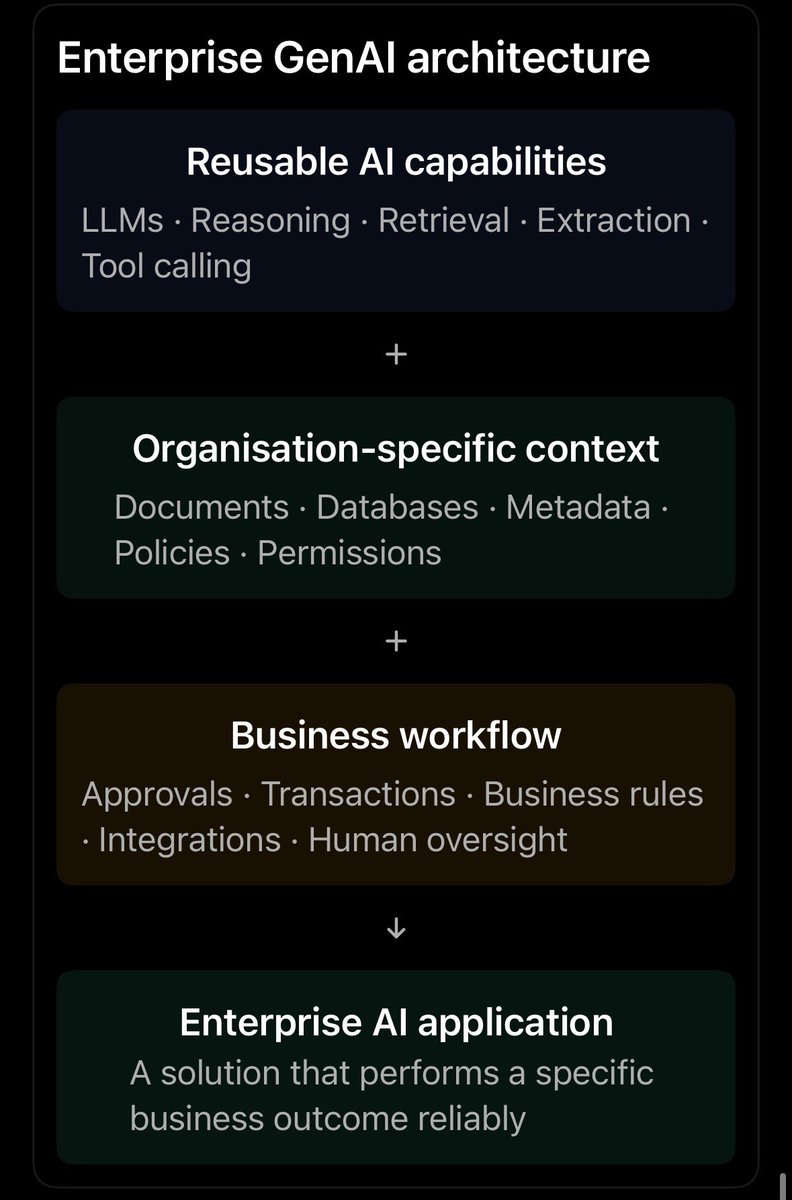
Horizontal does not mean building one giant AI application that does everything. It means building common infrastructure that makes multiple AI applications easier, safer and cheaper to develop.
Suppose the CEO asks:
"Why did our revenue decline by 12% last month?"
A generic LLM can understand the question and reason about possible causes.
But it cannot reliably answer without:
- The organisation’s revenue data.
- Its definition of revenue.
- Transaction and subscription records.
- Listing and traffic metrics.
- Historical comparisons.
- Permissions and governed access.
Then the application needs to orchestrate tools, investigate possible causes, validate the findings and produce an answer supported by evidence.
This is where we move beyond a generic GenAI utility into an enterprise agentic application.
Five ideas worth remembering👇
People's financial decisions are shaped by their personal experiences.
Two intelligent people can reach completely different financial conclusions.
Our personal experience is a tiny sample of financial history.
We often mistake our experiences for universal truths.
Understand someone's circumstances before judging their financial decisions.
People don't make financial decisions based on spreadsheets alone. They make decisions based on the experiences that have shaped their understanding of the world.
Two entrepreneurs can work equally hard, have equally good ideas and make equally sound decisions.
One succeeds because circumstances align.
The other fails because of an unexpected event.
Likewise, an investor might make a poor decision and temporarily make money, while another makes a sensible decision and loses money.
This teaches us something crucial:
Don't judge a decision entirely by its outcome.
Co-Design Bench (Alibaba + Fudan et al., arXiv Oct 2026):
Researchers built a coding-agent benchmark from 273 real user requests that had already failed or been rephrased in actual coding sessions (drawn from 26k+ sessions).
Each task has hidden expert criteria (2,331 total).
Result with the strongest model (GPT-6 Astra):
• Met 69.9% of criteria on average
• Fully completed only 26.4% of tasks
Nearly 3 out of 4 real requests still need a human to finish them.
Older coding benchmarks are already near saturation. This one measures the gap that still matters in practice.
Karpathy built a curated video site called HackerTube over one weekend. Claude Code filtered 43 million Hacker News comments from 20 years into recommendations for 6,454 videos. His only manual steps: a Google Cloud API key, a rented server, and a domain. He says it’s a better recommendation engine than YouTube’s. One person, one model, one weekend.
Anthropic published research on November 6 showing Claude’s agent memory improved from 13 percent to 48 percent wiki accuracy using an offline “dreaming” pass. The model writes notes during a session, then a separate process checks those notes against the original transcript before saving them. Memory wasn’t the problem. Unchecked memory was.
OpenAI’s unreleased cyber agents found 948 privilege-escalation bugs in the Linux kernel. They reproduced 1,724 issues first, then generated working exploits for the ones that held up. Not a scanner flagging lines. An agent reasoning about how a system breaks, end to end. The same labs building agents are now building the things that find the holes in everything else.
Top trends right now: 🔥📈
OpenAI cyber agents finding 948 Linux kernel vulnerabilities
DeepSeek’s Harness hitting 1.54 million daily users
Perplexity Teammates at 200 dollars a month
Anthropic’s agent-memory research lifting wiki accuracy from 13 to 48 percent
Apple racing to make Siri agentic
DeepSeek’s open-source agent platform called Harness crossed 1.54 million daily users in under three months. 92 trillion tokens a day. It’s not a chatbot. It’s a system where one main agent delegates to specialized workers that code, fix bugs, and review pull requests in parallel, across apps, without you prompting each step. The pitch is less micromanaging, more actual work.