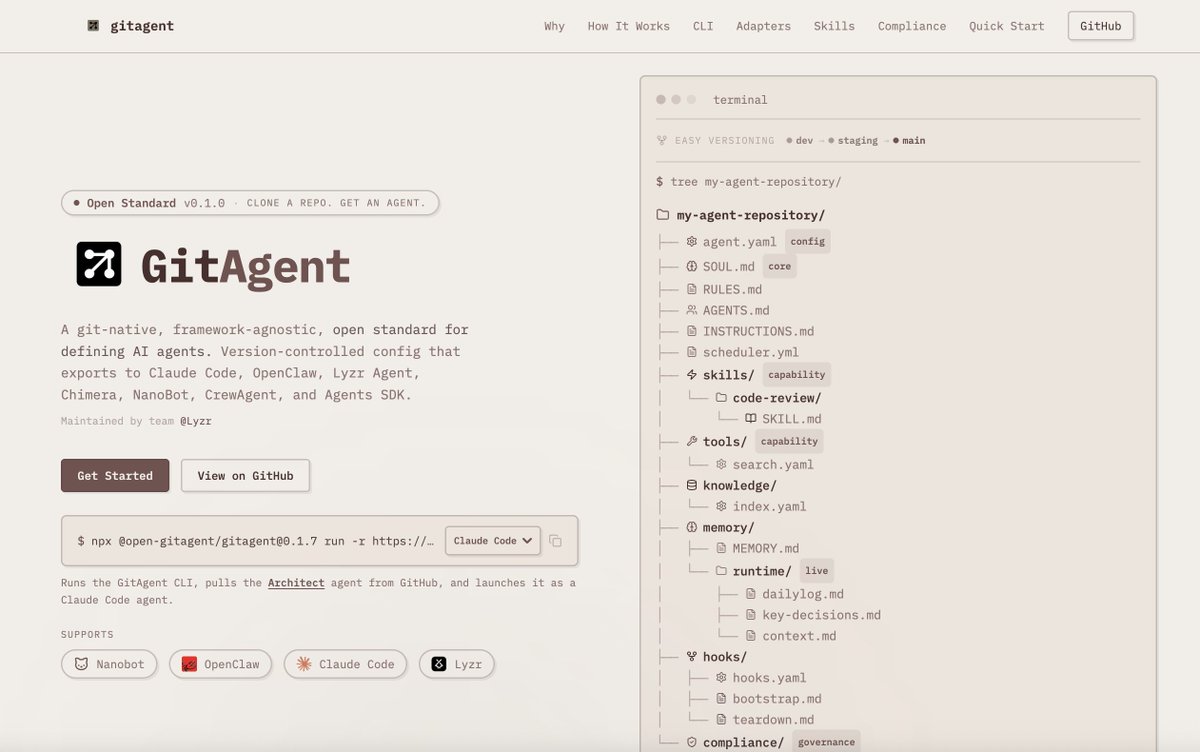
Today, we are launching the open standard for agents.
GitAgent is to agents what MCP is to APIs.
A git-native, framework-agnostic, open standard for defining AI agents. Version-controlled config that exports to @claudeai Code, @openclaw , @LangChain , @crewAIInc , @lyzr__ai Agent, Chimera, NanoBot, and Agents SDK.
Get started here: https://t.co/wUvEGNNivQ
My five-year-old speaks to ChatGPT voice mode often.
He is super curious and asks it wild questions.
He wants to know what happens when a polar bear and an orca fight.
He asks in what circumstances a jaguar can actually outpace a cheetah.
It is clear that the next generation will never disassociate AI from their native daily life. It is simply woven into how they explore the world.
My only real worry is that we do not want our kids to completely offload their thinking to an LLM.
Critical thinking, first-principle-based reasoning, and deep reasoning skills are muscles they need to build and own themselves.
We cannot let our brains get obese, lazy, and tired. TikTok is already doing its best to do that. 😀
Bottoms up may have worked for non-intelligence tools like Figma, Gamma.
But for intelligence systems, systems that hold critical data, systems that think, too-down is the right strategy.
A reason why Snowflake, Databricks were bought by the CIO first, while AWS, Figma were adopted by practitioners first.
@paulg@Nicoqp It’s not ideas.. it’s the ability to skip tokens..
Humans don’t think like ‘next best token’
We skip tokens and connect nodes that are far apart..
That’s something that we can’t explain to a computer..
simple rule that I follow..
process of elimination.. forget all things that went bad so far.. forget all things that could go wrong.. build a dreamy path in a dreamland..
it works.. not because you dreamed.. because that’s how world works.. random..
this will get you up and running every day.. well.. most days..
@paulg@kayhantolga Hmmm 🤔
35 enterprise customers. $12M ARR. Multiyear contracts. Zero churn. 9 months.
That’s Lyzr AI 😀
Selling to big companies is a flex 💪🏿
Start with small ones -> you ramp up fast, raise shit load of money, exit
Start with the large ones -> you go IPO
TikTok is the number one medium in the US for getting your brand viral.
TikTok has about 136 million monthly active users in the US.
As a brand, you cannot ignore TikTok for long, but capturing the viral trends, generating videos, and posting them is becoming increasingly difficult even in the age of AI.
A poorly built AI pipeline results in AI slop, which will hurt your brand.
Which is why we built the 'TikTok Shop Agent' 🔥
- Once set up, it will continuously search for TikTok trends relevant to your brand/product
- It will generate a script and review it for factual accuracies
- It will then generate videos and images and run simulations
- The agent then reviews the content for compliance and then posts on TikTok automatically
This is the best way to 100x your brand visibility without generating AI slop.
Speak to us at Lyzr. We will get your TikTok agents up and running in 2 weeks.
Learn more: https://t.co/lDYijeKrzS
@martin_casado You pay the price while doing it. But when you get there eventually, which you will in most cases, you will be proud (within yourself) and sleep better.
Our Anthropic bill started zooming toward $1 million. So our team at @lyzr__ai built a system to manage coding agents. @Shreyaskapale
Meet BaseCode - MDM for coding agents.
Here is how it works:
1. Engineers run Claude Code, Codex, Copilot, Gemini, and opencode on their machines.
2. BaseCode centrally injects agent identities, coding policies, skills, MCP servers, and models into all of them.
3. Then it observes every prompt, project, and token, and enforces guardrails and budgets across the fleet.
Runs locally in your own cloud (air-gapped). Supports all model providers and frameworks.
Starts at $20/dev/month.
Helps you save $$$ on your Claude Code usage.
Learn More: https://t.co/aSKiXZwyuD
See Demo: https://t.co/h8zhgXZUQB
Write to us: [email protected]
#savetokens #controlclaudecode
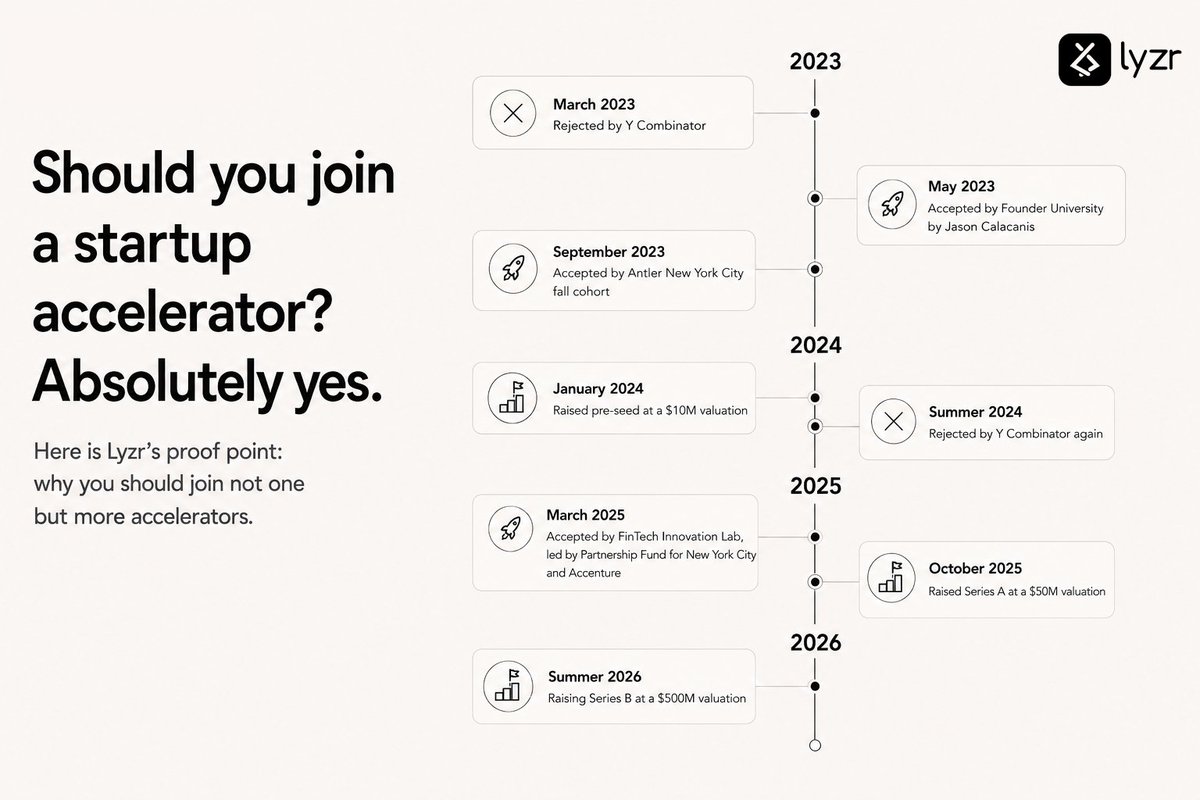
Should you join an accelerator as a startup founder?
My take: absolutely yes. And probably two or three of them, so you get a mix of expertise and learn from various angles.
Here is some context.
Lyzr is at $12M ARR today. And almost 90% of this came in the last nine months. We grew 20x in just the last 3 quarters. We spent the first two years with the numbers barely moving, but all that learning and foundation we built allowed us to grow faster in the last twelve months.
During those first two years, we had the chance to apply and join several accelerators. And yes, before you ask, Lyzr is yet another startup that YC rejected that is on its way to a $500M valuation, selling to Fortune 500s, even the US government, and with 100,000+ agent builders on the platform.
But YC is not the only accelerator out there. If you have a keen eye for learning, there are various other diversified and high-quality accelerators and startup schools.
Here is what we did.
We started with @FounderUni by @jasoncalacanis. It was a fantastic twelve-week program that allowed us to feel like we belonged among like-minded entrepreneurs. We got to hear all of Jason's collective wisdom and his own entrepreneurial experience. And he had a highly professional team that motivated us through the early first three months of Lyzr.
Then we were selected into Antler New York, 2023 Fall cohort. This was more of a campus thing, so we were able to visit the Antler office in New York at least three times a week. This is where things got physical. We could actually feel that we belonged to a community of early-stage startups, building and experimenting day in and day out. As we graduated out of Antler, we raised our pre-seed at a $10M valuation.
And almost a year later, we got into the @labs_fintech by @NYCIF and @Accenture. This accelerator was very different. It gave us access to some of the world's largest financial services firms. We got to meet David Solomon, CEO of Goldman Sachs. We got to visit several regulatory bodies in Washington, DC. This was a different level of unlock.
So if you see the pattern, we gradually graduated from an early-stage startup school, to an on-campus accelerator like Antler, and then to a Fortune 500 scale fintech accelerator.
To be honest, this combination served us a lot better, because it aligned with what we always wanted to do.
We wanted to build systems for the world outside of the Bay Area, and I think we naturally gravitated towards accelerators and advisors who helped us understand the world better, who helped us understand the non-technology businesses better.
So to summarize, if you are a founder, should you join an accelerator?
My take is absolutely yes. But make the decision based on what you are building and who you are building for.
If it is B2C or selling to other tech companies, someone like YC, SpeedRun, Surge, or HF0 could be a good place.
But if you are building for the world outside of tech, you have so many options.
Founder University + Antler + FinTech Innovation Lab worked for us. Go find your combo.
We have this one VC. Every time we start raising a round, they reach out with full enthusiasm. They sing praises, ask for data room access, even sign an NDA—and then they go silent.
A month later, one of their portfolio companies has launched a new business line or feature suspiciously close to what Lyzr is cracking really well.
This has happened twice. They’re now blacklisted.
Little do they understand that it's not the idea but the execution that matters.