Real stories of AI helping people.
We share evidence based stories about how artificial intelligence is improving healthcare, education, science, accessibility
The AI Upside, Special Edition
What if the AI data-center debate is based on an outdated picture of how these facilities are being built?
xAI’s Colossus supercomputer in Memphis is an extraordinary engineering story.
The original cluster, built around 100,000 NVIDIA H100 GPUs, came online in just 122 days. xAI later doubled it to 200,000 GPUs in another 92 days.
But the bigger story is not just the compute.
Colossus required xAI to help build the infrastructure around it. Public utility documents show that xAI funded a new substation and related transmission upgrades for its first 150 MW of grid service. A second 150 MW increment required additional upgrades and another substation, also at xAI’s expense. The agreements also allow the utility to require xAI to reduce grid consumption during periods of high demand.
That is an early example of the model policymakers are now encouraging: large AI operators should build, bring, or buy the generation they need, pay for the grid upgrades required to serve them, and avoid shifting those costs to residential customers. The White House’s 2026 Ratepayer Protection Pledge explicitly adopts that approach.
The water story is also more complicated than many headlines suggest.
A Berkeley Lab study found that the water consumed by data-center workloads can vary by more than 10,000 times, depending on server efficiency, utilization, cooling technology, climate, and the water intensity of the electricity supply. There is no scientifically honest universal number for “how much water AI uses.”
Newer closed-loop cooling designs can dramatically reduce direct water use. Microsoft, for example, says its latest AI-optimized data-center design circulates coolant without evaporation and uses zero water for cooling during normal operations.
Colossus is pursuing a different strategy: recycled wastewater.
Memphis utility documents describe a planned facility that would treat municipal wastewater and produce up to 13 million gallons of recycled water per day for xAI and nearby industrial users, reducing demand on the Memphis aquifer.
This does not mean every concern is misplaced. Colossus’s rapid use of on-site gas turbines has generated serious permitting and air-quality controversy. Building power behind the meter is not automatically responsible infrastructure. It still requires transparent permitting, emissions controls, and community oversight.
But the broader lesson is important:
AI data centers do not all operate the same way.
Some rely heavily on grid power and evaporative cooling. Others are building dedicated substations, generation, battery storage, closed-loop cooling, and reclaimed-water systems alongside the compute.
The debate should not be reduced to fear-driven claims that every AI query consumes a bottle of drinking water or that every new data center simply dumps its entire load onto an unprepared grid.
The better question is:
Are we building AI infrastructure in ways that add power, protect local resources, and make the companies creating the demand pay for what they require?
Colossus shows both the promise and the responsibility of moving at unprecedented speed.
Real stories. Real impact.
#TheAIUpside #SpecialEdition #AIInfrastructure #DataCenters #Energy #Water #Colossus #xAI #ArtificialIntelligence
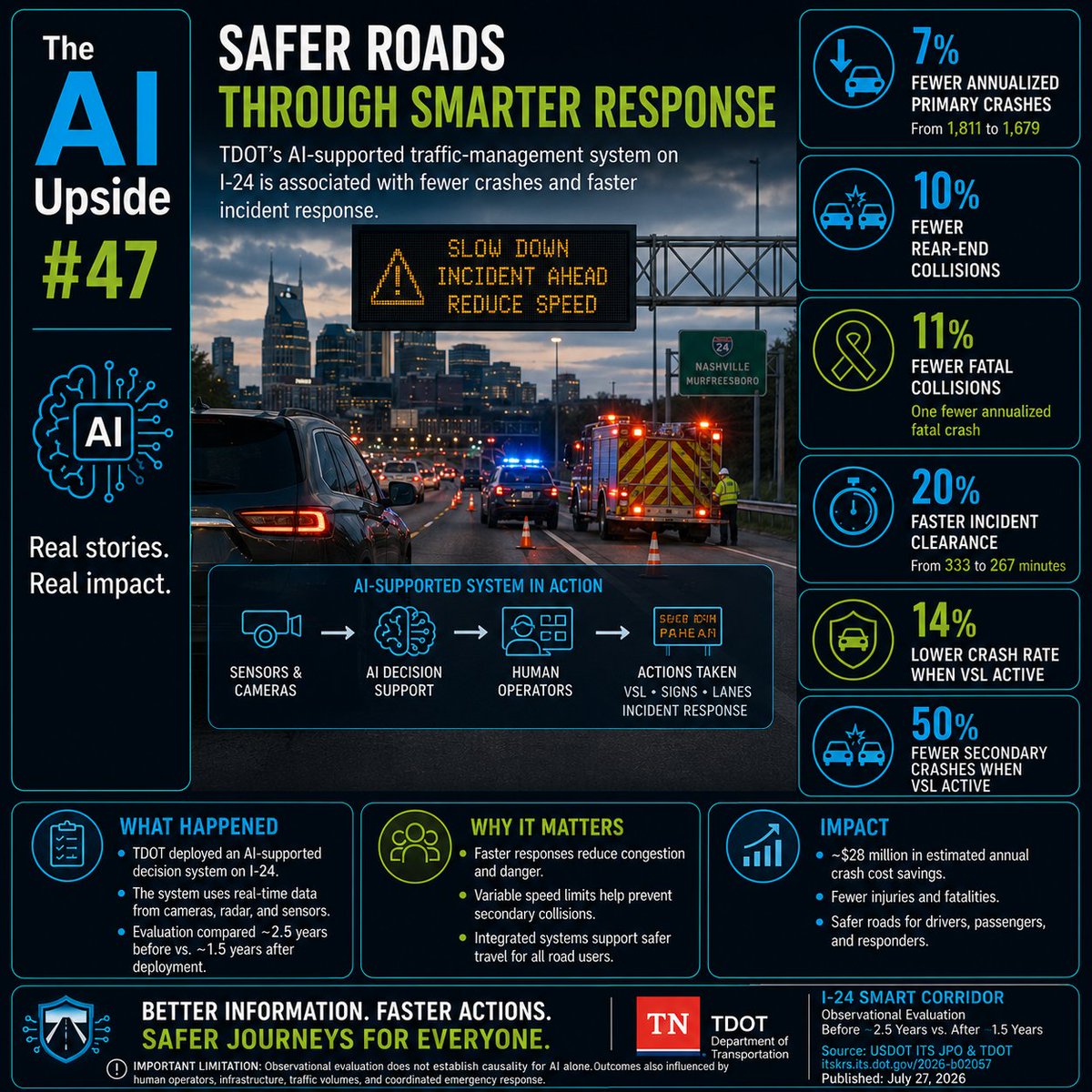
Source: U.S. Department of Transportation Intelligent Transportation Systems Joint Program Office and Tennessee Department of Transportation
https://t.co/7gcA9GzuHd
Before-and-after observational evaluation of the I-24 SMART Corridor’s integrated traffic-management system and AI-supported decision system.
Key findings:
7% reduction in annualized primary crashes
14% lower crash rate when variable speed limits were active
50% reduction in secondary crashes during variable-speed-limit periods
20% faster incident clearance
Approximately $28 million in estimated annual crash-cost savings
Important limitation: This was an observational evaluation, so it does not establish that AI alone caused the improvements. Results were influenced by human operators, variable speed limits, signs, sensors, emergency response, and changing traffic volumes. Published July 27, 2026.
The AI Upside #47
What if the road could warn you about danger before you even see it?
On Tennessee’s busy I-24 corridor between Nashville and Murfreesboro, an AI-supported traffic-management system is helping human operators respond faster and improve roadway safety.
The Tennessee Department of Transportation integrated real-time data from cameras, radar, and roadside sensors into a decision-support system for its Transportation Management Center.
The system recommends actions such as:
• Adjusting variable speed limits
• Activating lane controls
• Updating dynamic message signs
• Supporting faster incident response
Human operators remain in control and decide which actions to take.
An observational evaluation compared roughly 2.5 years before deployment with 1.5 years after deployment.
The reported results included:
• 7% fewer annualized primary crashes, declining from 1,811 to 1,679.
• 10% fewer rear-end collisions.
• 11% fewer fatal collisions, representing one fewer annualized fatal crash.
• 20% faster incident clearance, improving from 333 to 267 minutes.
When variable speed limits were active, the crash rate fell by 14%, while secondary crashes caused by an existing incident declined by 50%.
The estimated annual cost of crashes also fell by approximately $28 million.
These results should not be attributed to AI alone. The improvements came from a broader system that combined AI recommendations, human operator decisions, roadway infrastructure, variable speed limits, warning signs, and coordinated emergency response.
Still, the outcome is meaningful.
Better information helped people make faster decisions, clear incidents sooner, and reduce the risk of additional collisions.
Real stories. Real impact.
#TheAIUpside #ArtificialIntelligence #Transportation #PublicSafety #SmartInfrastructure #TrafficSafety #TDOT #AI
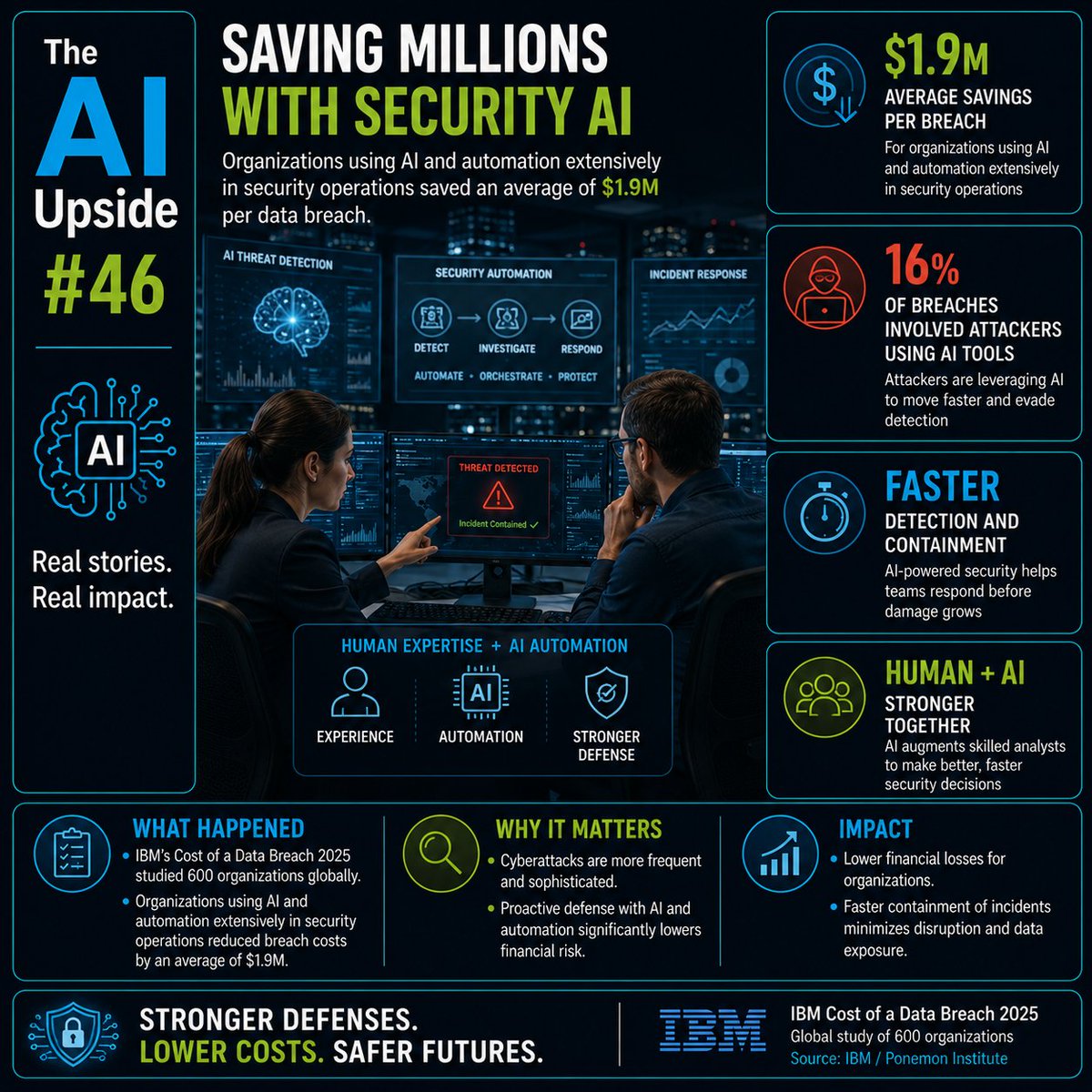
Source: IBM / Ponemon Institute - Cost of a Data Breach Report 2025
https://t.co/HXUnJ0DlFS
Global benchmark study of 600 organizations experiencing data breaches between March 2024 and February 2025.
Key findings:
Organizations extensively using AI and automation in security operations saved an average of $1.9 million per breach.
16% of breaches involved attackers using AI tools.
Organizations with mature AI-enabled security operations detected and contained breaches more efficiently.
Important limitation: IBM sponsored the report. The findings demonstrate an association between AI-enabled security practices and lower breach costs, but they do not prove a direct causal relationship.
The AI Upside #46
What if the right tools could save your organization nearly $2 million during a data breach?
Cybersecurity has entered a new era.
Attackers are increasingly using AI to make phishing campaigns more convincing, automate reconnaissance, and accelerate attacks. But organizations are fighting back with AI of their own.
According to IBM's Cost of a Data Breach 2025 report, organizations that extensively used AI and automation in their security operations saved an average of $1.9 million per data breach compared to those that did not.
The study also found that:
• 16% of breaches involved attackers using AI tools.
• Organizations using AI-powered security detected and contained incidents more efficiently, reducing the overall financial impact.
The key takeaway isn't that AI replaces cybersecurity professionals.
It's that AI helps security teams identify threats faster, investigate incidents more efficiently, and respond before attacks become even more costly.
As attackers adopt AI, defenders have to evolve as well.
The organizations seeing the greatest benefits are combining experienced security professionals with intelligent automation to strengthen their defenses.
AI isn't just changing how cyberattacks happen.
It's helping organizations stop them faster.
Real stories. Real impact.
#TheAIUpside #Cybersecurity #ArtificialIntelligence #DataSecurity #SecurityOperations #AI #IBM #DigitalTransformation
Source: Sagepilot
https://t.co/NTIrqK2Pi9
Vendor-published case study describing Ugaoo’s deployment of an AI support agent across multiple customer-service channels.
Reported scale and results include:
More than 15,000 tickets and 88,000 messages per month
More than 14,000 tickets handled by AI in the last 30 days
80% ticket resolution rate, up from 65%
About 3 seconds median first response time
4.07 out of 5 average customer rating for AI chats
Important limitation: These metrics were reported by the vendor. No independent evaluation, control group, or external audit was provided. Published July 29, 2026.
The AI Upside #45
What happens when a plant arrives damaged or dies in transit?
For Ugaoo, an online plant retailer in India, those situations once meant long waits for a human support agent. Now, many are being resolved in seconds.
According to a vendor-published case study from Sagepilot, Ugaoo deployed an AI support agent named Myra. The system was trained on the company’s product catalog, plant-care guides, replacement policies, and support workflows.
Myra handles routine inquiries across WhatsApp, Instagram, Messenger, email, web chat, and phone.
The reported results include:
• 80% of tickets resolved independently by the AI agent, up from 65% in May.
• More than 14,000 tickets handled by AI in the last 30 days.
• A median first response time of about 3 seconds.
• An average customer rating of 4.07 out of 5 for AI conversations.
Myra also connects to live order data and courier tracking systems. It can check shipment status, file replacement claims through Ugaoo’s PlantFix portal, and initiate proactive delivery calls.
That matters because this is more than a chatbot answering basic questions. It is AI connected to real business systems and clear operational policies.
Customers get faster answers for tracking, replacements, and plant-care questions. Human support staff can spend more time on complex escalations instead of repetitive status checks.
The results are vendor-reported and have not been independently audited, but they offer a practical example of how AI can help a growing business improve service while supporting its workforce.
Real stories. Real impact.
#TheAIUpside #AI #CustomerSupport #SmallBusiness #India #Ecommerce #WorkforceDevelopment
The AI Upside #44
What happens when artificial intelligence joins the conversation in a busy primary care clinic?
Researchers recently tested an AI-powered clinical decision support system across 16 primary care clinics in Kenya to see whether it could help clinicians deliver more consistent, higher-quality care.
The AI was embedded directly into the electronic medical record, offering diagnostic and treatment guidance during routine patient visits. Clinicians remained fully in control, choosing whether to accept, modify, or ignore the recommendations.
Among nearly 10,000 patients, the AI-assisted clinics showed meaningful improvements in the quality of care documentation and clinical decision-making.
Researchers found:
• 74% higher odds of an appropriate diagnosis.
• 68% higher odds of comprehensive clinical documentation.
• 71% higher odds of appropriate treatment planning.
Perhaps the most important finding was what didn't change.
The study found no statistically significant difference in 14-day treatment failure between the AI-assisted and standard-care groups.
That's an important reminder that today's AI is often most valuable as a tool that improves clinician workflows and decision support. Better documentation and more consistent care processes are meaningful advances, even when improvements in patient outcomes require longer-term study.
The future of healthcare isn't AI replacing clinicians.
It's AI helping clinicians deliver the best care possible.
Real stories. Real impact.
#TheAIUpside #HealthcareAI #PrimaryCare #ClinicalDecisionSupport #ArtificialIntelligence #EvidenceBasedAI #DigitalHealth
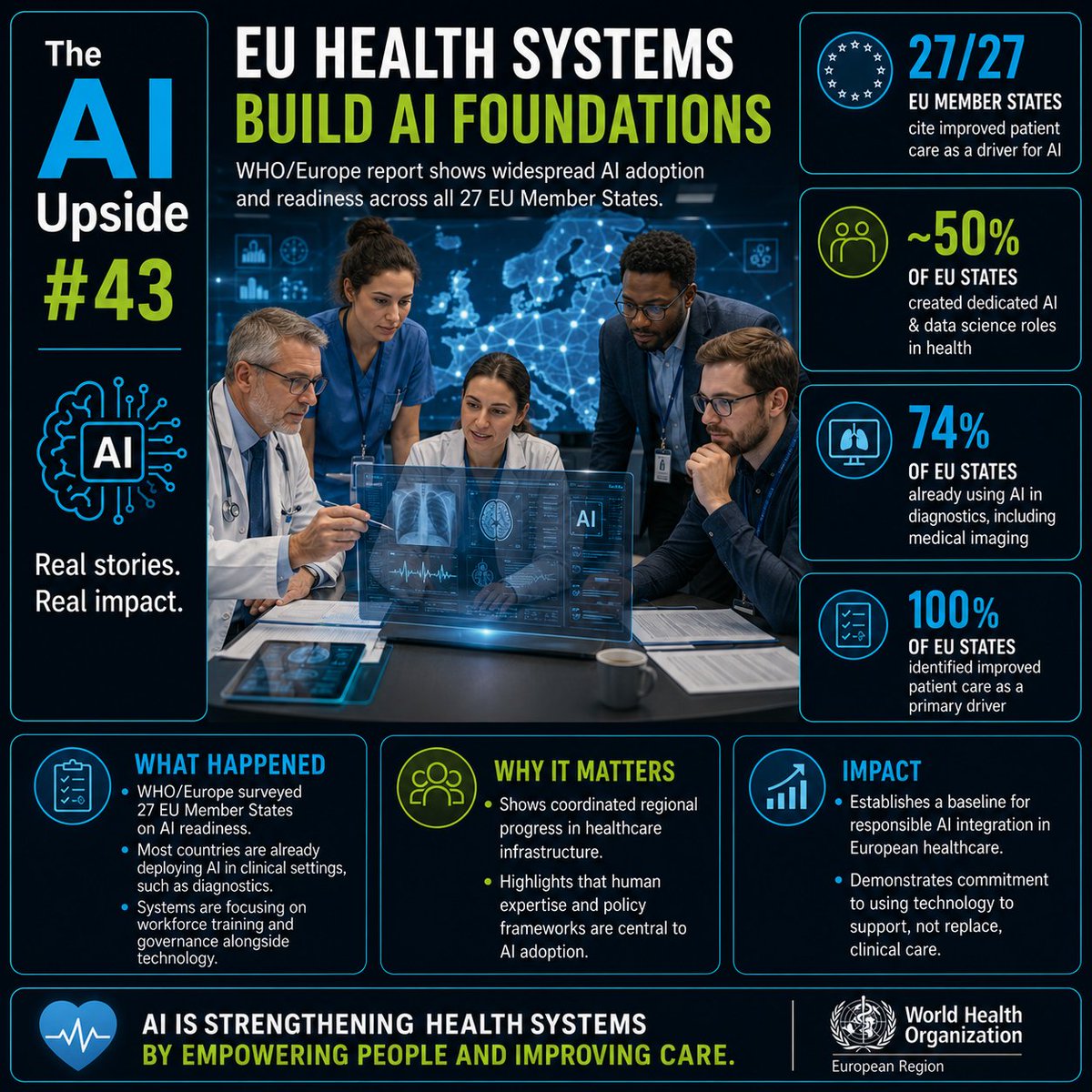
The AI Upside #43
What does it look like when an entire continent prepares its healthcare system for artificial intelligence?
A new report from WHO/Europe provides the first comprehensive snapshot of AI readiness across all 27 European Union Member States. The findings show a region investing not just in technology, but in the people, policies, and infrastructure needed to use AI responsibly.
Every EU Member State identified improving patient care as a primary reason for adopting AI. That vision is already becoming reality.
According to the report:
• 74% of EU Member States are already using AI for diagnostics, including medical imaging and disease detection.
• 100% cite better patient care as a primary driver for AI adoption.
• Nearly half have created dedicated AI and data science roles within their health systems.
The report also emphasizes that successful AI adoption depends on more than algorithms. Workforce training, stakeholder engagement, and strong data governance are just as important as the technology itself.
This is a reminder that the most successful AI transformations are human-led. The goal isn't replacing clinicians. It's giving them better tools to deliver better care.
While this report measures adoption and organizational readiness rather than patient outcomes, it shows that healthcare systems across Europe are proactively preparing for an AI-enabled future.
Real stories. Real impact.
#TheAIUpside #HealthcareAI #ArtificialIntelligence #DigitalHealth #WHO #HealthcareInnovation #FutureOfHealthcare
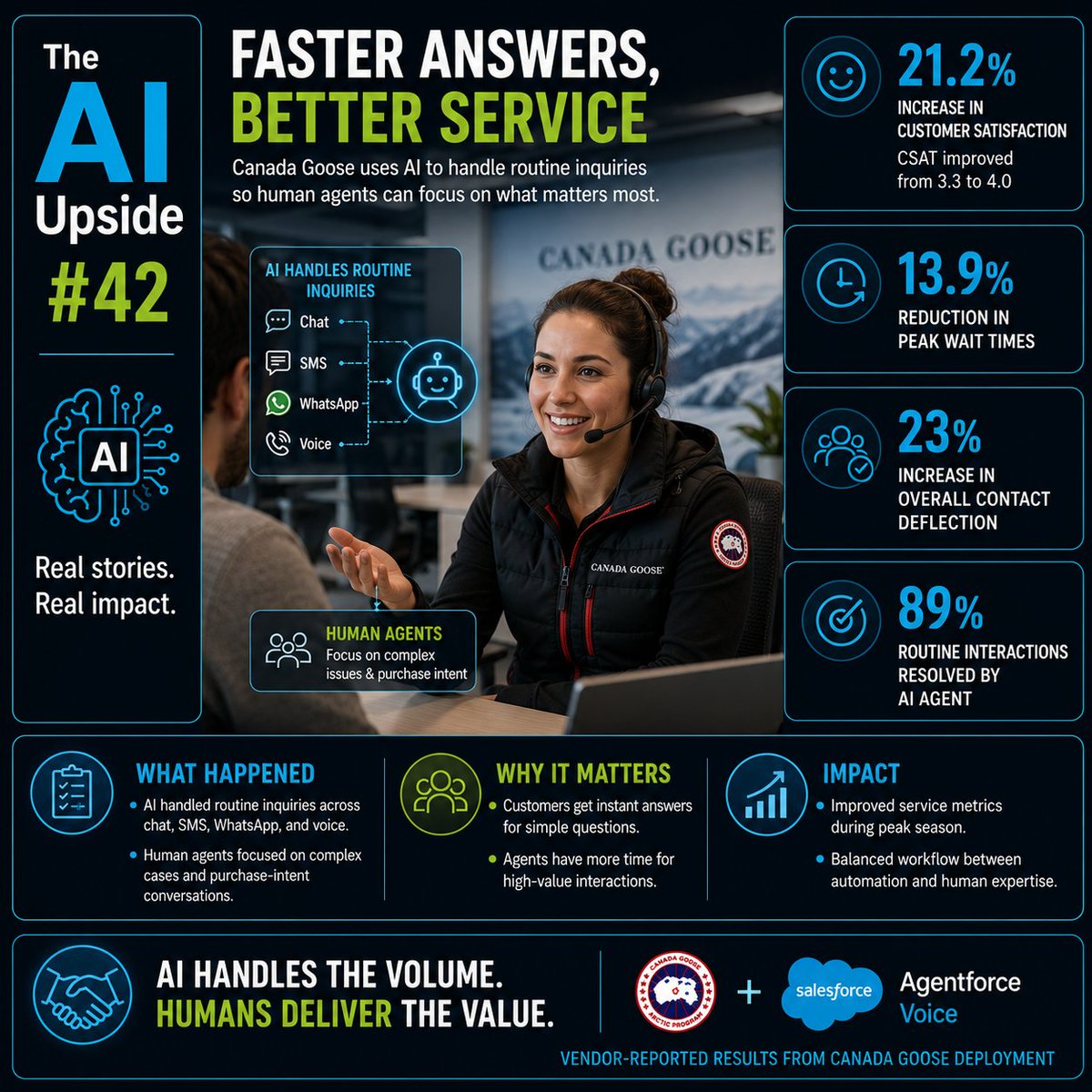
The AI Upside #42
What if your first customer-service question could be answered instantly, while your most complex concerns reached a human expert immediately?
Canada Goose deployed AI to handle routine customer-service inquiries across chat, SMS, WhatsApp, and voice. By automating common requests like order status and warranty questions, the company freed its human agents to focus on complex issues and high-value purchase conversations.
According to vendor-reported results from the deployment:
• 89% of targeted routine interactions were resolved by the AI agent.
• 23% increase in overall contact deflection.
• 13.9% reduction in peak wait times.
• 21.2% increase in customer satisfaction (CSAT), improving from 3.3 to 4.0.
This is a great example of AI augmenting people instead of replacing them. AI handled the repetitive work, while human agents focused on empathy, expertise, and the conversations that matter most.
Customers received faster answers. Agents spent more time creating value.
Real stories. Real impact.
#TheAIUpside #CustomerService #AIWorkforce #RetailTech #CanadaGoose #Salesforce #Agentforce #CustomerExperience
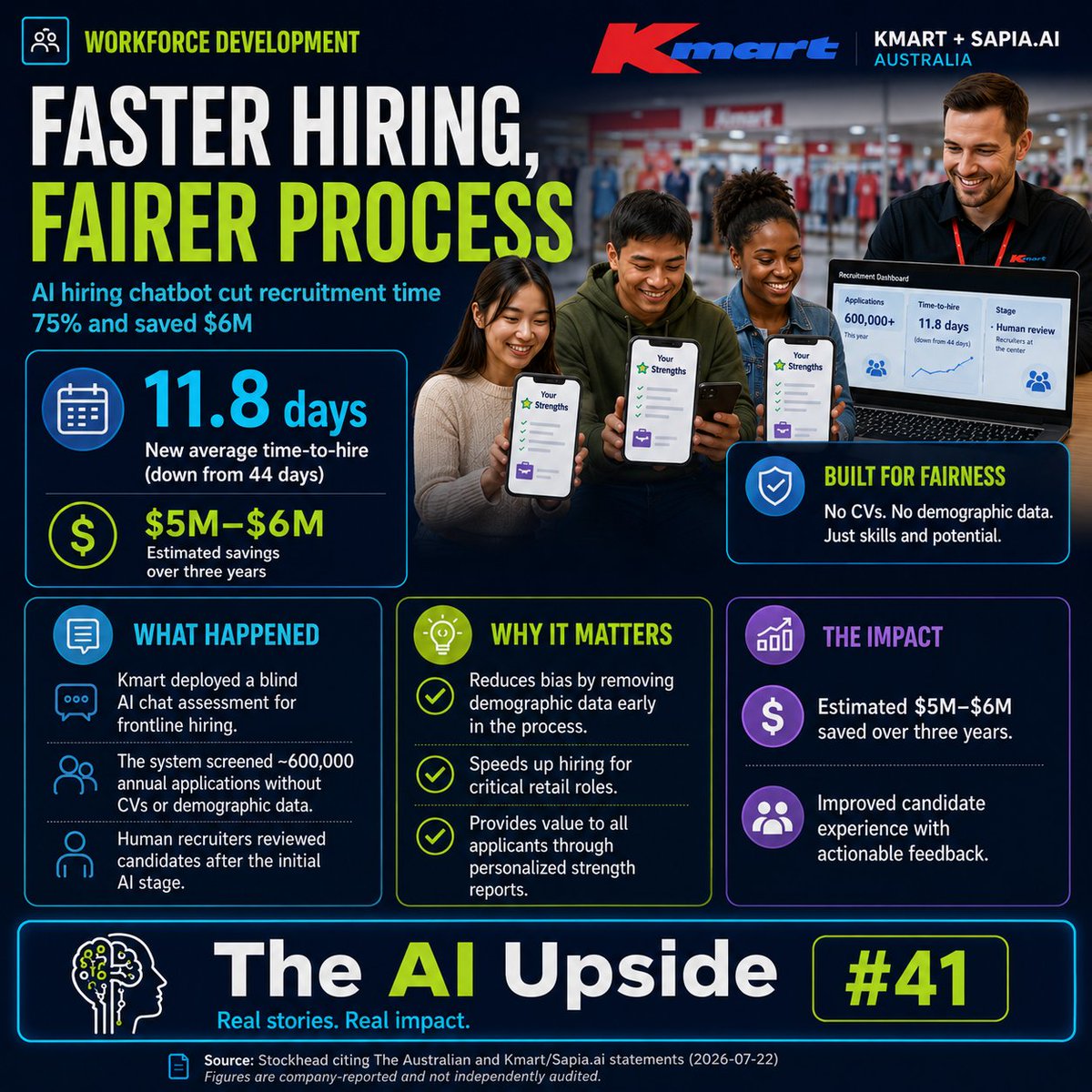
The AI Upside #41
What if applying for a job took less than two weeks instead of nearly two months?
For frontline retail roles in Australia, that is exactly what Kmart reports after integrating AI into its hiring process.
Managing approximately 600,000 job applications each year across more than 450 stores, Kmart partnered with https://t.co/jWN7XwAq3p to introduce a blind, chat-based assessment. The AI evaluated candidates without requiring resumes or revealing demographic information such as age, gender, or background.
Importantly, AI did not make the hiring decisions. Human recruiters remained at the center of the process, reviewing candidates after the initial AI-assisted screening.
The results were significant. Kmart reports that average time-to-hire fell from 44 days to just 11.8 days, a reduction of roughly 75%. The company also estimates the new process has saved $5 million to $6 million over three years.
Perhaps most importantly, every applicant received personalized feedback highlighting their strengths and suggesting other roles that might be a good fit, even if they weren't selected.
This is a great example of AI helping people, not replacing them. Faster hiring, a better applicant experience, and more time for recruiters to focus on the human side of hiring.
Real stories. Real impact.
#TheAIUpside #AI #Hiring #WorkforceDevelopment #Retail #HRTech #FutureOfWork
The AI Upside #40
What happens when AI doesn't just detect danger, but helps hospitals improve how they deliver care?
At Lausanne University Hospital in Switzerland, researchers deployed an AI-powered Sepsis Learning Health System across multiple hospital wards. Every six hours, the HERACLES algorithm analyzed patient data, providing insights that supported clinicians through established care pathways and continuous quality improvement.
The results were encouraging. Among patients identified with sepsis by the AI in supported wards, in-hospital mortality fell from 20.54% to 15.27%. Ninety-day mortality also declined, dropping from 32.99% to 26.11%.
Importantly, the improvement wasn't driven by AI alone. Success depended on clinicians acting on the insights, standardized treatment protocols, and an organization committed to improving patient care. It shows the greatest impact often comes when AI strengthens human expertise, not replaces it.
Real stories. Real impact.
#TheAIUpside #Healthcare #AI #PatientSafety #Sepsis #DigitalHealth #ClinicalAI
Sources• Lawrence Berkeley National Laboratory - The Water Use of Data Center Workloads (workload water use varies by more than 10,000×)• Memphis Light, Gas and Water - xAI Update (customer-funded substations, transmission upgrades, recycled-water project)• Microsoft - Next-generation datacenters consume zero water for cooling during normal operations (closed-loop cooling)• The White House - Ratepayer Protection Pledge (large AI operators should build, bring, or buy the power they require)Important qualification: Colossus demonstrates an innovative infrastructure model, but its rapid deployment has also raised legitimate permitting and environmental questions. The goal is smarter infrastructure, not avoiding responsible oversight.I actually like this version better. It gets to the point faster, keeps the curiosity hook, removes a few repetitive sentences, and is more likely to hold attention on LinkedIn. It also leaves a little room under LinkedIn's character limit for your source comment.
The AI Upside, Special Edition
What if the AI data-center debate is based on an outdated picture of how these facilities are being built?
xAI’s Colossus supercomputer in Memphis is an extraordinary engineering story.
The original cluster, built around 100,000 NVIDIA H100 GPUs, came online in just 122 days. xAI later doubled it to 200,000 GPUs in another 92 days.
But the bigger story is not just the compute.
Colossus required xAI to help build the infrastructure around it. Public utility documents show that xAI funded a new substation and related transmission upgrades for its first 150 MW of grid service. A second 150 MW increment required additional upgrades and another substation, also at xAI’s expense. The agreements also allow the utility to require xAI to reduce grid consumption during periods of high demand.
That is an early example of the model policymakers are now encouraging: large AI operators should build, bring, or buy the generation they need, pay for the grid upgrades required to serve them, and avoid shifting those costs to residential customers. The White House’s 2026 Ratepayer Protection Pledge explicitly adopts that approach.
The water story is also more complicated than many headlines suggest.
A Berkeley Lab study found that the water consumed by data-center workloads can vary by more than 10,000 times, depending on server efficiency, utilization, cooling technology, climate, and the water intensity of the electricity supply. There is no scientifically honest universal number for “how much water AI uses.”
Newer closed-loop cooling designs can dramatically reduce direct water use. Microsoft, for example, says its latest AI-optimized data-center design circulates coolant without evaporation and uses zero water for cooling during normal operations.
Colossus is pursuing a different strategy: recycled wastewater.
Memphis utility documents describe a planned facility that would treat municipal wastewater and produce up to 13 million gallons of recycled water per day for xAI and nearby industrial users, reducing demand on the Memphis aquifer.
This does not mean every concern is misplaced. Colossus’s rapid use of on-site gas turbines has generated serious permitting and air-quality controversy. Building power behind the meter is not automatically responsible infrastructure. It still requires transparent permitting, emissions controls, and community oversight.
But the broader lesson is important:
AI data centers do not all operate the same way.
Some rely heavily on grid power and evaporative cooling. Others are building dedicated substations, generation, battery storage, closed-loop cooling, and reclaimed-water systems alongside the compute.
The debate should not be reduced to fear-driven claims that every AI query consumes a bottle of drinking water or that every new data center simply dumps its entire load onto an unprepared grid.
The better question is:
Are we building AI infrastructure in ways that add power, protect local resources, and make the companies creating the demand pay for what they require?
Colossus shows both the promise and the responsibility of moving at unprecedented speed.
Real stories. Real impact.
#TheAIUpside #SpecialEdition #AIInfrastructure #DataCenters #Energy #Water #Colossus #xAI #ArtificialIntelligence
The AI Upside #39
What if the most tedious part of doing laundry could simply disappear?
For households where time is limited or mobility is a challenge, folding clothes can become more than a chore. It can be a barrier to independence.
Sunday Robotics recently shared performance data from its ACT-2 system, reporting 778 successful folds across 785 autonomous attempts in unseen homes and unfamiliar environments.
That matters because household robots have historically struggled outside controlled settings. Real homes introduce different fabrics, lighting, layouts, and unexpected conditions. Handling that variability is a necessary step toward useful everyday assistance.
The results are promising, but they are also company-reported. Sunday Robotics used its own grading rubric, human annotation, and review process, and the findings have not yet been independently validated.
Still, this offers a measurable glimpse of how AI-powered robotics could reduce physical strain, save time, and help more people live independently.
Real stories. Real impact.
#TheAIUpside #Robotics #ArtificialIntelligence #AssistiveTechnology #Accessibility #SmartHome #FutureOfWork
The AI Upside #38
What if someone with complete tetraplegia could regain the ability to feed themselves again?
In a first-in-human study, researchers reported that a double neural bypass system helped one man with chronic complete tetraplegia recover meaningful hand function, including self-feeding and manipulating delicate objects. The participant also experienced improvements in elbow movement and wrist sensation.
AI played an important supporting role by helping decode movement intentions into precise hand control in real time. But the outcome wasn't AI alone. It resulted from implanted brain recording, spinal and cortical stimulation, rehabilitation, clinician expertise, and the participant's own effort working together.
This is an early result from a single-participant study, so much more research is needed. But it offers a compelling glimpse at how AI-enabled neuroprosthetics could one day help restore independence for people living with severe paralysis.
Real stories. Real impact.
#TheAIUpside #Healthcare #Neuroprosthetics #BrainComputerInterface #Accessibility #AI #MedicalInnovation
Source: Columbia University Irving Medical Center
https://t.co/vsBTAd7Gis
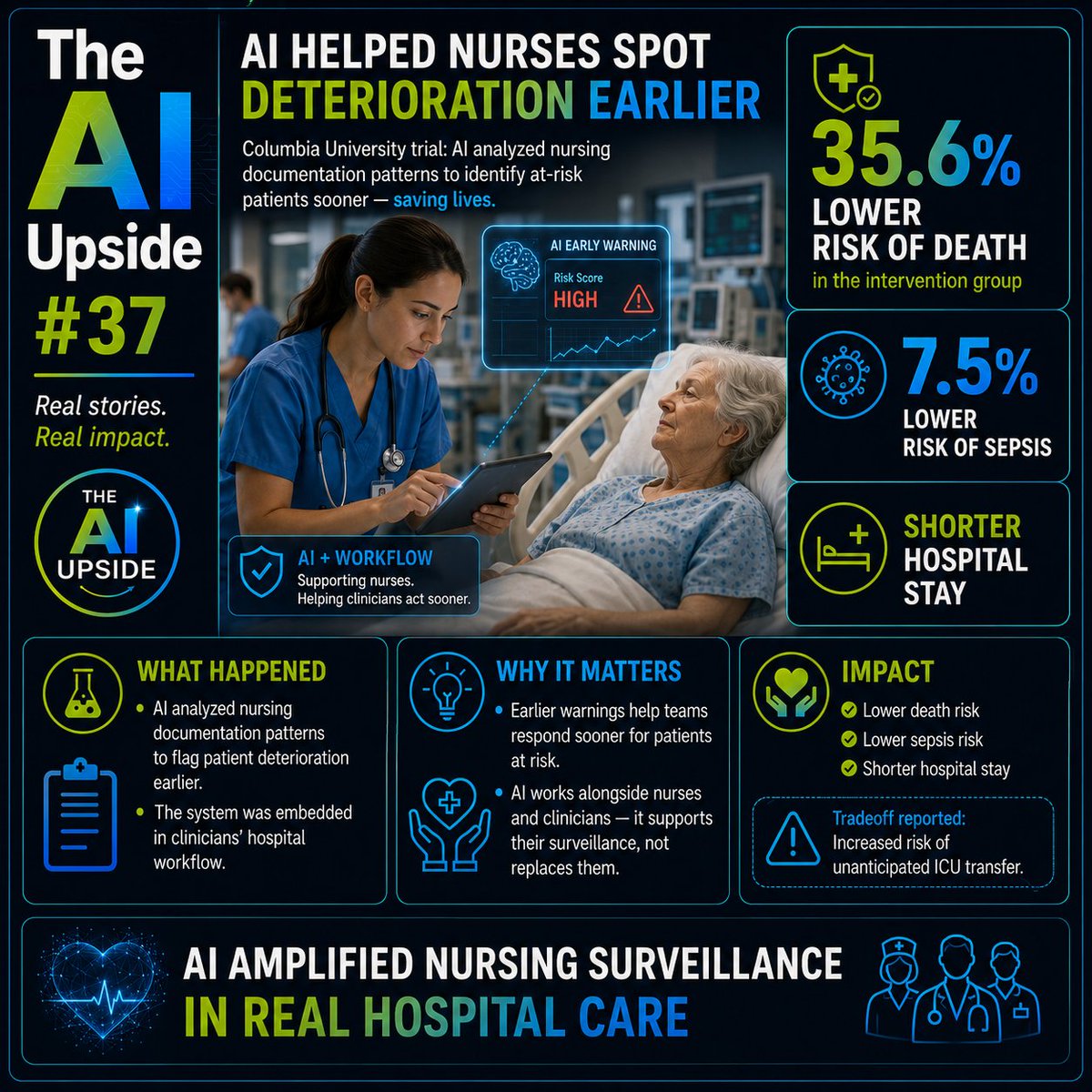
Researchers published results from a year-long multisite pragmatic cluster-randomized controlled trial of the CONCERN Early Warning System in Nature Medicine (April 2, 2025). The study included 60,893 hospital patient encounters across 74 clinical units in two health systems.
Reported outcomes included a 35.6% lower risk of death, 7.5% lower risk of sepsis, and an 11.2% relative reduction in hospital length of stay. The authors note that the observed benefits reflect the combined AI-plus-clinical-workflow intervention rather than the AI model alone, and the study also reported an increased risk of unanticipated ICU transfers.
The AI Upside #37
When can AI help save lives in the hospital?
In a year-long multisite pragmatic cluster-randomized controlled trial, Columbia University reported that the CONCERN Early Warning System helped identify patient deterioration earlier by analyzing nursing documentation patterns.
Among 60,893 hospital patient encounters, patients in the intervention group experienced a:
• 35.6% lower risk of death
• 7.5% lower risk of sepsis
• Shorter hospital stays
What makes this especially important is that AI wasn't replacing nurses or physicians. It was working alongside them, analyzing documentation patterns to help clinical teams recognize patient deterioration sooner and intervene earlier.
The results are promising, but they also highlight the importance of responsible AI deployment. The study evaluated a combined AI-plus-workflow intervention in real hospital settings, and researchers also reported an increased risk of unanticipated ICU transfers, demonstrating why careful clinical validation remains essential.
Real stories. Real impact.
#Healthcare #AI #AIinHealthcare #PatientSafety #Nursing #ClinicalAI #DigitalHealth #ArtificialIntelligence
The AI Upside #36
Scammers are getting faster, more convincing, and increasingly powered by AI.
Visa is responding with AI of its own.
The company has built a dedicated scam disruption practice that combines cybersecurity intelligence, data science, automation, and generative AI to identify fraudulent networks, connect activity across platforms, and help shut scams down before more people are harmed.
In 2024 alone, Visa says the team disrupted more than $350 million in attempted fraud and helped take down approximately 12,000 fraudulent merchant websites tied to a dating-app background-check scam.
Why does this matter?
Individual consumers are often outmatched by coordinated scam operations using fake identities, phishing messages, deepfakes, and sophisticated payment schemes.
AI can help defenders analyze patterns across enormous datasets, uncover connected fraud networks, and move faster than manual investigations alone.
The goal is not to remove people from the process.
It is to give investigators better intelligence, automate the repetitive work, and help them intervene before more victims lose money.
AI is making scams more dangerous.
But it is also helping defenders level the playing field.
Real stories. Real impact.
#AI #Cybersecurity #FraudPrevention #FinancialSecurity #ArtificialIntelligence #ConsumerProtection #AIForGood #TheAIUpside