If you want to be rewarded, you have to be irreplaceable.
If you want to be irreplaceable, you have to be unique.
If you want to be unique, you have to be authentic.
If you want to be authentic, stop listening to everyone and everything else.
It’s drowning “you” out.
- Naval
🚨 BILL GURLEY: “I would encourage people to read as much as they can about Anthropic … I don't think they think they're writing software. I think they're midwifing a deity.”
JASON: “I know some of these folks … They believe they're so powerful, that they can create God.”
Dans le manifeste "techno-optimiste" de Marc Andreessen, il y a une phrase qui m'a marqué :
"Our enemies are not bad people – but rather bad ideas."
Nos ennemis ne sont pas des mauvaises personnes. Ce sont des mauvaises idées.
Prenons Jancovici. L'homme est brillant, sincère, travailleur. Il ne se lève pas le matin en se disant qu'il va nuire à l'humanité. Mais l'idée qu'il porte la décroissance, le rationnement, la frugalité érigée en horizon civilisationnel est une idée profondément destructrice. Elle prend des esprits brillants et les transforme en commissaires politiques d'un futur appauvri.
Et le plus fascinant, c'est ce que cette idée fait aux gens qui l'adoptent.
Dans mon entourage, une grosse partie de mes amis est sur cette ligne décroissantiste, avec tout le package qui va avec. L'argent c'est mal mais ils en veulent. Il faut moins prendre l'avion mais ils rêvent de voyager partout. Il faut consommer moins mais ils ne renoncent à rien de ce qu'ils aiment vraiment.
Et tous ont un point commun : ils sont déprimés. L'un d'eux m'a même confié qu'il était sous antidépresseurs.
Ce n'est pas un hasard. C'est mécanique.
Quand tu crois que ton désir de vivre, de créer, de t'élever est moralement suspect tu te détruis de l'intérieur. Tu passes ta vie à t'excuser d'exister. Tu vis dans la dissonance permanente entre ce que ton corps veut (plus, mieux, plus loin) et ce que ton idéologie t'ordonne (moins, sobre, immobile).
D'où ma théorie :
Quand on pense quelque chose de fondamentalement faux décroissance, communisme, extrémisme religieux (de tout ordre) ce n'est qu'une question de temps avant que ça devienne vraiment destructeur.
D'abord pour soi. Puis pour les autres.
Les mauvaises idées tuent. Lentement chez ceux qui y croient, brutalement chez ceux qui les subissent.
C'est pour ça que la bataille des idées n'est pas un luxe d'intellectuel. C'est la bataille la plus importante de notre époque.
My biggest takeaways from @danshipper:
1. The future of work will happen inside Codex or Claude Code. Instead of putting AI into your SaaS tool, you’ll use your SaaS tools inside your favorite AI agents' in-app browser. Dan spends all his time in Codex now—writing documents, managing email, doing research, everything. He's using Google Docs, PostHog, and everything he needs within the agent's in-app browser. The agent can see what he’s doing, and has all of his context, so he and his agent collaborate quickly and super effectively.
2. Automation is a lie—every automation needs a human. Dan's company doubled in size this year despite being incredibly AI-forward. Why? Because in order to make automation work well, you need humans making sure everything keeps working. This is why benchmarks are misleading—they measure AI on problems we’ve already framed and can score, but there’s always a higher frame.
3. PMs will win the AI era. Marcus, a former PM who previously ran Axios’s writing product, joined Every after getting super AI-pilled. Now he runs their product Spiral, and ships faster than anyone on the team. He pairs technical knowledge with spiky product sense, deep user empathy, and an eye for what matters. Dan thinks any PM who gets really AI-native will be incredibly dangerous because the building is done for you—what matters is figuring out what to build and if it’s great.
4. Full-stack designers are becoming superheroes. Designers used to make beautiful interactions that engineers didn’t want to build or couldn’t execute properly. Now designers don’t need to hand things off; they can build it themselves. Designers are naturally creative people, and AI is the perfect tool for them because it lets them bring their vision to life without the traditional bottlenecks.
5. SaaS is not dead. In fact, Dan is bullish on SaaS stocks. When users bring their own AI (via Codex or Claude Code) to use SaaS products, the user—not the SaaS company—pays for tokens. This saves SaaS company’s margins. Since the agents need their own seats, Dan predicts that agents will create massive new demand for SaaS because there will be tons of agents using these products at high volume.
6. Every company will have one “super-agent” inside their Slack that every employee will use. Dan initially thought every employee would have their personal work agent, like a shadow AI org chart, but he’s completely flipped his view. He realized agents need humans who care about them. When someone gets tired of maintaining their personal agent, it becomes useless. The winning model is one forward-deployed engineer or AI-savvy person who maintains a company-wide agent (like Shopify’s River or Viktor), and then it trickles down to more specialized team agents as models improve and become less fiddly.
7. The AI job apocalypse is not happening, but you do need to evolve to stay relevant. Models make yesterday’s human competence cheap. But because everyone uses the same models, it all looks the same if you use it the default way; it becomes commoditized slop. Humans then take that frozen competence and use it to make something new and interesting for their specific situation. The key: “ride the models”—use them for everything you do, try new models when they drop, keep turning over rocks.
8. We will read way more AI-generated writing, and we will like it. Human writing is incredibly important for things that matter, but for internal docs, planning, and email, AI-generated is often better because most people are bad at writing strategy documents.
9. Build software for humans and agents to use together. The current model is building a CLI that an agent uses independently. Instead, you and your agent should be using the app together. This creates new design challenges—agents can make a billion requests in three seconds, so you need approval flows, inboxes that summarize what happened, logs, and easy rollback.
10. Forward-deployed engineers are the new most essential role. The big model companies have teams of people managing their internal agents, and those teams aren’t going away. It’s different from traditional software building, and certain engineers love it. As models get better, this role will evolve—you’ll be managing more agents doing more things.
Marc Andreessen says AI is teaching sand to think and it could be the most important technology in the history of humanity:
"Imagine a form of alchemy that turns sand into thought."
"Chips are made out of sand. They're made out of silicon, so they're literally made out of sand."
"We plug the chip into a data center, into power, we light it up, and we put AI on it, and all of a sudden it's thinking."
"We've turned sand into thought. And so it's possibly the most revolutionary technology in the history of the species."
"It's certainly on par with electricity and steam power. It's certainly more important than the internet."
@pmarca with @joerogan
It's never been easier to do everyday work with Codex.
Choose your role, connect the apps you use every day, and try suggested prompts.
Codex helps with everything from research and planning to docs, slides, spreadsheets, and more.
Uber founder Travis Kalanick just inverted the entire automation panic.
Everyone assumes AI eliminates human value.
The physics say the opposite.
Kalanick: “Let’s say the entire world, everything in our world, was automated except for plumbers. You had machines making buildings. You would basically have like a thousand buildings a day.”
The algorithm can design a skyscraper in a millisecond.
It cannot connect the pipes.
When compute violently accelerates the speed of construction, the unautomated human becomes the ultimate bottleneck.
And the bottleneck captures all the margin.
Kalanick: “How valuable would those plumbers be? Extremely valuable. Those guys, each and every plumber would be like LeBron. Why? Because plumbing is the long pole in the tent to progress.”
If the machine needs a human to finalize physical execution, that human doesn’t get replaced.
Their economic value goes exponential.
Kalanick: “You got so much efficiency everywhere else that you need millions of plumbers.”
The market thinks automation drives human wages to zero.
The physics dictate it drives the bottleneck’s wages to infinity.
The next decade doesn’t belong to whoever out-computes the machine.
It belongs to whoever stands at the exact point where the digital engine meets the physical world.
Kalanick: “If we get to this place where autonomous cars are everywhere, if it was a thousand to one, you still probably have, I don’t know, 20 million jobs, 50 million jobs.”
The panic over job destruction assumes a static volume of output.
When output goes infinite, the system demands more human oversight. Not less.
Waymo doesn’t delete the human. It shifts them from driver of one vehicle to director of a thousand.
Kalanick: “Until we get super AGI, humans are valuable and they are going to become more and more valuable because they will be the long pole in the tent to progress.”
You are no longer the engine.
You are the grid.
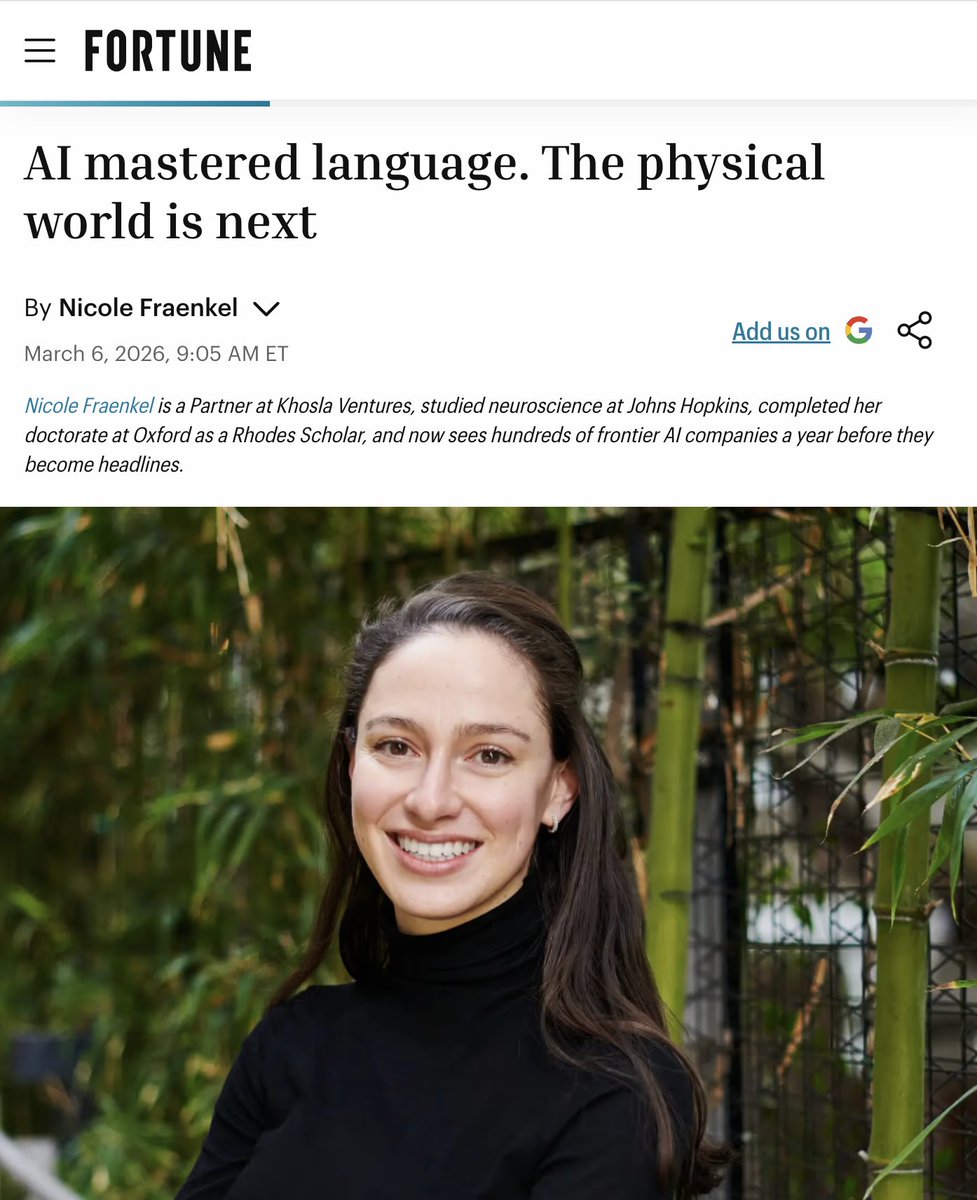
“The deepest value isn’t physics. It’s human intuition. A physics engine models how a drone moves; it can’t model how a skilled operator reacts when surprised. In surgery, it’s the feel for how the tissue responds to the scalpel. Train on human decision-making and you capture expertise that can’t be described with words, only shown, felt.”
KV Partner Nicole Fraenkel on world labs and why we bet on @gen_intuition last year
https://t.co/SH02wQGIb3
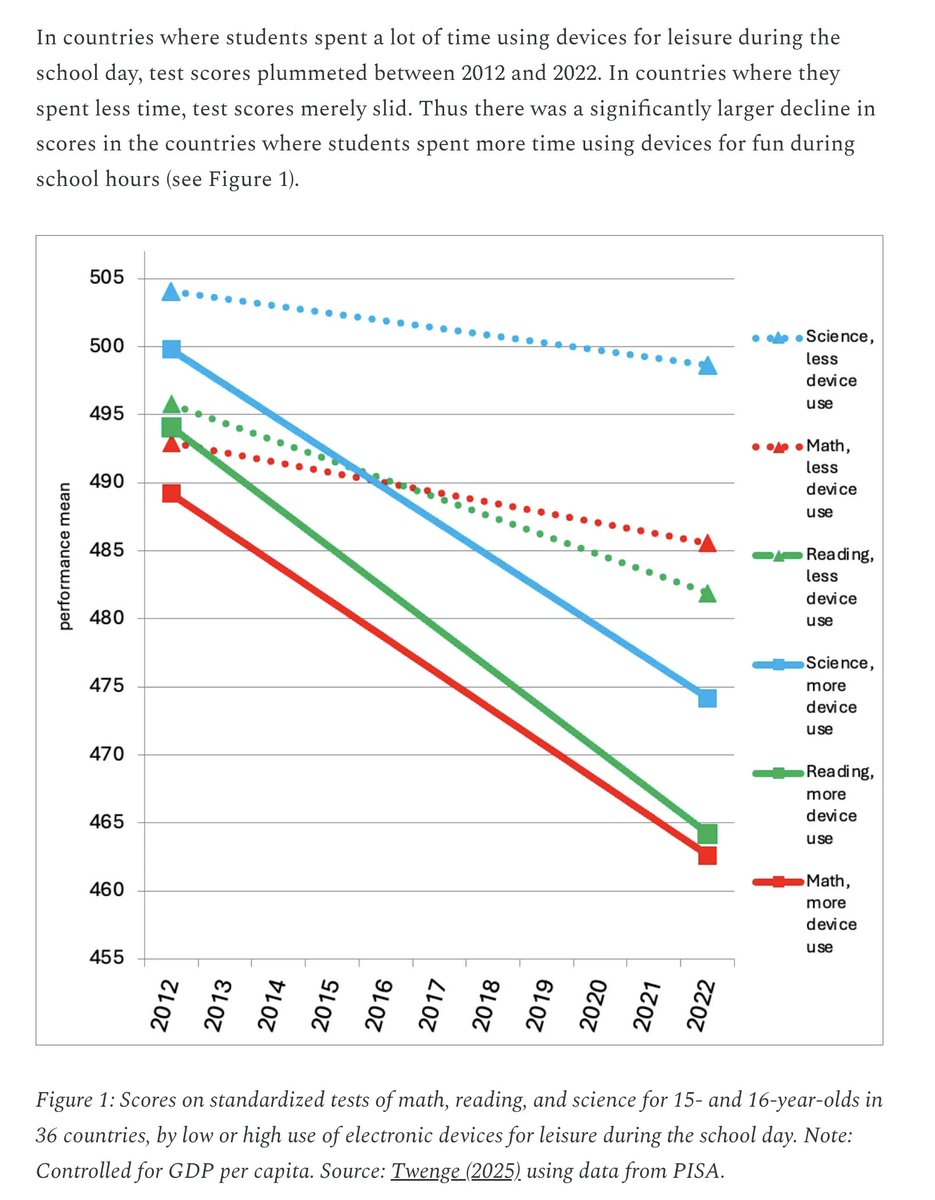
More evidence that the global decline in test scores that began after 2012 is linked to the proliferation of smartphones and computers in class: The slide was bigger in countries where students began spending more time on devices (for leisure)
https://t.co/HbzevWcG9e
A simple reminder.
For India’s currency to remain valuable, India must have something valuable to export to the world. Historically its has been cheap labour and growth story but when western countries replace that with AI and discover high growth industries in their home ground, rupee value could drop significantly and evening India imports would become dramatically costly.
And we do import a lot! Oil, electronics, gold. All of it would become expensive.
This is why India must remain competitive on the global stage. Our population will quickly go from being a growth driver to being a liability if we don’t ramp up on innovation and R&D.
It’s honestly an existential matter for the country’s future.
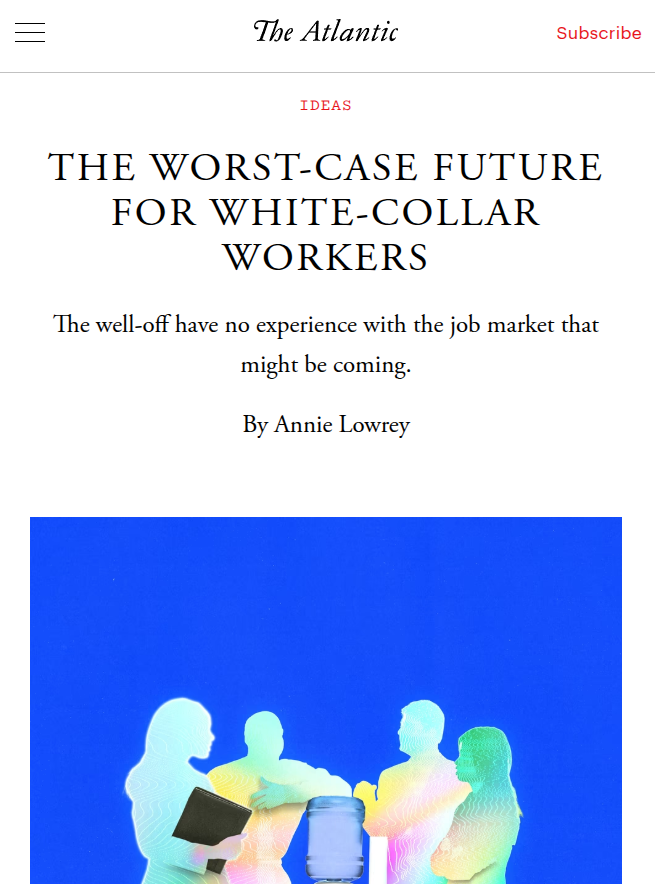
White-collar workers are starting to feel what blue-collar workers felt in past industrial shifts, when technology and trade changed which skills the economy actually needed.
Theatlantic published a piece.
Several signals point to a tilt against office work, including a record share of the unemployed holding bachelor’s degrees and faster hiring for high-school graduates.
The worry is not a normal recession where demand falls and then policy juice brings jobs back, but a structural shock where firms use systems like ChatGPT and Claude to remove roles and then simply do not need the same mix of accountants, analysts, managers, and support staff again.
Recent examples like big layoffs at firms like Baker McKenzie and Salesforce, cost cutting tied to AI deployments, and many are vibe-coding a workable software in a day.
If that kind of productivity jump spreads, the usual playbook of stimulus checks, lower interest rates, and public spending may lift spending without restoring hiring, because the missing piece is not money but demand for those specific skills.
The article argues this could hit upper-middle-class households unusually hard, since unemployment insurance is time-limited and often capped around $500 to $600 a week, far below many white-collar paychecks.
---
theatlantic .com/ideas/2026/02/ai-white-collar-jobs/686031/