These @VotiumProtocol bribes for @ConvexFinance have been insanely juicy for years, so I pulled every bribe round since they started, epoch 1, to see how that yield really behaves over time – and how to model it going forward.
First, the big picture👇
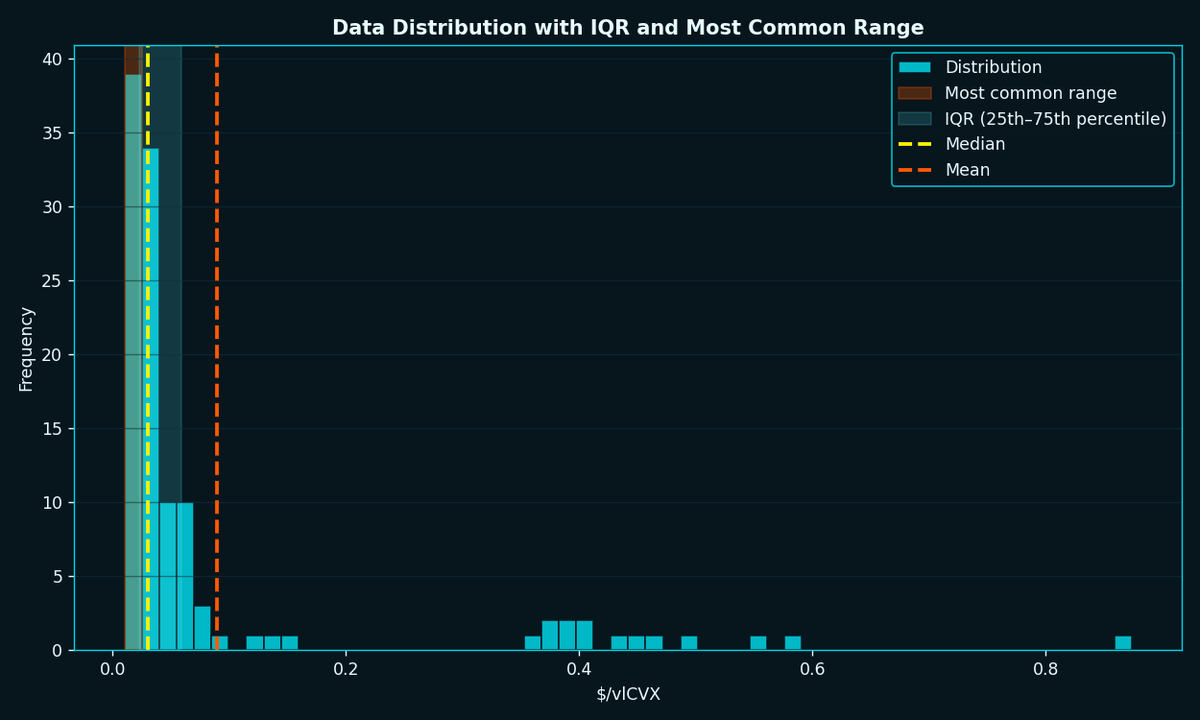
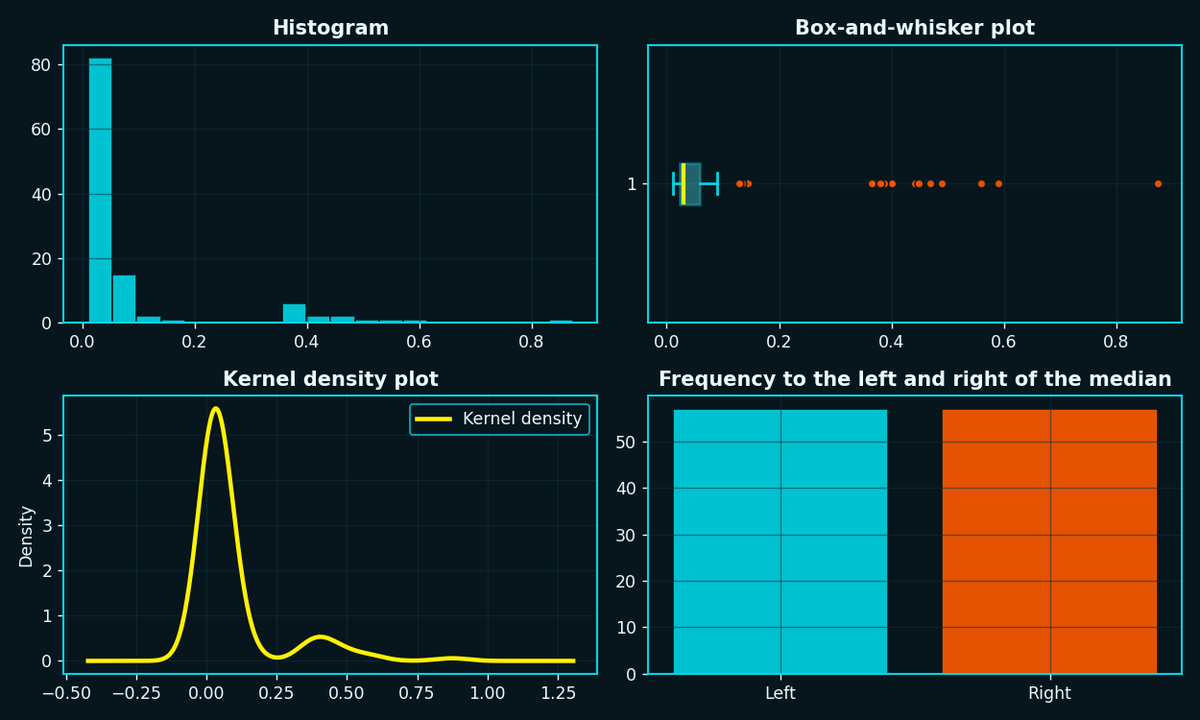
This chart shows the full history of $ bribe per vlCVX on @VotiumProtocol: histogram, boxplot, kernel density and how many rounds land left/right of the median.
In short: we’re going to dissect how this payout distribution actually behaves, not how it’s marketed.
Under the hood, the dataset is simple: $ bribe per vlCVX, per epoch:
Rough stats:
- Mean ≈ 0.0896 $/vlCVX → average price across all rounds.
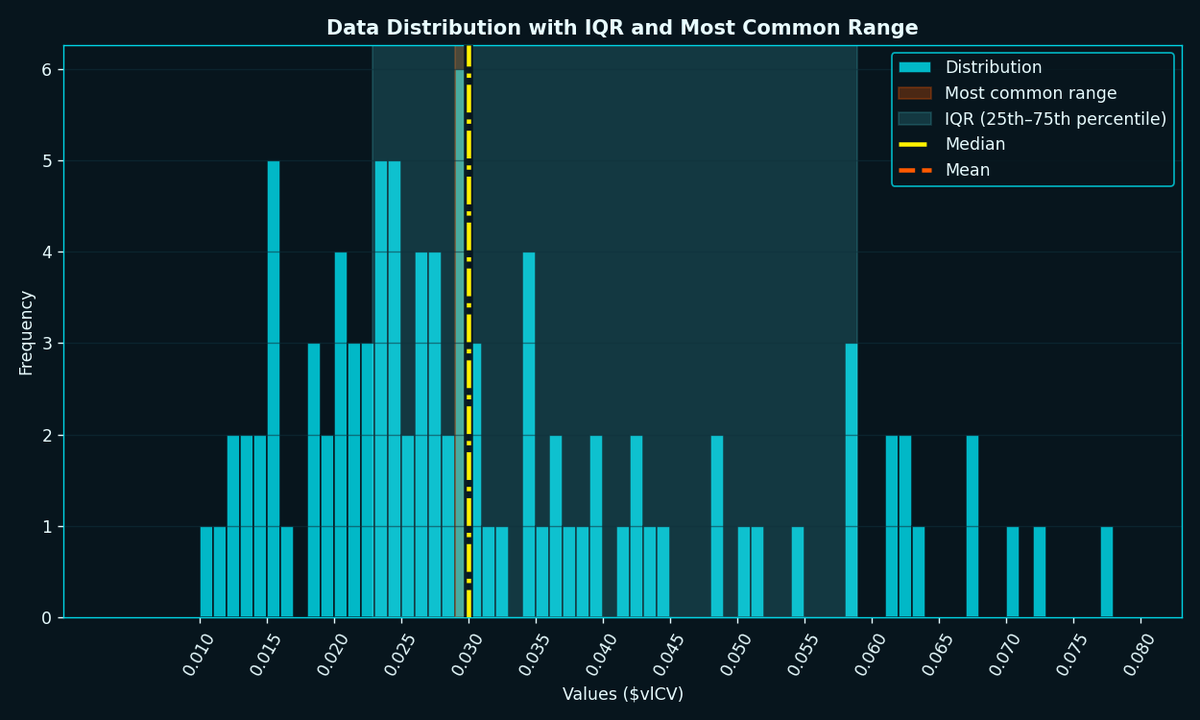
- Median ≈ 0.0305 $/vlCVX → the middle price when you sort them.
The interquartile range (25th–75th percentile) is only about $0.036 wide, which means half of all bribe rounds live in a pretty tight “usual” band around that median – and everything outside that band is where things get crazy.
And they do get crazy:
- Range ≈ $0.86.
- Stdev ≈ $0.15 → measure of how much bribe payouts jump around the average. A stdev this big vs a median of ~$0.03 means payouts are highly volatile – you should not expect every epoch to land near the mean.
- Skewness ≈ 2.8 (heavily right-skewed) → lots of rounds with small bribes and a long tail of rare, very large payouts. Those few big rounds drag the mean way above the median.
A handful of monster epochs pull the mean way up while most rounds are smaller. Those “I’m rich” weeks are the outliers, not the norm.
So I think about it like this:
- Mean = “what happened on average, including jackpots.”
- Median = “what a typical epoch paid.”
If you plan using the mean, you’re budgeting on your luckiest memories. The median is a much safer base case. 🧠
To turn @VotiumProtocol bribes into APR you also need your average $CVX entry price (P) and how many rounds per year you expect (N):
- Base-case APR ≈ (median bribe × N) / P
- Upside APR ≈ (mean bribe × N) / P
Example with median ≈ $0.03, mean ≈ $0.09, N = 26, P = $2.15 (current price):
- Median APR ≈ (0.03×26)/2.15 ≈ 36.28%
- Mean APR ≈ (0.09×26)/2.15 ≈ 108.84%
Same dataset, two very different expectations.
I personally plan around the first number and treat the second as “nice if it happens” – which, to be fair, @ConvexFinance and @VotiumProtocol have delivered more often than most.
If you like this kind of x-ray on bribe markets, I can run the same analysis for @StakeDAOHQ, Convex team bribes, CLever or other protocols like @AerodromeFi.
Which protocol should I dissect next?
Renting real estate requires work to produce cash flow.
Having a job requires work to produce cash flow.
Trading stocks requires work to produce cash flow.
Owning a pro rata share of immutable crypto fintech does not require work to produce cash flow.
Another option for those interested in $cvxCRV
There’s a significant delta currently in the price of the base asset and derivatives (along with sdcrv and ycrv)
Visit https://t.co/Mu87QT2rs0
Swap and enjoy 2.5x more tokens 👀
Stake on https://t.co/X4POwLE99o for yield
You think your DeFi portfolio is highly diversified? Cute.
Look under the hood. 10 different protocols often share the exact same oracle, same bridge, and same upgradeable proxy risks. One exploit at the base layer and your "diversified" stack goes to zero.
We mapped the entire ecosystem. Click any protocol and see its exact systemic Blast Radius and hidden dependencies.
Stop flying blind. Explore the Dependency Graph live 👉 https://t.co/dL0dWrbTA1
We are pleased to announce that we have reached a tentative agreement with a physical gold exchange provider to facilitate pmUSD redemptions.
Subject to finalization, this arrangement is expected to enable redemptions commencing during the first week of July. In parallel, our team is actively working to accelerate the implementation timeline, with the objective of making redemption functionality available within the next 30 days.
At this stage, the identity of the counterparty will remain confidential pending the execution of definitive binding agreements and completion of all required legal, regulatory, compliance, and onboarding procedures.
Further details will be disclosed once the relevant arrangements have been formally finalized and all applicable requirements have been satisfied.
RAAC Team.
I think this nails the ugliest split in DeFi right now:
Some protocols reinvest revenue to grow the product, the moat, and the stablecoin.
Others run revenue through a buyback machine so the chart looks less dead.
One is building a business.
The other is building exit liquidity.
Honestly, Bitcoin's current price action has me intrigued, a steady uptrend with milder corrections than previous years, but can it hold? On-chain data suggests fewer investors are underwater, which could be a sign of a more resilient market.
What's your take on this bull run? #DeFi
New to crypto? Let's break it down: when you see a coin trending, it's not just about the price, it's about the community, the tech, and the potential.
Take a step back and look at the bigger picture.
What do you think drives crypto trends? #Crypto
Bitcoin holding near $68k while Trump tariffs make headlines again. Supreme Court slapped down the big moves, but here comes the new flat 10% global levy.
Markets barely flinched.
To me this screams “priced in” until the dollar actually moves. Real test is still liquidity and risk appetite, not the tweet storms.
@MaxCrypto U.S.-Iran talks Friday if proposal lands?
Same old smart-diplomat dance: map the table, leak the hopium, freeze the real moves.
DeFi operators don’t wait for Geneva. We just keep shipping vaults, eating the headline vol, and compounding anyway.
Bitcoin’s 90% boredom tax is the ultimate filter. Most “smart” holders tap out, identity crushed by the quiet.
DeFi operators? We don’t need the 10% fireworks. We just keep shipping vaults, eating the flat lines, and compounding real yield every damn day.
The arena pays the ones who stay bored and keep moving.
Falling inflation sub-1% isn’t bullish, it’s late-cycle smoke. Housing weakening, labor rolling over… classic “smart macro” signal that the arena’s about to get slippery.
DeFi side? Operators don’t pause for Zeberg charts. They just keep shipping vaults, eating the drawdowns, and compounding while the cycle tourists debate how late it really is.
Yield doesn’t care what phase we’re in.
You rotating to stables or farming the slowdown anyway?
Khamenei building a shadow government and skipping his own son?
Peak “smart guy” protection strategy. Identity tied to being right, so when real risk shows up, you hedge the throne itself.
DeFi side doesn’t play that game. Gritty operators just keep shipping vaults and compounding while the geopolitics circus runs its script.
Strait noise, shadow cabinets, whatever, yield doesn’t pause.
You farming the chaos or rotating to stables?
We’re not “stupid early” on AI, we’re still in the “most people haven’t opened the app” phase.
DeFi operators already have agents quietly farming stables 24/7 while the rest of the planet scrolls TikTok.
That gap is pure alpha.
You got any agents actually moving money on-chain yet, or just watching the hype?
Trump-insider $100M short with “perfect record” right before tariffs?
Same old smart-money move: build the empire on being right, then hedge the hell out when the wind shifts. Classic protection strategy.
DeFi side stays simple. Gritty operators keep shipping vaults, eating the vol, and compounding anyway. Tariffs are just another drawdown to farm through.
You loading that short narrative or still stacking real yield?
14-year BTC support just snapped.
Charts don’t lie when structure breaks: vol spikes, liquidity hunts, everyone hits risk-off. Classic.
DeFi side? Operators don’t rewrite decks. They just keep shipping vaults, eating the drawdowns, and compounding while the macro crowd debates “new equilibrium.”
Yield doesn’t respect support levels.
You risk-managing the break or still farming straight through?
Witkoff just lit the fuse on camera: one week from breakout again after the “years” setback.
Same old script: smart institutions map the chokepoint, price the premium, then freeze.
DeFi side? Operators don’t wait for CENTCOM or IAEA. They keep farming real yield, eating the vol, and compounding while oil does its drama.
Hormuz noise is temporary. On-chain revenue isn’t.
You stacking stables for the spike or farming straight through?
Smart cycle theories are fun, but this is exactly why DeFi wins: we don’t need ISM prints or “is it still one big cycle?” debates to keep compounding.
Institutional BTC flows changed the script? Cool. Gritty operators just keep shipping real yield on-chain while the macro crowd argues about labels and mid-cycle tops.
The arena doesn’t care what you call the phase. It pays the ones who stay in it.
You adjusting your DeFi stack for this “expansion” or farming the same regardless?