@AlertaNews24 Argentina tiene las de peder si quiere recuperar una simple isla llena de ingleses, Inglaterra está fuertemente armada y aunque Trump apoye con reclamos Trump pierde las elecciones en noviembre y le queda un año, Melei no a acomodada en nada la economía de su país, es burro
SpaceXAI engineer, Lauren Tan:
"I'm running 20+ GrokBot agents with /loop, /goal, inside pstack. My bots shipping code even when I sleep
at SpaceXAI, 85% of our engineers running 10+ GrokBot agents as a team. I have a Chief of Staff agent, it knows other agents and manages everything"
in a 1-hour workshop, a SpaceXAI engineer revealed how to build a team of GrokBot agents from scratch
worth more than a $500 agentic engineering course
watch today, then read the article on how to build a team of GrokBot agents from scratch
Sony Music and Warner Chappell have sued Anthropic over song lyrics and sheet music they say were used to train Claude
The complaint also names CEO Dario Amodei and co-founder Benjamin Mann as defendants
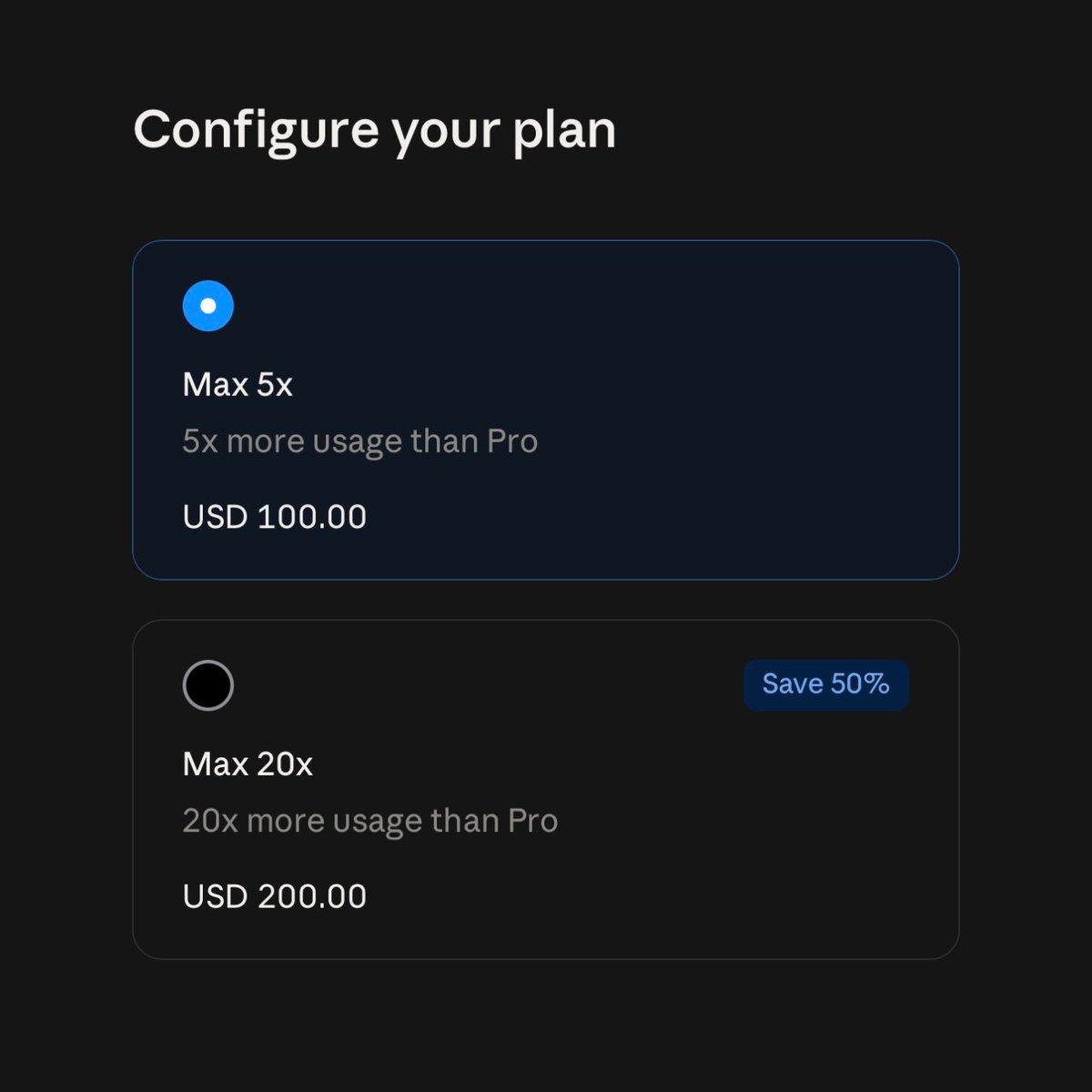
Anthropic has been misleading people with the Max plans: it has been advertising the $200 plan as 20x and the $100 plan as 5x. You'd expect to get 4 times more usage with those figures, but it turns out it's only 1.7x.
You pay twice the price, for 1.7x the usage. And yet they've literally been marketing it as if you're saving 50% (see screenshot below).
The usage figures Anthropic gave in July 2025 were 140–280 Sonnet hours at 5x and 240–480 at 20x.
Turns out that multiplier only covers the daily 5-hour session window. So in the end, if you take weekly cap into account, you pay more per hour with the 20x than with the 5x.
CLAUDE + OBSIDIAN + LOOP ENGINEERING = A VAULT THAT RUNS ITSELF
the core idea: the vault is the loop's state, not the chat window
everything Claude knows lives in a .md file
the loop:
> capture - a thought lands in 00-inbox
> context - Сlaude Opus 5 pulls links, tags, and neighbouring notes
> draft - edits happen inside a git worktree, never the live vault
> review - a critic agent checks the diff before anything ships
> commit - appended to the vault, nothing gets rewritten
the key insight: frontmatter fields like supports, contradicts, and supersedes are graph edges, not metadata - the note format is the write API
start with a plain loop, it runs about 2-4x the cost of one direct call
> only move to a full graph once state has to outlive the session, several agents need to coordinate, or you have to explain what changed - that jump can run 10-50x
one review assistant climbed from 55% to 72% to 84% just by moving through these shapes in order
worth stealing even without a graph: the review step. most vaults skip it - claude writes straight to live notes
errors compound silently for months
set that gate first
RAG vs. CAG, clearly explained!
In a standard RAG setup, every query hits the vector DB, including queries about a product manual or policy documents that haven't changed in months.
The retrieval adds latency, and then the model prefills those same retrieved chunks again on every subsequent query.
CAG is a technique that drops the vector search and moves the prefill off the query path.
The preprocessing step runs those documents through the model once, before any query arrives, and keeps the key and value tensors it produces for every token at every layer.
At query time, the model loads that state and starts decoding, with no vector search or prefill on the knowledge.
The amount of context you can store as cache isn't limited by the context length of the model but rather the GPU memory.
For instance, in a 70B model at BF16, the cache takes around 300 KB/token, so even a small corpus can produce tens of GBs of cache to manage.
That's why production setups run both RAG and CAG together.
↳ Static, high-value knowledge that nearly every query reads gets cached once, like policies, product docs, and standing instructions.
↳ Everything else stays in the vector DB, since a document that surfaces in one query out of a thousand doesn't justify holding its tensors on the GPU all day.
The diagram below depicts this.
To use this in practice, you don't need to build a custom serving stack.
The transformers library already implements the cache as an object of KV vectors that you can preserve, so you can prefill a corpus once, retain the returned tensors, and reuse them across queries in about ten lines.
And this KV cache is only one of four separate caching layers in an LLM stack.
The other three are prefix caching on the server, prompt caching billed by a provider, and a semantic cache that skips the model entirely.
I wrote a full breakdown of all four caches in LLM serving that you should know as an AI engineer, with code for each.
Read it below.
this is f*cking gold
Andrej Karpathy just joined anthropic to lead a team using claude to accelerate its own pretraining research
an AI helping design the AI that replaces it
that part is real, confirmed directly
the claim going around - "two anthropic seniors made his loop 1000x better with graph engineering" - i can't verify that anywhere
not going to invent a testimonial just to sell you a bigger number
here's what's actually real and public:
anthropic's own claude cookbook on knowledge graph construction
> extract
> resolve
> assemble
> query
no leak. no insider quote. just the method anthropic already shipped
read that first. then decide if the article below earned your click
How to run your whole workday on loop...
🇯🇵 Japan is quietly laying the groundwork to put stock and bond settlements on blockchain
and this isn't some startup pitch, it's the FSA, Finance Ministry, AND Bank of Japan getting in the same room this summer.
Real-time settlement would kill the days-long delays baked into traditional markets for decades. Study group launches this summer, development plan by early 2027, live system possibly early 2030s.
Slow and steady wins the infrastructure race.
Source: @DeItaone / Writer: Oliver
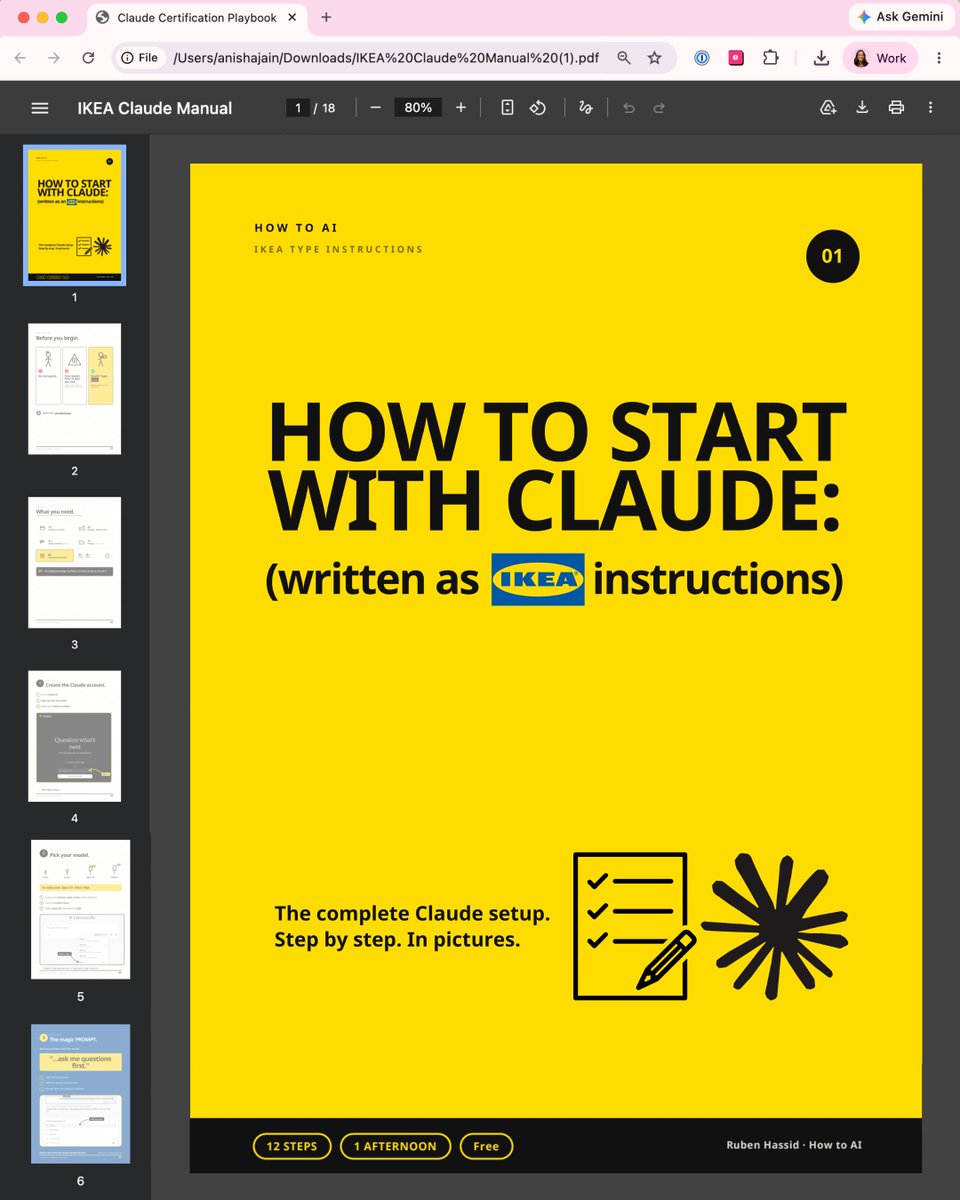
Claude doesn't come with a manual.
So I wrote a simple guide (like IKEA instructions):
Most people open Claude, type a question, get a bad answer & decide it's "just another chatbot."
The problem is nobody handed you the instructions. So I wrote one, like flat-pack furniture.
Here's the whole thing:
1. Get the entire manual (for free)
Go to https://t.co/psB7XxB2Y4. Subscribe for free.
Open the received email in your inbox.
Go to the link, download "Ikea Claude manual"
Keep it open in a second tab while you follow along.
2. The one sentence to end every prompt with - it makes you better at Claude than 99% of people
3. Goals vs. tasks: why "write me an email" gets a worse result than telling Claude what you want
4. The Claude rule that stops your chats getting slow, dumb, and expensive
5. How to give Claude a memory, so every chat already knows who you are
6. The expensive model nobody warns you about and when to use it
7. Connecting your Gmail and calendar, and the skills you build once and never rebuild
No coding. No folders. No jargon.
If you can build a bookshelf, you can do this.
Keep it open in a second tab while you follow along:
→ https://t.co/psB7XxB2Y4.
I removed every word that wasn't necessary and drew the rest.
If your team is still typing one-line questions into a Ferrari, send them this.
(If you share it, mention the newsletter. Be nice.)
🚨 HUMANITY MAY HAVE HIT PEAK BABY
A new paper by economists Jesus Fernández-Villaverde and Patrick Norrick argues that global fertility may have fallen below replacement level for the first time in human history.
Their model puts peak population at roughly 9 billion around 2056, followed by a decline that accelerates with every generation.
The UN’s current projection is much more optimistic, reaching about 10.3 billion in the 2080s.
The stranger part is where fertility is collapsing.
It’s no longer just a rich-country problem. The authors find declining fertility across 219 of 236 countries, including poorer nations where the decline is happening much faster than demographic models expected.
For most of human history, the nightmare was figuring out how to feed everyone.
We may be entering an era where the problem is figuring out who’s left to do the feeding.
Source: CIG in TG / Writer: Oliver
🇺🇸 Palantir’s latest system is designed to fuse satellites, radar, cameras and other sensors into a single real-time picture of people and movement.
The obvious question is what happens when that architecture meets something like Flock’s enormous network of automated license-plate cameras.
Suddenly, the infrastructure exists to connect where people are, where they’ve been and what is watching them into one persistent system.
The technology itself does not mean Americans are being tracked this way today. But the possibility is no longer science fiction.
The pieces are being built today.
Writer: Oliver
Fable 5. Opus 5. Sonnet 5. Haiku 4.5.
How to pick the right Claude model (every time):
Step 1: Does your task require a complex answer?
☑️ No: use Haiku 4.5 or Sonnet 5.
☑️ Yes: use Opus 5 or Fable 5.
Step 2: If your task is quick:
→ Need maximum speed & minimal tokens?
☑️ Yes: Haiku 4.5 (lightweight, token-saver).
Chat without files. Turn on web search.
Plan in Chat, build in Cowork.
Prompt example:
"I want [desired result] with [constraints]. Ask me questions using AskUserQuestion before you start."
☑️ No: Sonnet 5 (fast, everyday model).
Perfect for simple tasks.
Connect your apps with Connectors: Slack, Google Drive, Notion, Figma, Granola, Gamma + 50 more.
Prompt example:
"You are a [role]. [Task] this [input]. Keep it under [length]. Tone: [casual/formal]. No preamble - just the output."
Step 3: Is this your hardest, most ambitious work?
(multi-step reasoning, agents, long-thinking tasks)
☑️ No: Opus 5 (deep-work model).
Use Cowork. Put Effort on High. Always.
Use Skills in Projects (like /linkedin or /excel-style).
Prompt example:
"/[skill] topic: [topic]. DO NOT start yet. Ask me clarifying questions (use AskUserQuestion) so we can refine the approach step by step."
After Cowork:
→ Download your file.
→ Or convert it into a Claude Skill.
→ Start a fresh session to save tokens.
☑️ Yes: Fable 5 (the smartest model by Claude).
Deep research. Analytical decisions.
Prompt example:
"Here is my goal: [goal]. Here are my constraints: [constraints]. Think through the tradeoffs before answering, propose 2–3 approaches, and recommend one with your reasoning."
Too long to write yourself?
I built a skill for that: /fable-prompter.
Type a messy prompt → get a Fable-worthy prompt.
It's free in my Skill library, with +26 Claude Skills.
1. Sign up with your best email at https://t.co/psB7XxB2Y4.
2. Find the welcome email in your inbox named "Don't lose access to your AI library."
3. Click on the library link.
4. Open the "Claude Skills" folder. Download it all.
5. Upload to Claude → Settings → Skills.
⚠️ But careful with Fable 5:
☑ It costs a lot of tokens (very fast).
☑ Only ~10% of tasks actually need it.
☑ Use it 1-2 turns for strategy, then switch to Opus.
☑ Long conversations = expensive. Claude re-reads the whole thread every turn.
When Opus gets stuck, escalate to Fable.
Everything else, route down the tree.
♻️ Repost this, so your team stops burning tokens.
@AlertaNews24 Esperemos que sea sometido a juicio por robar en vez de ayudar a estados unidos solo hasta dinero en guerras pendejas roba sin pistola con su aranceles solo amenaza pero cuando deje de ser presidente pagará todas las que hizo por robar en vez d ayudar a Venezuela solo robo
















![rubenhassid's tweet photo. Fable 5. Opus 5. Sonnet 5. Haiku 4.5.
How to pick the right Claude model (every time):
Step 1: Does your task require a complex answer?
☑️ No: use Haiku 4.5 or Sonnet 5.
☑️ Yes: use Opus 5 or Fable 5.
Step 2: If your task is quick:
→ Need maximum speed & minimal tokens?
☑️ Yes: Haiku 4.5 (lightweight, token-saver).
Chat without files. Turn on web search.
Plan in Chat, build in Cowork.
Prompt example:
"I want [desired result] with [constraints]. Ask me questions using AskUserQuestion before you start."
☑️ No: Sonnet 5 (fast, everyday model).
Perfect for simple tasks.
Connect your apps with Connectors: Slack, Google Drive, Notion, Figma, Granola, Gamma + 50 more.
Prompt example:
"You are a [role]. [Task] this [input]. Keep it under [length]. Tone: [casual/formal]. No preamble - just the output."
Step 3: Is this your hardest, most ambitious work?
(multi-step reasoning, agents, long-thinking tasks)
☑️ No: Opus 5 (deep-work model).
Use Cowork. Put Effort on High. Always.
Use Skills in Projects (like /linkedin or /excel-style).
Prompt example:
"/[skill] topic: [topic]. DO NOT start yet. Ask me clarifying questions (use AskUserQuestion) so we can refine the approach step by step."
After Cowork:
→ Download your file.
→ Or convert it into a Claude Skill.
→ Start a fresh session to save tokens.
☑️ Yes: Fable 5 (the smartest model by Claude).
Deep research. Analytical decisions.
Prompt example:
"Here is my goal: [goal]. Here are my constraints: [constraints]. Think through the tradeoffs before answering, propose 2–3 approaches, and recommend one with your reasoning."
Too long to write yourself?
I built a skill for that: /fable-prompter.
Type a messy prompt → get a Fable-worthy prompt.
It's free in my Skill library, with +26 Claude Skills.
1. Sign up with your best email at https://t.co/psB7XxB2Y4.
2. Find the welcome email in your inbox named "Don't lose access to your AI library."
3. Click on the library link.
4. Open the "Claude Skills" folder. Download it all.
5. Upload to Claude → Settings → Skills.
⚠️ But careful with Fable 5:
☑ It costs a lot of tokens (very fast).
☑ Only ~10% of tasks actually need it.
☑ Use it 1-2 turns for strategy, then switch to Opus.
☑ Long conversations = expensive. Claude re-reads the whole thread every turn.
When Opus gets stuck, escalate to Fable.
Everything else, route down the tree.
♻️ Repost this, so your team stops burning tokens.](https://pbs.twimg.com/media/HQUeTjlbYAANZkL.png)