"How quickly the United States can deploy a new generation of advanced nuclear reactors will depend in large part on whether the NRC can license them efficiently and at scale."
Subscribe to Nuclear Notes (Link below):
"Unfortunately for its critics, industrial meat production is the only way to produce enough meat and dairy products without accelerating the deforestation of wild lands or driving up food prices."
https://t.co/p0ClFMWPur
"The higher the capital expenditure (CAPEX) per ton of annual metal output, the smaller the share of global production of that metal by advanced economies other than Russia or China."
The way to fix that imbalance: low-cost debt.
https://t.co/23XoTJioj0
The relative lack of new critical minerals processing in high-income countries stems from a high capital cost feedback. High capital costs depress internal rate of return, disincentivizing projects. Growing lack of plant development experience and technical know-how, over decades, worsens the CAPEX problem. 🧵
We find a rough decreasing relationship between metallurgical plant CAPEX/ton and the share of global production ex-China and ex-Russia.
The most powerful policy solution is low-cost debt finance.
New guest piece for @TheBTI from Matt Helligg—a metallurgical industry engineer—myself, and @RyanAlimento.
"With changes, Part 57 can become a durable and effective licensing framework because it is more focused, not because it is less rigorous."
Read @thebti's comment on NRC Part 57: https://t.co/w9r6pIPGI5
"@TheBTI urges the NRC to make clear that Part 57's central purpose is high-volume licensing, not a technology category, and to ensure its eligibility criteria, security requirements, environmental review, and emergency planning are calibrated to demonstrated risk and administrable at scale."
All 110 pages of our public comment on the NRC's proposed Part 57 rule for licensing micro and factory fabricated reactors.👇
"For all the talk of feedbacks in the climate system, we’re not very good at thinking about, much less modeling, feedbacks in our socio-economic systems."
Read @TedNordhaus's latest: https://t.co/VzIbJMlrut
Antares Nuclear's Mark-0 became the first under the DOE Reactor Pilot Program to achieve criticality ahead of the July 4 deadline.
Learn what the prototype actually means, and what it does not: https://t.co/bcs1QTi8v7
Thanks to @DC_Hartman and @MichaelGiberso3 for responding to @TheBTI essay on use of transmission reform as a pathway to stealth electricity deregulation. Very happy to have this debate and to engage different perspectives on this question. We are all better for it.
"Better transmission policy improves service to customers in vertically integrated territories, restructured markets, and hybrid models alike."
Read @MichaelGiberso3 and @DC_Hartman's response to @thebti's "Stealth Deregulation" argument: https://t.co/RhpnqOUzjA
Today we're publishing a response by @MichaelGiberso3 and @DC_Hartman, "A Defense of Utility Deregulation," which pushes back against our earlier piece by @TedNordhaus, @RyanAlimento and myself ("Don’t Let Stealth Deregulation Sink Permitting Reform")
Have always been proud of how @TheBTI's commitment to upfront public debate--surfacing competing views in tension that otherwise simmer unresolved beneath polite professional interactions--can advance discussion. This exchange is the latest expression of that philosophy in action, and certainly won't be the last!
https://t.co/usNQJ59aLr
Breakthrough posted an article a few weeks back asserting that permitting reform was a kind of "stealth deregulation." @DC_Hartman and I disagreed with the piece on several points. Breakthrough published our response at The Ecomodernist via Substack. (Short🧵; link in next.)
I have been thinking a lot about the politics of meat lately, thanks, in large part, to @jan_dutkiewicz and @gnrosenberg's new book Feed the People. My take: industrial meat is here to stay, we need to embrace it and improve it: https://t.co/auPyIaSzPT
"If technologically advanced, large-scale, highly capitalized production provide the solutions to the problems caused by agriculture in general, why would they not also provide the solutions to the problems caused by animal agriculture in particular?"
https://t.co/p0ClFMWPur
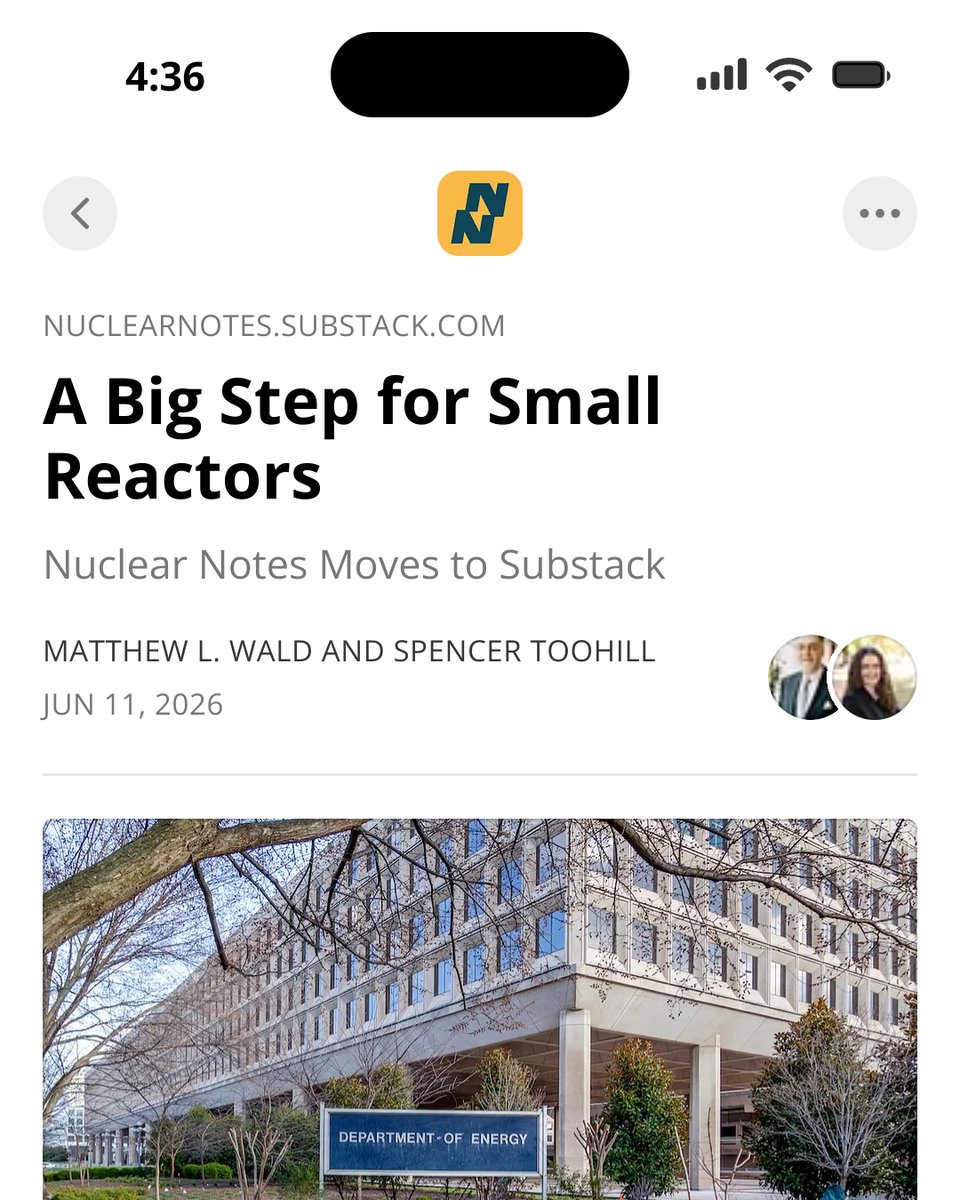
⚛️ Nuclear Newsletter Announcement ⚛️
Subscribe to NUCLEAR NOTES, @TheBTI’s new weekly newsletter on the latest news in nuclear policy, politics, and industrial development.
https://t.co/ok4xMGDP2H
Antares Nuclear hit initial criticality on June 4 at Idaho National Lab. We explain what this means and why this matters in the first issue of Nuclear Notes on Substack.
You can subscribe for new issues every Thursday (link in comments):