This afternoon at our GHRU AGM, we’re diving into challenges and opportunities of structured surveys through a World Café format.
From communicating results beyond journals to measuring impact, colleagues from across the GHRU network are exchanging insights and solutions that will make a valuable contribution to our future work.
Kicking off Day 2 of #GHRU2025 in Bohol 🇵🇭 with a focus on structured surveys.
Our @NIHRresearch-funded Global Health Research Unit teams are sharing updates on the KlebSurvey and developing rapid reports to support public health decision-making.
We’re in the Philippines 🇵🇭 this week for the 6th NIHR Global Health Research Unit Annual Meeting on Genomic Surveillance of AMR.
Hosted by our partners at @RITMPH, teams from across the GHRU network are sharing progress and planning for the future.
Our @NIHRresearch funded GHRU together in Bohol, Philippines.
Colleagues from Colombia, India, Nigeria, the Philippines & the UK working together to strengthen genomic surveillance of AMR at the Unit’s annual general meeting. 🌍🤝🧬
Future planned updates include a) incorporation and filtering of additional metadata (e.g. isolate source), b) adding the ability to display data from bespoke genome collections (including user-defined) and c) extending to additional pathogens/vaccine targets.
Pleased to share our new preprint describing https://t.co/SHQ7a2yFUq, an interactive platform enabling exploration of vaccine target diversity from global genome data: https://t.co/p72GCpCfBq
https://t.co/TlO2nswEUA currently displays data for >100k high-quality genomes with geotemporal sampling information (post-2010), but we demonstrate that substantial biases and geographic gaps remain in the coverage of available genomes.
By combining survey data with additional public data, we also found substantial global spread of high-risk E. coli clones with NDM-5 and other carbapenemases. We found many introductions of these into European hospitals in 2019, albeit with limited onward nosocomial transmission.
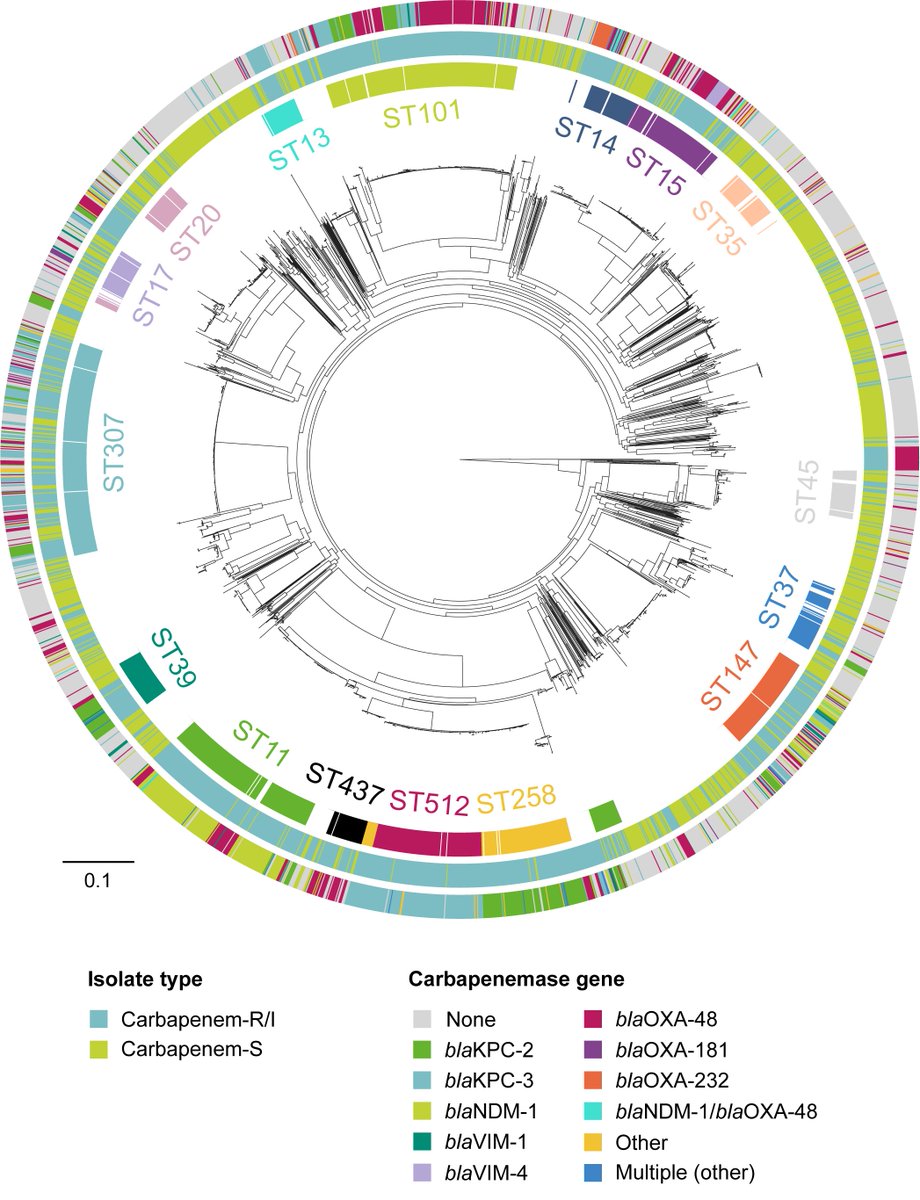
We’re pleased to share two new preprints with results from a structured survey of carbapenem- and/or colistin-resistant Enterobacterales (CCRE), conducted in 37 European countries in 2019.
E. coli: https://t.co/mlh3IV8G5E
K. pneumoniae: https://t.co/zmFxFfhr2N
@ECDC_EU
Our findings suggest that the situation with carbapenem-resistant K. pneumoniae has continued to worsen and that control measures have not been able to interrupt transmission of high-risk lineages circulating within European hospital networks.
Huge disparity in genomic data: We support all efforts to increase the genomic surveillance of pathogens on a global scale as dynamics differ locally: what happens in one place does not translate to another and high-risk clones can emerge anywhere. https://t.co/x7XlcXutbi can be used to assess the representation of geographic regions, e.g. with countries here in white currently lacking any public genomes. See more at: https://t.co/IywIToFcbO
Our latest preprint is out describing https://t.co/x7XlcXutbi – a platform for monitoring AMR trends from global genomics data. Supporting all WHO priority pathogens (2017), https://t.co/x7XlcXutbi summarises the geographic and temporal distribution of genotypic variants (e.g. STs) in the context of AMR to aid monitoring and prioritisation efforts. https://t.co/nUJtVzL0HF
Always-on: all QC’d genomes with geotemporal metadata, are ingested from archives, analysed in https://t.co/unoU08iIUL and results visualised within https://t.co/x7XlcXutbi. Data are extracted and updated every 4h, with observed trends therefore only delayed by time to genome deposition. See more on filtering here : https://t.co/5sHT5uxvNO