🚨New Paper🚨
how do you screen nanoparticles other than LNPs in vivo?
Ayo & Vanessa identified key design parameters that enable surface barcoding of any nanoparticle type. This allows the screening of any nanoparticle type in vivo.
To read more visit: https://t.co/DsTqz3d893
🎓🎓Meet our latest Alumni🎓🎓
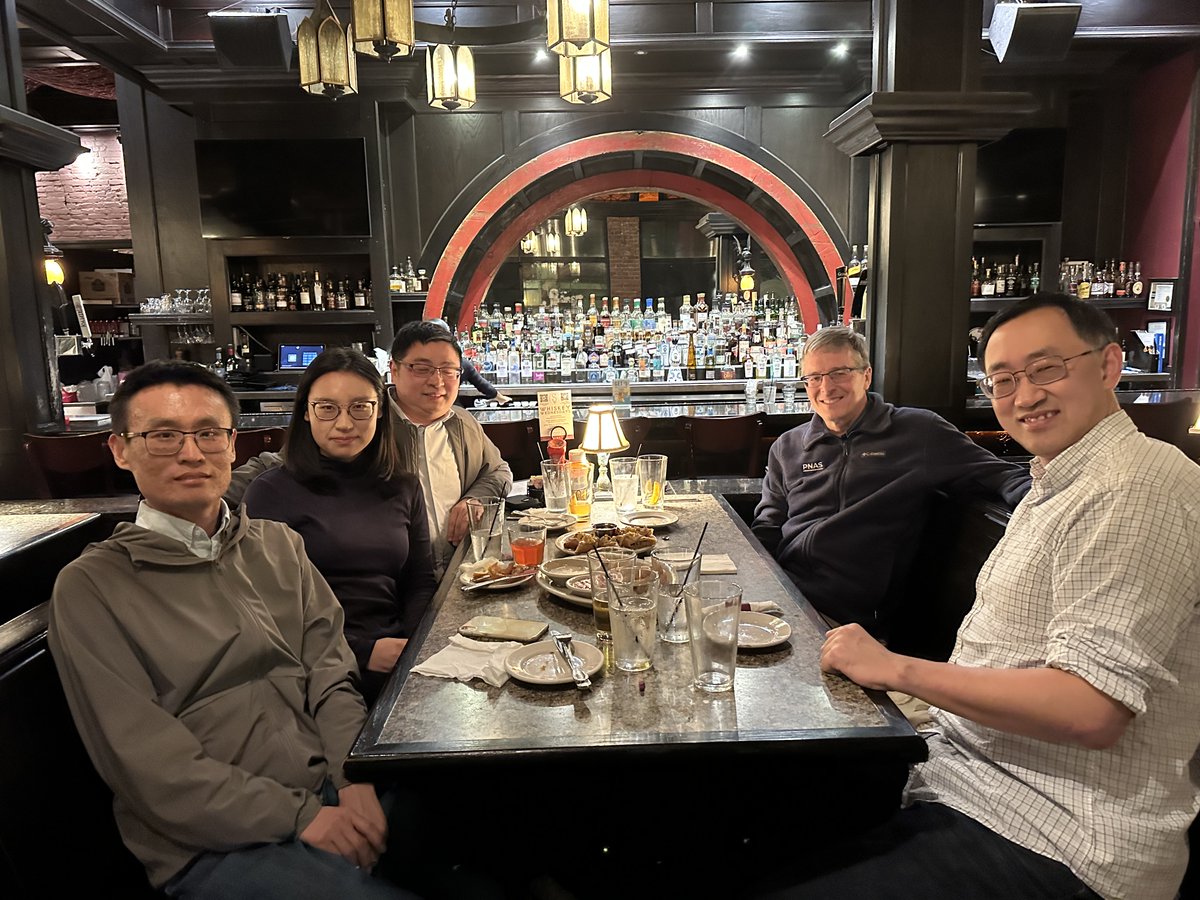
Lab members (Bram Bussin, Hongmin Chen, Zahra Sepahi and Ben Stordy) successfully defended their doctoral theses. It has been an exciting and eventful couple of months. We are proud to introduce our latest Drs.
(Hongmin Chen not pictured)
🚨 New Publication: Why don’t nanoparticles deliver to target cells?🚨
We built a model, termed the binding ratio, that predicts nanoparticle targeting efficiency with 90% sensitivity and 88% specificity‼️
Check out our paper here published in @J_A_C_S: https://t.co/hxvNzIgqnn
🚨New Paper🚨
Want to deliver nanoparticles outside the liver? Bram et al. identified nanoparticle corona proteins that liver macrophages use to capture nanoparticles. This discovery helped increase delivery to organs outside the liver by 12x!
🔗https://t.co/vlc2h0jTA7
🚨New Paper 🚨
Bram et al. identified how nanoparticle charge interfaces with the cellular glycocalyx, dramatically affecting nanoparticle delivery. This enabled a new approach to improve nanoparticle targeting!
🔗 https://t.co/y3T3JNpSJA
Congratulations to the academic community at the @UofIllinois for a wonderful 20th anniversary event to celebrate the formation of their Department of Bioengineering! Over this relatively short period, the department has transitioned from a nascent effort launched in 2004 with Bruce Wheeler as the department head and with just two or three full time faculty (notably Rohit Bhargava and Michael Insana), to a world class entity – by many metrics one of the best such programs in the country! I was honored to serve as one of several invited speakers at the event in Champaign to celebrate this occasion, with a talk titled “Frontier Developments in Bioelectronics: Degradable, Wireless Optoelectronics for Electrotherapy,” covering our most recent work on optically programmable polyphasic nerve stimulators and millimeter-scale cardiac pacemakers. My talk also acknowledged my wonderful time on the faculty at UIUC, from 2003 to 2016, with a special shout-out to leaders (@RashidB23819196, Ilesanmi Adesida and @deancangellaris) and collaborators from that time who were not only instrumental in the development of the Department of Bioengineering but also in my own career – interestingly, collected together in September at an annual research symposium at @NUedukz in Astana, Kazakhstan!! See my other post on this amazing trip. I was also reminded by the current department head, Mark Anastasio, that I was an invited speaker at the 10th anniversary of the department, back in 2014! It was great fun to catch up with former colleagues at UIUC – some of whom such as Taher Saif, Rashid Bashir, Stephen Boppart and others are current collaborators! Amazing speakers – including @ShanaOKelley, @StephenQuake, @TejalADesai, @SMitragotri, @SamuelAchilefu, Michael Miller, @MayDWang1 on the first day and others on the second day. Link below to the entire agenda. Thanks to @NieShuming and Mark and others for the invitation! The night before, I had a chance to get together with some amazing former group members who are now stand-out faculty at UIUC – four in four different departments!: Prof. Qing Cao (former PhD student, in materials science and engineering), Prof. @XinNingAero (former postdoc, in aerospace engineering), Prof. @cunjiangyuUIUC (former postdoc, in electrical engineering) and Prof. @Siyi_Xu_ (former undergraduate researcher and postdoc, in mechanical engineering). Finally, thanks to Xin for a tour of his labs – amazing facilities, and powerful, unique set-ups for testing of materials and structures in simulated conditions of outer space!
https://t.co/6SDy1gNnwy
https://t.co/eATXAHg6DP
Here's the latest release from @TheChanLab! 🙌
@jamielywu and collaborators at @bme_uoft show that nanoparticles cross tumor #EndothelialCells predominantly using the non-receptor-based macropinocytosis pathway.
💬 More in @NatureNano | https://t.co/JSyYdRhHSV
🚨🚨NEW PAPER ALERT🚨🚨
@jamielywu et al. discovered the pathways tumour endothelial cells use to transport nanoparticles.
Link to paper: https://t.co/omGzAiJUzx
Below is a thread by Dr. Jamie Wu summarising the method and results:
How do nanoparticles enter the tumour?
In our latest study @NatureNano, we found tumour endothelial cells bring NPs in mostly using macropinocytosis & interestingly, macropinocytosis membrane ruffling is elevated in tumour vs healthy vessels 🧐@TheChanLab
https://t.co/FLccqLWAqh
🚨New Paper🚨
@MladScientist et al. utilized 3D electron microscopy to visualize and study the transport of nanoparticles across tumour blood vessels.
Link to paper: https://t.co/rRYfsoNNmF
Below is a thread summarising the method and results:
I’m excited to share that my paper was published this week in @PNASNews and that I gave an oral presentation on this work in Singapore at the @ICBME2024 conference. @TheChanLab (1/n)
🚨New paper🚨
Bringing quantum dot barcodes to the point-of-care!
Matt O. et al. designed a portable device that harnesses the unique fluorescence of quantum dots for multiplex diagnostics. Their device runs sample-to-answer in under 40 minutes.⏲️
https://t.co/Y1TA4WJFpt
BREAKING NEWS
The Royal Swedish Academy of Sciences has decided to award the 2024 #NobelPrize in Chemistry with one half to David Baker “for computational protein design” and the other half jointly to Demis Hassabis and John M. Jumper “for protein structure prediction.”