GIVEAWAY: This is a football helmet that holds six ice cold beers inside of it. Until today you’ve never needed a football helmet as much as you need this football helmet. GOOD NEWS: we’re giving (3) of them away because we love you and we want you to have this football helmet.
Here’s how to win one:
1) RT this tweet
2) Follow @drinkgaragebeer
3) Tag a friend in the replies
Giveaway ends 1/10/25 @ 11:59PM PST
Must be 21+ years to enter
Why is this relevant, and why did I include 5-loss Michigan? Michigan and Bama both beat one Playoff-Bound opponent. And Michigan and Alabama both beat 5 bowl eligible teams. So what was the difference between Michigan and Alabama this year (besides, of course, Michigan without most of its starters beating Alabama)? Michigan had 2 objectively more difficult games. So if Michigan played Mercer (by choice) and UCLA (by draw) instead of Texas (by choice) and Oregon (by draw), they would’ve been 9-3 and replaced Alabama as the team people argued should be in the playoff, coming off a win at Ohio State, which may have pushed them in.
Am I arguing Michigan should’ve been in the playoffs? No. I’m simply pointing out the scheduling disparity between the SEC and Big Ten, then using the Strength of Schedule logic that most SEC homers use.
Strength of Schedule is a completely biased made-up metric that should always be taken with a grain of salt. It’s complete nonsense when the analysts claim “we need to account for quality wins & strength of schedule” when a “quality win” and “strength of schedule” are the two most opinion-based metrics that exist.
College football is the most unique sport in the world, considering there are 130+ teams, and teams only play one game per week. The only solution is to take the arguments out, and do a real playoff. The FCS has the answer — no need to slowly inch toward the answer or try to reinvent the wheel.
And to start, every P4 team needs to have the same amount of conference games. I’d argue that number needs to be 10, but 9 would be a good start (SEC & ACC). Whatever the number is, it needs to be the same all across the board.
Oh… and while we’re at it, push back the transfer portal until the playoff is over, too.
Now that the Big Ten is 4-1 vs the SEC in bowl games, I think it’s time we have a serious discussion. Strength of Schedule is a completely flawed metric that begins and ends with a biased opinion and should be taken with a grain of salt.
It begins with a biased pre-season ranking, which influences an initial strength of schedule, then is effected by minimal cross-conference games, and compares conferences that don’t even have the same amount of conference games being played, as well as teams who have drastically different schedules within those conferences.
Biased pre-season rankings.
There is no logical reason why pre-season rankings exist, other than orchestrated drama to increase TV ratings. The CFP system got this right by not ranking teams until November. HOWEVER, the CFP does take into account Strength of Schedule, which traces back to the biased pre-season rankings. If it weren’t, then who’s to argue that the MAC isn’t the best conference (e.g. NIU beating Notre Dame) that faced a few upsets (e.g. Ohio State upsetting Akron) and not the other way around? Obviously we all think it’s the other way around, and that’s an extreme, but the point is it traces back to a human opinion from pre-season expectations.
Minimal cross-conference games.
They’re all games between an unknown placed team from one conference vs another (e.g. future SEC’s 4th place Alabama defeating B1G’s future 15th place Wisconsin, or the future B1G’s 9th place USC defeating SEC’s future 7th place LSU) early in the season to set a preconceived notion that one conference is better than the other without truly knowing anything about each conference yet — not to mention teams evolve throughout the season.
The ACC and SEC only have 8 conference games… by choice.
Half the SEC plays a P4 opponent rival (e.g. UGA-GT, SC-Clemson, etc.) to fool you into thinking they schedule tough Out-of-Conference opponents. But let’s not forget, that’s just the equivalent of a Big Ten’s 9th conference opponent. And the other half schedules an FCS opponent before their rival.
Half of the SEC schedules are only 67% P4 and include an FCS opponent. The other half is 75% P4 and also includes an FCS opponent. While half of the B1G schedules are 83% P4 with no FCS opponent. And the other half is 75% P4 with no FCS opponent. Both types of B1G schedules are objectively more difficult than either type of SEC schedule. Don’t let UGA-GT “out of conference” games fool you. That’s just the equivalent of a 9th Big Ten (or Big 12) conference game.
Some teams have easier schedules than others… by draw. Within their own conference that is. For example, 7 of Michigan’s 9 conference opponents were bowl eligible, while only 5 of Penn State’s 9 conference opponents were bowl eligible. And then all 8 of LSU’s conference opponents were bowl eligible, while only 5 of Georgia’s conference opponents were eligible. Am I arguing LSU would beat Georgia and Michigan would beat Penn State? Well… maybe yes to the later. But the point is, we’ll never know… and that’s even within a conference.
Example Comparisons
Let’s look at Michigan & Bama’s four Out-of -Conference games (well… Michigan’s 3 OOC games and then their first conference game), for example.
🐘: USF, WKU, Mercer and Wisconsin. (Only 2 bowl opponents and an FCS opponent).
〽️: Fresno, Texas, Ark St, and USC (All 4 bowl opponents).
Now let’s compare some key SEC & B1G schedules broken down by # of opponents.
# of Bowl Eligible Reg. Szn Opponents:
Michigan: 10
Texas: 9
Ohio State: 8
Alabama: 8
Penn State: 7
Georgia: 7
Tennessee: 7
# of Playoff-Bound Reg. Szn Opponents:
Michigan: 4
Ohio State: 3
Georgia: 3
Alabama: 2
Texas: 1
Penn State: 1
Tennessee: 1
🚨TWITTER GIVEAWAY🚨
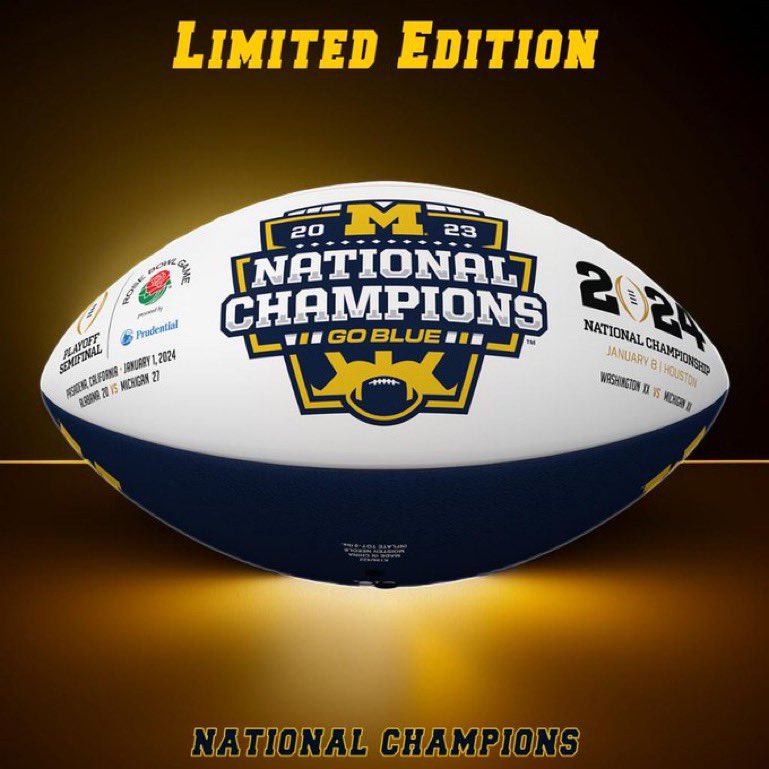
Retweet this tweet and tag a friend in the replies who would love one of these Michigan Wolverines National Champion footballs.
If selected, you'll both win! Or skip the theatrics, order yours now and use code BELL for $10 off https://t.co/hYyEyKN2mA #GoBlue