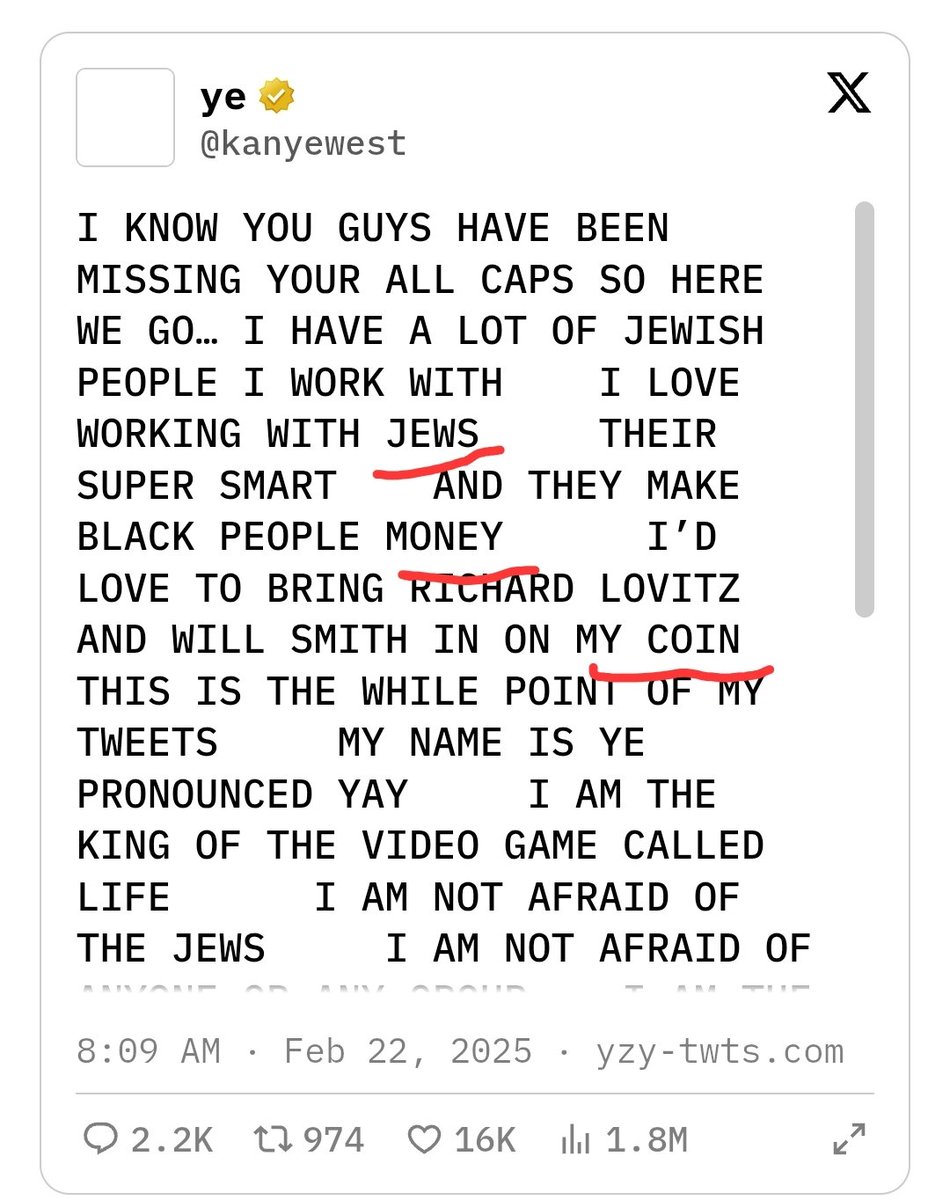
The mission is pro retail, anti insider, anti rug, anti extraction. The mission is the complete reverse of every* celebrity memecoin launch to date.
They want to show that you can launch in a fair way that gives anyone a chance, while actively lying to and psyopping insiders who might take advantage. No one is above another.
I've found too many coincidences and clues I believe it is impossible [redacted] is not launched by him/the team working with him.
I have complete faith and belief they will follow the mission and protect retail. Shake outs, no rug. They are giving retail every chance and actively preventing bad actors from winning.
Since the college dropout each new project unleashed a paradigm shift in the music industry, then he did it again in fashion. Crypto will be no different.
A perfectionist, a genius, and yes completely crazy. The most influential artist of our generation.
It is with a heavy heart that we announce we are winding down the Botanix network.
This decision is the hardest one we have made in four years, and we want to share the reasoning openly because the people who backed us, built with us, and used what we shipped deserve more than a quiet shutdown notice.
First off, an immediate practical consideration for the Botanix community: please withdraw your Bitcoin and other assets before July 9th, 2026.
When we started in 2022, the pitch was simple enough to say in a sentence: bring real utility to Bitcoin. What that actually meant in practice, and what we have spent nearly four years building toward, was more ambitious than that sentence made it sound. We were trying to build a Bitcoin-based blockchain that could find genuine product-market fit as a platform for Bitcoin applications, without using token incentives to drive growth, manufacture users, or simulate utility. Almost every chain that has launched in the last cycle has reached for the same playbook (issue a token without PMF, engineer the incentive surface, point at the resulting metrics), and we did not believe this route is a viable strategy in the long term. We wanted to know whether a Bitcoin chain could earn its users on the strength of what was built on top of it, the value it brings in the market with Bitcoin itself as the only meaningful economic primitive in the system.
And we built it. The Spiderchain went live and stayed live, a year of mainnet operation with one hundred percent uptime and zero security incidents on a genuinely novel cryptographic architecture. We built Dynafed, a dynamic federation that turned the Spiderchain from a static multisig set into a rotating, decentralized one, the technical milestone that most people in this space said could not be built on Bitcoin without compromising trust assumptions. Twenty-five million transactions, two hundred thousand wallets, and tens of millions of dollars in assets moved across the chain, every single number of that earned organically without a token, without airdrops, without points programs, or any of the manufactured-demand machinery. Chainlink, Morpho, GMX, Dolomite, Fireblocks, Alchemy, Galaxy, OKX Wallet, all integrated. We shipped a Bitcoin neobank with BINK on iOS and Android, with self-custodial email login for Bitcoin (something that had never existed before), native Bitcoin yield, and the lowest borrowing rates against Bitcoin anywhere in the world, all of it downstream of owning the infrastructure. The point of saying this is not to argue with our own conclusion. The protocol works, the product works, and our team and ecosystem worked in concert to do exceptional work.
We have run this experiment in earnest, with a working protocol, real applications, and a serious team, for over a year on mainnet and nearly four years in total. The honest answer we have arrived at, after living inside it every day, is that it did not work, at least not in this market and not on this timeline.
We want to share what we think we learned, with the caveat that some of this is conviction and some of this is still suspicion, and we would rather be transparent about the difference than pretend to have clarity we do not have.
The first thing I've had to sit with is timing. Bitcoin utility, making Bitcoin programmable, productive, and integrated into real financial activity, isn't where the real world users sit right now. The conversation is still on Bitcoin as a reserve asset, on its monetary and political positioning, on base-layer conservatism. Those questions are upstream of the ones a Bitcoin L2 needs people to be asking. I still believe Bitcoin gets there, but belief in the destination is not the same as being able to predict when, and nobody can. It's also possible the destination never materialises at all, and that Bitcoin's role as a reserve asset is simply where it settles. If that's true, there will never be a market for what we were building, and no amount of time or capital would change that.
The second is the token question. We intended to eventually launch a token. We saw it, and still see it, as a genuinely new form of equity, something closer to an IPO than an airdrop, to be done when you reach product market fit and the moment is right. That moment never came. What became clear over the last year is that the market largely stopped rewarding even the more considered versions of that playbook. Token launches across the board have broadly underperformed, and those that did go to market with tokens haven't seen the outcomes or PMF that the model is supposed to produce.
The third lesson is about where DeFi demand on Bitcoin actually lives. For most use cases that exist today, lending, yield, leveraged exposure, WBTC on a mature general-purpose L2 is genuinely sufficient. Users have voted with their behaviour, and the verdict is that the trust assumptions of a wrapped representation on Ethereum are acceptable to almost everyone who wants Bitcoin-denominated DeFi. Decentralisation matters to people in principle and in conversation; in practice, when something cheaper and easier is in front of them, they use it. The security case for a dedicated Bitcoin L2 is real, but it only matters for a narrower band of applications than our thesis required, one of the clearer lessons this market has taught us.
The fourth lesson is structural. The on-chain economy is consolidating around venues that own the user relationship: Hyperliquid, Robinhood, the major CEXes, and now TradFi participants absorbing an ever-larger share of attention, flow, and revenue. Convenience and institutional credibility win, every time, as soon as they're available. As retail participation thins, that concentration only deepens. We were, and still are, believers in decentralisation, but the current direction of on-chain growth is running through distribution, and any team building base-layer infrastructure today is rowing upstream against that current. We were no exception.
The fifth lesson is the most concrete. Both of the above played out directly in our economics. The users we attracted were primarily using Bitcoin as a store of value for yield, a legitimate use case, but not the high-frequency transaction volume that drives fee revenue on a network like ours. BINK was our answer to that: a Bitcoin neobank designed to bring daily usage of BTC and stablecoins on-chain, driving the transaction volume the network needed. It was the right strategic instinct, and one we never got the chance to fully test. BINK only landed on both app stores in the last few weeks, a product that by its nature could only be built once the underlying infrastructure was proven and live. When users choose the convenient option and economic gravity pulls toward distribution, what's left on a decentralised infrastructure layer is a user base that costs more to serve than it generates. Infrastructure costs are what they are, and the fee income never came close to covering them.
If you would like to see how we were imagining a Bitcoin future and what we have been working on since September, feel free to download BINK and give it a spin: it’s a full-fledged self-custodial Bitcoin Neobank with email login, one click borrowing, a Lightning integration and more.
App store: https://t.co/36aTfvcfHF
Play store: https://t.co/qoSQ26vbWr
This UX is where we think Bitcoin is ultimately heading towards although it feels too early. You can use invite code 1SD31R, but remember to remove your funds by July 9th.
We could keep going. We have chosen not to, however, because continuing past the point where additional time stops producing additional learning is not conviction, it is something that looks like conviction from the outside while corroding into something else on the inside. We would rather stop now, with integrity intact and resources available to take care of the people who took a chance on us, than push the experiment past the point where it still has something to teach us.
Reminder: Please withdraw all your assets by July 9th. After this, the federation will sweep the remaining Bitcoin. Any other assets or tokens on the network from then onwards will unfortunately be unrecoverable.
After this, the federation will sweep the remaining Bitcoin. Any other assets or tokens on the network from then onwards will unfortunately be unrecoverable.
To our investors, who backed a thesis that was harder to defend than it should have been, to our partners who built alongside us and bet pieces of their own roadmaps on ours, to the developers who deployed on Spiderchain, to our users and the BINK community who showed up for something experimental and stayed, and most of all to the Botanix team who shipped a genuinely novel system with rigour and care and who made every hard day worth the difficulty: Thank you, more than the words available here can carry.