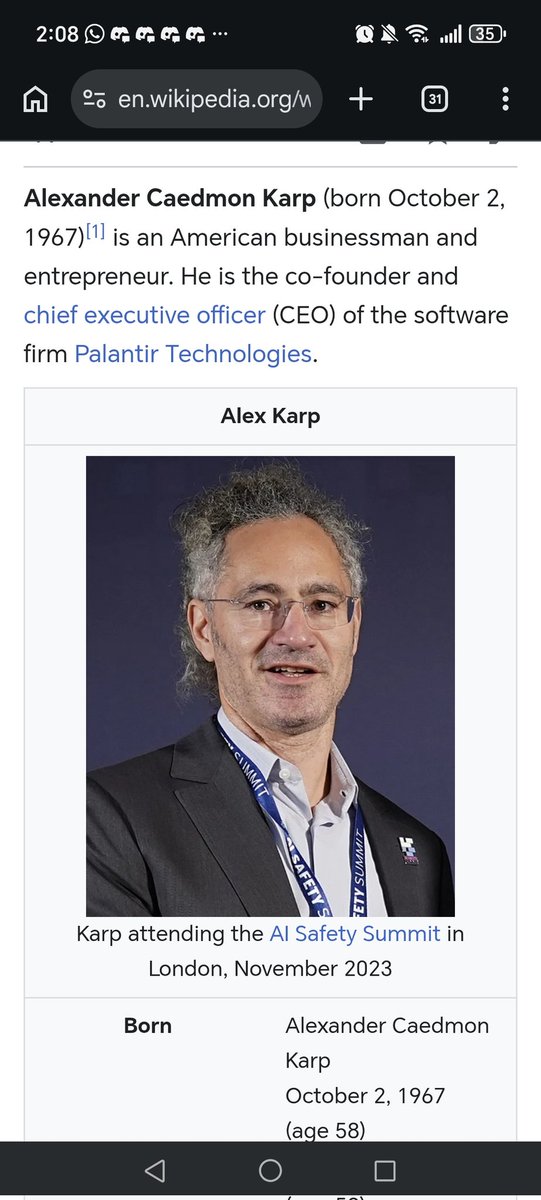
El jefe de Palantir es un filósofo continental que forma parte de la escuela crítica de Frankfurt, que fue alumno de Habermas y que es experto en psicoanálisis.
Tiene un doctorado en Teoría social, se identifica como Neo-Marxista y se considera a sí mismo progresista.
So basically here is a man who advocated for sound money (#Bitcoin ) to realize a real liberal economy, now pushing for an AI society with no working class, enterprises and risk: just a few pigs (state&owners) feeding a mass of useless plebs. #Orwell
Universal HIGH INCOME via checks issued by the Federal government is the best way to deal with unemployment caused by AI.
AI/robotics will produce goods & services far in excess of the increase in the money supply, so there will not be inflation.
Bit gold did solve the double-spending and network consensus problems, with probabilistic Byzantine consensus and timestamped property transfer chains. That network consensus technology already existed and I applied it to solve the double-spending problem. Bit gold didn't solve these problems as well as Satoshi did eleven years later with Bitcoin.
i'm not satoshi, but I was early in laser focus on the positive societal implications of cryptography, online privacy and electronic cash, hence my ~1992 onwards active interest in applied research on ecash, privacy tech on cypherpunks list which led to hashcash and other ideas.
Elon Musk just said what no economist will: the entire system is about to break and nothing can stop it.
AI and robotics aren’t generating growth. They’re destroying the scarcity framework economics depends on.
Musk: “It will hit us like a supersonic tsunami.”
Production compounds exponentially. Money supply grows linearly. Productivity sustaining permanent double-digit expansion. Numbers that sound impossible becoming baseline.
Not evolution. Replacement.
Musk: “Prices collapse hard.”
Not decline. Implosion. AI strips out labor costs, eliminates production errors, removes every inefficiency keeping goods expensive. Manufacturing anything approaches zero marginal cost while quality accelerates.
Governments will react on instinct. Print money. Inject stimulus. Playbook designed for scarcity economies colliding with abundance they have no framework to understand.
Musk: “GDP metrics are already meaningless.”
Every economic model assumes constrained labor, limited output, gradual improvement. AI doesn’t work within those boundaries. It deletes them as variables.
Production explodes. Central banks flood liquidity. Prices collapse regardless because physical abundance scales faster than any monetary intervention can match.
The production wave outruns policy response. Always.
Deflation signals crisis in every historical model. But this isn’t demand collapse. It’s supply going infinite.
The economy isn’t failing. It’s transforming beyond tools built to measure scarcity.
Power belongs to whoever controls the systems generating unlimited output. Money becomes secondary when production costs vanish. Policy makers are steering with instruments calibrated for limits that stopped existing.
This already started. And the people running things have zero answers for what happens when their entire profession becomes obsolete overnight.
Elon Musk warns: AI + robotics will hit us like a "supersonic tsunami."
Peter Diamandis: “We’re basically demonetizing everything. Labor becomes the cost of CapEx and electricity. Intelligence is available at almost zero price.”
Elon’s forecast:
Prices collapse hard.
Output of goods & services explodes faster than money supply → deflation.
Governments will frantically print faster — but won’t keep up.
Productivity could hit high double-digit growth every year.
GDP metrics are already meaningless and will look even more absurd.
Universal high income won’t come from taxes & redistribution.
It comes from radical abundance where stuff & services approach zero cost.
If prices for almost everything crash and intelligence becomes dirt cheap…
what’s the first thing you’d do — or build — in that world?
Ad Astra
If there is a common destiny of great men, it is their gaze turned to the stars. From Julius Caesar to Seneca, from Giotto to Thomas Aquinas, from Dante Alighieri to Petrarch, from Michelangelo to Caravaggio, from Amerigo Vespucci to Galileo Galilei, and then so many other men and women who have shaped entire eras. But the stars do not belong only to the greats of history: they also belong to ordinary people. Enrico Fermi recounted that, as a boy, he saw two shepherds stop to gaze at the sky, and that one commented to the other on what, to him, appeared simply as the magnificence of infinity. Today we are facing a change we do not yet fully understand: for the first time in history, we simultaneously possess enabling technologies and industrial capacity that not only permit exploration, but also make it possible for human civilization to extend beyond the atmosphere and, at the same time, structurally improve conditions on Earth. Two closely trajectories are becoming crucial: the first is solar energy, the second is computational capacity dedicated to artificial intelligence. The first concerns not only terrestrial photovoltaics but also the collection and conversion of power in orbit, where irradiance is more stable and (nearly) continuous, potentially offering a higher capacity factor, and where infrastructure can scale without many contraints. The second concerns the growth of computing power (accelerator architectures such as GPUs/TPUs), high-bandwidth, low-latency interconnections, and, of course, the physical constraints that are becoming increasingly dominant: energy and thermal dissipation to support increasingly dense data centers. At first glance, these two stories may seem distant or irrelevant. In reality, they converge at a single strategic point because abundant energy enables computation at scale, and advanced computation accelerates the discovery and optimization of energy technologies, materials, and industrial processes. If humanity is capable of harnessing solar energy in space and maximizing computation in space through dedicated infrastructure, even envisioning orbital data centers, two systemic effects could be generated, with varying propagation times in different regions of the planet: i) a drastic reduction in the marginal cost of energy and an increase in reliable energy access. II) a more universal diffusion of "cognitive" resources in the form of computational services and artificial intelligence models available on a large scale. The first effect could translate into a structural reduction in poverty and sustainable growth less constrained by fuel and geopolitical bottlenecks. The second makes currently unsolved problems in employment, healthcare, and scientific research economically and technically tractable, from diagnostics and drug discovery. The engineering challenges remain enormous: thermal management in a vacuum on an industrial scale, radiation degradation of electronics and materials (total ionizing dose), reliability and redundancy of autonomous systems, high-capacity ground-to-space links, in-orbit maintenance and servicing (Optimus?), orbital sustainability, and debris mitigation. To find potential solutions the main variable is the time needed. I remember once Elon told me that, for him, the most important thing is the value of his time. Generally speaking, the bottleneck is often a mix of technical and bureaucratic time, but the capacity to attract the world's best talent, concentrated in a few companies, is accelerating the process. Once we realize it's both a scientific and industrial problem, and a problem of scale: if the critical infrastructure threshold is exceeded, then energy and computation become multipliers of prosperity, and what today seems like science fiction could transform into the largest technological project of the century.
True.
Once the solar energy generation to robot manufacturing to chip fabrication to AI loop is closed, conventional currency will just get in the way.
Just wattage and tonnage will matter, not dollars.
French police is currently raiding X’s office in Paris. France is the only country in the world that is criminally persecuting all social networks that give people some degree of freedom (Telegram, X, TikTok…). Don’t be mistaken: this is not a free country.
@zerohedge True.
That is why Bitcoin is based on energy: you can issue fake fiat currency, and every government in history has done so, but it is impossible to fake energy.
JUST IN: 🇺🇸 Elon Musk says, “#Bitcoin is based on energy: you can issue fake fiat currency, and every government in history has done so, but it is impossible to fake energy.”
🇺🇸 PRESIDENT TRUMP: "Maybe we’ll pay off our $35 trillion debt by handing them a little crypto check. We’ll hand them a little Bitcoin and wipe out our $35 trillion."
Bitcoin that has been finally forfeited to the federal government will be the foundation of the Strategic Bitcoin Reserve that President Trump established in his March Executive Order.
In addition, Treasury is committed to exploring budget-neutral pathways to acquire more Bitcoin to expand the reserve, and to execute on the President’s promise to make the United States the “Bitcoin superpower of the world.”