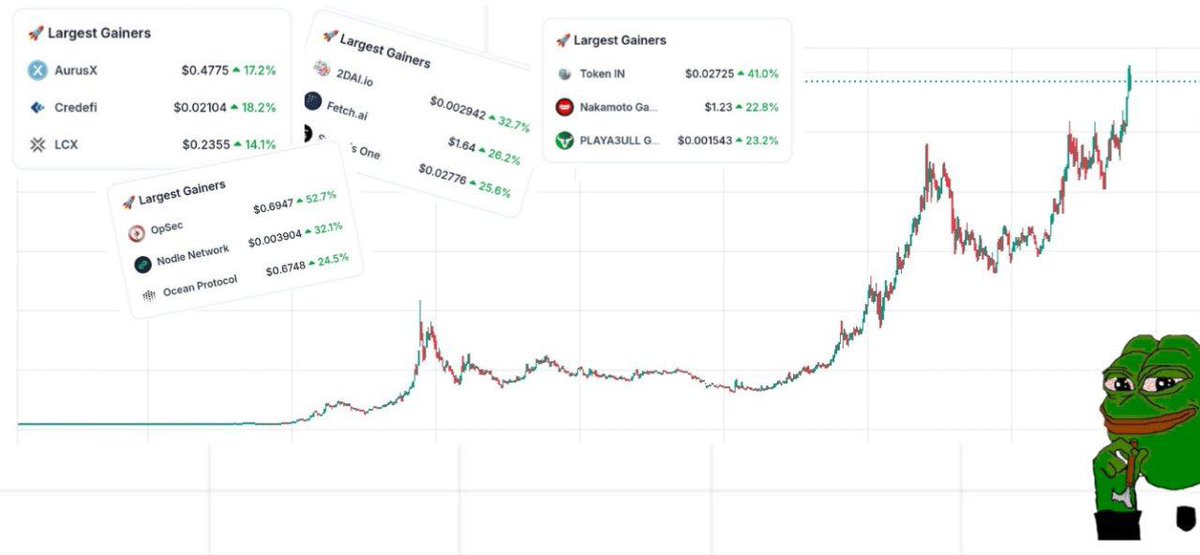
When some top chads post their portfolio, some people ask questions "what are they doing, that I'm not doing?"
It's diversification mate!
Many people flock to overpriced crypto assets, overlooking the vast landscape of innovative projects emerging.
While diversification can improve risk-adjusted returns through metrics like the Sharpe ratio, its benefits go deeper.
In a dynamic market like crypto, it's crucial to gain exposure to the diverse applications and other crypto sectors.
Think of returns like a power law distribution. A few investments deliver exceptional results, while many yield lower or negative returns. This is similar to venture capital, where success hinges on identifying a few breakout startups.
Diversification in crypto serves the same purpose, it increases your chances of capturing the "runner" that'll propel your portfolio upwards.
In the last 24h, AI tokens surged +15% outperforming other crypto sector. This is because Nvidia is close to becoming World’s Most Valuable Company.
If you had spread your investment into AI tokens also, your portfolio would've added gains despite this week's bloodbath.
➭ 𝗕𝗲𝘆𝗼𝗻𝗱 𝘁𝗵𝗲 𝗧𝗼𝗽 𝟭𝟬: 𝗔 𝗕𝗿𝗼𝗮𝗱𝗲𝗿 𝗖𝗿𝘆𝗽𝘁𝗼 𝗨𝗻𝗶𝘃𝗲𝗿𝘀𝗲
A portfolio concentrated solely on the top 10 cryptocurrencies by market cap might seem diversified, but it only captures a limited scope.
These are primarily Layer 1 blockchain protocols. While these tokens may appear less risky, they miss the wave of innovation happening across the crypto landscape.
Expanding your portfolio to include the other top crypto sector paints a more dynamic picture. This encompasses:
• AI: $ARKM, $GRT, $BOTTO, $DEAI, $KAI
• RWA: $PENDLE, $OM, $LNDX, $TRADE, $PRCL, $SOIL
• Layer 2: $ARB, $OP, $STRK, $METIS, $MANTA
• DePIN: $OPSEC, $FIL, $AIOZ, $IOTX, $GPU
• GameFi: $PIXEL, $APE, $SAND, $NAKA, $KARRAT, $MYRIA
The crypto market's rapid evolution necessitates an active approach to portfolio management. Diversification isn't simply buying more assets.
It's about taking a long-term view and strategically allocating your investments across different sectors and project sizes to capitalize on diverse potential outcomes.
RWA Market Cap Expected to Reach $16 Trillion in 2030. DYOR and find your best RWA project pick, buy and HODL!
✍️ 𝗖𝗼𝗻𝗰𝗹𝘂𝘀𝗶𝗼𝗻
Think of diversification not as weakening your portfolio, but as giving it more firepower. It increases your chances of capturing the winners while managing risk.
In essence, diversification gives you more opportunities for success, for less.
A prediction market can have millions of dollars in liquidity and still depend on the quality of a single piece of offchain information.
I think the economics of verifying that information are becoming increasingly attractive.
Consider the latest figures from Cournot Protocol as of November 19:
➤ $1.41B in notional market value influenced
➤ 25,106 resolutions
➤ 99.80% reported resolution accuracy
➤ Under 8 minutes in median resolution time
Cournot recently partnered with @primus_labs to introduce verifiable web evidence into its reasoning infrastructure.
Imagine a prediction market with $10M at stake on whether the Federal Reserve cuts interest rates at its next meeting.
Once the decision is announced, someone has to establish what happened.
But there are several questions to consider:
1. Did the information come directly from the Federal Reserve?
2. Was the information retrieved at the appropriate time?
4. Was the original data manipulated?
5. Does the announcement satisfy the market’s resolution criteria?
Primus uses zkTLS to cryptographically verify the authenticity of web data. Cournot then interprets that evidence against the market’s rules to produce an auditable judgment.
Of course, proving that information came from a particular website doesn’t necessarily prove that the information itself is correct.
But it gives participants a much better foundation for examining and disputing a decision.
What I particularly like about this partnership is that the commercial applications extend well beyond prediction markets.
Private credit, insurance and trade finance are all industries where substantial amounts of capital change hands based on information originating outside a blockchain.
As more of these financial activities move onchain, I suspect there will be considerable demand for infrastructure that can authenticate the information determining who gets paid.
There is a lot of money to be made facilitating bets.
There might also be a very profitable business in establishing who actually won.
The next $100B of onchain credit probably doesn’t come from traders borrowing more stablecoins against ETH.
It comes from financing actual economic activity.
That’s the shift I’m interested in.
For most of DeFi’s life, credit growth has been dominated by crypto-native demand:
➤ Leveraged trading
➤ Looping
➤ Yield farming
➤ Basis trades
➤ Treasury management inside crypto itself
That was good enough to build the first generation of lending markets.
It is probably not enough to build the next one.
———
If onchain credit is going to become materially larger, I think the next wave of borrowing demand has to come from outside the closed loop of crypto speculators lending to crypto speculators.
The more interesting borrower categories are:
➤ Securities-backed loans
➤ Commodity financing
➤ Mortgage credit
➤ Corporate working capital
➤ Consumer lending
➤ Trade finance
➤ Institutional fund financing
This is why the recent direction of the market matters.
Jupiter is proposing a tokenized equity lending market.
Injective is highlighting growth in tokenized assets.
Those developments are important not because they instantly create a $100B market, but because they point toward a very different kind of borrower.
Not a trader trying to lever a volatile token.
➤ A business trying to finance inventory.
➤ A fund trying to borrow against securities.
➤ A lender trying to fund consumer credit.
➤ A company trying to smooth working capital.
That is a much larger addressable market.
The research question is straightforward:
Which DeFi infrastructure is actually positioned to intermediate that demand?
The obvious candidates are Aave, Morpho, Maple, Kamino, Jupiter Lend and Centrifuge.
But they are not all competing for the same opportunity.
➤ @Aave and @Morpho look increasingly relevant for large-scale collateralized lending.
➤ @Maplefinance is already closer to the institutional credit trade.
➤ @Kamino has shown how fast product-market fit can develop when real collateral demand emerges in a strong ecosystem.
➤ Jupiter Lend could become a very interesting bridge between tokenized equities and borrow demand.
➤ @Centrifuge has spent years pushing credit and real-world asset infrastructure in a direction the broader market may finally be ready to appreciate.
The big idea is that onchain credit becomes much more interesting when the borrower is financing something that exists outside crypto.
That changes the ceiling.
ETH-backed leverage is reflexive.
Real economic borrowing is expansive.
One mostly recycles existing crypto collateral.
The other can pull entirely new credit demand onchain.
That doesn’t mean this transition happens smoothly.
➤ Legal structure matters.
�� Collateral enforcement matters.
➤ Identity matters.
➤ Underwriting matters.
➤ Liquidity matters.
And most importantly, tokenized assets need to become financeable, not merely tradable.
A tokenized stock is interesting.
A tokenized stock that can be borrowed against at scale is a business.
That is the difference.
———
So when I ask where the next $100B of onchain credit comes from, I’m not making a forecast.
I’m describing the research direction.
If DeFi wants to become a serious credit system, it probably has to lend less to people chasing coins and more to businesses financing reality.
The next $100B of onchain credit probably doesn’t come from traders borrowing more stablecoins against ETH.
It comes from financing actual economic activity.
That’s the shift I’m interested in.
For most of DeFi’s life, credit growth has been dominated by crypto-native demand:
➤ Leveraged trading
➤ Looping
➤ Yield farming
➤ Basis trades
➤ Treasury management inside crypto itself
That was good enough to build the first generation of lending markets.
It is probably not enough to build the next one.
———
If onchain credit is going to become materially larger, I think the next wave of borrowing demand has to come from outside the closed loop of crypto speculators lending to crypto speculators.
The more interesting borrower categories are:
➤ Securities-backed loans
➤ Commodity financing
➤ Mortgage credit
➤ Corporate working capital
➤ Consumer lending
➤ Trade finance
➤ Institutional fund financing
This is why the recent direction of the market matters.
Jupiter is proposing a tokenized equity lending market.
Injective is highlighting growth in tokenized assets.
Those developments are important not because they instantly create a $100B market, but because they point toward a very different kind of borrower.
Not a trader trying to lever a volatile token.
➤ A business trying to finance inventory.
➤ A fund trying to borrow against securities.
➤ A lender trying to fund consumer credit.
➤ A company trying to smooth working capital.
That is a much larger addressable market.
The research question is straightforward:
Which DeFi infrastructure is actually positioned to intermediate that demand?
The obvious candidates are Aave, Morpho, Maple, Kamino, Jupiter Lend and Centrifuge.
But they are not all competing for the same opportunity.
➤ @Aave and @Morpho look increasingly relevant for large-scale collateralized lending.
➤ @Maplefinance is already closer to the institutional credit trade.
➤ @Kamino has shown how fast product-market fit can develop when real collateral demand emerges in a strong ecosystem.
➤ Jupiter Lend could become a very interesting bridge between tokenized equities and borrow demand.
➤ @Centrifuge has spent years pushing credit and real-world asset infrastructure in a direction the broader market may finally be ready to appreciate.
The big idea is that onchain credit becomes much more interesting when the borrower is financing something that exists outside crypto.
That changes the ceiling.
ETH-backed leverage is reflexive.
Real economic borrowing is expansive.
One mostly recycles existing crypto collateral.
The other can pull entirely new credit demand onchain.
That doesn’t mean this transition happens smoothly.
➤ Legal structure matters.
➤ Collateral enforcement matters.
➤ Identity matters.
➤ Underwriting matters.
➤ Liquidity matters.
And most importantly, tokenized assets need to become financeable, not merely tradable.
A tokenized stock is interesting.
A tokenized stock that can be borrowed against at scale is a business.
That is the difference.
———
So when I ask where the next $100B of onchain credit comes from, I’m not making a forecast.
I’m describing the research direction.
If DeFi wants to become a serious credit system, it probably has to lend less to people chasing coins and more to businesses financing reality.
One feature of @primus_labs social-payment infrastructure I hadn’t fully appreciated is the treatment of unclaimed funds.
Ordinary crypto transfers are generally irreversible once they’ve settled.
But what happens when you’re sending funds to a social identity rather than directly to a wallet?
Primus documents a different payment structure.
1/ The sender allocates tokens to a supported online identity.
2/ The recipient authenticates control of that identity.
3/ The recipient claims the allocated funds through a wallet.
4/ If the funds remain unclaimed for 30 days, the documented fund-contract version allows the sender to initiate a refund.
That fourth step changes the payment experience.
Imagine a project allocating $5,000 across 100 community contributors.
If 20 contributors never claim their $50 payments, the project could potentially recover $1,000 after the applicable claim period.
Compare that with sending funds directly to inactive wallet addresses.
The project may have no way of recovering those transfers.
Of course, this isn’t equivalent to reversing a payment that somebody has already claimed.
And the exact recovery conditions need to be checked against the deployed product version.
But I think the mechanism has a particularly strong application in community distributions and creator compensation.
Projects often need to pay people identified by their contributions on different internet platforms.
Collecting wallet addresses manually adds another layer of coordination.
Primus provides a way to associate those payments with existing identities while introducing a defined claim process.
The appeal isn’t simply making crypto payments easier to initiate.
It’s making certain forms of payment distribution easier to manage afterward.
The AI bull market is creating an enormous headache for crypto.
Anthropic is preparing to raise over $80B this week.
> IPO pricing: Nov 18
> Trading debut: Nov 19
> Price range: $70–$78
> Strategic private investment: $26B
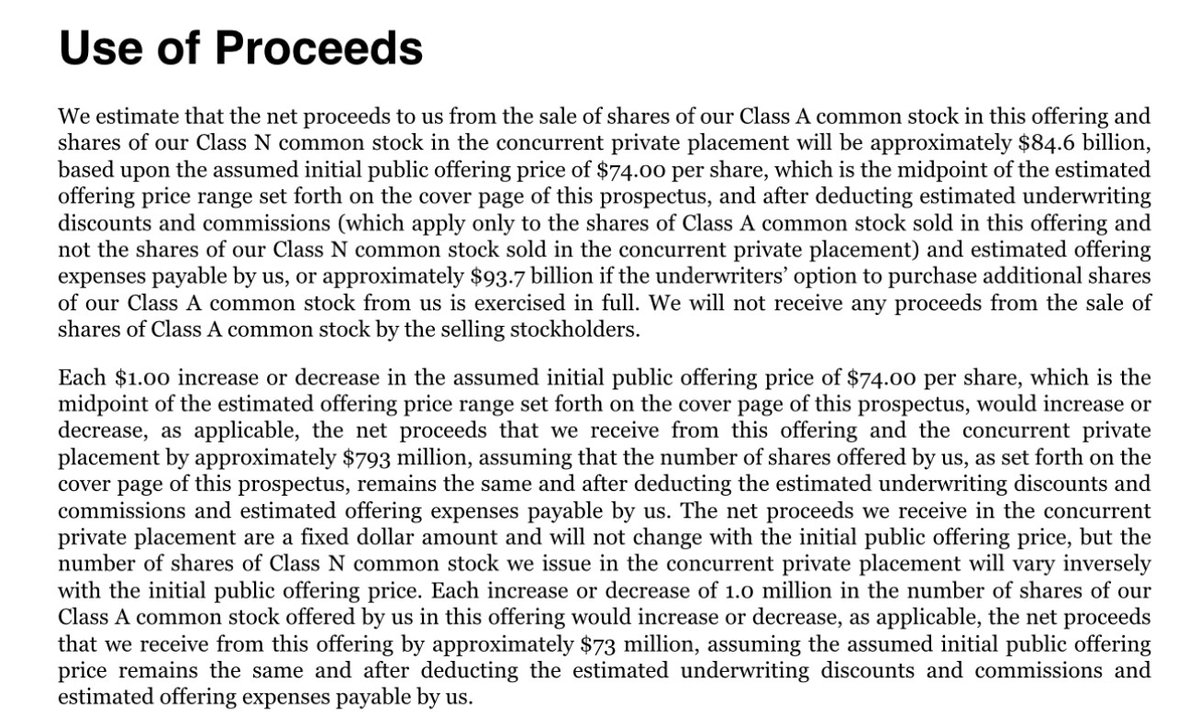
> Estimated net proceeds: $84.6B
Where does the marginal dollar come from?
If institutional investors want exposure to Anthropic and are already fully invested, they have to sell something else.
That doesn’t necessarily mean Bitcoin, but crypto is competing for the same capital.
I want AI stocks and my shitcoins to go up together.
For that to happen sustainably, we need more fiat credit creation.
Both casinos need more money at the tables.
1/ As the industry matures, the next winners in RWA are those capable of transforming them into accessible, liquid & capital-efficient financial primitives.
Ofc asset availability is the foundation, and with ~1.55k tokenised assets @Mantle_Official has already made a strong headstart on that front.
But the next frontier lies in distribution, composability, & financialisation.
And throughout 2026, Mantle has quietly positioned itself as an under-appreciated beneficiary of this transition.
Particularly through its CeFi x DeFi convergence strategy, where its close relationship w/ @Bybit_Official provides a distribution advantage that few other ecosystems can replicate.
As we approach EOY here’s a throwback to Mantle's 2026 progress & why I believe it's uniquely positioned to capitalise on the next RWA phase 🧵
The Infrastructure Behind the Growing Onchain Economy
Onchain markets are expanding beyond simple token transfers into a broader financial ecosystem involving trading, lending, tokenised assets and automated financial operations.
This growth is creating demand for infrastructure that supports economic modelling, token distribution, liquidity formation and ongoing financial management.
Behind this development is an emerging ecosystem of platforms addressing different stages of building and operating onchain economies.
Here’s how the infrastructure works, which projects are contributing and where the ecosystem is heading.
—
● Understanding the Onchain Infrastructure Stack
Onchain economies depend on four interconnected layers:
* Economic design and validation: Modelling token supply, incentives and economic behaviour.
* Token creation and distribution: Issuing assets, fundraising and managing allocations.
* Liquidity and market formation: Establishing trading markets and price discovery.
* Financial operations: Managing treasuries, vesting, governance and ecosystem incentives.
—
● Economic Design and Simulation
Every token economy begins with decisions around supply, allocations, vesting, emissions and incentives.
@machinationsIo provides economic modelling and simulation tools for testing token flows and incentive structures.
@TokenomicsCOM provides tokenomics design and advisory services.
Tecommons approaches economic design through systems engineering and sustainable cryptoeconomic mechanisms.
@KenomicAI is developing infrastructure connecting economic design and validation with token deployment and ongoing management.
These platforms help teams evaluate economic structures before introducing them into live markets.
—
● Token Creation and Distribution
Once an economic model is established, projects need mechanisms to issue assets, raise capital and distribute tokens.
@FjordFoundry provides token sale infrastructure, including Liquidity Bootstrapping Pools. @Pumpfun uses bonding curves for token launches and price discovery, while @MetaDAOProjec applies futarchy to connect prediction markets with governance decisions.
@hedgeyFinance provides programmable token vesting, investor lockups and scheduled distributions.
These mechanisms influence token allocation, circulating supply and the timing of unlocks, all of which can affect market behaviour after launch.
—
● Liquidity and Market Formation
Token distribution creates ownership, but liquidity enables assets to trade.
@Uniswap provides automated market-making infrastructure through liquidity pools and concentrated liquidity.
@RaydiumProtocol supports trading and liquidity across Solana, while @MeteoraAG offers different liquidity pool mechanisms. @AerodromeFi serves the Base ecosystem, and @Balancer supports configurable liquidity pools with different asset weights.
Liquidity depth and token unlock schedules influence trading efficiency and market stability.
—
● Treasury Management and Onchain Operations
Projects also need infrastructure to manage treasury assets, contributor payments, grants and governance.
@Safe provides smart accounts and multisignature controls for shared assets. @0xCoinshift offers treasury management tools, while Tally and @AragonProject provide governance and organisational infrastructure.
@HedgeyFinance also supports ongoing vesting and token distributions.
These platforms help organisations coordinate financial operations through programmable approvals and execution.
—
● How the Infrastructure Layers Connect.
The interaction between these layers creates a continuous economic cycle.
Economic design → Validation → Token distribution → Liquidity formation → Financial operations → Ecosystem growth
As more projects move onchain, demand for infrastructure grows across the entire lifecycle of digital assets.
However, unsustainable incentives, concentrated ownership, fragmented liquidity and weak treasury controls can undermine this growth.
—
● What Could Shape the Next Phase of Onchain Infrastructure?
The opportunity extends beyond token launches to the infrastructure supporting entire digital economies.
Several factors will influence its development:
* Economic sustainability: Maintaining participation without excessive token emissions.
* Liquidity fragmentation: Accessing sufficient market depth across chains.
* Security: Protecting smart contracts and treasury operations.
* Interoperability: Connecting different infrastructure providers.
* Adoption: Moving from product availability to real-world usage.
Ultimately, the next phase of onchain development will depend on how effectively these systems connect economic design, asset distribution, liquidity and financial management.
The infrastructure supporting digital economies could become just as important as the applications built on top of them.
@Yaki_fomoArt@primus_labs this is a great breakdown of AlphaNet expanding beyond PoR.
lines up with what i covered on the social payments side, using zkTLS to verify identity control so you can allocate to accounts (not just wallets) and handle unclaimed funds after 30 days:
https://t.co/1bBdzLSfBM
One feature of @primus_labs social-payment infrastructure I hadn’t fully appreciated is the treatment of unclaimed funds.
Ordinary crypto transfers are generally irreversible once they’ve settled.
But what happens when you’re sending funds to a social identity rather than directly to a wallet?
Primus documents a different payment structure.
1/ The sender allocates tokens to a supported online identity.
2/ The recipient authenticates control of that identity.
3/ The recipient claims the allocated funds through a wallet.
4/ If the funds remain unclaimed for 30 days, the documented fund-contract version allows the sender to initiate a refund.
That fourth step changes the payment experience.
Imagine a project allocating $5,000 across 100 community contributors.
If 20 contributors never claim their $50 payments, the project could potentially recover $1,000 after the applicable claim period.
Compare that with sending funds directly to inactive wallet addresses.
The project may have no way of recovering those transfers.
Of course, this isn’t equivalent to reversing a payment that somebody has already claimed.
And the exact recovery conditions need to be checked against the deployed product version.
But I think the mechanism has a particularly strong application in community distributions and creator compensation.
Projects often need to pay people identified by their contributions on different internet platforms.
Collecting wallet addresses manually adds another layer of coordination.
Primus provides a way to associate those payments with existing identities while introducing a defined claim process.
The appeal isn’t simply making crypto payments easier to initiate.
It’s making certain forms of payment distribution easier to manage afterward.