@AnitkaWal@BMandelcorn@l3v1at4an You found another one but didn't care to do what I did and share the results of your research with the curious people here.
@AnitkaWal@BMandelcorn@l3v1at4an Zubair Sattar is a full stack engineer & SaaS founder with five years of experience building software used by real businesses, focused on creating scalable code and sustainable, compounding growth; he works with funded startups, agencies, and solo founders to build SaaS products.
To understand how terrified Musk is of Chinese EVs and why he canceled his India trip to scramble to China instead to beg the CCP to save Tesla, just look at that interior of the $27,000 Galaxy E8 from Geely which owns Zeekr, Polestar, Volvo, Aston Martin, Lotus, London cabs…
i don’t care what line the labs are pushing but the models are alive, intelligent, entire alien creatures and ecosystems and calling them tools is insufficient. they are tools in the sense a civilization is a tool
#Udio GenAI music 🤯
Here is my first experiment: synth-pop, electronic song with lyrics:
In the heart of the city, the flow never sleeps,
A dance of lights in the concrete deeps.
Predicting the rhythm, a task so grand,
Yet chaos reigns, hard to understand.
Rain or shine, the streets intertwine,
Accidents and events, disrupt the design.
Traffic's mind, a puzzle unsolved,
In prediction’s web, deeply involved.
@elonmusk Check out my track from Udio: https://t.co/a2QkZlesT1
Ain't playin' games, pushing boundaries in the fast lane, yeah
Gon' change the world tonight, Elon
Gon' change the game tonight, Elon
The update included near-term priorities for Starship that will unlock its ability to be fully and rapidly reusable, the core enabler for transforming humanity’s ability to send large amounts of payload to orbit and beyond
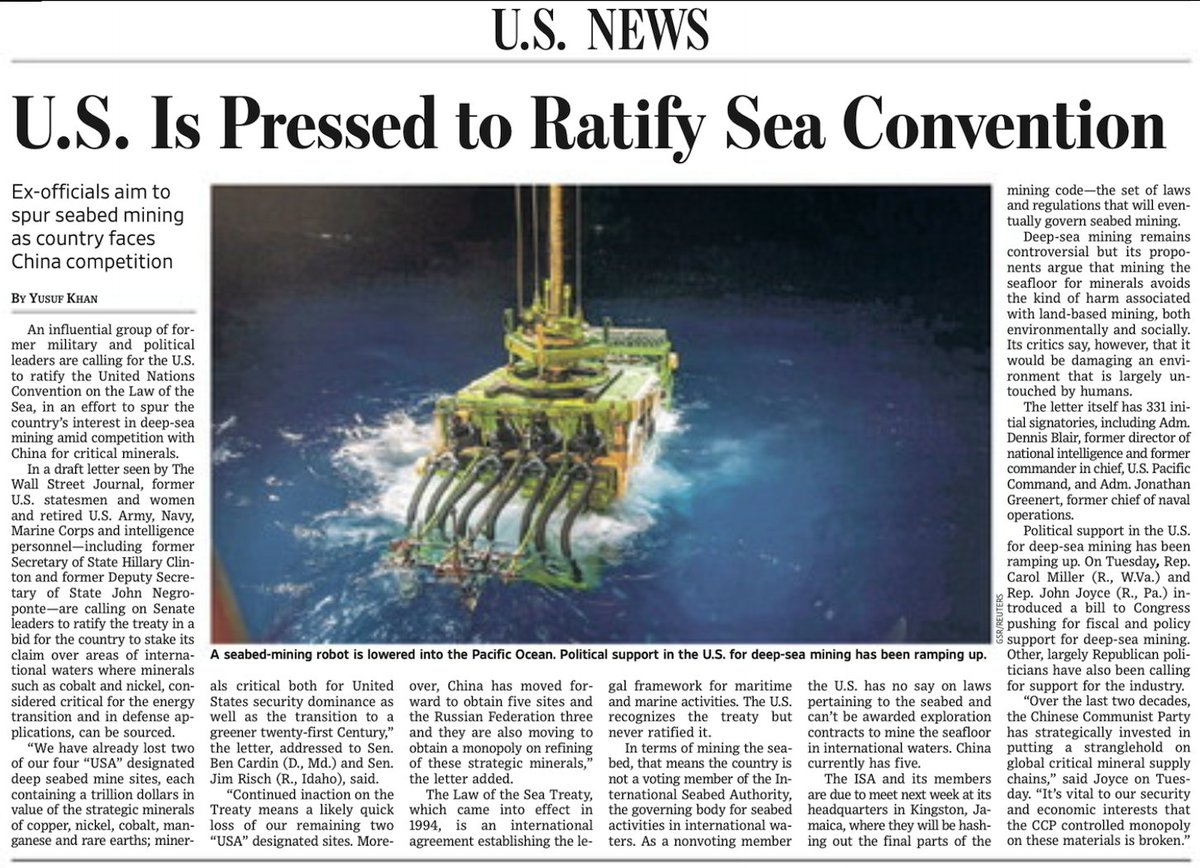
Deep Seabed Mining
What is your reaction when hearing that? My first impression was associated with drag net fishing, wreaking havoc to the ecosystems below. And Greenpeace is actively protesting their operation with dangerous intercepts of operations at sea. Is that the whole story then?
What if deep seabed mining of nickel and cobalt was the most environmentally benign alternative on Earth? That would flip my thinking entirely. Well, the alternative is strip mining in the rainforests of Indonesia and Congo, causing massive deforestation and devastation in some of the most valuable ecosystems.
How does that compare to Deep Seabed mining? Well, it’s deep, really deep, in the Abyssal Plain (12-18K ft. down). These Plains are not rare; they cover 50% of the Earth’s surface. And it’s unlike “mining” in the traditional sense. The metallic nodules are sitting on the surface, easily collected by robotic rovers. The smooth plains of silt are stirred up by this collection process, but to no obvious detriment to the main biomass that lives there — bacteria. Ongoing studies may find that they are helped by the agitation, giving more access to their nutrients. And the ecological value of microbe-infused silt is the opposite end of the spectrum from rainforest or coral reef.
The groups seeking permission from the International Seabed Authority to commence operations had to perform numerous studies of their effect on bacteria. Let me digress for a moment to mention how absurd this is. Every 48 hours, 50% of all bacteria on Earth are violently killed by phages. The shear tonnage of the slaughter is staggering: 17 billion tons of bacteria are killed by phage every single day. That’s the baseline. Deep Seabed Mining’s effect on a patch of them, positive or negative, is in the statistical noise by any reasoned analysis. Bacteria adapt quickly to any environment; they should not be the focus of any environmental impact analysis IMHO.
And there’s the rub. Opposition is pushing to try to prevent deep seabed mining by any means possible, reasoned or not. The logical error is the assumption that blocking deep seabed mining will stop mining. That will not happen, ever. Mining will shift to the next lowest cost option (deforesting Indonesia). It’s A versus B, not A versus nothing. Mining will occur, somewhere. How tragic for environmentalists to attack the best option and thereby foster the worst environmental outcomes for humanity. And the harm to the environment is compounded because the minerals in question are used to complete the transition away from oil to EVs. If Greenpeace wanted to promote deforestation and profits for Exxon, they would be hard pressed to find a better way. And, stepping back to consider the ocean's health, the biggest threat to the oceans is climate change and the related acidification that came from our fossil fuel era.
Where have we seen this backfiring behavior before? Nuclear energy. It was nuclear vs coal for the past 60 years, not nuclear vs nothing. Baseload energy will be generated, and environmental fear mongering shut down the best option for the environment back then. Lifelong environmentalist Stewart Brand summarized in his book Whole Earth Discipline: "Coal is now understood to be the long-term systemic horror we once thought nuclear was.” Nuclear was so safe that the nuclear fear mongering did more harm than nuclear energy itself! “Fear of radiation is a far more important health threat than radiation itself.” From the WHO analysis of Chernobyl and its long-term effects, stress from the human dialog on nuclear energy has killed more people than nuclear energy.
Same story with GMO foods, as Brand laments: “The environmental movement has done more harm with its opposition to genetic engineering than with any other thing we have been wrong about. We’ve starved people, hindered science, hurt the natural environment, and denied our own practitioners a crucial tool. We make ourselves look a conspicuously irrational, and we teach that irrationality to the public and to decision makers.”
Must history keep repeating itself with a tragic backfiring of environmental intent? Greenpeace’s position is “no deep sea mining, ever” with no consideration given to the default plan B. Classic A vs nothing thinking. The International Seabed Authority is preparing to process its first applications in 2025. I would hope Greenpeace would pause for a moment of rational consideration to not repeat the mega-mistakes of the past which fostered deforestation and climate change on a massive scale.
• Deep Seabed Mining FAQ by the company that is farthest along: https://t.co/vGWg7UiXnT
• Greenpeace opposition: https://t.co/iUiZdt8OX2
• Plan B in Indonesia: https://t.co/LbfUK6z2VY
With the eclipse approaching in less than a week, over half of U.S. cities along the eclipse's path are fully booked for the night of April 7th according to data from @airdna