To be clear, I am just pointing out that the trend (so far) is for an economy that is slowing. To have this data point, and many others, suddenly reverse (ie big boost in economic output) in the absence of Fed cuts would appear to be a low probability event.
I am always worried about being wrong and focused on the data. With more #investors worried about a re-acceleration (and I would be as well if the #Fed cut rates soon) - in the absence of a cut, how should we interpret that the quits rate is back to pre-covid levels?
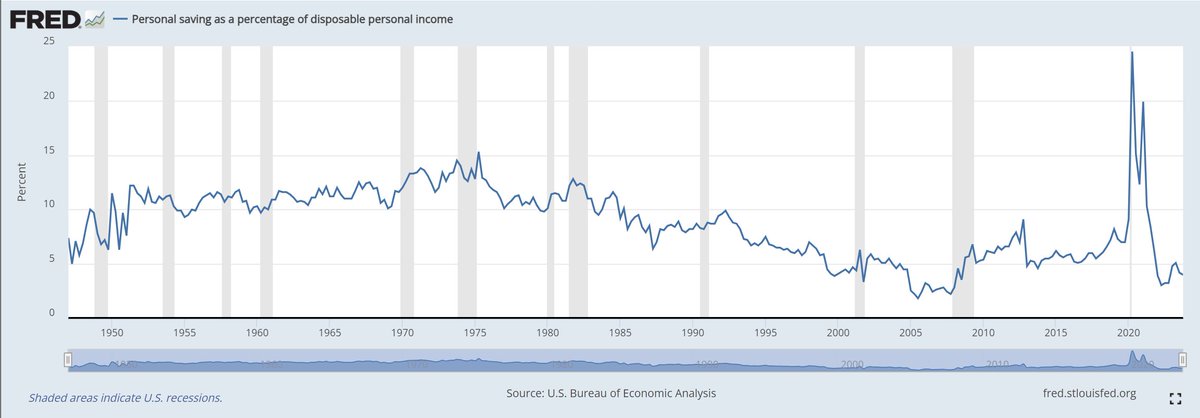
#Consumers are just fine, right? Do you know that the personal savings rates as a percentage of disposable income is not just lower than pre-pandemic, but at levels not seen since 2007! More in the recent research report.
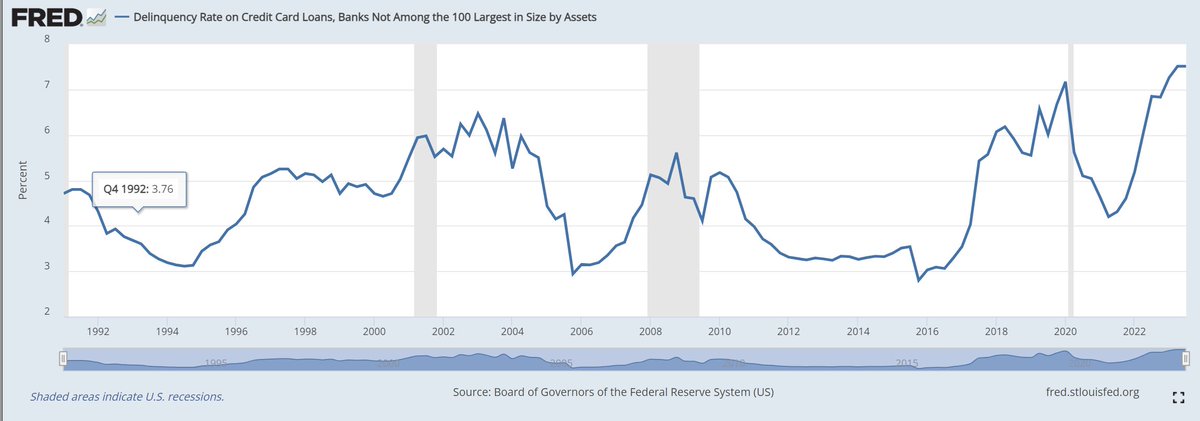
In the latest research report (link in the bio) I looked at credit card delinquencies from banks not in the top 100, which is now at the highest point going back to 1992! Courtesy of the St. Louis Fed
Note that the prior January prints were strong as well. However CPI m/m this year is 0.3 vs 0.5 last year. This type of data is not linear, we will see oscillations. The question is if a trend is now reversing. We need more data, but I would say no so far
Strong #CPI print, but the #Fed is focused on PCE. Housing is a much bigger input into CPI than #PCE and shelter contributed to more than 2/3 of the increase in core CPI.
What does this mean for fixed income #trades? Two things, 1) if the economy really is accelerating that is a concern, but I think more important is that 2) the #Fed is willing to keep #rates in restrictive territory for longer. This increases the probability of #economic weakness
It will be interesting to see how probabilities for future #Fed cuts change, or not as the case may be, following the #FOMC meeting and #Powell presser.
March currently is at 57.8% probability of a 25bps cut, May 51.8% prob of another 25bps cut. I still think March is too high
Clearly this is the concern of the #Fed, the economy is still too strong.
Those betting on #Fed cuts were too focused on the #inflation data when the Fed included other factors.
@Claudia_Sahm Agreed, probabilities for March never made sense to me.
His comments RE labor market were interesting as he is not worried on that front. If he sees limited risks RE labor, and he expressed worries over inflation anchored > 2%, staying in place for longer is logical outcome
@TheStalwart Given the narrative and data, this is consistent with the Fed’s approach and comments by officials.
I have have been pushing back against March cuts for quite a while.
#Powell “based on the meeting today, not likely the #FOMC will reach level of confidence to identify March as the meeting for cuts, probably not the likely/base case” paraphrasing
I have been pushing back against March cuts for quite a while, #Powell confirms
#Powell “not looking for low annualized inflation for a month or two, not looking for inflation to anchor below 2%” paraphrasing
Markets cheering a positive month or two of inflation data are running ahead of the #Fed
#Powell “risk #inflation could reaccelerate, greater risk inflation stabilizes meaningful above 2%”
Pretty clear to me how they are thinking about the situation. They are worried about #inflation above 2% and less about labor market weakness
#Powell “labor market is almost back to normal… wages increase are still at a healthy level” paraphrasing
To me,they are not worried about the downside RE labor market weakness. This means they are leaning towards keeping #rates at current levels for longer and not cutting IMO
Powell: If we saw an unexpected weakening in the labor market, that would certainly call for cutting sooner. If inflation was stickier or higher than anticipated, that would argue for moving later.
@NickTimiraos That is an interesting response. Without labor market weakness I have been saying that the Fed will stay put longer. However if there is labor market weakness, I think they will cut by more than the market expects. Both are big divergences from market expectations