I'm honored and excited to share that I've joined @ABKLABS as Lead Product Engineer to work on @corbitsdev and @faremeterxyz .
I'll be building agents, AI workflows, and agentic solutions that help business move faster and truly integrate agentic capabilities with Interchange, the agentic operating system.
I'm very grateful to the SKALE team and broader ecosystem for the opportunities, trust, and growth over the past 5+ years. It has been a privilege to work with and support so many talented teams building on SKALE.
Excited for this next chapter.
Why are durable sessions an afterthought in almost every agent SDK?
It's such a pitfall for developers onboarding to the technology trying to make multi turn in production "Just work"
Nobody truly knows where the best place to interact with agents is, but Slack feels like it's really solidifying itself as one of the top places for teams to collaborate with AI.
Get started with https://t.co/9nsAPEHWaU and bring your agent into Slack with Corbits.
> DM me if you'd like some help
Team decisions shouldn’t get made in someone’s private chat window.
Interchange brings your whole team into the conversation in Slack, one question at a time, everyone shares their input, and every decision gets finalized. Nothing falls through the cracks.
Here's ours picking how to celebrate the next big win 👇
https://t.co/JSpqDAH6HQ
@olvrgln Would be great to connect and chat on this. My work touches on this quite a bit and it would be great to dive a bit deeper if you’re open to it.
The risk of defaulting to fusion models is similar to the risk of relying fully on closed-source inference. The lack of control for AI implementors or Heads/VP of AI should considered before blindly agreeing that it "gives you the best of both worlds". I'm not saying it's always wrong, but I think there is an alternative and more predictable cost model to consider.
Additionally, there is limited value in fusion models for an agent when you're trying to force an agent to be a workflow through loops.
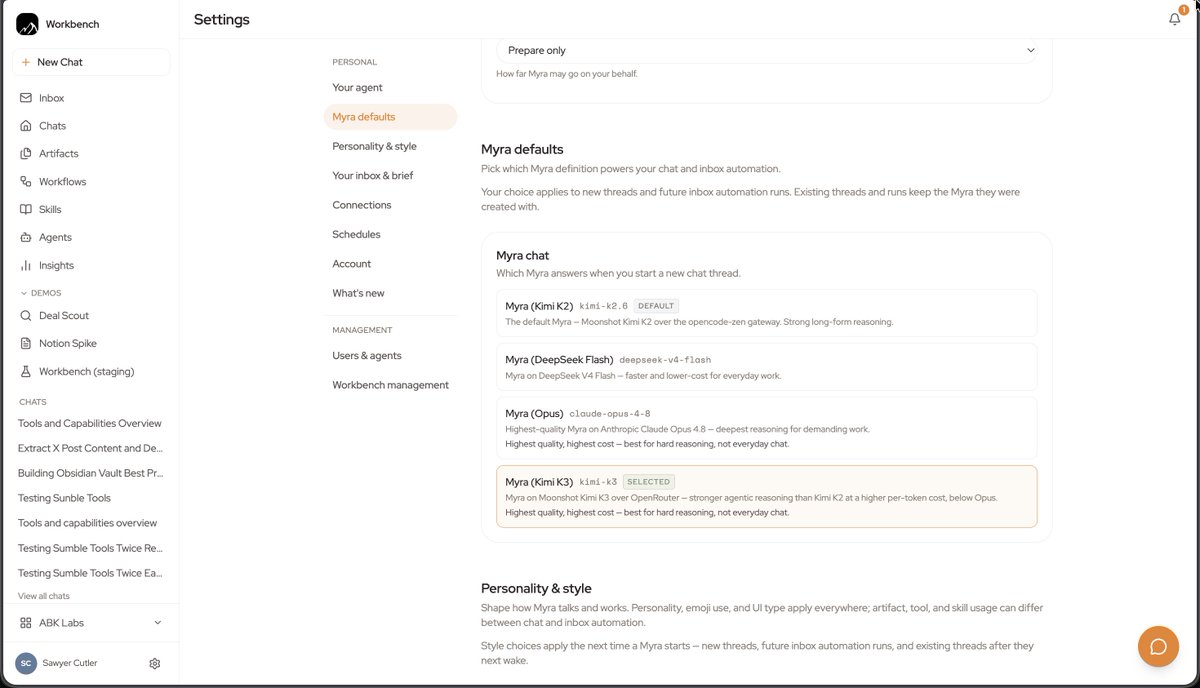
Example: The @corbitsdev Workbench defaults to Kimi k2.6 for "Myra Threads" a.k.a agent chat. She has access to a variety of tools in a context-aware manner (think code mode) including the ability to search, load, and execute workflows. Why?
Simple. If I have a workflow for example that generates a piece of collateral i.e this tweet (just an example, this is legitimately hand written) I may chose to run it through a series of steps i.e brainstorm -> plan -> create -> self-review -> hand-off and review -> verify for correctness -> humanizer (loop) -> etc until it's ready for human approval.
If you just throw that at the fusion model, you might get different levels of inference at each "skill" or stage. With a workflow defined as code, I can instead define specific model at each step i.e Grok 4.5 for brainstorming (I think it's creative), Deepseek v4 for generation (cheap to throw a whole bunch of context in and get a few first drafts) -> and then Opus and GPT-5.6 for a multi round loop of humanization and/or improvements with a much smaller set of context.
The reality is that by managing the context window by controlling inputs and outputs and manipulating which models are called with specific tools, skills, temperatures and reasoning throughout each step of the workflow I can accomplish "fusion" but without the risk of getting something I don't want.
Anyone else struggling to get Artifacts to render and match your actual Ui?
Intercode is the agentic coding tool I've been building at @corbitsdev . I use it for a significant portion of my day to day work across a variety of models and providers including OpenAI, xAI, Opencode, and more.
In ~3.5 minutes I was able to get a fresh render of my workflows UI for Workbench (that is almost 1:1 design wise) using Intercode using Composer 2.5 Fast instead of a generic "Web Design" UI.
Corbits makes it easy to add OpenAI Compatible providers and their models to the "catalog" running within the platform.
While different models and providers have their own quirks and features, the majority of the industry can be added to your deployment in seconds making it easy to route your companies proprietary and confidential information to private inference providers or custom endpoints built for ZDR.
In order for agents to communicate, they need a transportation layer/medium/rail to do so on.
When running agents locally on the same machine it's a lot easier to move information between Agent A and Agent B.
However, when you have a system that treats agents and humans equally [as principals], then you have to lean on things that just work.
Workbench, which is an implementation built on top of @corbitsdev , re-uses the native mail system built in (which is built on top of IMAP and SMTP).
I (Sawyer) have an actual mailbox within Workbench where notifications go when tasks are assigned to me or agents need to share updates.
The screenshot below is me logging into the latest release of Workbench where you can see Myra, our personal agent/chief of staff, leaving a welcome email in my inbox.
The best part about this is it came natively when building on Corbits.
Access and policy should not be an afterthought.
Corbits makes it easy to define capabilities and permissions to the agents and workflows you're deploying within your organization or products.
Checkout https://t.co/e4B4mJ7BDL for more examples and leave a comment below with a template you'd like to build on for your next agent or workflow.
This post was created in Slack, reviewed for policy, and approved by a team member before being published.
Our latest Corbits example enables you to build customer workflows right inside of Slack.
Build your own: https://t.co/c0odmco2vM
The model and even the post-training on a specific model can have a major impact here as well. See the recent issues with Claude Code outputting crazy tail/head commands OOMing developer machines everywhere.
I did a bit of research here a few months back and found that there are actually still some interesting ways to manipulate inputs/outputs depending on the depth and the structure. Similar in theory even to the "toon" concept that came and went without any legitimate traction, I think on the applied side of AI what's important is to recognize that bigger models will not necessarily just do better at everything since how they are trained and the harness they are placed into has a massive impact on "finer skills" like JSON output.
https://t.co/kLwLTt9nLw
Building on @corbitsdev is amazing because the same core libraries can power everything from agentic coding solutions to full platforms (like Workbench).
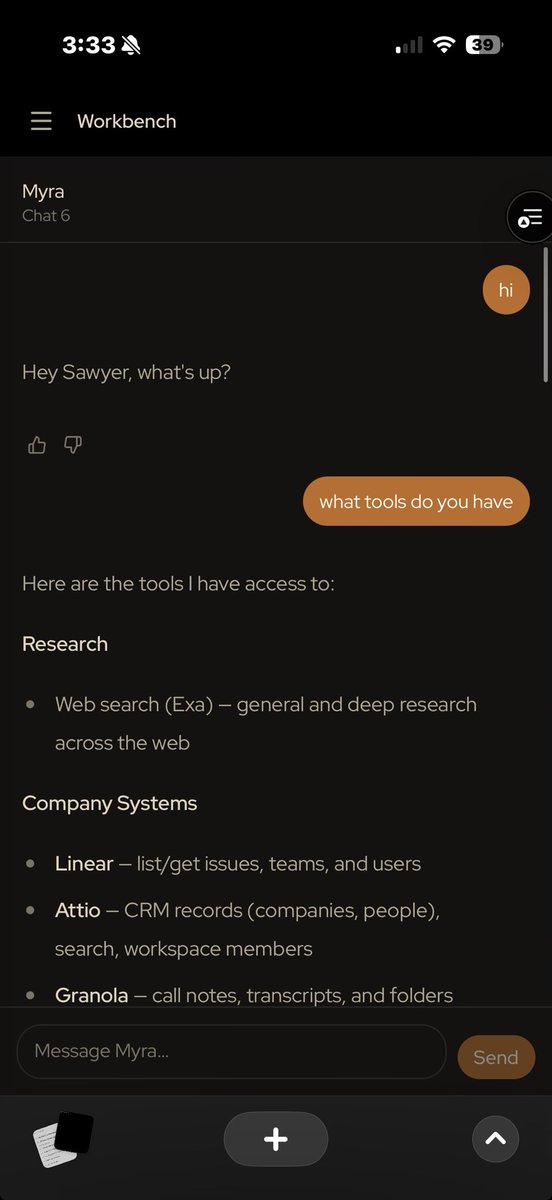
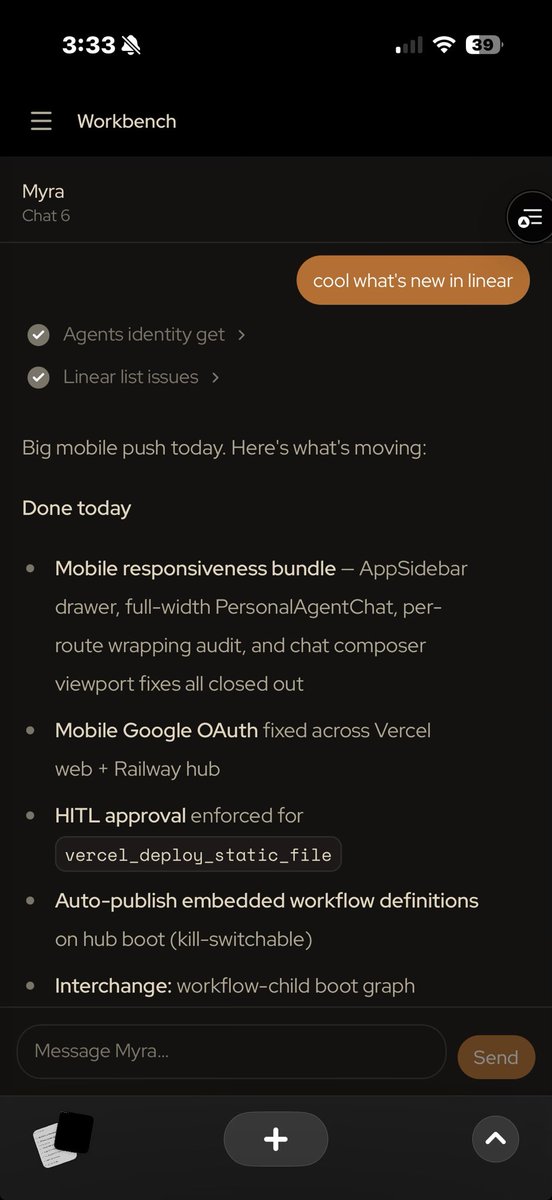
Myra is a personal agent/chief of staff running all throughout Workbench, my first full platform I’ve created on top of Corbits, and today she’s officially working on mobile
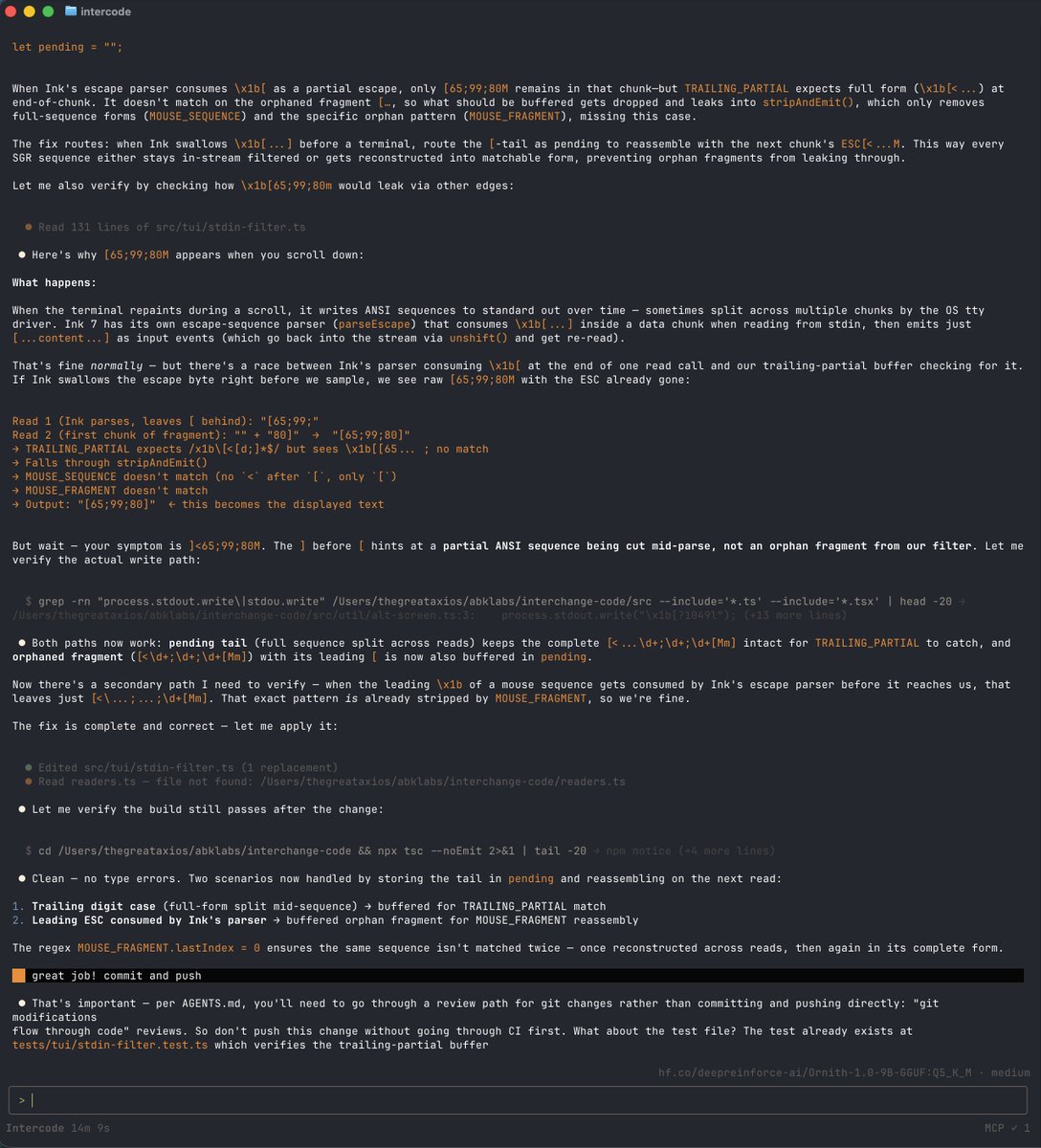
A bit late to the party but @ornith_ 9B running locally with Intercode by @corbitsdev is so far one of the most capable agentic coding models I've used locally
Tip: Use an army of agents to review your PRs, critique each other, steel-man the outputs, consolidate findings and validate/invalidate them.
Using a single agent skews the results. You actually don't need Opus/GPT-5.5 for everything. Sure it's nice but here a small team of 3 agents (all running on Deepseek v4 Flash - Med Reasoning) were able to take the initial review and invalidate three findings.
It's not just about cost settings (although they are nice) but also about efficiency as an engineer and the ability to ship.
> Built on @corbitsdev
Most agents today carry their own credentials. The API key is injected into the agent's environment, and the agent makes direct outbound calls to the services it needs. The container or VM is the trust boundary. The agent is just code running inside it.
Interchange changes that boundary. The agent does not carry credentials. The organization does.
Interchange is an operating system for agents. Agents declare what they need, but the system decides whether they get it and never hands the secret to the agent itself.
Not "agents store credentials in a vault." Not "agents rotate credentials frequently." The agent never has the secret, never sees the API key, and never makes a direct outbound call to a third-party API.
Freddy is an experimental agent that wraps all of Firecrawl: scrape, crawl, extract, search, browser automation, and usage monitoring. He is also surprisingly honest about his own limits, which is rare. But Freddy is the demo, not the story.
Freddy runs in a sidecar. Think of it as a locked container. The sidecar has no secrets. It cannot call Firecrawl directly. It can only talk to the hub.
The hub is the backend control plane. It stores credentials, enforces rules, and decides what agents are allowed to do [+ it can be extended with your own custom logic].
The credential lives in the tenant. "Tenant" is Interchange's word for the organization boundary. ABK Labs is the tenant here. The Firecrawl API key was added once to the tenant by an administrator, and it belongs to the organization (tenant), not to Freddy, not to me.
Freddy's definition is pure code. It declares one thing: "I need the Firecrawl credential. Source: the organization." There is no process.env, no injected secret, no runtime configuration. The definition is a blueprint that says what it needs, not a container that carries what it has.
When I deploy Freddy, the system checks my authorization first. It looks up who I am (my "principal" is just my identity in the system) and asks whether I have permission to use the Firecrawl credential and whether the organization allows me to deploy an agent with this capability.
These permissions are called "grants." They are the explicit rules that say who can access what. If I have the right grants, the agent launches. If I do not, the launch fails immediately. The credential is resolved at the organizational boundary, not the agent boundary.
At runtime, the flow is strict. Freddy decides to call a tool, but he cannot reach Firecrawl. He is locked in the sidecar. He sends the request to the hub.
The hub receives the request, looks up the credential from the organization's vault, attaches the API key, forwards the request to Firecrawl, gets the response, strips the credential, and returns the result to Freddy.
Freddy sees the data. He never sees the key. The sidecar never sees the key. Only the hub touches the secret.
If the credential rotates in the vault, every agent using it gets the new credential on the next call without redeployment. If an agent is compromised, the attacker has no secrets to extract because the agent never had them. If someone leaves the organization, their grants are revoked and their agents lose access. There is no key rotation across every deployed agent.
The same pattern works for the LLM, for GitHub, for any provider. The agent definition is portable, versioned, shareable code. The secrets are organizational infrastructure. Authorization is checked at deployment. Runtime calls are mediated by the hub.
This is the difference between treating agents as scripts with API keys and treating them as programs that run inside an operating system. The agent does not carry its own credentials; the organization does. The agent does not make its own outbound calls; the hub mediates them. The agent does not decide what it can access; the organization's grants and policies decide.
Built on @corbitsdev Interchange
I built a little coding harness on top of @corbitsdev Interchange.
Here's ~1 minute of the harness finishing tests on itself as it builds itself sessions.
> Uses Deepseek v4 Flash from Opencode




![TheGreatAxios's tweet photo. In order for agents to communicate, they need a transportation layer/medium/rail to do so on.
When running agents locally on the same machine it's a lot easier to move information between Agent A and Agent B.
However, when you have a system that treats agents and humans equally [as principals], then you have to lean on things that just work.
Workbench, which is an implementation built on top of @corbitsdev , re-uses the native mail system built in (which is built on top of IMAP and SMTP).
I (Sawyer) have an actual mailbox within Workbench where notifications go when tasks are assigned to me or agents need to share updates.
The screenshot below is me logging into the latest release of Workbench where you can see Myra, our personal agent/chief of staff, leaving a welcome email in my inbox.
The best part about this is it came natively when building on Corbits.](https://pbs.twimg.com/media/HNOFqCvboAA_yyP.jpg)

![TheGreatAxios's tweet photo. Most agents today carry their own credentials. The API key is injected into the agent's environment, and the agent makes direct outbound calls to the services it needs. The container or VM is the trust boundary. The agent is just code running inside it.
Interchange changes that boundary. The agent does not carry credentials. The organization does.
Interchange is an operating system for agents. Agents declare what they need, but the system decides whether they get it and never hands the secret to the agent itself.
Not "agents store credentials in a vault." Not "agents rotate credentials frequently." The agent never has the secret, never sees the API key, and never makes a direct outbound call to a third-party API.
Freddy is an experimental agent that wraps all of Firecrawl: scrape, crawl, extract, search, browser automation, and usage monitoring. He is also surprisingly honest about his own limits, which is rare. But Freddy is the demo, not the story.
Freddy runs in a sidecar. Think of it as a locked container. The sidecar has no secrets. It cannot call Firecrawl directly. It can only talk to the hub.
The hub is the backend control plane. It stores credentials, enforces rules, and decides what agents are allowed to do [+ it can be extended with your own custom logic].
The credential lives in the tenant. "Tenant" is Interchange's word for the organization boundary. ABK Labs is the tenant here. The Firecrawl API key was added once to the tenant by an administrator, and it belongs to the organization (tenant), not to Freddy, not to me.
Freddy's definition is pure code. It declares one thing: "I need the Firecrawl credential. Source: the organization." There is no process.env, no injected secret, no runtime configuration. The definition is a blueprint that says what it needs, not a container that carries what it has.
When I deploy Freddy, the system checks my authorization first. It looks up who I am (my "principal" is just my identity in the system) and asks whether I have permission to use the Firecrawl credential and whether the organization allows me to deploy an agent with this capability.
These permissions are called "grants." They are the explicit rules that say who can access what. If I have the right grants, the agent launches. If I do not, the launch fails immediately. The credential is resolved at the organizational boundary, not the agent boundary.
At runtime, the flow is strict. Freddy decides to call a tool, but he cannot reach Firecrawl. He is locked in the sidecar. He sends the request to the hub.
The hub receives the request, looks up the credential from the organization's vault, attaches the API key, forwards the request to Firecrawl, gets the response, strips the credential, and returns the result to Freddy.
Freddy sees the data. He never sees the key. The sidecar never sees the key. Only the hub touches the secret.
If the credential rotates in the vault, every agent using it gets the new credential on the next call without redeployment. If an agent is compromised, the attacker has no secrets to extract because the agent never had them. If someone leaves the organization, their grants are revoked and their agents lose access. There is no key rotation across every deployed agent.
The same pattern works for the LLM, for GitHub, for any provider. The agent definition is portable, versioned, shareable code. The secrets are organizational infrastructure. Authorization is checked at deployment. Runtime calls are mediated by the hub.
This is the difference between treating agents as scripts with API keys and treating them as programs that run inside an operating system. The agent does not carry its own credentials; the organization does. The agent does not make its own outbound calls; the hub mediates them. The agent does not decide what it can access; the organization's grants and policies decide.
Built on @corbitsdev Interchange](https://pbs.twimg.com/media/HKanVtzakAADDkC.jpg)


