🚨 US STOCK WATCHLIST UPDATE 📈
Want to keep an eye on potential opportunities in the US stock market?
I share: ✅ Stocks on my radar ✅ Key market trends ✅ Important price levels ✅ Trading setups worth watching
Want the latest watchlist?
👇 Add me on WhatsApp: https://t.co/H9DhwXtz7q
Send “Stock List” and I’ll share the latest available updates.
Follow the data. Manage the risk. Stay ahead of the market. 📊
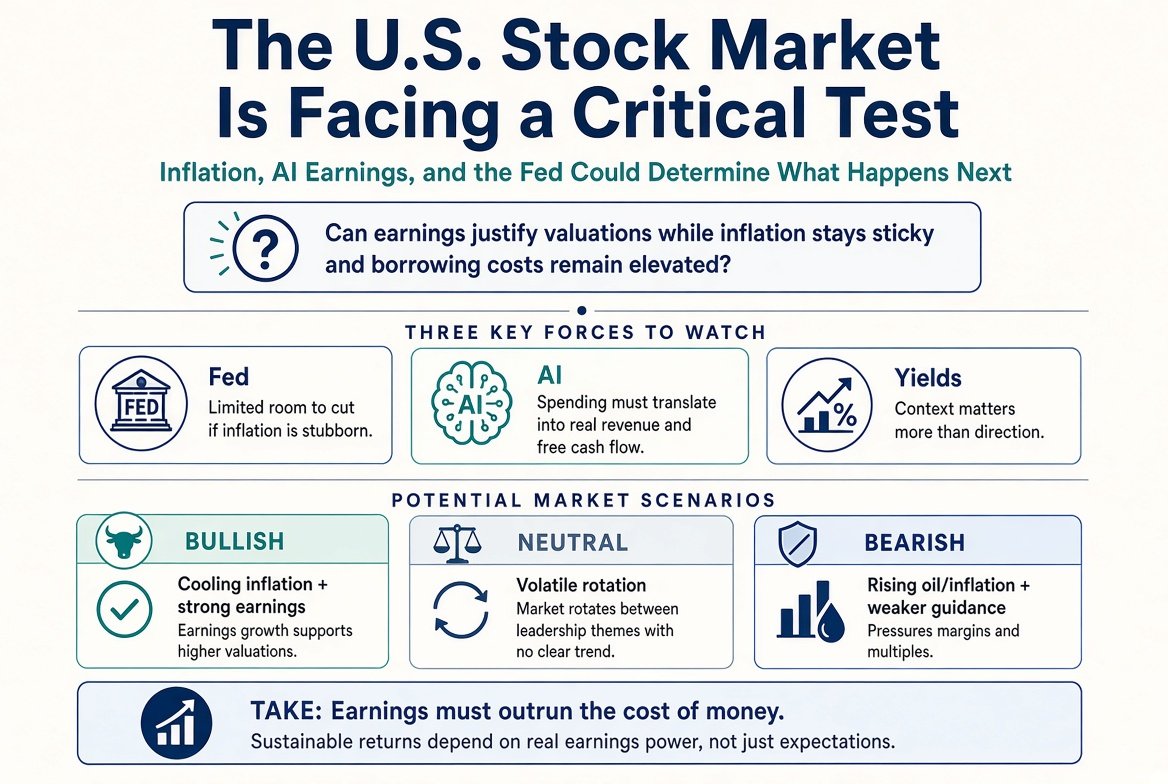
The U.S. Stock Market Is Facing a Critical Test
Inflation, AI Earnings, and the Fed Could Determine What Happens Next
The biggest question facing Wall Street right now is not whether the U.S. economy is growing.
It's whether corporate earnings can justify current stock valuations while inflation remains a concern and borrowing costs stay elevated.
Three forces could shape the next major move in the market.
1. The Fed Is Still the Market's Biggest Macro Variable
Investors want lower interest rates. But the Federal Reserve cannot simply cut rates because markets want relief.
If inflation remains stubborn, policymakers may have limited room to ease monetary policy.
That creates a difficult trade-off:
Strong economic growth supports corporate earnings, but it can also keep interest rates higher for longer.
And higher rates can put pressure on stock valuations, especially companies whose prices depend on profits expected years into the future.
Strong economic data does not automatically mean higher stock prices.
2. AI Is a Growth Story. But Is It a Good Investment at Any Price?
AI remains one of the most important long-term investment themes in the market.
But the conversation is changing.
Investors are increasingly asking whether massive AI infrastructure investments will generate enough revenue, profits, and free cash flow to justify their costs.
Three things matter:
How much are companies spending?
How quickly are those investments generating returns?
How much future growth is already reflected in stock prices?
Even a great company can be a poor investment if expectations are too high.
The next stage of the AI trade may reward companies that demonstrate financial returns—not simply companies that promise technological breakthroughs.
3. Treasury Yields Could Become the Market's Pressure Point
The 10-year Treasury yield is one of the most important indicators to watch.
Higher yields can make bonds more competitive with stocks and reduce the present value of future earnings.
That is particularly important for expensive growth stocks.
But context matters.
If yields decline because inflation is cooling, equities may benefit.
If yields decline because the economy is deteriorating sharply, stocks may still struggle.
Investors need to understand why yields are moving, not just whether they are rising or falling.
4. Oil Could Complicate Everything
Higher oil prices can create a difficult environment for both consumers and policymakers.
Energy inflation can squeeze household budgets, increase business costs, and make it harder for the Fed to ease policy.
Airlines, transportation companies, and other energy-sensitive businesses could face additional pressure.
If oil prices rise while inflation remains elevated, the market may have to reassess its expectations for interest-rate cuts.
5. Three Possible Market Scenarios
Bullish: Inflation cools, yields stabilize, earnings remain strong, and market participation broadens.
Neutral: Earnings hold up, but interest-rate uncertainty keeps stocks volatile and drives sector rotation.
Bearish: Oil and inflation rise, yields climb, and companies begin lowering earnings guidance.
The key is to watch the evidence rather than become emotionally attached to one forecast.
My Take
I am watching three things more closely than anything else:
The direction of Treasury yields.
Whether AI spending translates into actual earnings and cash flow.
Whether market strength broadens beyond a small group of mega-cap stocks.
If earnings remain strong and inflation moderates, equities could find further support.
If inflation accelerates while financing costs rise, even high-quality companies may face valuation pressure.
The next major move in the stock market will depend on whether earnings can outrun the cost of money.
That is the real battle Wall Street needs to win.
What matters more for the next market move: the Fed, AI earnings, or Treasury yields?
#StockMarket #SP500 #FederalReserve #AIStocks #Investing
For informational purposes only. Not investment advice.
🇺🇸 US MARKET OUTLOOK | OCT 20
The rebound is broadening—but tech leadership remains unconvincing.
The Dow is up ~1%, the S&P 500 ~0.4%, and the Nasdaq ~0.2% as healthcare and financials lead and oil retreats from recent highs.
Here’s my watchlist:
$NVDA / $AMD — Can AI demand justify infrastructure spending? $META — Will AI monetization outweigh rising capex? $TSLA — Can margins and cash flow support its growth premium? $NFLX — Will guidance confirm durable growth?
The key signal isn't just whether stocks beat earnings estimates. It's how management guides—and how the market reacts.
My take: Improving breadth, but no confirmed all-clear for tech.
Watch earnings, free cash flow, and forward guidance before chasing the rebound.
#Stocks #SP500 #Nasdaq #AIStocks #Earnings
🇺🇸 US MARKET UPDATE | OCT 20
Stocks are rebounding as oil cools and Treasury yields ease.
But don’t mistake macro relief for an all-clear.
Three signals matter now:
• OIL: Is the pullback sustainable, or is geopolitical risk still underpriced? • RATES: Are lower yields easing valuation pressure—or signaling weaker growth? • EARNINGS: Can AI leaders turn record capex into durable free cash flow?
Weak housing data is another reminder that elevated borrowing costs are still working through the economy.
Tonight’s $NFLX results and the latest $SPCX earnings will test more than EPS: investors want evidence of sustainable growth and capital discipline.
My take: Cautiously constructive, but confirmation matters more than the bounce.
#SP500 #Nasdaq #AIStocks #Macro #Earnings
🇺🇸 US MARKET UPDATE | OCT 20
The early selloff is giving way to a broader rebound.
📈 Dow: +1.2% 📈 S&P 500: +0.7% 📈 Nasdaq: +0.6%
Oil has pulled back from its highs, while healthcare and financials are leading. Market breadth has improved sharply.
But don’t confuse a relief rally with a confirmed bottom.
The real test: Can earnings support valuations while AI capex, financing costs, and geopolitical risks remain in focus?
Tonight’s $NFLX results—and the market’s reaction—matter more than the headline EPS beat.
My take: Constructive on breadth, cautious on confirmation.
#SP500 #Nasdaq #Earnings #AIStocks
🇺🇸 US MARKET OUTLOOK | OCT 20
A key divergence is emerging:
📉 Nasdaq 100 futures: ~-0.6% 🛢��� Brent crude: above $111 📉 10Y Treasury yield: below 5.11%
Lower yields aren't automatically bullish.
If yields fall on safe-haven demand while oil fuels inflation risk, equities still face a difficult setup.
The bigger question: Can AI earnings justify rising capex, financing costs, and lofty expectations?
My stance: Cautious, not outright bearish. Watch free cash flow, earnings guidance, and market breadth before calling a durable rebound.
#SP500 #Nasdaq #AIStocks #Markets
🇺🇸 US MARKET INSIGHT | OCT 20
The market is no longer trading one simple macro narrative.
The Dow is holding up better than the Nasdaq, while Brent crude remains above $110.
Three forces are colliding:
Higher energy costs threaten margins.
Sticky inflation limits policy flexibility.
AI capex must translate into sustainable free cash flow.
This week’s earnings are a test of capital discipline—not just EPS.
My framework: Follow earnings revisions, cash conversion, and market breadth—not headline index moves.
The key question: Is this healthy sector rotation, or the early stage of broader earnings risk?
#StockMarket #SP500 #Nasdaq #AIStocks #Earnings
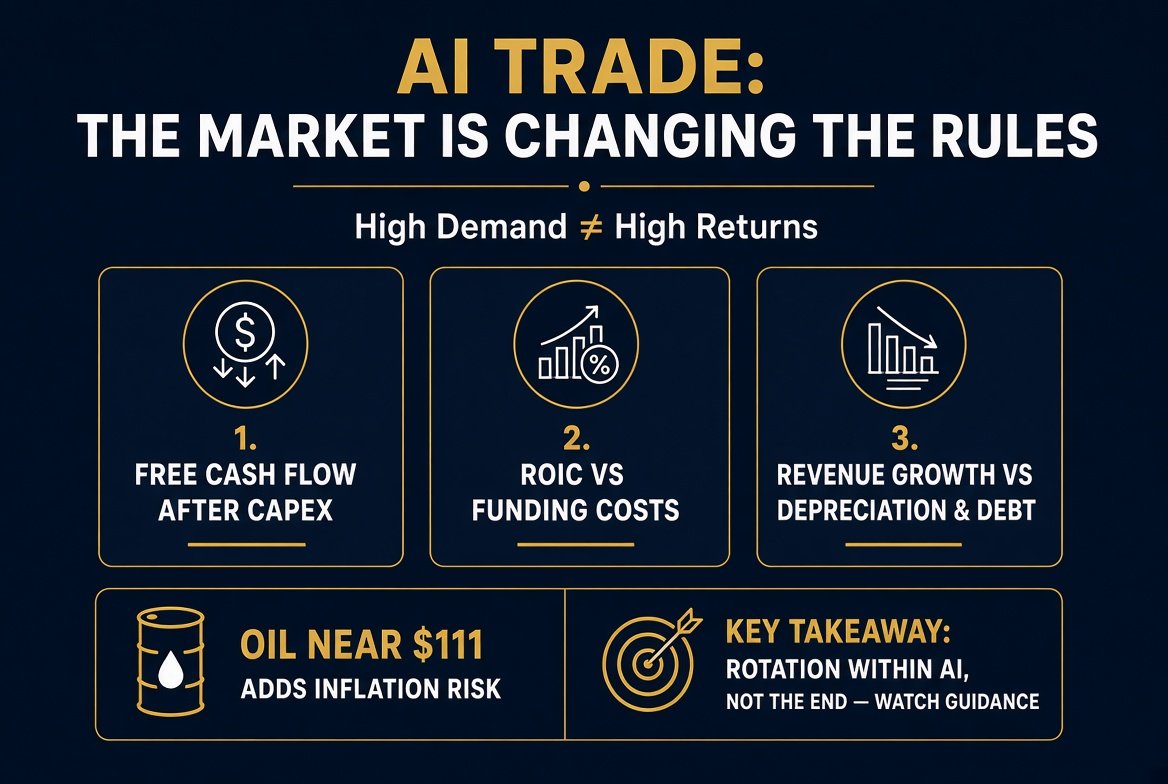
AI TRADE: THE MARKET IS CHANGING THE RULES.
The question is no longer just how fast AI demand grows.
It’s whether returns can justify the capital required to meet that demand.
Three metrics matter now:
• Free cash flow after capex • Return on invested capital vs. funding costs • Revenue growth relative to depreciation and debt
High demand ≠ high returns.
As oil near $111 adds inflation risk, capital-intensive AI names face a tougher test.
This may be a rotation within AI—not the end of AI.
Watch earnings guidance, not just EPS beats.
#AIStocks #NVDA #Nasdaq #Earnings $NVDA
🇺🇸 US MARKET ALERT | OCT 20
Today’s setup reveals a deeper problem for equities.
📉 Nasdaq 100 futures: -0.6% 🛢️ Brent crude: above $110 📊 10Y Treasury yield: below 5.12%
Why aren’t lower yields lifting tech?
Because this selloff isn’t just about discount rates. Investors are questioning AI capex returns, debt-funded expansion, and future free cash flow.
The real test this week: Can earnings validate the spending?
Watch $NFLX today, then $META and $TSLA Wednesday.
My view: Selective market, not a confirmed bottom.
#Stocks #Nasdaq #AI #Earnings
📊 US STOCK MARKET OUTLOOK | OCT 20
Monday's tech rebound is already facing fresh pressure.
Three forces are driving the market right now:
🛢️ Oil: Brent crude near $111 raises renewed inflation concerns.
📈 Interest rates: Higher Treasury yields can pressure equity valuations, especially long-duration growth stocks.
🤖 AI earnings: Investors want proof that massive AI spending can generate sustainable profits and free cash flow.
My market framework:
• Bullish: Oil cools, yields stabilize, and earnings guidance improves. • Neutral: Strong earnings offset by elevated financing costs. • Bearish: Inflation risks rise while AI returns disappoint.
The key question isn't whether the market can bounce.
It's whether the rebound has enough breadth and fundamental support to last.
I'm watching market breadth, Treasury yields, and earnings guidance before chasing strength.
What's your view: another buying opportunity, or more volatility ahead?
#StockMarket #SP500 #Nasdaq #AIStocks #Investing
📊 THE AI TRADE IS ENTERING A NEW PHASE.
The market is no longer rewarding AI spending alone. Investors want proof that massive investments can generate sustainable earnings and free cash flow.
Two stocks I'm watching closely:
🔹 $NVDA — The AI infrastructure leader
NVIDIA's growth outlook remains powerful, but the key questions are margins, supply constraints, competitive pressure, and whether earnings can keep pace with expectations.
🔹 $AMZN — The cloud monetization story
AWS revenue grew 37% YoY in Q2 2026. But Amazon's trailing 12-month free cash flow turned negative as AI-related capital spending surged.
That's the real debate: growth versus return on invested capital.
📌 My framework: • Track revenue growth. • Monitor margins and free cash flow. • Compare valuation with realistic earnings expectations. • Never confuse a strong business with a stock that's attractive at any price.
The next phase of AI investing may reward capital discipline as much as technological leadership.
Which would you research first: $NVDA or $AMZN?
Follow for data-driven US stock analysis, earnings breakdowns, and market insights.
#NVDA #AMZN #AIStocks #StockMarket
@Barchart That’s a massive vote of confidence in global equities. 📈
But the bigger question is where that capital is flowing — and whether earnings growth can justify current valuations.
Capital flows tell us where money is going. Fundamentals tell us whether it should stay
That’s a massive vote of confidence in global equities. 📈
But the bigger question is where that capital is flowing — and whether earnings growth can justify current valuations.
Capital flows tell us where money is going. Fundamentals tell us whether it should stay.
📊 US STOCK MARKET: THE AI TRADE FACES A CRITICAL TEST
Monday's rebound was encouraging, but one green session doesn't confirm a trend reversal.
Here's what I'm watching this week:
🔹 $META — AI monetization vs. rising capex
🔹 $TSLA — Auto margins, free cash flow & autonomy
🔹 $SPCX — Starlink growth and AI spending returns
🔹 $LRCX — Semiconductor equipment demand
🔹 $NVDA / $AVGO — AI infrastructure demand and sector momentum
The bigger issue isn't whether companies are spending billions on AI.
It's whether those investments can generate sustainable earnings and free cash flow.
Three signals matter most: 1️⃣ Treasury yields
2️⃣ Earnings guidance
3️⃣ Price action backed by volume
My view: Stay selective. A rebound is an opportunity to reassess risk—not a reason to chase every AI stock.
Are you buying this dip or waiting for earnings confirmation?
#StockMarket #AIStocks #GrowthStocks #Investing
📊 US MARKET OUTLOOK: AI & GROWTH STOCKS
The Nasdaq rallied 1.78% on Monday, Oct. 19, as AI-related stocks rebounded after last week's selloff.
But don't confuse a relief rally with a confirmed trend reversal.
Here's what I'm watching:
🔹 $NVDA : AI chip demand, margins & order visibility.
🔹 $MSFT / robinhood:0x12f190a9f9d7d37a250758b26824b97ce941bf54 / $GOOGL: Cloud growth, AI monetization & capital spending returns.
🔹 $META : Ad growth, AI-driven efficiency & spending discipline.
🔹 High-debt AI infrastructure stocks: Financing costs and free cash flow deserve extra scrutiny.
3 factors will drive the next move:
1️⃣ Treasury yields and interest-rate expectations
2️⃣ Earnings growth versus AI infrastructure spending
3️⃣ Management guidance on margins, cash flow & future demand
My thesis: AI remains a major long-term growth theme, but stock selection matters more as valuations and financing risks come under pressure.
The next winners may not simply be the companies spending the most on AI — but the ones turning that spending into sustainable earnings.
Are you buying the AI dip, or waiting for earnings confirmation?
#AIStocks #NVDA #GrowthStocks #StockMarket
🚨 SpaceX ($SPCX): A $10B Promise — But What Does It Mean for Investors?
Elon Musk says he plans to give one SpaceX share to every American child in 2027.
At roughly $146 per share and an estimated 73 million U.S. children, the pledge implies a potential transfer worth more than $10.6 billion at that reference price. The actual value will fluctuate with the stock.
But investors should look beyond the headline.
📊 1. VALUATION MATTERS
SpaceX combines several major growth opportunities: satellite broadband through Starlink, launch services, and the longer-term potential of Starship.
The upside is significant, but expectations matter. Even a transformative business can be a poor investment if its valuation already prices in too much future growth.
🚀 2. GROWTH VS. EXECUTION RISK
Investors should monitor Starlink subscriber growth, operating margins, launch economics, capital expenditure, and Starship's development milestones.
Revenue growth alone isn't enough. The key question is whether growth translates into sustainable free cash flow.
⚠️ 3. THE SHARE GIVEAWAY IS NOT AN INVESTMENT THESIS
The proposed distribution could introduce millions of children to stock ownership, but the mechanics remain unclear.
Who qualifies? How will shares be transferred? What restrictions apply? And what happens when recipients become eligible to sell?
Until those details are confirmed, the pledge should be treated as a proposal—not a completed transaction.
📈 4. WHAT LONG-TERM INVESTORS SHOULD WATCH
• Revenue growth and profitability
• Free cash flow versus capital spending
• Starlink's competitive position
• Starship's technical and commercial progress
• Valuation relative to realistic future earnings
My takeaway: SpaceX may have extraordinary long-term potential, but a compelling business story doesn't automatically make a compelling stock at every price.
The best investors separate the narrative from the numbers.
Would you hold $SPCX for the next 10 years, or wait for a more attractive valuation?
#SpaceX #Stocks #Investing #StockMarket