If you buy a cup of coffee that costs $4.00:
• At $0.04: You pay 100 KAS.
• At $10.00: You pay 0.4 KAS.
• At $50.00: You pay 0.08 KAS.
But the real question is what will happen to fees?
Current fee is ~0.003 $KAS ($0.00012).
Will it stay the same? 🧵
🧊 What if Hal Finney was never really gone?
There’s a theory that Hal Finney was Satoshi Nakamoto 👀
The first person to receive Bitcoin. One of its earliest developers. A cryptographer who was there from the very beginning. ₿
And today, Hal is cryogenically preserved.
His body was frozen after his death, waiting for a future where science might be able to cure ALS, repair the damage and bring him back. 🧬🔬
Frozen between the past and a future that doesn’t exist yet. 🧊
Imagine a world where scientists finally find the cure…
And Hal Finney wakes up. 👁️
What would be the first thing he would say?
“I am Satoshi.” ₿🧊
$KAS Fam:
Below is a VERY BASIC overview of $KAS since 2023, for the newbies and for those who need a digestible reminder of the technical marvel that is Kaspa!!!
Kaspa rebuilt the software so it could go faster
From 2023 into 2025, the team rewrote the core program in a faster language (Rust). Think of it as replacing an old engine so the car can handle higher speed without falling apart. That rewrite is what made the later upgrades possible.
May 2025: ten times more blocks. Before this, Kaspa produced about one block per second. After the “Crescendo” upgrade, it produces about ten per second.
A block is a small package of transactions. More blocks per second means payments can confirm faster and the network can handle more traffic.
The rules for mining difficulty and storage were also tightened so the extra speed would not clog the system or make junk transactions cheap.
June 2026: the money got simple rules attached. Until then Kaspa was mostly “send coins from A to B, quickly.”
The “Toccata” upgrade added two useful tools: Spending rules on the coins themselves. You can say things like “this money can only move after a date,” or “it can only go to this kind of address,” or “it must follow these steps.” Useful for vaults, escrow, and scheduled payments - without a separate app chain.
Proof checks. Someone can do heavy work off the network, then hand Kaspa a short mathematical proof that the work was done correctly. Kaspa checks the proof instead of redoing all the work. That is the hook for side networks and more advanced apps.
They also added a programming language (SilverScript) so developers can write those rules more easily, and they split transaction records into lanes so an app only has to prove its own activity, not the whole network’s.
September 2026: maintenance and security. A node update made syncing smoother for people running the software and closed some security gaps in how nodes talk to each other and to mining pools. It did not change how fast the network runs.
What is still planned, not live, a smarter consensus system (DAGKnight) that adapts to real network conditions instead of fixed settings.
Even higher speed later, with talk of up to about 100 blocks per second around 2027. Richer apps that can share state, still in research.
Bottom line: Kaspa went from a fast payment coin to a fast payment coin that can also carry simple programmable rules and checks.
It is built so many blocks can be added at once instead of waiting in a single line.
The big speed jump already happened in 2025. The “smart money” features arrived in mid-2026.
The next leap in speed is still on the drawing board. Kaspa is a digital money network, like Bitcoin, that people can EASILIY mine with computers.
Please share this article so more people can understand Kaspa better and ultimately bring them into this amazing community.
In my typical fashion, $KAS is king!!!
3/3
The real test is in the details: the price in KAS, how volatility is handled, and protections for buyers and sellers. Bayit has yet to explain how payment will work. Crypto community: what would it take for you to buy a home with $KAS? Reply and share 👇
2/3
Why does blockDAG matter? Kaspa orders blocks produced in parallel instead of discarding them. Its network runs at 10 blocks per second, which can shorten the wait for on-chain confirmation. But a fast transaction doesn’t mean an instant property closing.
1/3
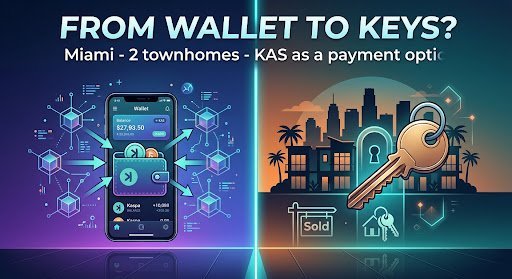
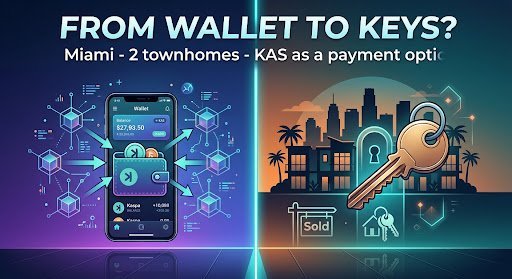
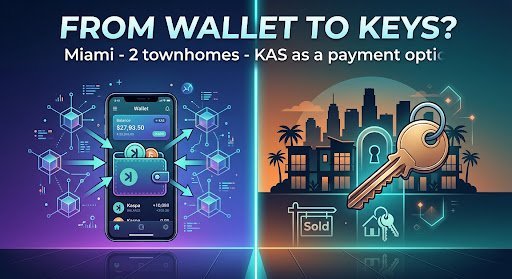
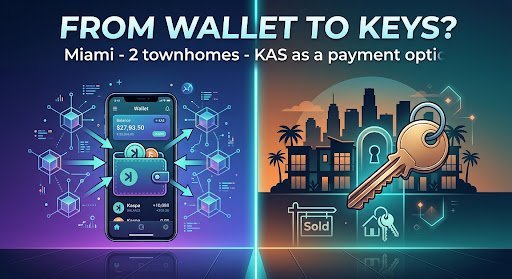
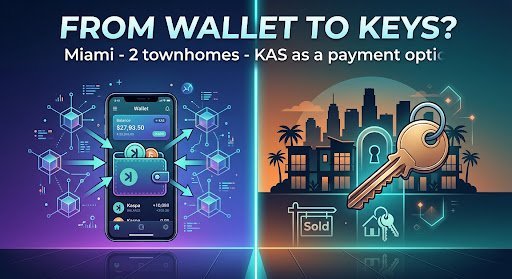
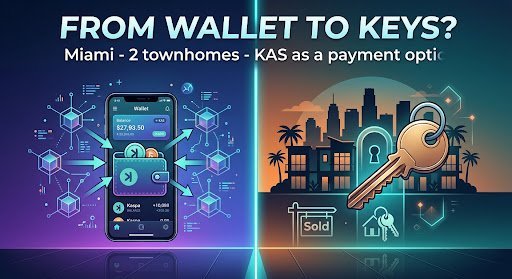
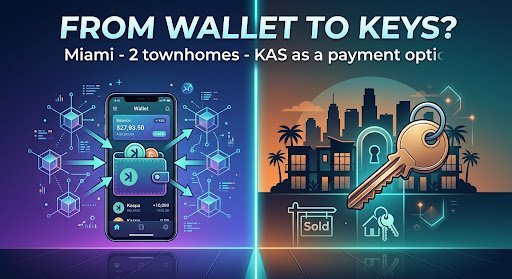
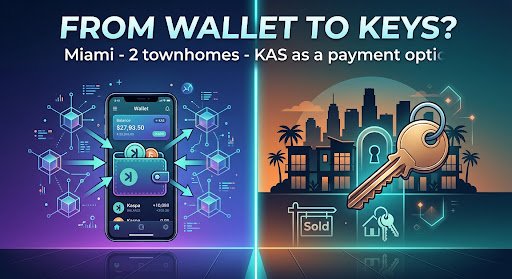
🏡 Buy a home with $KAS? Bayit Development plans to accept Kaspa for 2 luxury townhomes in Miami, with completion expected in March 2027. Crypto meets real estate—but will this become a real-world use case? 🧵
Kaspa’s recent pump has everyone watching the chart. 👀
But here’s the real question: is this a breakout—or just a moment of hype?
What’s your take on $KAS? 👇
#Kaspa#Crypto