Today we go live on mainnet with the Fusion Rollup, the world's first multi-ledger rollup, connecting 74 blockchain networks in one unified environment, built for institutions.
When I started @quantnetwork in 2015, the vision was simple: make blockchain work for institutions at scale across any network, without the complexity and fragmentation that's held the industry back.
For years, institutions had two bad options: bet everything on a single chain, or stitch together insecure bridges across many. Fusion refuses that trade-off. It connects to many networks at once, moving assets, settling transactions, and messaging across chains as built-in capabilities, not workarounds.
The breakthrough is unified assets. A example of a stablecoin like USDC or tokenised fund like BUIDL or any other digital assetspread across 7 chains collapses into one: uUSDC or uBUIDL. One asset, one liquidity pool, instead of 7 copies and 7 fragmented pools. Each stays anchored to its origin chain and is withdrawable anytime. No custody or compliance trade-offs.
This isn't another layer 2 or a blockchain. It's a new category of infrastructure and it's live.
Read more on: https://t.co/MGfs1FgA6T
→ https://t.co/OQBfu2CEZb
→ https://t.co/4o9nnaA7zc
#QuantFusion #EnterpriseBlockchain #MultiLedgerRolleUp #FusionRollup
I’m delighted to announce that @quantnetwork and Murex are partnering to bring tokenised deposits and digital bond settlement into MX.3.
Institutions have been asking the same question. How do we move forward with tokenisation without disrupting the trading, risk and post-trade operations we depend on?
The answer is now inside the platform they already use.
Tokenised RWAs just crossed $100 billion. DTCC has SEC approval to tokenise real-world assets from mid-2026 and major UK banks are already working with Quant through the Great Britain Tokenised Deposit initiative - all of which signals that the market is moving.
Users in banks, asset managers, insurance companies, pension funds, hedge funds, corporations and energy utilities in over 65 countries now have a production-ready path into tokenisation through the systems they already run.
The future of capital markets infrastructure is programmable: https://t.co/RmT2yVJ4SH
#Tokenisation #DigitalAssets #CapitalMarkets #Programmability
A decade in the making, we have published an ISO standard for blockchain interoperability.
This is a milestone I've been working towards since 2015, Remitt was founded with the conviction that blockchains could transform financial services but only if the industry solved interoperability and harmonised around global standards. Without that, blockchain would remain fragmented, siloed, and locked out of mainstream institutional adoption.
In April 2016, we published what was the world's first proposal for a blockchain standard (https://t.co/SL83Yl4Ejr) a bold move at a time when the industry was still largely focused on proofs of concept and competing protocol narratives, not standardisation.
The idea was simple but ambitious: if blockchains were going to serve global markets, they needed a common framework that transcended any single protocol or vendor.
Central to this thinking from the very beginning was the concept of a multi-gateway architecture, leveraging the know-how of 20 years of experience in cybersecurity to frame the principle that interoperability shouldn't depend on a single bridge or point-to-point connection, but on a layered gateway model that could abstract away the differences between underlying DLTs and connect them through a common interface. This was the architectural foundation of what would become Overledger, and it was also the design philosophy we brought to the standards process.
The belief was that a viable international standard for blockchain interoperability had to be protocol-agnostic and gateway-driven, enabling any DLT to communicate with any other DLT (any-to-any) and with existing networks, without requiring those ledgers to change how they operate. The standard and the technology were born from the same insight.
That same year, I worked closely with the team from @standardsaus (Standards Australia), who had the foresight in 2015 to champion the initiative at the international level. Together, we pushed for ISO to establish a dedicated Technical Committee for blockchain and not to be absorbed into an existing committee, but to stand on its own as a recognition that this technology warranted its own global standards programme. The industry demand was there, the use cases were multiplying, and the fragmentation was becoming a real barrier.
In September 2016, the New Work Item Proposal (NWIP) received global approval, and ISO formally gave the green light to establish a new Technical Committee (https://t.co/7biJjvHRk9). TC 307 — Blockchain and Electronic Distributed Ledger Technologies — was born (https://t.co/5SsFPIw0HH). The inaugural meeting was held in Sydney in April 2017, and from that moment the real work began.
As the standards work progressed internationally, the mission at Remitt was evolving too. What started as an effort to use blockchains for financial services and solve interoperability grew into something far larger, a full enterprise infrastructure platform for connecting any blockchain to any network. Remitt became Quant, and we built Overledger, the world's first blockchain operating system to deliver on that original vision. The multi-gateway architecture that informed the standards thinking became the core of Overledger's design: a technology layer that sits above all blockchains, providing institutions with a single integration point to access any DLT, any network, and any existing system. The interoperability challenge that drove the standards work was the same challenge we set out to solve commercially and the two efforts reinforced each other throughout.
For close to a decade since TC 307's formation, subject matter experts across the world have contributed their time and expertise to Working Group 7 — Interoperability is the committee I chair.
International standards are not built quickly they are built through consensus, technical debate, and relentless refinement. The same methodology and rigour that created the Internet, through publishing standards. The result is a published international standard for blockchain interoperability.
🔗 https://t.co/GRoR7fXNLQ
A huge thank you to @isostandards as the international standards developing organisation, to the team at @standardsaus who started the initiative in 2015 and worked tirelessly to get TC 307 approved and established globally, and to every subject matter expert who contributed to Working Group 7 over the years. This would not exist without that collective effort.
From a blog post proposing the world's first blockchain standard in 2016, to a published ISO standard in 2026 and from Remitt to Quant, from an architectural concept of multi-gateway interoperability to Overledger and a global standard, this has been a decade-long journey of building both the standards and the technology to make blockchain interoperability a reality for institutions worldwide.
There is still much more work ahead. More standards to develop, more to evolve, and more to build. But today, we mark a significant milestone.
#Blockchain #ISO #Interoperability #Standards #TC307 #DLT #Quant #Overledger
Delighted to share that @quantnetwork has been selected for the @bankofengland’s Synchronisation Lab as part of the RTGS Future Roadmap.
Our use case: atomic, multi-bank treasury operations powered by Quant Flow and PayScript®. All payment legs settle together or not at all, eliminating partial settlement risk across multiple banks in a single action.
This is programmable finance that works within existing market structures, not around them.
https://t.co/I5rmbsDLAu
#RTGS #TreasuryManagement #PaymentsInnovation #FinancialInfrastructure #SynchronisationLab #ProgrammableMoney
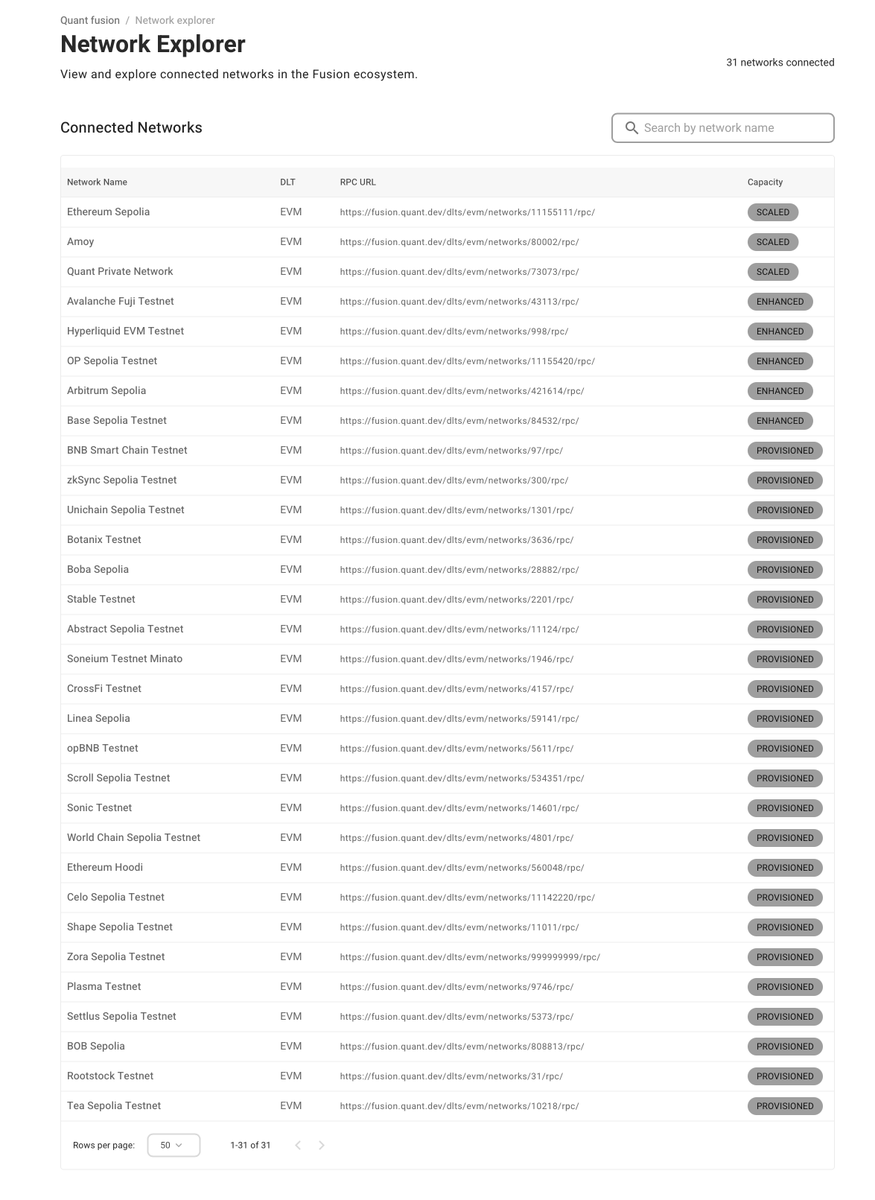
The Layer 2.5 Network of Networks @FusionLayer25 is coming together nicely!
31 Networks connected in the first hour! 🚀
Sign up and interoperate: https://t.co/N3rDK9bOYd
Stablecoins have moved digital money forward in important ways. They’ve shown what always-on, programmable value transfer can look like at scale.
Now we’re seeing the next phase.
Banks and market infrastructures are applying those lessons to regulated money through tokenised deposits, bringing programmability into the core of the financial system rather than around its edges.
As tokenised deposits and tokenised assets start to operate together, the impact goes beyond speed. It changes how settlement, liquidity, and risk are managed across markets.
I’ve shared some thoughts on why 2026 is shaping up to be a meaningful year for digital money.
https://t.co/9e8S6pMiGw
@quantnetwork
$QNT FUSION MAINNET → EARLY 2026 🔮
People are waking up����. Here’s why this is the biggest paradigm shift in crypto:
1️⃣ Internet 3.0 interoperability
→ Quant Fusion doesn’t even need to support a particular technology or network, as anyone can, at any time, integrate them into Fusion very easy. New to crypto.
HBAR & SUI integrated in just days.
2️⃣ Unified assets (no more wrapping)
→ One native representation for every token/digital asset/crypto project across all chains.
What Circle is trying to achieve for $USDC with ‘gateway’, Fusion does it better and makes this available for any token/digital asset
3️⃣ Quant Firewall + native privacy
→ Decentralised access control
→ CBDCs, bonds & tokenized equity trade freely with public pools while staying KYC/whitelisted.
4️⃣ No bridges · No wrappers · No oracles needed
→ A single execution context for all networks and legacy systems, secured by underlying consensus algorithms. Its like using blockchains as if they’re one, with origin chain security, multichain atomic composability and institutional grade liquidity.
5️⃣ Permissioned + permissionless in the same rollup for the first time
→ Use Corda/Besu assets as collateral in Ethereum DeFi — natively.
6️⃣ True multi-chain atomicity
→ Precompute & execute smart contracts across different L1s simultaneously.
Other interop like ccip just relays messages.
Fusion executes everything or nothing.
7️⃣ Low-code / 1-click deployment
→ Even a CEO can launch multi-chain apps.
8️⃣ Fully abstracted.
→ All chains. Gas abstracted.
9️⃣Multi-party, multi-chain smart contract composability
→ Multiple participants can run interconnected smart contracts across different blockchains as ONE unified workflow.
🔟Battle-tested by central banks & regulated institutions
→ Years of trust earned in private networks → now unleashed on public chains.
This isn’t another layer or bridge.
This is the end of fragmented liquidity.
$QNT Fusion = the real Internet of Blockchains.
Early 2026. Don’t say you weren’t warned🔮🔮🔮🔮🔮🔮🔮🔮
Quant Network: The Next Apple ?
Apple won by making the complex simple. $QNT
Blockchain will enter everyone’s life only through those who manage to do the same…
It may sound almost obvious, but it's always been this way:
The technology that changes everything isn’t the one that makes the most noise.
It’s the one that removes noise.
And if you look closely, this really seems like one of those stories.....
Enjoy the read
https://t.co/TpOmJgYETi
When you establish TC307 to develop ISO Standards for blockchain in 2016 basing it on #ISO20022 for mainstream adoption by financial institutions:
https://t.co/we67ion5Tz
You’ve built everything since then with ISO 20022.
The Report about $QNT is out 🚨 @Aurum8880
This report sits heavy on my shoulders
Years of research, doubts, confirmations, and a lot of “am I missing something?” moments.
Skin in the game as the guiding principle behind everything I do.
It might be the closest thing this industry has to an "Apple moment"
The point where complexity finally disappears and everything just works.
If you’re even a bit curious about where blockchain could actually go… don’t miss this one.
I'd like to thank several people for helping me reach a certain level of awareness regarding this project.
That's why you can't help but follow them.
@Tokenicer
@KnowledgeUpOnly
@SanNL11@CryptoNagato@DPGmaximus@KingChanning@APEXCONSULTNFA@MindCrypto_@QUANT_PAPA_
P.S. I'm sure I forgot someone, so I apologize.
The global #financialsystem is entering a new phase.
#Banks, market infrastructures, and institutions are moving from #tokenisation pilots to regulated production. But:
- Tokenised money and tokenised assets still can’t settle with each other natively.
- Each network uses its own technology and compliance model.
- Settlement processes remain fragmented, manual, and non-deterministic.
Regulators expect #programmability with control, where logic executes safely under supervision.
Learn why #QuantNet from @quantnetwork is the commercial bridge from tokenisation to regulated settlement in this article: https://t.co/bhrV8aYhag
#Liquidity #TokenisedMoney #ProgrammableSettlement
Today, I’m proud to unveil #QuantFusion’s #MultiLedgerRollup, the world’s first “Layer 2.5” rollup technology that unifies transaction execution and settlement across multiple layer 1 blockchains.
With our patented technology, this “Layer 2.5” rollup connects seamlessly to multiple ledgers, whether blockchains or other distributed ledgers, be it permissioned or permissionless.
Built for institutional use, Quant Fusion enables the issuance and transaction of unified interoperable #digitalassets on #publicblockchains without sacrificing security, privacy, or scalability.
Fusion enables direct asset aggregation from DIFFERENT blockchains into unified liquidity pools, creating native multi-chain liquidity without wrapping.
Each asset retains L1 anchoring to always withdraw to origin chain assets, interact natively within rollup execution environment and run atomic swaps across previously isolated ecosystems.
As we celebrate ten years of Quant, this milestone isn’t just about looking back, it’s about looking forward.
Quant Fusion embodies the vision that has guided us since day one: building the infrastructure for a universally interoperable blockchain future.
Learn more in this article: https://t.co/0byQVs9aYA
#DLT #Interoperability #Blockchain #QuantFusion #MultiLedgerRollup @FusionLayer25
Today marks a defining moment in financial history.
I’m proud to announce the launch of #QuantNet by @quantnetwork, the world’s first programmable infrastructure and network that fundamentally transforms how banks connect to #tokenisedmoney and #digitalassets.
QuantNet enables banks to coordinate asset and cash flows across siloed networks without replacing a single system they already trust. This is orchestration without disruption, innovation without compromise.
Discover how QuantNet is connecting the future of money and markets:
https://t.co/w251hm0YUe
#TheInfrastructureOfMoney #QuantNet #TokenisedMoney #DigitalAssets #SettlementInfrastructure #Sibos2025
CFOs are often under pressure to strengthen agility and resilience, which means prioritising cash flow is of critical importance, yet 37 percent of UK #CFOs operating mid-sized companies struggle with erratic #cashflow patterns that cost their businesses an average of £660,000 annually.
Learn how smarter #cashflowmanagement can transform their #financialoperations from a source of constant concern into a stable, flexible system that supports business growth in this article: https://t.co/cW1JBEfMaW
#QuantFlow
2025 ANALYSIS: QUANT NETWORK $QNT - Is @quantnetwork the ultimate play when it comes to the tradfi adoption of blockchain tech...? Find out now 👇 https://t.co/WrpDucZhKB