I am an Austin, TX based dentist who focuses on in Airway, Breathing, and Sleep. I care about maximizing human health. I also like trying to make good food.
At 53, I encountered a problem: I couldn’t eat a meatball sandwich while using my CPAP. So, I invented a new CPAP machine. Today, I’m a millionaire. You’re never too old to start writing your second act.
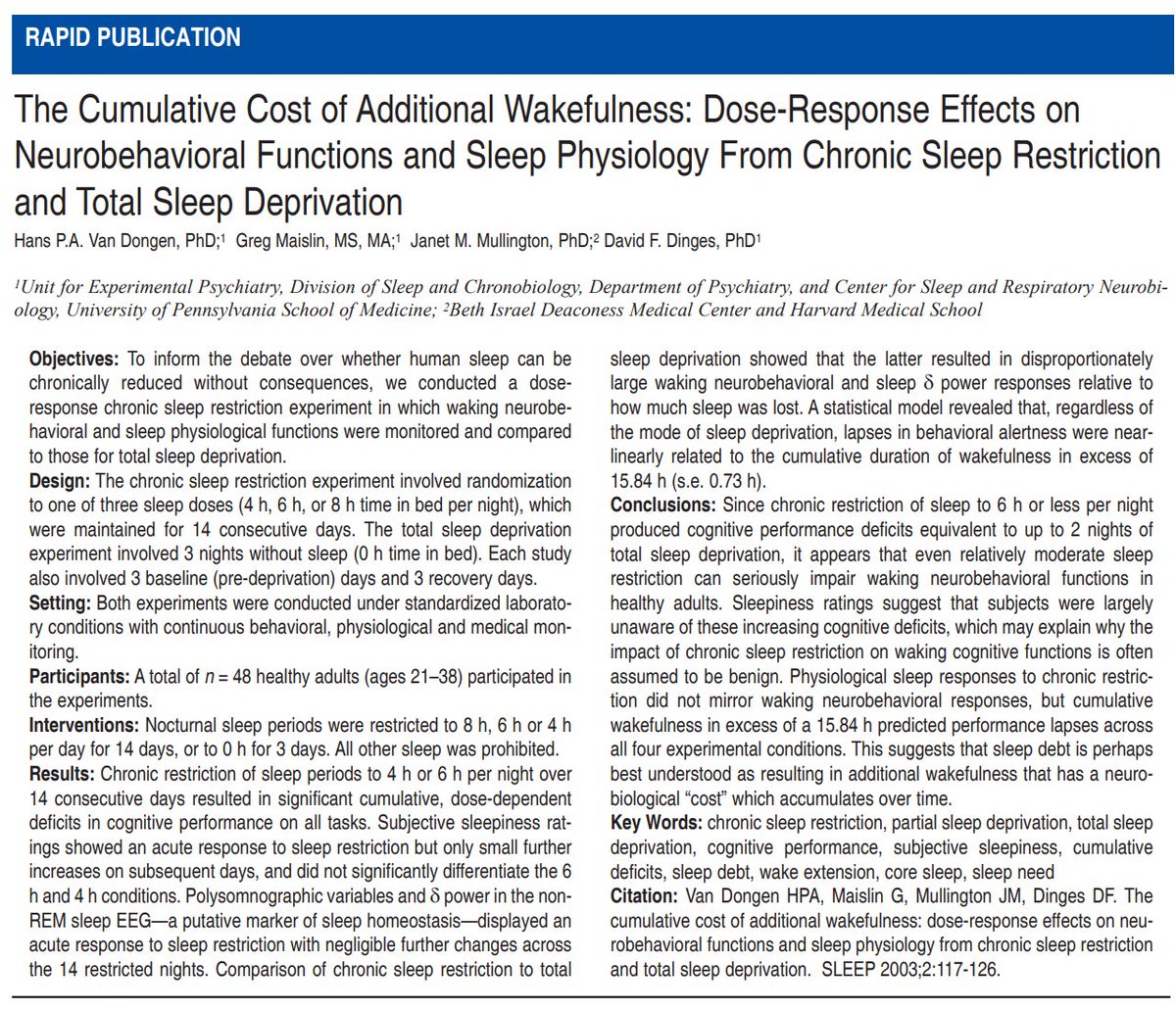
The scariest finding in this paper: the subjects couldn't tell it was happening.
UPenn ran this study on 48 healthy adults. One group slept 8 hours. Another slept 6. Another slept 4. For 14 straight days. They tested cognitive performance every 2 hours from 7:30am to 11:30pm.
The 6-hour group's reaction times, working memory, and sustained attention deteriorated on a near-linear curve. By day 14 they were performing at the same level as someone who hadn't slept at all in 48 hours. The 4-hour group hit that threshold by day 6.
Here's the part that should unsettle everyone who thinks they "do fine" on 6 hours: the subjects' self-reported sleepiness flatlined after the first few days. Their brains kept getting worse. Their perception of how impaired they were stopped updating. The cognitive decline was invisible to the person experiencing it.
The researchers found a hard threshold. Any wakefulness beyond 15.84 hours in a day produces cumulative neurobiological cost. That cost compounds every single day you exceed it and does not reset with a weekend of sleeping in.
About 35% of American adults sleep less than 7 hours a night. 40% of those get 6 hours or less. In 1942 that number was 11%. We built an entire professional culture around a sleep schedule that this paper says is functionally equivalent to pulling consecutive all-nighters.
"I'm fine on 6 hours" is the most common response to sleep research. The first thing chronic sleep debt destroys is your ability to notice chronic sleep debt.
Exercise can offset the mortality risk of short sleep
People sleeping fewer than 7 hours a night have significantly higher all-cause mortality... but not if they exercise
Longitudinal studies show that short sleepers who meet physical activity guidelines (75 min vigorous or 150 min moderate per week) have mortality rates comparable to people getting 7–9 hours of sleep
If your sleep is off, exercise is one of the best levers you can still pull
It is with profound sadness that we share the passing of Bobby Weir. We send him off the way he sent so many of us on our way: with a farewell that isn’t an ending, but a blessing. A reward for a life worth livin'. https://t.co/2qdBbh80v1
📸 Chloe Weir
ADHD is closely linked to circadian rhythm dysfunction.
Growing evidence suggests that targeting circadian misalignment can meaningfully improve symptoms.
Grateful to Dr. Matt Walker for sharing our new study!
https://t.co/gqnqRt0s8G
Deep sleep is a nightly brain cleanse, flushing out metabolic toxins like beta amyloid and tau protein—the culprits behind Alzheimer's. It's a power cleanse you can't afford to miss. @TheDiaryOfACEO