Making the Middleman Obsolete
What L1 programmability is actually for
Every meaningful advance in technology does one thing: it makes systematic, redundant human work obsolete. The printing press replaced the scribe. The assembly line replaced the craftsman. The spreadsheet replaced the ledger clerk. Progress is the progressive automation of whatever trusted intermediary currently sits between people and what they're trying to do.
Satoshi understood this and applied it to trust itself.
The original Bitcoin insight wasn't "store value securely." It was: cryptographic proof can replace institutional trust. Every middleman, the bank, the escrow agent, the clearing house, the notary, exists because two parties don't trust each other enough to transact directly, and someone has to sit between them and guarantee the outcome.
The simple UTXO with its locking script was the first implementation of that idea: a gate that enforces the condition automatically, without anyone administering it. The gate replaced the bank teller.
That's automation. Not a product feature. The actual point.
The Circuit Board of Money
Kaspa's Hardware-Native Programmability
A logic gate doesn't care what's energizing it. It reads an input state, applies a fixed condition, and switches - open or shut, one or zero.
The same gate logic runs on transistors, on relays, on pneumatic valves, on hydraulic ones. The condition is the constant. The medium is whatever's available.
Kaspa is a network of gates. The medium is sompi.
PART ONE: THE MEDIUM
ARCHITECTURE
Each UTXO Is a Gate with a Memory Cell
A UTXO is a gate-and-register pair.
The locking script and its covenant are the gate - a fixed condition that evaluates a signature, or a more complex rule, and either permits the transition or doesn't.
The sompi held inside is the register: a value sitting in storage, inert, until the gate in front of it switches.
When a UTXO is spent, the old gate doesn't pass its register through to the next one. It evaluates once, switches once, and the register it guarded is cleared.
What it held is written fresh into a new register, behind a new gate, under a new condition. No continuous state. No relabeling. One discrete evaluation, then the circuit moves on.
TIMING
10 Hz Global Clock - for the moment
Every gated system needs timing, or every gate would evaluate the instant its inputs happened to be ready, with no agreement on order.
Kaspa's GHOSTDAG provides that timing at 10 blocks per second - a real system clock, with the natural jitter any physical clock has. Inputs arrive close together but not perfectly aligned; GHOSTDAG resolves the order deterministically, the way a synchronizer resolves near-simultaneous signals into a clean sequence before the next stage reads them.
On every tick, any number of gates evaluate in parallel. Old registers clear. New ones latch, governed by whatever condition was just etched into them. The mempool is nothing more than inputs queued on the rail, waiting for the next clock edge to be read.
MATERIAL
What the Gate Is Made Of
Pneumatic gates are valves - metal and rubber, switched by pressure. Hydraulic gates are the same, switched by fluid instead of air. Both wear. Both can be forced under enough pressure in the wrong place. That's why real systems layer faster electrical control on top of slower mechanical gates - but speed and global agreement are different problems. A transistor switches in nanoseconds and still can't, by itself, get distributed actors on opposite sides of the planet to agree on order. It just switches. Agreement is a separate problem, bolted on afterward, in every system built before this one.
Kaspa's gates are built from code and cryptography - material as hard as the coin moving through it.
A covenant doesn't wear out, and it can't be forced; it can only be broken by breaking the cryptography itself, the same guarantee securing the sompi sitting in its register.
The gate and the register are made of the same kind of hard.
And the rate this medium switches at isn't just fast. It's agreed - globally, by every node, at the same time, with no separate coordination layer bolted on afterward.
The ordering is native to how the medium itself propagates.
That's the medium. It doesn't do anything on its own. It just switches, correctly, forever, with the whole network agreeing on every switch as it happens.
What it does next is up to whoever decides to harness it.
Final day before the scheduled activation window.
The release says the network moves to P2P protocol version 10 peer behavior 24 hours before activation.
Checklist:
• v2.0.1 or newer installed
• peers healthy
• wallet and indexer paths checked
• pool or exchange infrastructure tested
• DAA score monitored
Target remains 474,165,565.
No early live calls.
$KAS #Toccata
The meaning of curiosity
Comes before anyone fails.
And we learn what not to do.
Then curiosity becomes bravery.
If you choose to accept that no answer can answer anything fully.
Then you are ok.
I recently chatted with @michaelsuttonil about kaspa:native’s upcoming Toccata hard fork.
Some of it was genuinely lost on me at first. After a bit of thinking and reading, I decided that instead of publishing our whole conversation, I’d write out my thoughts and put them on https://t.co/oH0cCaHY0c.
I wrote it for the person who wants to go deeper on Kaspa’s upcoming upgrade, guided by what Michael walked me through, in the hope it helps others (and myself) understand what’s actually happening here.
Here’s my attempt at explaining what this upgrade is and why it’s a big deal, scheduled to activate on mainnet in just a few days:
https://t.co/HUWUDEQi8O (3 parts)
Congrats to all the Kaspa devs, y’all know who you are. Special shoutout to @OriNewman for spearheading this fork, and to some others whose work I’ve heard great things about: @Max143672@IzioDev@hus_qy@smartgoo_@manyfest_@asaefstroem@coderofstuff_@FreshAir08@elldeeone@supertypo_kas
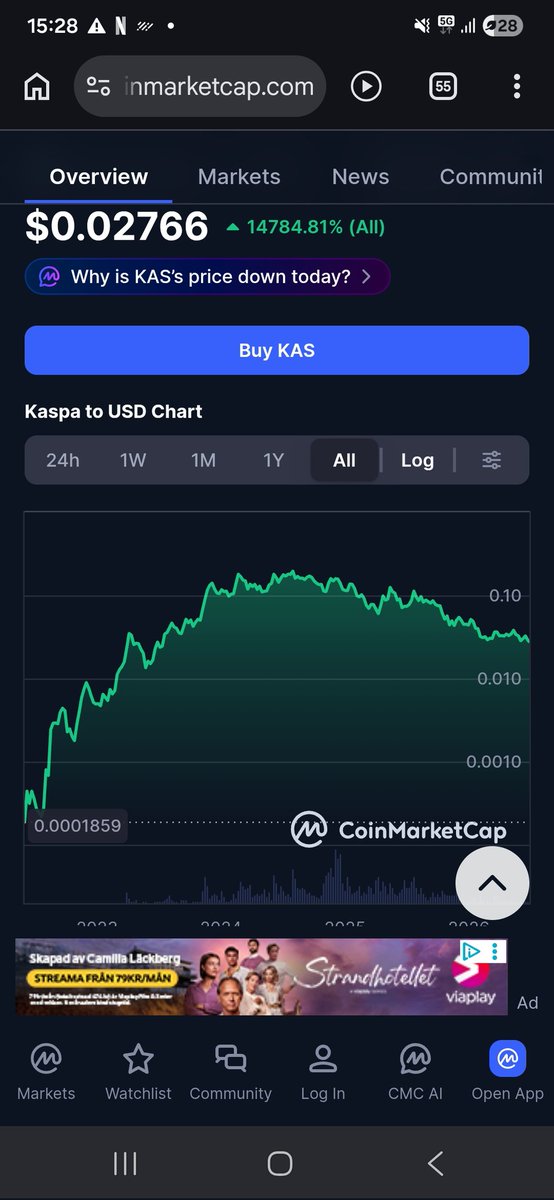
@damiendubsy You press the "log" button, you can clearly see high volatility turning in to stableness.
The volatility this month is in the measuring stick rather than kas itself
At this point, when price and hashrate are stable over some time
The engine has found s2f - supply and demand - cost of production equillibrium.
#kaspa $kas
(1/2)
The Trinity of Supply vs. Demand - Stock-to-Flow - Cost of Production and the Balance of Two Extremes
The Monetary Part - The Gold Comparison
The cost of production of gold is high, and the effort needed is massive.
This makes the elasticity of the S2F very low and the inertia very high. If demand increases and gold prices rise for a longer period of time, profitability in gold mining increases. Older abandoned gold mines might become active again, and sites where there is known gold but too little to be feasible for mining might start to become feasible.
More mining takes time and increased cost, but if prices increase enough, it will happen. As a result, more gold will be mined, the S2F will shrink, and scarcity will decrease. Thus, it will self-balance on a new level of supply-demand, cost of production, and S2F.
So, if effort intensiveness and cost of production are high, elasticity becomes low, inertia becomes high, and it requires a significant change in one or two aspects to meaningfully change anything.
And this is essential for a long-term store of value.
The Opposite, Electronics - The Mining Side of the Network
Now we go the exact opposite way for contrast—PCs or cell phones, the most used electronics.
They have a very low stock-to-flow. The cost of production halves at least every other year with Moore's Law, and demand flees as fast as new electronics come out.
S2F is about 2, meaning supply overshoots demand very fast.
If demand rises, production can match supply very fast. This makes it the poorest form of store of value.
Bitcoin and Kaspa Both Use This Contrast Within the Two Extremes Described
For simplicity, let's skip fees for now and only go with issuance.
On the monetary level, the production of new coins can never increase faster or above the set issuance schedule.
In the end, S2F grows to infinity.
Because of the difficulty adjustment, no matter the effort or cost, one can never affect the supply at any time.
So that part of the trinity is static—there is no elasticity, and there is no inertia other than the inertia set by the schedule.
So we only have supply-demand and cost of production that are dynamic and can change.
If demand increases → price increases → profitability increases → mining increases until the cost has matched demand. This is the highest form of store of value ever—the digital scarcity.
But in contrast to the perfect store of value, you need specialized electronics, which is the worst form of store of value, to mine the coins.
So, the trinity of the monetary network has to balance itself with the trinity of the mining side of the network.
As long as the demand for coins is higher than the market supply and miners remain profitable, ASIC manufacturers will produce until the ASIC market is saturated. This happens when the supply-demand of coins and ASICs both reach balance. If the ASIC market becomes oversupplied, the coin supply also becomes oversupplied.
If Kaspa is gonna be adopted its not going to be free to use BUT with $KAS advancing to 100bps this gives users the ability to mine their own transactions with a reasonable wait time at whatever fee rate they choose!
I really don't think people comprehend this advancement because everyone is so used to the traditional slow block times/high fee is the only way to be included life.
$KAS is built different. Study it.
It was a great show! thanks @IzioDev and @manyfest_ for sharing!
We all say thanks to the dev team for their years of work. Toccata will be a pivot point for digital ledger tech and a new epoch for blockchain with Kaspa being the catalyst and pioneer.
4 Days to "Real-Time, Decentralized Programmable Money" https://t.co/j5oSvGp6UF
Golang -> Rust transition is not just a rewrite in different language but a rewrite from first principles. We’re able to implement new, complex consensus changes because the foundation is optimized and allows for it. The old codebase just didn’t have that setup and a bunch of these HF work would’ve taken longer to implement or been impossible to do so.
Fee wording needs care.
The Toccata guide says the minimum standard fee rate moves to 100 sompi per gram after activation.
The fee floor is:
100 sompi * max(compute grams, 2 * transaction bytes)
This is node policy and mempool/relay behavior.
Consensus and standard relay are different rule categories.
Wallets and services should use node fee estimation where possible.
$KAS #Toccata
@DesheShai@simogattok@OmikCSGO The point of the community is to translate that stuff to human readable language iteration by iteration until normal people can understand it. It's just heavy compute in human terms done offchain, sometimes we get it right sometimes wrong, trial and error and error-correction
Regulation is in full force in time for the greatest bull run in history. Not just in the United States, but in almost every country in the world, a movement is underway to implement crypto into the global financial plumbing system. And the financial dinosaurs (especially the CME and banking elite) are scared, trying to do whatever they can to stop it; the good news, as this report will show, is that they aren't winning. https://t.co/XYwLz1cUkv