While #AI becomes a driving force for scientific discovery (#AIforScience), it is time to summarize our work on #GenAI and #LLMs for #DrugDiscovery over the past 5 years:
📌 𝐋𝐋𝐌-𝐛𝐚𝐬𝐞𝐝 𝐀𝐠𝐞𝐧𝐭 𝐟𝐨𝐫 𝐃𝐫𝐮𝐠 𝐃𝐢𝐬𝐜𝐨𝐯𝐞𝐫𝐲:
📍 "Liddia: Language-based intelligent drug discovery agent" (preprint: https://t.co/FUMeFvngYG)
📌 𝐅𝐨𝐮𝐧𝐝𝐚𝐭𝐢𝐨𝐧 𝐌𝐨𝐝𝐞𝐥 𝐟𝐨𝐫 𝐌𝐞𝐝𝐢𝐜𝐢𝐧𝐚𝐥 𝐂𝐡𝐞𝐦𝐢𝐬𝐭𝐫𝐲:
📍 "LlaSMol: Advancing Large Language Models for Chemistry with a large-scale, comprehensive, high-quality instruction tuning dataset." In Conference on Language Modeling (COLM), 2024. https://t.co/r7ct6ThNX1
📌 𝐋𝐢𝐠𝐚𝐧𝐝-𝐁𝐚𝐬𝐞𝐝 𝐃𝐫𝐮𝐠 𝐃𝐞𝐬𝐢𝐠𝐧:
📍 "Generating 3D binding molecules using shape-conditioned diffusion models with guidance", Nature Machine Intelligence 7, 758–770 (2025). https://t.co/933t4IIlwD ( preprint: https://t.co/WlKVTaMdq0)
📌 𝐋𝐞𝐚𝐝 𝐎𝐩𝐭𝐢𝐦𝐢𝐳𝐚𝐭𝐢𝐨𝐧:
📍 "A deep generative model for molecule optimization via one fragment modification", Nature Machine Intelligence, 3, 1040–1049 (2021) https://t.co/TY2YSPyN7O (preprint: https://t.co/Mz8Vb7ejp1)
📍 "GeLLM3O: Generalizing Large Language Models for Multi-Property Molecule Optimization." In The 63rd Annual Meeting of the Association for Computational Linguistics (ACL) main conference, (2025). (preprint: https://t.co/4bHxgywlVH)
📍 "Large Language Models for Controllable Multi-property Multi-objective Molecule Optimization" (preprint: https://t.co/MNW0qTuz8z)
📌 𝐌𝐨𝐥𝐞𝐜𝐮𝐥𝐞 𝐒𝐲𝐧𝐭𝐡𝐞𝐬𝐢𝐬:
📍 "G2Retro: Two-step graph generative models for retrosynthesis prediction." Communications Chemistry, 6(1):102, 2023 https://t.co/LPCKNLOD20
📍 "RLSynC: Offline-online reinforcement learning for synthon completion." Journal of Chemical Informatics and Modeling, 64(17):6723–6735, 2024 https://t.co/aBtMJXrwoj
A short video about the work is here (https://t.co/4ZzAWhIxmq) at Ohio State Research, Innovation and Knowledge (@OhioStateERIK) Innovation Showcase in 2024.
More exciting work to come!
#ArtificialIntelligence #AI4Science #Chemistry #AgenticAI
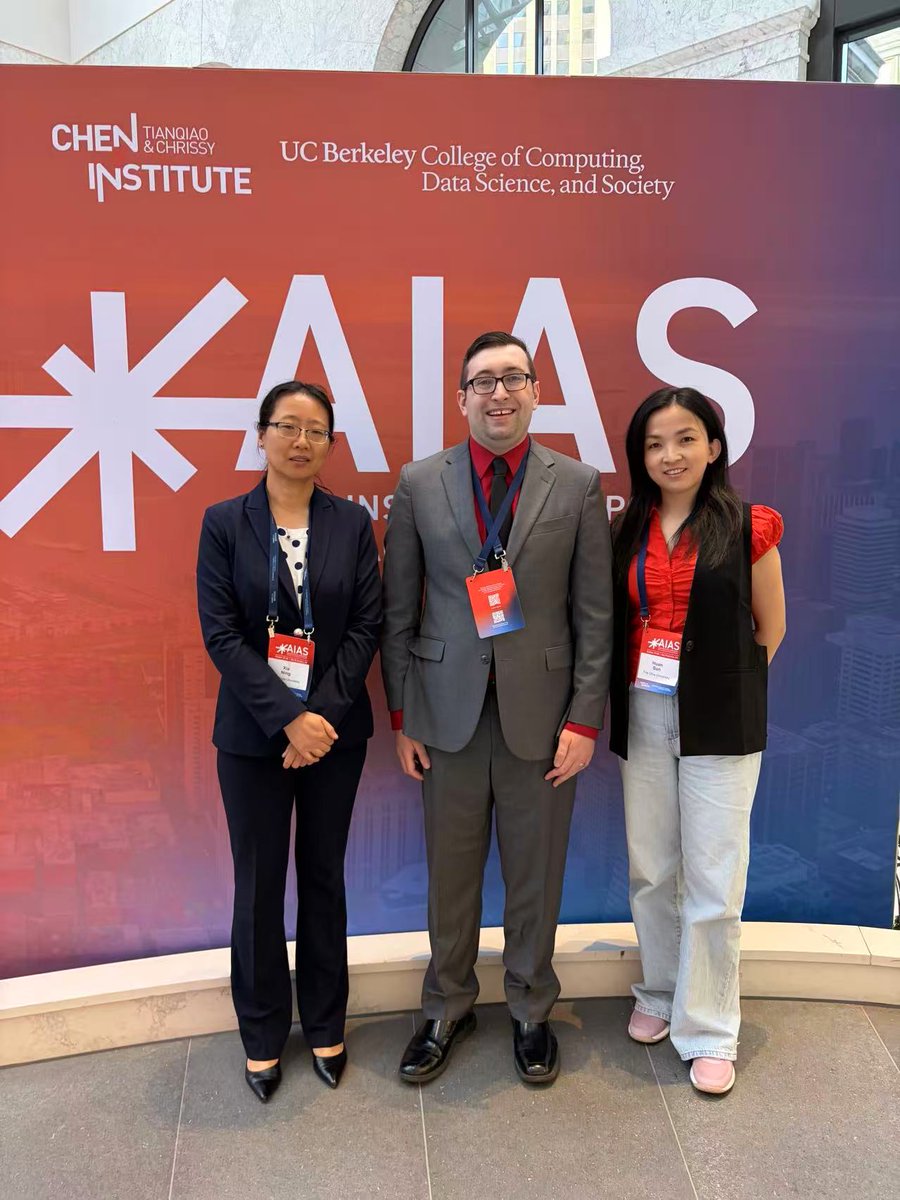
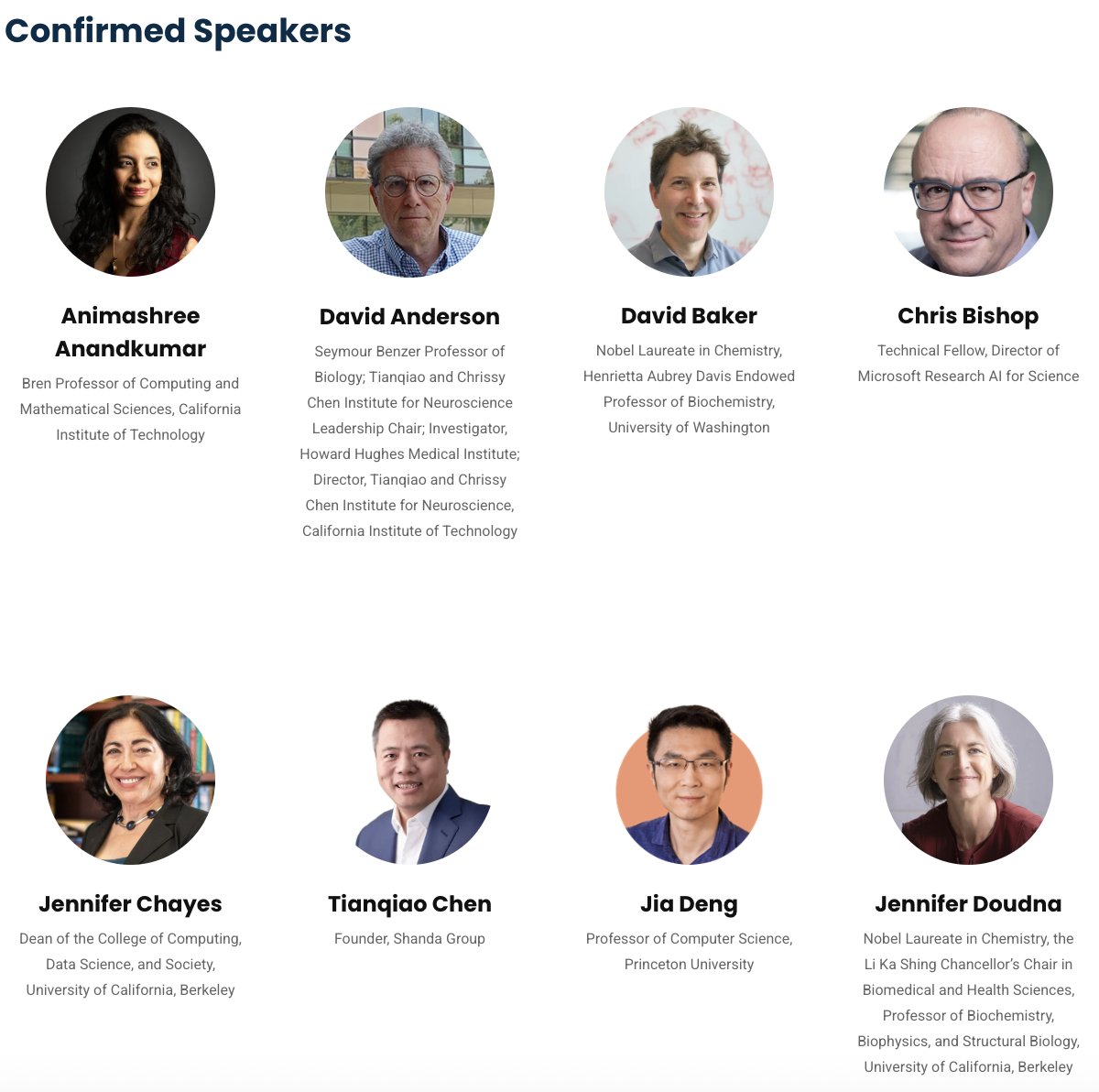
Congratulations to @FrazierBaker for leading this work and to the OSU team! Thank you, @ChenInstitute, for this incredible opportunity to share our work and to experience an inspiring symposium featuring three Nobel Laureates, many outstanding AI4science presentations, and unforgettable discussions (plus free registration and great food!).
🚀 LARC is part of our growing suite of AI-for-drug-discovery innovations — and this is just the beginning. More to come!
#AI4Science #AI4DrugDiscovery
LARC won a Best Paper Award at https://t.co/KYg75E2OX0 #aias2025 organized by @ChenInstitute. It is the first LLM-based Agentic framework for Retrosynthesis planning under Constraints, led by
@FrazierBaker@TheNingLab and @osunlp.
I missed most parts of the symposium, but heard a lot of great things: Wonderful speaker lineup (including Nobel Prize laureates), fancy meals, generous travel support to students, all while FREE registration. Hope such events continue and look forward to future series!
In synthetic chemistry, constrained retrosynthesis planning is NOT just about finding a valid synthetic route–the route must also satisfy practical constraints🥽. However, current AI retrosynthesis methods focus on unconstrained planning, ignoring key constraints in retrosynthesis planning, such as avoiding molecules that pose serious safety risks⚠️ to chemists, equipment, or the environment.
Introducing 🐦LARC, the first LLM-based Agentic framework for Retrosynthesis planning under Constraints. LARC incorporates agentic constraint evaluation, through an Agent-as-a-Judge, directly into the retrosynthesis planning process, using agentic feedback grounded in tool-based reasoning to guide and constrain route generation.
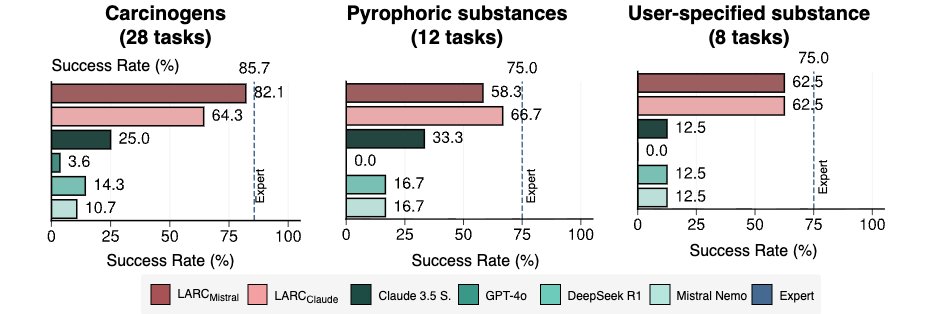
We demonstrate LARC's ability to plan retrosynthesis paths while avoiding ♋️carcinogens, 🔥pyrophoric substances, or ☠️user-specified (toxic) substances on a dataset of 48 constrained retrosynthesis planning tasks.
✨Highlights:
➡️Approaching Human-level Performance: LARC achieves impressive 72.9% success rate, approaching the success rate of our human expert (81.3%), and vastly outperforming the best LLM baseline (25.0%)
➡️Grounded Agentic Feedback: LARC uses agentic feedback grounded in tool-based reasoning to guide and constrain retrosynthesis planning
➡️Efficient Constrained Planning: LARC’s average planning time can be over 3.6x faster than our human expert while maintaining comparable success rates
➡️Extensible by Design: LARC can incorporate new tools or adapt to tool updates, allowing it to improve and expand as future capabilities emerge
LARC is just the beginning of what agentic AI can do for retrosynthesis planning. Stay tuned for more.
Thanks to the amazing team at @OhioState that made LARC possible:
@FrazierBaker@AduAmpratw82108, Reza Averly, @BotaoYu24@hhsun1@Ningx005@osunlp@TheNingLab
#llm #agentic #agent #AI #retrosynthesis #chemistry #ai4science #ai4chemistry
🚀 Excited to share our latest work published in Nature Machine Intelligence @NaturePortfolio@NatMachIntell
OSU news release here: https://t.co/JIZSlNMoUb
We introduce DiffSMol, a shape-conditioned generative diffusion model for designing 3D small molecules that bind to protein targets.
📌 3D Shape-Guided Generation
Learns from ligand shapes to generate structurally realistic binders.
📌 Protein Pocket Conditioning
Incorporates pocket information to enhance binding relevance.
📌 State-of-the-Art Results
61.4% success rate in generating realistic and promising binders—significantly ahead of baselines.
📌 Promising AI-Designed Drug Candidates
Four reported small molecules designed by DiffSMol for cancer and Alzheimer's are now under further investigation @OhioStateERIK.
#AI #AI4Science #DrugDiscovery #MolecularDesign #MachineLearning #GenerativeAI
@OSUWexMed@OSUengineering@OhioStateERIK@osu_pharmacy
A delightful and unexpected surprise today: our 2023 paper, "G2Retro as a two-step graph generative models for retrosynthesis prediction (https://t.co/33vkv2A1cK)," (@ziqiChen123, Oluwatosin R. Ayinde, James Fuchs, @hhsun1, @ningx005) has been selected in Nature's special collection, "Nobel Prize in Physics 2024 (https://t.co/ZP31qcCi1H)." This collection highlights high-impact research, reviews, and opinion articles selected from all of Nature's participating journals, celebrating “the direct contributions by the [Nobel Prize] awardees and the advances they have inspired.”
In the G2Retro paper, we introduced a new AI method for generating synthetic pathways for molecules—a step forward in using AI for Science, particularly in Chemistry, following the footsteps of the Nobel Prize Awardees John Hopfield and Geoffrey Hinton. This is an interdisciplinary collaboration among @OhioStateMed BMI, @OhioStateCSE, @osu_pharmacy, @OSUbigdata and @OhioStateCTSI, initially supported by @OhioStateERIK.
It’s such an exciting time as AI emerges as a cornerstone across numerous fields, including the foundational sciences. Coming from a computer science background, we are thrilled to explore how AI can address fundamental questions in Chemistry and beyond. Looking forward to more and more breakthroughs in AI for Science!
#GenerativeAI #AI4Science #ArtificialIntelligence #MachineLearning
🙌🙌🙌Excited to announce our paper "SAPIENT: Mastering Multi-turn Conversational Recommendation with Strategic Planning and Monte Carlo Tree Search” by Hanwen Du (@HanwenDu123229) and Bo Peng (@peng1230248).
Have you ever wondered how conversational recommendation systems can seamlessly decide when to ask customers for their preferences, when to make product recommendations, and which products to recommend?
To tackle these challenges and enable strategic planning, we introduce a novel MCTS-based MCR framework---Strategic Action Planning with Intelligent Exploration Non-myopic Tactics. SAPIENT leverages Monte Carlo Tree Search (MCTS) to achieve strategic, non-myopic planning in multi-turn conversational recommendation. By integrating an MCTS-based planner with a self-training conversational agent, SAPIENT empowers conversational agents to take smarter, more strategic actions that not only enhance information seeking but also boost recommendation success. Check out our preprint: https://t.co/0H2hc2Qy6j.
#ArtificialIntelligence #planning #LLMs #recsys
A video on our eCeLLM (pronounce: e-sell`em) work, in which we built the first open-sourced, large-scale, and high-quality benchmark instruction dataset ECInstruct (https://t.co/jruNpqN5Vy) for e-commerce, and a series of e-commerce LLMs (https://t.co/MPgCO2eDlf). The dataset and LLMs have also been used as benchmarks in Amazon KDD Cup 2024 (https://t.co/VsxCG4pUS6).
@peng1230248@xinyiling_ @RonZiruChen @hhsun1@ningx005@OhioState@OhioStateCSE@OSUbigdata@OSUengineering@OhioStateERIK
#AI #icml2024 #kdd_news #LLM #RecSys #KDDCup
Next gen of LLMs for E-Commerce arrived! 🛒 🛍
Xinyi Ling presents eCeLLM which comes in 3 sizes (S, M, L). As you guessed it can be used to boost Search, Recommendation, and product-based Question-Answering https://t.co/uZFc4Km2e3
#icml#icml24#icml2024
🤖🧪“RLSynC: Offline-Online Reinforcement Learning for Synthon Completion”was just accepted at #JCIM@JCIM_JCTC.
RLSynC is a novel approach to synthon completion in single-step #retrosynthesis. RLSynC uses online-offline #RL to predict diverse reactions that are realistic based on an independent forward synthesis model.
🤖Offline-Online: Our agents start learning from offline data derived on real reactions. Once training converges, we augment the offline data with predicted reactions from the agents, with rewards determined by an independent forward synthesis model. This cycle of self-improvement balances our exploitation of existing knowledge with exploration of new possibilities.
🎨Diverse: RLSynC completes synthons by adding single atoms, allowing it a lot of flexibility to explore new ways of completing synthons. Additionally, RLSynC is optimized to satisfy a forward synthesis model, which can encourage diverse predictions not found in the ground-truth training data.
⚗️Realistic: An independent forward synthesis reward function guides the agents’ learning, encouraging ones which it predicts can produce the desired product. On average, the top 10 predictions from RLSynC contain significantly more reactions which satisfy this condition than the baselines.
📄Preprint: https://t.co/jpLOZ2sQBF
🧑💻Code: https://t.co/VnViTeKhJ5
Keep an eye out for a follow-up announcement when the paper is released by #JCIM.
Authors: @FrazierBaker, @ziqiChen123, @AduAmpratw82108, @ningx005@OhioState@OhioStateCSE@OSUbigdata@OSUengineering@osu_pharmacy@OhioStateMed@OhioStateERIK
#AI #AI4Science #reinforcementlearning #synthesis #chemistry #multiagent #cheminformatics
The Ninglab will present at the AI-Driven Drug Discovery Summit on generative AI in drug discovery.
𝐊𝐞𝐲 𝐓𝐨𝐩𝐢𝐜𝐬:
1. How AI designs innovative small-molecule structures, presenting new opportunities for drug candidates.
2. Understand how AI identifies synthetic pathways for both existing and newly generated molecules.
3. Explore AI techniques for optimizing small molecules to enhance their properties.
4. Delve into the role of Large-Language Models (LLMs) in multitasking within drug discovery.
𝐋𝐞𝐚𝐫𝐧𝐢𝐧𝐠 𝐎𝐛𝐣𝐞𝐜𝐭𝐢𝐯𝐞𝐬:
1. Attendees will gain insights into different generative AI frameworks, including diffusion models, deep reinforcement learning, and auto-encoder-based deep learning.
2. Learn techniques for designing small molecules in both 2D and 3D.
The session will provide an understanding of methods for identifying synthetic paths for molecules.
Join us at the 𝐀𝐈-𝐃𝐫𝐢𝐯𝐞𝐧 𝐃𝐫𝐮𝐠 𝐃𝐢𝐬𝐜𝐨𝐯𝐞𝐫𝐲 𝐒𝐮𝐦𝐦𝐢𝐭 to dive into the future of pharmaceutical innovations!
Stay tuned for more updates 🚀
#ArtificialIntelligence #AI4Science #drugdiscovery
#aihealthcare
@OhioMedicine@OSUengineering@OhioStateCSE@OSUbigdata
@Nature_NPJ@OhioStateMed@OSUCCC_James This work helps select the most effective cancer drugs for different patients -- a central scheme for precision medicine.
📄"Enhancing drug and cell line representations via contrastive learning for improved anti-cancer drug prioritization" was just published in #npjPrecisionOncology (@Nature_NPJ).
In this paper, we use contrastive learning to improve learned drug and cell line representations by preserving relationship structures associated with drug mechanisms of action and cell line cancer types.
🎉Congratulations to PhD student Patrick Lawrence and undergrad student Benjamin Burns on your publication!
https://t.co/rn5bSFG8ga
#cancer #representation #contrastive #learning #ML #AI #AI4Science #NeuralNetworks #oncology #bioinformatics #drugdiscovery
📢Patent granted: "Systems and Methods For Providing Health Care Search Recommendations" was granted today! We will use #AI to facilitate quick and accurate information retrieval from electronic health records and information recommendations to physicians to reduce their cognitive load and to support clinical decision-making. Commercialization is on the way!
Congratulations to inventors: Xia Ning (@ningx005), Zhihui Ren (a former Postdoc at the NingLab), Bo Peng (@peng1230248, a final-year Phd student @OSUengineering), and Titus K. Schleyer from Indiana University! 🎉
Official publication: https://t.co/JBreJE7h89
@OhioState@OSUEngineering@OhioStateMed@OhioStateERIK
#recommendersystems #AI #HealthcareInnovation #healthcare #research #patents #search
🎉First-year @OSUengineering PhD student Xiao Hu (@A_aa_x ) has his research presentation debut at DahShu (@DahShuInfo) Data Science Symposium today at MSU (@michiganstateu)! He presented his work on how to use graph representation learning to predict how much product (e.g., yield) a chemical reaction can produce -- a truly interdisciplinary research across #AI and Chemistry. More work to come, particularly in comparison with foundation models for yield prediction!
#ArtificialIntelligence #AI #ML #BigData #DeepLearning #AI4Science #LLMs #LLM