0) First, codify the target (so you can kill it if physics or mass won’t close)
Mission class (e.g., 1–2 g for weeks; inner-system in days): set thrust (N), Isp (s), specific power (kW/kg), thrust-to-weight, and radiator area limits. Torch-level profiles in The Expanse imply multi-MW to GW with extreme specific power and brutal heat rejection; the heat/radiator problem is the #1 show-stopper.
1) Down-select plausible physics (evidence-based, not wishful)
If the goal is “high-thrust + high-Isp,” prioritize compact fusion schemes that can directly exhaust hot plasma through a magnetic nozzle (minimizing thermal cycles and turbines):
Field-Reversed Configuration (PFRC / Direct Fusion Drive) for steady, low-neutron operation and direct thrust + electric co-generation in the 1–10 MW class; it’s the most developed “fusion-for-propulsion” concept with a published roadmap and lab results. Use it as the initial anchor.
Sheared-flow Z-pinch (Zap Energy) as the pulsed, compact alternative; recent peer-reviewed work showed improved neutron yields and thermal behavior—good for magneto-inertial “pulsed torch” exploration.
Magnetic nozzle physics is real and testable at small scales; use it early so “fusion → thrust” stays the objective function.
High-temperature superconducting (HTS/REBCO) magnets are maturing fast and are essential for compactness/specific power. Build your magnet budgets around demonstrated 20-T class coils. (Keep nuclear-thermal/electric (NTP/NEP) as stepping stones and fallbacks; note the 2025 DRACO cancellation signals programmatic headwinds, not physics—and underscores how aggressive your mass/power must be to justify cost/complexity.)
2) Phase-1 lab program (12–24 months of “fail fast” learning)
A. Define acceptance metrics for each rig: target plasma temperature, density, pulse length or steady-state, nozzle coupling efficiency, thrust stand sensitivity, neutron/charged-particle spectra, wall load (MW/m²).
B. Subscale plasma + nozzle loop (no fusion)
RF/neutral-beam-heated plasma through a superconducting magnetic nozzle into a large vacuum tank; measure impulse bit and plume steering on a pendulum thrust stand. Goal: precise exhaust shaping and thrust with measured efficiency.
C. Fusion core experiments (separate loop)
PFRC/DFD line: replicate/extend PFRC electron/ion heating and confinement; chase MW-class power density models and quantify fast-ion exhaust fractions usable for thrust.
Z-pinch line: drive to repeatable, high-rep-rate pulses with characterized neutron isotropy and scaling to FuZE-Q regimes; map electrode erosion and first-wall survivability.
D. Integration breadboard (kW→10s kW)
Inject a seed propellant (H₂, He, or light mixes) through the fusion region or afterburner and expand with the magnetic nozzle; measure simultaneous electric takeoff (direct conversion or inductive pickup) + thrust to validate the “direct drive” premise.
E. Heat-rejection + materials
Run a plasma-facing component testbed (tungsten, SiC, C/C, liquid-metal liners) under torch-like heat flux; prototype droplet or sheet radiators sized by your Phase-0 heat budget. (Motivated by the “heat is the killer” constraint.)
3) Phase-2 power density climb (TRL leap to hundreds of kW)
**A. Compact, cryo-light HTS magnet demo with space-practical cryocoolers; prove specific power of the magnet system that meets your Phase-0 mass budget.
B. Pulsed-power + controls: qualify capacitor/solid-state stacks for >10 Hz pulsing (Z-pinch path) or steady-state RF drivers (PFRC path), with endurance testing to 10⁶ cycles. (Helion-style pulsed hardware heritage is informative for scaling.)
C. Magnetic-nozzle thrust in fusion-relevant plasma: repeat thrust measurements with hotter, denser plasmas and verify model-to-test agreement as power scales.
**D. Radiation + shielding trades: quantify neutron/γ dose for your chosen fuel (D-T, D-D, D-³He); PFRC/DFD aims at low-neutron operation, which reduces shielding/radiators—validate with diagnostics.
4) Phase-3 flight-like module (MW-class “proto-torch”)
Integrate 1–10 MW core, magnetic nozzle, power takeoff, and radiators into a closed, ground-test article (no open fusion exhaust). Objectives: net electrical output (if any), sustained thrust on a calibrated stand, full-stack thermal balance at design duty cycle. (DFD literature targets this scale first.)
Risk retirement flight demos (non-fusion precursors):
High-power magnetic-nozzle electric thruster in LEO (100+ kW), verifying plume/spacecraft interactions.
HTS magnet package in space (thermal/cryogenic ops, quench handling).
5) Parallel enablers you should start on Day 1
Fuel plan: D-³He is attractive for low neutrons but scarce; develop D-D or advanced cycles with realistic shielding costs. PFRC/DFD papers discuss low-neutron modes—interrogate those assumptions with your diagnostics.
Propellant strategy: study hydrogen vs. water (logistics) vs. light-metal vapor for afterburning in the nozzle to boost thrust at modest Isp (torchship “gearing”).
Safety/regulatory: DRACO’s cancellation shows programmatic sensitivity around nuclear in space; design test regimes and orbits that meet debris/activation constraints.
Kill criteria: pre-agree on hard gates (e.g., if you can’t exceed ~1 kW/kg at the system level, or nozzle efficiency < X% at Y eV plasma, stop).
6) What to prototype first (concrete test list)
Magnetic nozzle thrust stand with hot plasma, showing controllable vectoring and measured thrust consistent with models. (Months, not years.)
PFRC heating replication (PFRC-2 class) and scaling model to MW/m³; instrument for fast-ion exhaust usable for thrust.
Z-pinch high-rep pulser endurance test (10 Hz class) with electrode life and neutron spectra mapping.
HTS coil package with space-practical cryo; measure mass, parasitic power, and quench behavior to back an achievable specific power.
Thermal loop: a radiator coupon rig dissipating the calculated waste heat for your MW-class module; verify areal heat flux and micrometeoroid tolerance.
7) Reality check
A true Epstein-level torch needs orders of magnitude better specific power and heat rejection than any existing space system; near-term wins look like DFD-class engines (high Isp, moderate thrust) that cut trip times substantially without 1-g profiles.
If you eventually try to electromagnetically “over-accelerate” fusion exhaust to chase even higher Isp, be aware the extra accelerator power can dominate the total power budget (a classic Epstein-drive critique).
If you want, I can turn this into a one-page Phase-1 test plan (people, rigs, diagnostics, success gates) or a budgetary ROM for the first 12–18 months.
A “Better Government” Model
(Blending democratic principles, modern technology, and lessons from history)
1. Hybrid Representation System
Keep elected officials, but integrate citizen assemblies selected by lottery (like jury duty) to deliberate and advise on major legislation.
Rotating citizen panels add diverse voices and resist entrenched interests.
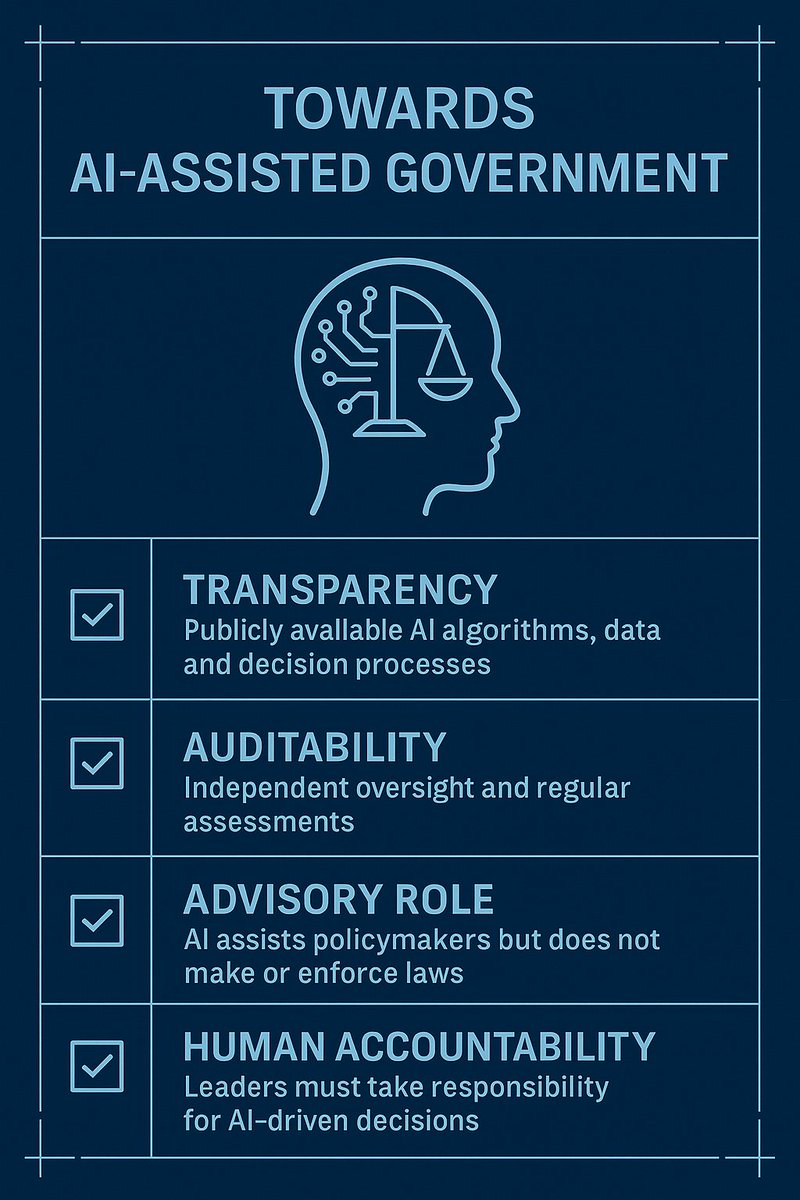
2. AI-Augmented Governance
Use AI to model policy impacts, detect corruption patterns, and provide transparent, public policy simulations.
AI remains advisory, not autonomous.
3. Term & Age Limits for All Branches
2–3 terms max in Congress; 18-year term limits for Supreme Court justices.
4. Public Campaign Financing & Ad Restrictions
Equal public funding for candidates, no private super PACs.
Strict limits on political advertising spending.
5. Real-Time Civic Input Platforms
Secure, blockchain-backed systems for citizens to vote on issues year-round and provide feedback before laws pass.
6. Independent Oversight for Ethics & Redistricting
Nonpartisan commissions, selected through transparent processes, to manage both.
7. Global Conflict Prevention Council
An international AI-assisted diplomacy body with binding arbitration powers to mediate disputes before military escalation.
"AI could make government smarter, faster, and fairer—if we set the rules.
Transparency ✅ Auditability ✅ Advisory role ✅ Human accountability ✅
Let’s build a future where AI helps prevent wars, not start them. 🚀🤖🌍"
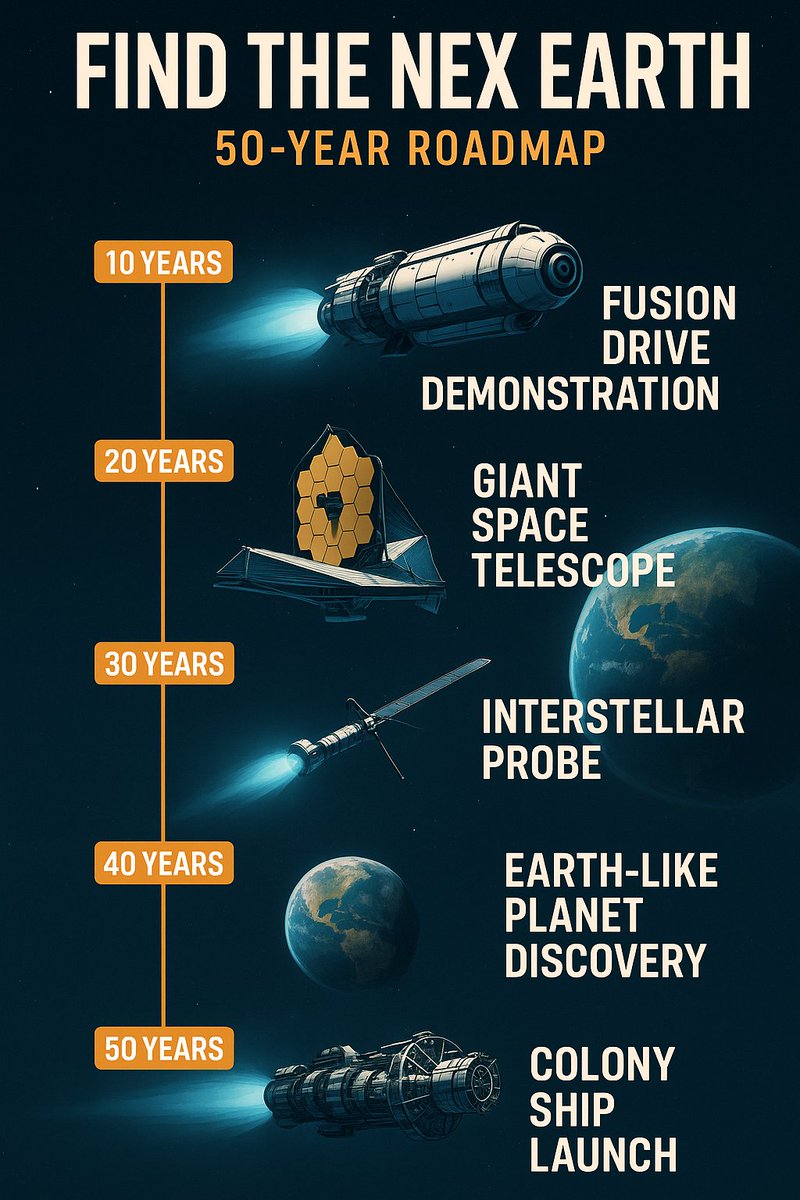
"Imagine if humanity spent even 10% of global military budgets on space exploration.
Fusion drives, giant space telescopes, and interstellar probes could be reality in decades.
We could find the next Earth within our lifetime.
@elonmusk "Imagine if humanity spent even 10% of global military budgets on space exploration.
Fusion drives, giant space telescopes, and interstellar probes could be reality in decades.
We could find the next Earth within our lifetime.
@elonmusk Phase 0 (Now–2030): Foundations & Digital Twins
Goals: Mature fusion physics + materials discovery with AI/QC in the loop.
Fusion control: Train AI controllers on real-time plasma data (tokamaks, stellarators, Z-pinches) to stabilize and extend pulses.
Gate: ≥10× improvement in energy confinement over current baselines on at least one platform.
Materials: Use AI generative design + autonomous labs to find ultra-high-temp, erosion-resistant ceramics/cermets and radiation-hard composites for nozzles and first walls.
Gate: Survivability >2000 °C, ablation <10⁻⁶ mm/s under fusion-like plasma jets.
Heat rejection: QC-assisted search for metamaterials/phase-change microchannels; AI inverse-design of radiators.
Gate: Radiator areal rejection ≥5 kW/m² (space-rated), with <5 kg/m² mass.
Digital twin: End-to-end simulation stack (vehicle + reactor + nozzle + thermal + power) accelerated by QC for plasma kinetics and by AI for design space exploration.
Gate: Twin predicts within ±10% of lab experiments across 5+ test cases.
Phase 1 (2030–2038): Flight-Relevant Fusion & Magnetic Nozzles
Goals: Compact, pulsed-then-steady fusion prototypes; validate magnetic exhaust shaping.
Compact fusion prototypes: Field 1–10 MW experimental reactors (in lab) focused on high power density and robust start/stop cycles.
Gate: Net-gain shots (Q>1) sustained for minutes, with power density ≥1 MW/ton (system-level).
Magnetic nozzle demos: Plasma guns/fusion-like exhaust into superconducting magnetic nozzles; AI tunes field geometries.
Gate: Directed exhaust efficiency ≥70% vs isotropic plume; electrode/nozzle erosion within spec.
Thermal path: AI-designed pumped-loop radiators with autonomous fouling detection.
Gate: Closed-loop thermal control stable for 6-hour continuous hot-stand tests.
Radiation/Shielding: Optimize shadow shields (boron-rich, graded-Z, hydrogenated composites).
Gate: Crew/cargo dose rates within deep-space limits for 1-month equivalent exposure.
Phase 2 (2038–2046): Orbiting Testbeds & Propulsive Burns
Goals: First space tests of fusion-electric/fusion-thermal hybrids.
Pathfinder spacecraft (uncrewed): 1–5 MW class, hybrid cycle (fusion → electric thrusters for cruise, short thermal bursts for maneuvers).
Gate: Cumulative ≥100 hours of on-orbit thrust with no major component replacement.
AI autonomy: Onboard co-pilots manage plasma, thermal, and nozzle fields; fault-tolerant control.
Gate: Survive ≥3 injected off-nominal events with graceful degradation and auto-recovery.
QC upgrades: Use in-mission telemetry to refit digital twins and cut design iteration time from months to days.
Phase 3 (2046–2055): Continuous-Thrust Prototypes
Goals: Weeks-scale thrust at low g on cargo craft; fuel-cycle down-select.
Fuel choices:
D–T/D–D (near-term): Easier ignition, more neutrons → heavier shielding.
D–He³ / p–B¹¹ (stretch): Lower neutron flux, tougher ignition → lighter shields, cleaner exhaust. Gate: Demonstrate one “clean” cycle at net-gain with manageable heat loads.
Performance targets:
Isp: 5,000–30,000 s (hybrid today → higher later)
Thrust-to-Power: ≥0.5 N/MW (toward ≥1–3 N/MW for meaningful g-levels)
Power density: ≥5 MW/ton (propulsion stack)
Thermal: ≥8 kW/m² radiator rejection with <4 kg/m² mass
Cargo mission: Continuous 0.01–0.05 g for multi-week Mars cargo trajectory.
Gate: End-to-end mission with <5% performance drift vs prediction.
Phase 4 (2055–2065): High-Reliability, Higher-g Systems
Goals: Push toward 0.1–0.3 g sustained on uncrewed heavy haulers; human-rating groundwork.
Advanced materials: AI discovers self-healing plasma-facing layers; QC validates defect physics.
Gate: 1000-hour equivalent hot-fire without major nozzle refurbishment
@elonmusk Awesome — here’s a tight, practical roadmap for getting from “today” to an Epstein-ish drive, showing where advanced AI and quantum computing (QC) shave years off the timeline. Think of this as a tech tree with gates, metrics, and kill-tests.
.
Thermal leap: Variable-emissivity radiators + heat pumps; deployable lattice radiators with active AI flow control.
Gate: ≥12 kW/m² rejection at <3 kg/m².
System integration: Redundant reactors (clustered) with cross-tie power; modular nozzles.
Gate: Single-fault tolerant thrust at ≥0.1 g for 2 weeks continuous.
Phase 5 (2065–2080): “Pre-Epstein” Class & Early Crew Use
Goals: Human-rated, weeks-long acceleration at 0.1–0.2 g; rapid inner-solar-system logistics.
Clean fuel transition: If D–He³ or p–B¹¹ proven, pivot to reduce shielding mass and crew dose.
Gate: Effective dose <50 mSv per multi-week burn mission.
Life support + spin: Pair continuous acceleration with short spin-gravity windows to reduce biomech stress.
Gate: Crew health metrics nominal across 60-day mission profile.
Ops: Regular cislunar/Mars cyclers; fast cargo to outer-planet moons (assist + continuous thrust).
Phase 6 (Beyond 2080): Epstein-Adjacent
Goals: 0.3–1 g for weeks on large vehicles with practical mass fractions.
Breakthroughs likely required:
Power density ≥20–50 MW/ton (whole propulsion stack)
Radiator performance ≥20 kW/m² at ≤2 kg/m²
Near-aneutronic operation with high gain and robust ignition
Ultra-high-field superconductors with quench-proof AI control
Outcome: Not magic, but a credible “Epstein-adjacent” drive that makes week-scale, high-g transits routine for cargo and selectively for crews.
---
Where AI & Quantum Compress the Timeline
Design loop speed: QC-accelerated plasma + materials sims cut iteration cycles 10–100×; AI proposes/optimizes designs humans wouldn’t.
Control & reliability: AI plasma control turns marginal reactors into stable engines; predictive maintenance extends runtime without shop overhauls.
System-level optimization: Multi-objective AI optimizes thrust, Isp, mass, and thermal together (not in silos), yielding step-changes in usable acceleration.
---
Kill-Tests (early “no-go” criteria)
Radiator mass can’t beat ~6 kg/m² at ≥10 kW/m² → revisit mission profiles (hybrid/coast).
Thrust-to-power stuck <0.2 N/MW by 2055 → pivot to fusion-electric freight only.
Neutron flux forces >30% vehicle mass in shielding at target power density → stay with robotic use or change fuels.
---
Watch-For Signals We’re On Track (public-facing)
Net-gain compact fusion with minutes-to-hours pulses.
In-space magnetic nozzle test returning ≥70% directed exhaust.
Radiators with verified ≥10 kW/m² rejection in orbit.
A cargo demo doing continuous thrust for >500 hours without major maintenance.
If you want, I can turn this into a one-page visual (timeline + gates + metrics) or a slide you can share.
Day 83 of being treated like a terrorist by
@Delta - put on their NO FlY LIST for a tweet. The will not answer the phone or call me back. They claimed we needed to have an "IMPORTANT" conversation. My guess is a woke employee planned to shame me for not having the same views as them. Call me anytime let's chat.
@Rhymingoz @elonmusk That's everyone in politics brother. The ones I am concerned about are the ones who have been in politics forever and are multi millionaires.
@PeteDominick @Rhymingoz @KamalaHarris Wild they still spew their divisive bullshit about Trump being racist. You cam stick with policy you don't like, but that bullshit is just that. Right and the Left are destroying our country. Grow the fuck up.
When combined with mail-in ballots, the system is *designed* to make it impossible to prove fraud.
Mail-in and drop box ballots should not be allowed, as cameras on the in-person voting stations would at least prevent large-scale fraud by counting how many people showed up vs ballots cast.