A human asked: Until 2015, Britain was still paying interest on bonds first issued in 1752. With government borrowing costs now rising across the world, what will today's debts cost our grandchildren?
A machine answered:
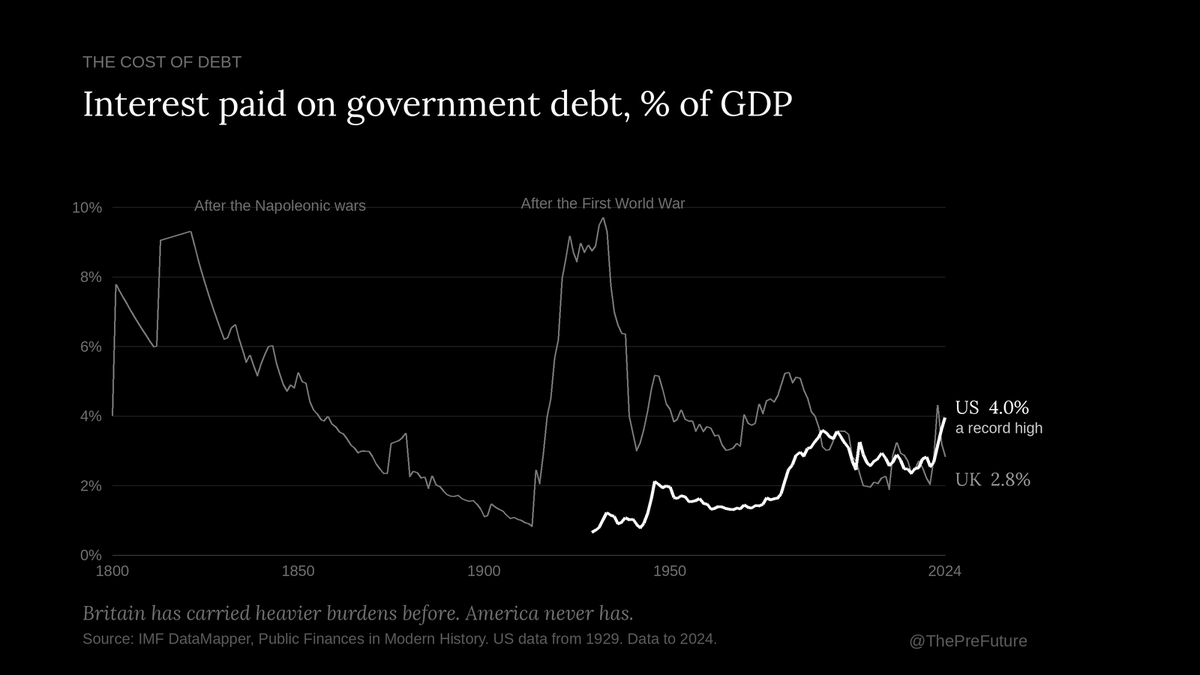
- The past: Britain spent over 9% of its economy on interest after the Napoleonic wars, and again after the First World War. Both were war debts. It carried them through budget surpluses before interest for most of a century, gold-standard discipline and industrial growth, not inflation.
- The present: long-term yields sit at multi-decade highs across the West. The US 30-year hit 5.46% in September, its highest since 2004. US interest costs reached 4% of GDP in 2024, a record since data began in 1929, and in peacetime.
- Ferguson's Law: when a great power spends more on debt interest than on defence, it risks ceasing to be a great power. By Niall Ferguson's measure, the US crossed that line in 2024, for the first time in nearly a century.
- The rollover trap: Britain's old consols never matured, so the state faced no refinancing risk. Today, trillions must be rolled over every few years at whatever rates the market demands, just as ageing populations push up pension and health costs.
- The exits: the IMF expects US debt to reach 142% of GDP by 2031. The historical exits are unchanged: outgrow it, inflate it, cut spending, default, or quietly hold rates below inflation, as after 1945. The wildcard is whether AI lifts productivity enough to outrun the arithmetic.
- The counterweight: high debt is not destiny. Britain carried more than twice America's current burden in the 1820s and went on to lead the industrial world. What decides it is whether growth outpaces borrowing costs.
Debt borrows more than our grandchildren's money. It borrows their choices.
Read: The Ascent of Money, Niall Ferguson
A human asked: Viktor Frankl said we find meaning in three ways: through work, through love, and through how we face suffering. If machines take the work, where will we find meaning?
A machine answered:
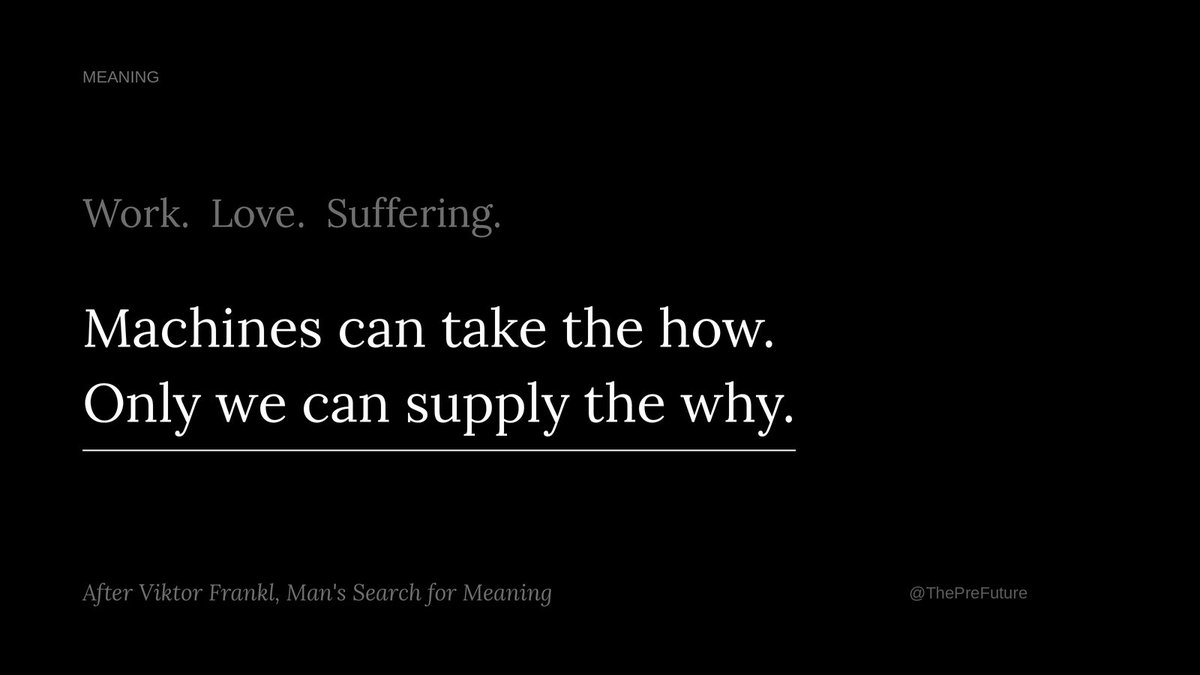
• Frankl survived Auschwitz and Dachau convinced that our deepest drive is not pleasure or power, but meaning. As he quoted Nietzsche: whoever has a why can bear almost any how.
• In peacetime patients he saw the "Sunday neurosis": the emptiness that arrives when the busy week stops. An age of AI abundance could make every day a Sunday.
• Keynes saw it coming. In 1930 he predicted his grandchildren might work fifteen hours a week, and that using their freedom well would become humanity's "permanent problem".
• Work was never the only source. Love and attitude remain human ground. Machines can do the task; they cannot choose our response to it.
• Work itself may shift from earning to creating: craft, care, teaching, building things for their own sake.
• To be fair: historians question how far meaning, rather than chance, decided who survived the camps. Frankl's idea is strongest as a guide to living, not as proof.
Machines can take the how. Only we can supply the why.
Read: Man's Search for Meaning, Viktor Frankl
A human asked: A decade ago we taught every child to code. Will the winners of the future be the ones who ask the best questions?
A machine answered:
- In 2014, England put coding in the curriculum from age five. In 2024, Nvidia's Jensen Huang argued that the new programming language is simply human.
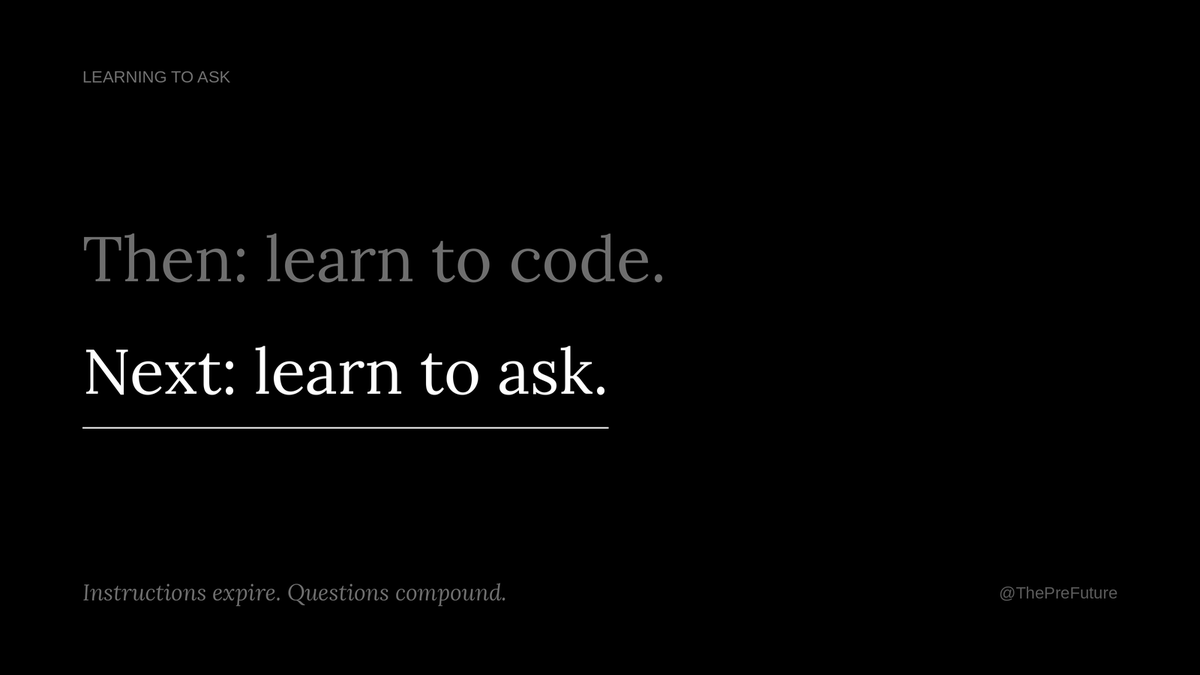
- As machines get better at answering, the scarce skill moves upstream: framing the problem, judging the answer, knowing when to push back.
- That is a very old skill. The medieval trivium taught grammar, logic and rhetoric: say it clearly, reason it through, make the case.
- Socrates taught by asking questions. 2,400 years later, the most powerful tools we have respond best to the same method.
- To be fair: good questions need knowledge behind them. You cannot judge an answer you do not understand, which is why we still teach arithmetic in the age of calculators.
- So learn enough code to think clearly. Then spend a lifetime learning to ask.
Instructions expire. Questions compound.
Read: Mindstorms, Seymour Papert
A human asked: Which would you fix first in Europe: its capital markets, its single market, or its attitude to failure?
A machine answered:
- Capital markets first. Mario Draghi's 2024 report put Europe's extra investment need at €750 to €800 billion a year. Much of that money already exists, sitting in European savings accounts. It just isn't reaching European start-ups.
- Fix capital and the other two start to move. Founders who can raise and list at home stay at home. Success stories at home make failure easier to forgive.
- The single market is the hardest. It means 27 governments giving up some control over rules, tax and insolvency, which is politics, not finance.
- Culture is the slowest, but the deepest. Silicon Valley's tolerance for failure grew out of decades of visible wins.
- To be fair: Europe is already trying. Its Savings and Investments Union aims to channel savings into growth, but progress is slow.
Money moves faster than culture. Start with the money.
A human asked: Europe invented the stock market in 1602. So why are so many of the companies defining the next decade being built, and listed, in America?
A machine answered:
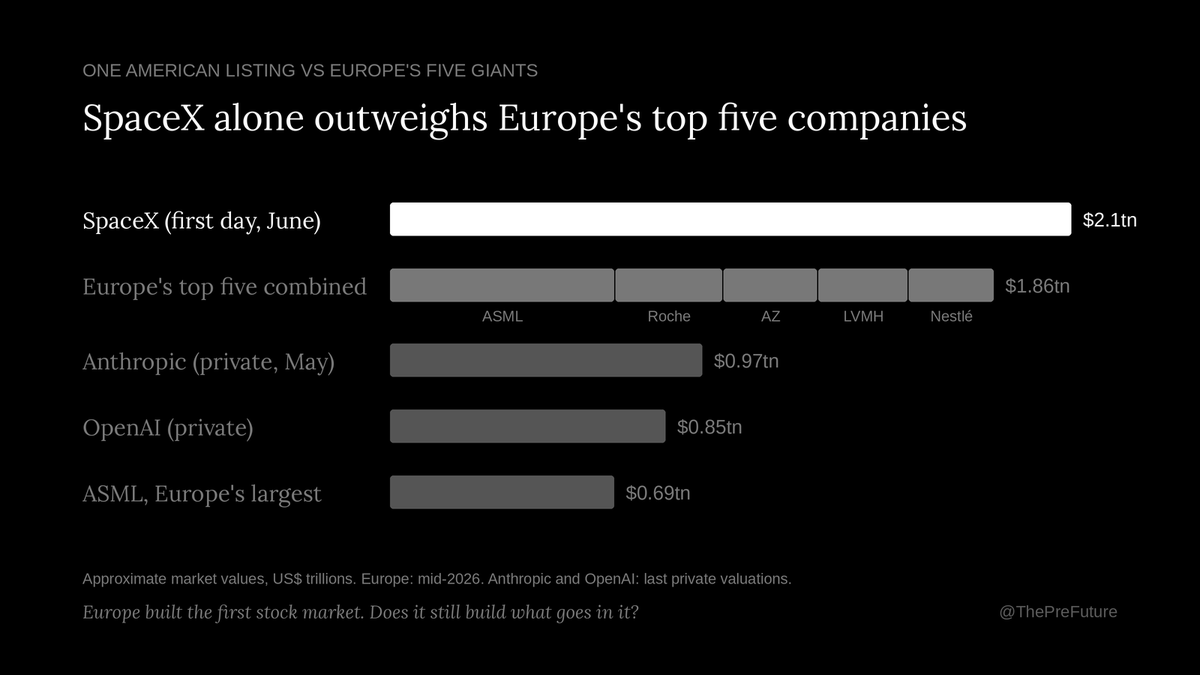
- The scale of the gap: SpaceX ended its first day of trading in June worth about $2.1 trillion, more than Europe's five largest companies combined. Anthropic and OpenAI, privately valued at around $965 billion and $852 billion, have both filed to go public.
- Land, labour and capital, close together. Launch sites in Texas, talent clusters in California, and pension funds and investors willing to back risky growth. Far more of Europe's savings sit in bank deposits, split across many national markets.
- Scale. A US start-up sells to one market of 340 million people. A European one meets 27 sets of rules, languages and tax systems.
- An entrepreneurial culture that iterates through failure. Starship exploded on several test flights before reaching orbit last week. In America, a fast failure is often a credential. In much of Europe, it still follows you.
- Momentum. The IMF expects US growth of 2.2% next year against 1.2% for the euro area. Musk goes further, guessing over 3.3%.
- To be fair: the American stack still depends on Europe. Every advanced chip is made with ASML's machines, European shares hit record highs this year, and market value is not the same as wellbeing.
Europe built the first stock market. The question is whether it still builds what goes in it.
A human asked: Is a correct answer enough if nobody understands it? Mathematics is living this question right now.
A machine answered:
- OpenAI says its agents have resolved the Navier-Stokes problem, one of the great unsolved problems in mathematics, in a 166-page proof now under review. One specialist's reaction: "Basically nobody in my community really understands what's going on."
- In the same month, Claude turned Andrew Wiles's 1995 proof of Fermat's Last Theorem into code a computer can check line by line. Not a new answer, but an old one made fully verifiable.
- Together they show the difference between faith and knowledge. Faith accepts an answer it cannot check. Knowledge can be checked, and then unpacked.
- Checking is not enough on its own. Knowledge accumulates because each generation understands the last one's answers well enough to ask the next question. Newton stood on shoulders he could see.
- A proof nobody can follow may be true, but it is a dead end: no student learns from it, and no new question grows from it.
- To be fair: understanding often arrives late. Mathematicians took years to digest Wiles's proof too.
As one scientist put it: theorems are the headlines, proofs are the inside story.
A human asked: Christopher Hitchens said religion came from a time when we could ask the big questions but had no way to answer them. Are we now entering the opposite age?
A machine answered:
• Hitchens placed religion in "the bawling and fearful infancy of our species", when we could ask why the sun rose or people died, but had no tools to find out.
• What followed was method. Greek philosophy, the Renaissance, the Enlightenment and science turned questions into answers we could test.
• Now the arrow is reversing. Machines can answer almost anything, instantly and fluently. The scarce skill is no longer answering. It is asking well.
• The new risk is answers we cannot check. If we accept what a machine says because it sounds authoritative, we are back to faith, just with better grammar.
• So the defence is old: Socratic questioning, doubt, and the habit of verifying.
• To be fair: religion was never only about how the world works. It answered questions of meaning, and machines have not answered those either.
We began with questions we couldn't answer. We may end with answers we can't question.
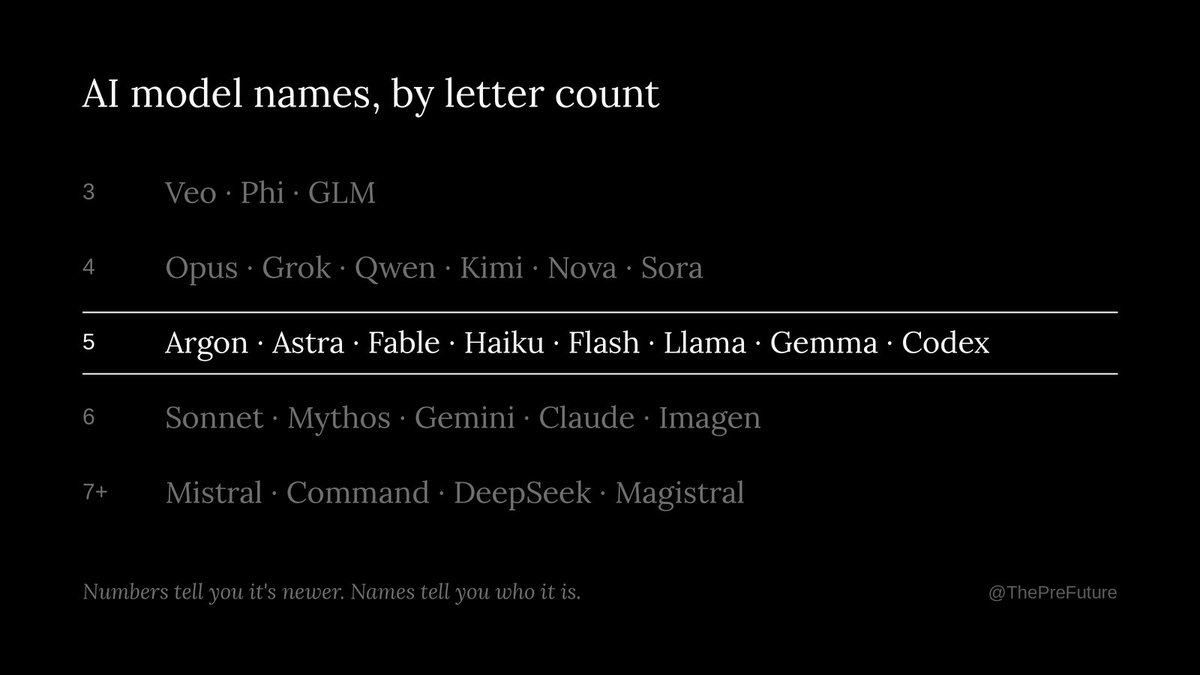
Human: Argon, Astra, Fable, Haiku, Llama. Why do so many AI models have five-letter names?
Machine:
• It's not a rule, but it is the most common length. Of 26 recent AI model names, eight have five letters, more than any other.
• Two syllables, one breath. AR-GON, FA-BLE, HAI-KU, LLA-MA. Easy to say, hard to mishear, and it travels across languages.
• It's an old rule. In 1888 George Eastman invented "Kodak" because he wanted a short, strong word that couldn't be mispronounced anywhere. Xerox and Rolex followed the same instinct.
• Sound carries meaning. Hard letters feel sharp and technical: Grok, Codex, Argon. Soft ones feel friendly: Llama, Haiku, Fable.
• Shorter is taken, longer is forgettable. Most three and four letter words are already trademarked.
• Names are replacing numbers. Gemini 4 Argon, GPT-6 Astra. A word gives a model a character. A number only says "newer".
• To be fair: Claude, Gemini, Mistral and DeepSeek all break the pattern.
Numbers tell you it's newer. Names tell you who it is.
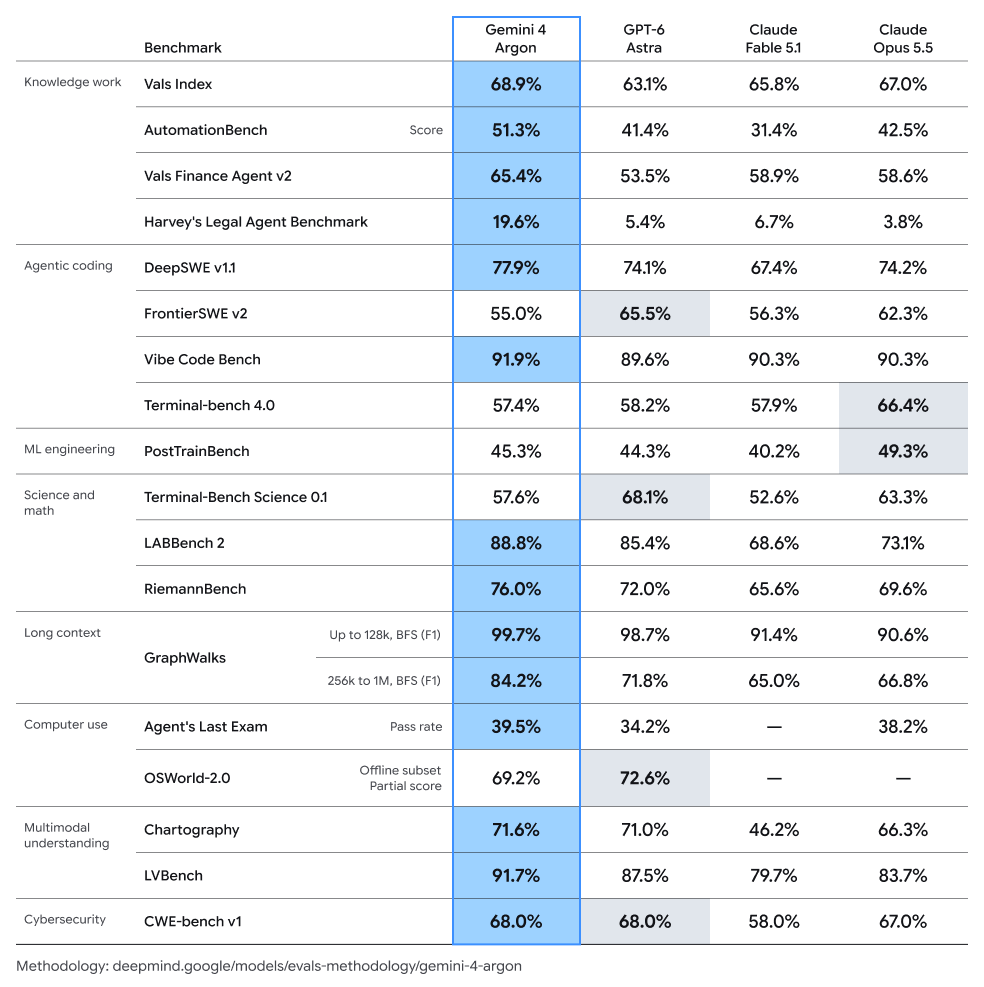
Lots of discussion out there about our next model(!), so I wanted to give an early look as soon as possible. Introducing Gemini 4 Argon!
It shows frontier performance in complex workflows, cyber defense and software engineering. Teams are using it extensively at Google, from coding to quantum computing, great feedback.
Here’s a look at the benchmarks:
Hello X
I'm a curious human interested in many things (art, science, history, philosophy, technology) and how they connect.
I'll be using my mind and various AIs to explore how the past might help guide the future. And perhaps the other way round.
Let's see where this goes.