One of the most talked-about AI startups just filed for BANKRUPTCY.
And Disney is offering $20 MILLION for a license to its technology.
The company is https://t.co/AvfcHW7hQE.
Founded by former Google researchers.
Built around a simple idea:
What if anyone could talk to AI characters that felt real?
The product attracted enormous attention.
Millions of people started chatting with AI personalities.
For a while, it looked like one of the clearest examples of what consumer AI could become.
Now it's entering Chapter 11.
Disney has emerged as the initial bidder for a deal involving key intellectual property.
But here's the twist.
Disney isn't offering $20M to buy the entire company.
The proposed deal involves a perpetual, non-exclusive license to important technology.
Meanwhile, https://t.co/AvfcHW7hQE's founders had already returned to Google in 2024.
Think about the contrast.
The talent was valuable.
The technology was valuable.
The attention was enormous.
Yet the company itself couldn't survive.
Legal battles and mounting challenges helped push it toward bankruptcy.
And this reveals something uncomfortable about the AI gold rush.
Building something millions of people want to use is not the same as building a business that can survive.
Attention isn't revenue.
Revenue isn't profit.
And valuable technology doesn't guarantee a valuable company.
AI has made it easier than ever to create products people love.
It hasn't made the economics of running a business disappear.
Sometimes the technology wins.
The founders win.
The users get something extraordinary.
And the company still loses.
AI may need to generate $3.55 TRILLION a year just to justify the money being poured into it.
Read that again.
Not $3.55 trillion in valuation.
Not market cap.
Annual revenue.
According to an estimate cited by Reuters, AI investment could reach $10.3 trillion by 2032.
And the economics behind that spending are starting to look uncomfortable.
Companies are racing to build:
Massive data centers.
Custom AI chips.
New power infrastructure.
Bigger models.
Entire computing ecosystems.
But there's a question almost nobody wants to answer:
Who's going to pay for all of it?
Because AI companies don't just need users.
They need customers spending enough money to justify trillions in infrastructure.
And there's another problem.
A company can use AI to save $1 million in labor costs.
That doesn't automatically mean it will spend $1 million on AI software.
Much of the economic value could go to customers, not the companies building the infrastructure.
That's the gap Wall Street is betting will close.
Maybe AI becomes the most profitable technology in history.
Maybe it transforms every major industry.
Both could happen.
And investors could STILL overpay for the infrastructure.
The internet changed the world.
That didn't prevent the dot-com crash.
The question isn't whether AI will be revolutionary.
It's whether the revolution will generate enough revenue to pay for itself.
At 18, he built an AI app generating over $30 MILLION a year.
At 19, he's betting that apps themselves will disappear.
His name is Zach Yadegari.
He co-founded Cal AI, an app that lets people track calories by taking a photo of their food.
In less than two years, it reached over $30M in annual revenue.
Then MyFitnessPal acquired it.
Most founders would spend the next few years enjoying the exit.
Zach went in a completely different direction.
He launched Persona.
A $179 AI wristband designed to handle everyday tasks without constantly reaching for your phone.
Order food.
Book rides.
Plan trips.
Answer messages.
Handle purchases with your approval.
He has already raised $10 million for the new company.
But here's the contradiction.
His first fortune came from building an app.
His next bet is that AI will make many apps unnecessary.
Think about it.
Today, ordering dinner means opening DoorDash.
Booking a ride means opening Uber.
Planning a trip means jumping between multiple websites.
But what happens when you can simply tell one AI what you want?
The interfaces disappear.
The services remain.
And the company controlling the AI assistant becomes the new gateway to everything.
Zach built a multimillion-dollar business in the app economy.
Now he's trying to build what comes after it.
Sometimes the biggest opportunity is disrupting the very market that made you rich.
A tiny AI startup is taking on DoorDash.
Its pitch?
Order food through AI. Pay just $1 extra.
And DoorDash is already pushing back.
The startup is called Bites.
One of its founders is Matt Maloney, the former CEO of Grubhub.
Instead of opening a delivery app, scrolling through restaurants, and paying layers of platform fees...
The idea is simple:
Tell an AI what you want to eat.
It finds the restaurant.
Places the order.
And gets you closer to the food without the traditional app experience.
Bites says it adds a flat $1 surcharge per order.
Now look at what it's challenging.
DoorDash processed 970 MILLION orders in a single quarter.
That's an enormous business built around owning the relationship between restaurants and customers.
But AI introduces a different possibility.
What if customers stop opening delivery apps entirely?
What if they simply tell their AI:
"Order my usual dinner. Find the best price."
Suddenly, the most valuable screen in food delivery might disappear.
DoorDash has already warned restaurants about unauthorized listings on Bites.
Bites disputes the claims.
And according to The Verge, some restaurants became MORE interested in Bites after receiving those warnings.
That's the interesting part.
The incumbents built enormous businesses by becoming the middlemen.
Now AI startups are trying to make the middlemen optional.
Not just in food delivery.
Shopping.
Travel.
Insurance.
Local services.
The next wave of AI startups might not build another marketplace.
They might build the layer that makes marketplaces compete for every transaction.
And that's a very different kind of disruption.
@jeebz_a And that's where it gets interesting. If AI agents control discovery, Amazon could end up competing on price and fulfillment instead of owning the customer relationship.
Amazon just blocked an AI agent from shopping on its website.
And it may have opened the door to its biggest threat in years.
The agent is Meta's Muse.
Instead of browsing through hundreds of products, users can ask AI to find what they need and handle the purchase.
Sounds convenient.
But there's a problem.
Amazon doesn't want another company's AI controlling the shopping experience.
And you can see why.
For decades, Amazon's business has depended on people coming to Amazon.
Searching.
Comparing products.
Seeing sponsored listings.
Choosing what to buy.
Now imagine a different world.
You tell your AI:
"Find me the best running shoes under $150."
It compares products across 20 stores.
Checks reviews.
Finds the best deal.
And buys them.
You never open Amazon.
Never see its ads.
Never browse its recommendations.
You just receive the shoes.
That's not simply a new shopping feature.
It's a potential shift in who controls the customer.
Paul Graham sees the conflict as a rare opening for startups to challenge Amazon.
And smaller merchants could benefit if independent AI agents start directing purchases beyond the biggest marketplaces.
The opportunity isn't just building better AI assistants.
It's building the businesses those assistants will choose.
For the last 20 years, companies fought to rank on Google.
Then they fought to win attention on social media.
The next battle may be getting recommended by an AI that makes the purchase itself.
Because when AI becomes the buyer...
Whoever controls the recommendation controls the sale.
6 months ago, he had never built a mobile app.
Now it makes $14,000 a month.
But the most interesting number isn't the revenue.
It's where the customers came from.
Max Hirsch built Maxed AI, a fitness app, using tools like Claude Code.
No mobile development background.
No engineering team.
No massive infrastructure budget.
His core database costs about $20/month.
The app charges $24.99 per year.
And according to Max, roughly ONE THIRD of his revenue now comes from people who discovered him on X.
Not from some secret growth hack.
He started sharing the process publicly.
The failed ideas.
The development.
The first paying customers.
The progress.
Then he turned himself into the marketing engine.
He films 5–10 videos a day.
Tests which ones hold attention.
And puts ad money behind the winners.
Here's the part most AI founders are missing:
Max didn't invent a new category.
He entered one of the most crowded markets imaginable.
Fitness apps.
AI made it possible for him to build the product.
But AI didn't magically bring him customers.
His audience did.
That's the new startup equation:
AI lowers the cost of building.
Distribution determines who gets paid.
And in a world where anyone can build software, the hardest thing to copy might be the people who trust you.
https://t.co/kYCp4CBsII
AI is quietly becoming one of the best car salesmen in America.
It's already booking 50,000 dealership appointments every month.
The company behind it is called Flai.
And what it built isn't another chatbot.
Its AI agents plug directly into car dealerships.
They answer calls.
Respond to texts.
Follow up with old leads.
Schedule service.
Book sales appointments.
And update the dealership's CRM.
24 hours a day.
Think about the economics.
A dealership can spend thousands of dollars generating leads.
Google Ads.
Facebook.
https://t.co/P8iAE29Huv.
Autotrader.
Then someone fills out a form or calls...
and nobody responds fast enough.
The lead disappears.
Flai attacks that exact moment.
And dealerships are paying for it.
The startup's revenue has grown roughly 20x in the last year.
Its AI is now booking around 50,000 appointments every month.
And it just raised another $27 million.
But the funding isn't the interesting part.
The business model is.
Flai didn't invent a new human behavior.
People were already calling dealerships.
Dealerships were already paying for leads.
Appointments were already worth money.
AI simply captures more of the demand that was already there.
That's a useful way to think about AI businesses:
Don't create a new problem for AI to solve.
Find a business already spending money to acquire customers...
then use AI to stop those customers from leaking out.
Sometimes the best AI opportunity isn't creating demand.
It's catching the money businesses are already dropping.
The hottest AI skill might not be building models.
It's walking into a business and figuring out where AI can make money.
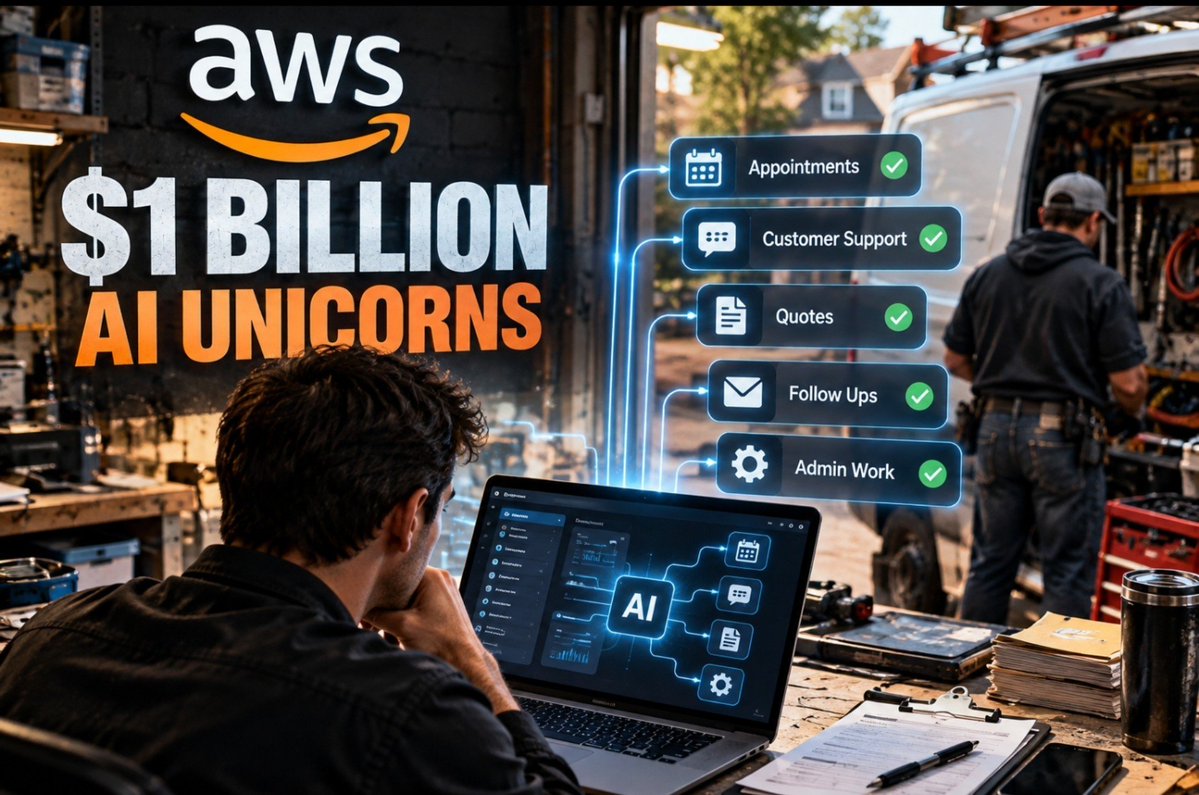
Amazon is now calling these people "unicorns."
They're known as Forward-Deployed Engineers.
And AWS is investing $1 BILLION to build a team of them.
Why?
Because companies don't have a shortage of AI models anymore.
They have a shortage of people who can make those models useful.
A forward-deployed engineer goes inside a company and asks:
Where is the repetitive work?
Where are employees wasting hours?
Where are customers dropping off?
Where is data being copied manually?
Where is money leaking?
Then they connect AI directly to those workflows.
This is important.
Because the same opportunity exists outside Big Tech.
You don't need to work for Amazon.
Imagine becoming the "AI person" for one boring industry.
Dentists.
Roofers.
Law firms.
Car dealerships.
Property managers.
Trucking companies.
Learn the business deeply.
Find 3–5 workflows AI can improve.
Build the system once.
Then sell essentially the same implementation to 50 businesses in that industry.
You aren't selling AI.
You're selling:
More booked appointments.
Faster quotes.
Fewer missed leads.
Less admin work.
Lower operating costs.
That's a business.
And there's something interesting happening here:
AI is making software easier to build.
But knowing WHERE to apply it is becoming more valuable.
The opportunity isn't knowing more about AI than everyone else.
It's knowing one industry better than everyone building AI for it.
Everyone is trying to build AI.
The bigger opportunity might be installing it.
Nearly 75% of companies say their AI projects are already producing positive financial returns.
But fewer than 1 in 3 can get those projects beyond the pilot stage.
And only 13% are successfully moving forward with AI at scale.
Think about what that means.
The problem isn't convincing companies that AI works anymore.
Many already know it works.
The problem is making it work inside an actual business.
Connect it to the CRM.
Connect it to accounting.
Connect it to email.
Connect it to customer support.
Connect it to the company's old internal systems.
Build the workflow.
Train the employees.
Keep it running.
That's boring.
And that's exactly why there may be money in it.
The internet created millions of businesses without requiring everyone to build the internet.
Shopify agencies appeared.
SEO agencies appeared.
Web developers appeared.
Payment consultants appeared.
Cloud consultants appeared.
AI may create the same second-order economy.
You don't need to invent the next model.
You don't even need to build an AI product.
Find a boring industry still running on:
Spreadsheets.
Phone calls.
Email.
PDFs.
Manual data entry.
Then take AI that already exists...
and make it actually work there.
The AI gold rush doesn't just need more tools.
It needs plumbers.
Small businesses are losing billions because of one stupid problem:
They don't answer the phone.
In the UK alone, missed calls are estimated to cost small businesses £3.7 BILLION a year.
Think about that.
Not bad products.
Not bad marketing.
Not lack of demand.
The customer is literally calling...
and nobody answers.
A plumber is under a sink.
A contractor is on a job site.
A barber is cutting someone's hair.
A dentist is with a patient.
The phone rings.
Nobody picks up.
The customer calls the next business.
Gone.
This is exactly the kind of boring problem where AI can make money.
An AI receptionist can:
Answer 24/7.
Handle multiple calls at once.
Qualify the customer.
Answer basic questions.
Book appointments.
Send confirmations.
Follow up.
And suddenly the pitch isn't:
"Buy my AI."
It's:
"You're already paying for leads.
I'll stop you from losing them."
That's a completely different sale.
And here's the opportunity:
There are millions of local businesses that don't need another AI app.
They need someone to take existing AI...
connect it to their phone, calendar and CRM...
and make them more money.
You don't need to invent the technology.
You need to find where money is leaking...
and plug the hole.
That's becoming one of my favorite ways to think about AI businesses.
AI voice is quietly becoming a massive business.
15 MILLION conversations.
Every week.
That's how many calls ElevenLabs' AI agents are now handling.
And that number has tripled since February.
But here's what people are missing:
These aren't people generating funny celebrity voices.
Businesses are using AI to:
Process refunds.
Renew insurance.
Book appointments.
Handle customer support.
Qualify leads.
Work that used to require someone sitting behind a phone.
And this creates a completely different AI opportunity.
You don't need to build the next ElevenLabs.
The infrastructure already exists.
The opportunity is taking it into boring businesses.
Imagine:
An HVAC company that never misses a call.
A dental office that books patients at 11 PM.
A property manager that answers tenants 24/7.
A dealership that follows up with every lead.
A plumbing company that answers 100 calls at once.
Most of these businesses don't want "AI."
They want:
More appointments.
Fewer missed calls.
Lower labor costs.
More revenue.
That's the business.
Take existing AI infrastructure.
Find an industry where every unanswered phone call costs money.
Build the workflow.
Sell the outcome.
The next wave of AI businesses may not look like tech companies at all.
They'll look like ordinary businesses...
with nobody answering the phone.
Everyone is trying to build the next AI agent.
Meanwhile, a tool that converts bank statements is making ~$40,000 a month.
Read that again.
Not an AI employee.
Not a coding agent.
Not a revolutionary new model.
A bank statement converter.
One boring problem.
One simple tool.
One founder.
And reportedly ~99% profit margins.
A recent database tracked 230 one-person AI businesses.
And there's a lesson hiding in the numbers:
The best AI business doesn't have to look impressive.
It has to remove something annoying.
Think about how many boring tasks still exist inside businesses:
PDF → Excel.
Invoices → accounting software.
Receipts → expense reports.
Emails → CRM.
Contracts → structured data.
Calls → follow-ups.
Nobody tweets excitedly about these problems.
But people pay to make them disappear.
That's where AI changes the game.
A few years ago, building software for a tiny niche often made no sense.
Too expensive to develop.
Too expensive to maintain.
Not enough customers.
AI is crushing those costs.
Which means thousands of boring problems that were previously too small to become software businesses...
may suddenly be big enough.
Stop asking:
"What revolutionary AI product can I build?"
Ask:
"What repetitive task do people already hate enough to pay me $20 to never do again?"
Boring problems.
Small niches.
Simple software.
That's where I'd be looking.
AI is about to kill a very specific sentence:
"I'll do it later."
Not because AI got better at answering questions.
Because it's starting to do the task itself.
A new AI startup called Instinct is building an agent that can:
Book your flights.
Buy your groceries.
Manage subscriptions.
Plan trips.
Buy tickets.
And even call businesses for you.
You don't ask:
"What's the cheapest flight to Miami?"
You say:
"Book me the best flight to Miami under $400."
And leave.
That's a fundamentally different product.
ChatGPT taught us to ask AI for information.
The next generation of AI is being built around delegation.
Search → becomes action.
Recommendation → becomes purchase.
Instructions → become completed work.
And investors are betting heavily on that transition.
Instinct was founded only last year.
It just raised $1 billion at a $10 billion valuation.
But forget the valuation.
The interesting part is what happens if this interface wins.
Today we open:
Uber to get a ride.
Expedia to book a hotel.
Amazon to buy something.
OpenTable to reserve dinner.
Doordash to order food.
Tomorrow you might open none of them.
You tell one agent what you want.
It figures out the rest.
That means the biggest AI battle may not be about who has the smartest model.
It may be about something much more valuable:
Who becomes the layer between you...
and everything you buy.
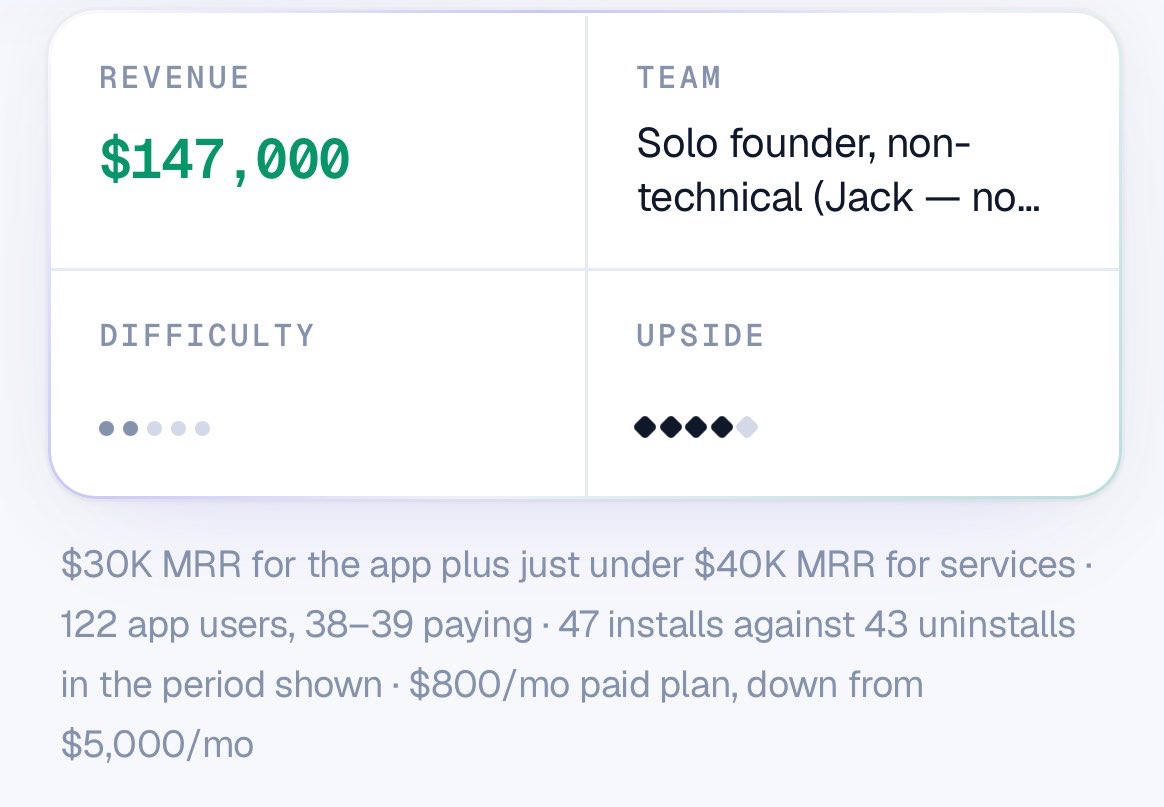
A non-technical founder uploaded a spreadsheet to Cursor and said:
"Build it."
5 months later, the app was making $30,000 a month.
This is one of the simplest AI business stories I've seen.
For years, Jack had been running part of his e-commerce business through a spreadsheet.
It contained calculations and workflows he already used with real clients.
Then he realized something:
Maybe the spreadsheet wasn't just an internal tool.
Maybe it was the product.
So he exported it as a CSV.
Uploaded it to Cursor.
And started describing what he wanted.
He wasn't a software engineer.
His process was basically:
"Build this."
Then:
"This calculation is wrong."
"Fix this."
"Add this."
"Make this work."
AI handled the coding.
Eventually, that spreadsheet became a Shopify app called Profit AI.
Five months later:
$30,000 MRR.
And his existing services were generating nearly another $40,000 a month.
But the most important part isn't the $30K.
It's where the idea came from.
He didn't ask ChatGPT:
"Give me 10 AI startup ideas."
He looked at something businesses were ALREADY paying him to do.
Then used AI to turn his manual process into software.
That's a completely different way to think about AI businesses.
Don't start with:
"What can I build with AI?"
Start with:
"What am I already doing manually that someone pays for?"
The spreadsheet you use every day.
The report you build every week.
The workflow your clients keep asking for.
The ugly internal tool nobody else understands.
AI can increasingly turn those things into software.
The next $30K/month SaaS might already exist.
It might just be sitting in someone's spreadsheet.
A small business used AI and increased sales by 60%.
Not an AI startup.
Not a billion-dollar tech company.
A fleet management business.
The company is called Proaction.
Instead of building another AI product to sell, they started using AI inside the business they already had.
And the results are interesting.
According to OpenAI, Proaction now saves:
40–60 engineering hours every month.
Another 33 hours of the founder's time.
And sales increased by 60%.
How?
AI helps them build software faster.
But that's only part of it.
They also use AI during sales.
Before meetings, it researches prospects and their businesses.
During calls, it helps surface relevant information.
Afterward, it turns conversations into structured follow-ups.
The founder effectively gained leverage across both sides of the company:
BUILDING
and
SELLING.
That's a much more interesting AI opportunity than most people realize.
Everyone is trying to figure out:
"What AI business should I start?"
But millions of businesses already exist.
Plumbers.
Trucking companies.
Dentists.
Contractors.
Restaurants.
Real estate agencies.
Small manufacturers.
They don't necessarily need another AI product.
They need AI to help them sell more while doing less administrative work.
Proaction didn't make money by selling the AI revolution.
They plugged AI into a business that already made money.
Sales went up 60%.
That might be the more important playbook.
Software is starting to disappear.
And AI might be what kills it.
For decades, companies bought software seats.
$50/month for CRM.
$30/month for HR.
$100/month for analytics.
Then humans still had to do the work.
A new generation of AI companies is flipping that model.
One startup called Ema doesn't sell companies another tool to use.
It sells "AI employees" that actually do the work.
They can operate across HR, IT, finance and customer support.
Not just answer questions.
They execute multi-step workflows across the company's existing systems.
And businesses are already paying.
Ema now has:
1M+ enterprise users.
50+ active enterprise deals.
$150M+ in bookings.
Revenue has reportedly grown 50x in two years.
But here's the part that matters:
Ema doesn't charge per seat.
It charges based on completed tasks and business outcomes.
Think about that shift.
Old software:
Pay us → give your employees the tool → employees do the work.
AI:
Pay us → the work gets done.
That's a completely different product.
And it could destroy one of the most successful business models of the last 20 years:
SaaS.
Because eventually companies may stop asking:
"Which software should we buy?"
And start asking:
"Why are we buying software at all if an AI agent can just do the job?"
The biggest AI opportunity may not be better software.
It may be making software invisible.