The short answer: Because we are 3 different countries and we like it that way. 🙂
A bit more context though:
There are roughly 7,000 living languages in the world today. Yet only a very tiny proportion, like the Baltic countries, have their own state to represent their people. Very few have even just a shared state where their language is in some way official.
So, sadly, nearly half of all languages in the world today are currently endangered. Many are doomed (when there are no more children learning it as a first language).
The loss of any language is a tragedy. It’s a unique way of seeing the world and deeply intertwined with culture and identity.
It’s a tragedy repeated on a vast scale throughout history. The vast majority of languages that ever existed are now extinct. In fact, most languages that were alive as recently as the 18th century are now extinct. Estonian, as it happens, also looked like it was surely heading for extinction at that point.
Yet - against the odds of history - Estonian, Latvian, and Lithuanian survive. Each of our peoples had their own National Awakening (or re-Awakening in Lithuania’s case as a much older state). The result was that each created their own Republic dedicated to the continuation of their people, language, and culture.
That’s despite being in a difficult neighbourhood with one big neighbour who still can’t get over the fact that we exist.
The idea of the Baltic countries as a single entity is mostly a russian thing. They’ve called us Pribaltika (Прибалтика) since tsarist times. As elsewhere by other powers, colonisers don’t care about local cultures and like to construct simple, less meaningful identities that are easier to rule over.
To this day, trolls and propagandists acting for some “great powers” continue to rage about the existence of each of the Baltic countries. They obsessively tweet about how no one cares about us, somewhat unconvincingly in their case at least. It’s pretty sad.
What really annoys them isn’t just that we survive, but that we thrive.
By every quality of life indicator, our time as independent nation states has been astronomically better for everyone (including minorities). Because in our own states, we have more influence and more of a say over decisions that shape our lives. Come to one of our song festivals, for example, and you’ll realise what it truly means to be a nation.
We wouldn’t give that up for anything - not to be on the periphery of a large, poorer empire that tramples our rights, steals our prosperity, and represses our language and culture. But also not to be some boring regional grouping.
The Baltic countries are more similar than we usually like to admire but far more different than the rest of the world assumes. In some ways, we could be from opposite sides of the planet.
Every country in the world has a neighbour with just as much or even more similarities. The US and Canada, for example. Spain and Portugal. North Korea and russia. But we don’t question why they are not a single state.
The question itself reflects an imperial mentality.
I have to confess being just as dumb about this kind of stuff myself in the past. I once met someone from Lesotho, which is entirely landlocked by South Africa, and I asked them why they’re not just part of South Africa. “Because we are not South Africa”. Fair point.
The Baltic countries are part of the same defence alliance and same single market. That’s all we need. Everything else is friendship and cooperation based on mutual respect.
Because, more than anything, the one thing that the Baltic countries have in common is the determination to live free and let everyone else do the same.
Just negotiate with russia to end the war, they said.
In the 1990s, the Chechen Republic of Ichkeria made multiple ‘peace’ deals with russia.
Each time, russia used the lull to prepare its next more devastating military offensive, while still waging war though other means to destabilise the fledgling nation.
In reality, russia’s war against the Chechens never stopped until the territory and its people - who were striving again for independence after centuries of russian attempts erase them - were consumed and then weaponised for russia’s next war against others.
This is Dzhokkar Dudayev, the first President of the Chechen Republic of Ichkeria, eventually murdered by a russian missile.
If Ukrainians stopped resisting, the fate of the Chechens today would be theirs tomorrow. It could be your nation after that, using the children of Ukrainians being attacked and stolen today.
“But Chechnya is part of russia,” the world tried to reason when looking away in the 90s.
Now the goalposts have shifted to “But Ukraine was part of the russian empire”.
Imperial logic can lead anywhere. And russia will always find a pretext to advance. Sacrificing one more nation to russian aggression will never make it stop.
But, for Chechens, another future was possible without russia.
If you’ve never heard of Dudayev then that’s understandable. The russian empire throughout its various rebrandings has continuously erased people, physically but also from memory. Sometimes the problem isn’t bad takes, but no takes at all.
But Dudayev is still a legend to us here in the Baltics.
Dudayev was born into russian genocide. As a new born baby, he was deported along with the rest of his nation. Let that sentence sink in.
In that purge of Chechens and the related Ingush, Soviet records show half a million were snatched and locked into wagons, although the real number is likely much higher. At least a quarter of the nation died through the brutality of the deportation process.
The goal was to erase their nation, exploit their labour in remote parts of russia, and let russian settlers move into their land. Their books and records were destroyed, their cultural heritage torn down, even their graves removed.
It’s a familiar story everywhere people have come into contact with russia over centuries.
In an attempt to detoxify and consolidate itself after Stalin, russia did its periodic display of mysterious soul searching and unlocked the survivors. A large scale return of Chechens began, including a 13 year old Dudayev.
Fast forward.
Dudayev became Major-General in the Soviet Air Force and was stationed in occupied Estonia with 4,000 occupiers under his command.
Yet Dudayev displayed a genuine fondness for Baltic peoples, even learning Estonian.
At the height of the Signing Revolution, Moscow ordered Dudayev to crush the re-independence movement. He refused. “I will not throw a bomb on a people fighting for the independence of their homeland,” he said.
He even went on radio to reassure Estonians that he’d prevent soviet forces entering Estonian airspace to replicate the deadly January Events seen in Lithuania.
Moscow pulled his whole division out of Estonia and forced his resignation - which meant he could dedicate himself to Chechen independence, ironically inspired by the Baltic movements he was ordered to crush.
Following a referendum, Dudayev was elected President of the newly proclaimed Chechen Republic of Ichkeria in autumn 1991.
But in Ichkeria, the empire strikes back, desperate to halt the continued break up of the russian empire.
Today, Dudayev is remembered across the free part of the former empire, including with a plaque in Estonia, a street in Latvia, and a square in Lithuania.
Dudayev admired Ukrainians too. He once wrote that the biggest mistake is to consider the Ukrainians weak. “Ukrainians always come back,” he said.
As of 2022, Ukraine recognises the Chechen Republic of Ichkeria as temporarily russian-occupied.
I’m always grateful when people remind us of this referendum because ‘do you want to save it as something different’ is legit hilarious. And then people three decades later still say: “See, they didn’t want change”. 🤣
How do I explain the fact that Chechnya voted to…
[checks notes]
“preserve the Union of Soviet Socialist Republics as a renewed federation of equal sovereign republics, in which the rights and freedoms of a person of any nationality will be fully guaranteed?”
This is an hilariously soviet question in that both ‘yes’ and ‘no’ are to be interpreted as voters wanting to ‘save the soviet union’.
No means you want ‘save’ it as it is. Yes means you want to ‘save’ it as something different with new promised freedoms.
Opponents of the soviet union couldn’t agree which option was best but many voted yes as the best way to end as much of it as possible. The subsequent coup attempt ended the reforms anyway.
The Baltics boycotted this whole bullshit, by the way, not just because the question was dumb but because we refused to allow a soviet vote imposed on occupied countries.
Across the captive nations, clearly worded independence referendums provided a better judge of public sentiment.
If the masses really wanted to save the soviet union, then it wouldn’t have resorted to mass repression and genocides. And it may have offered more than one dumb and deceptive vote at the end of its 80 years of existence.
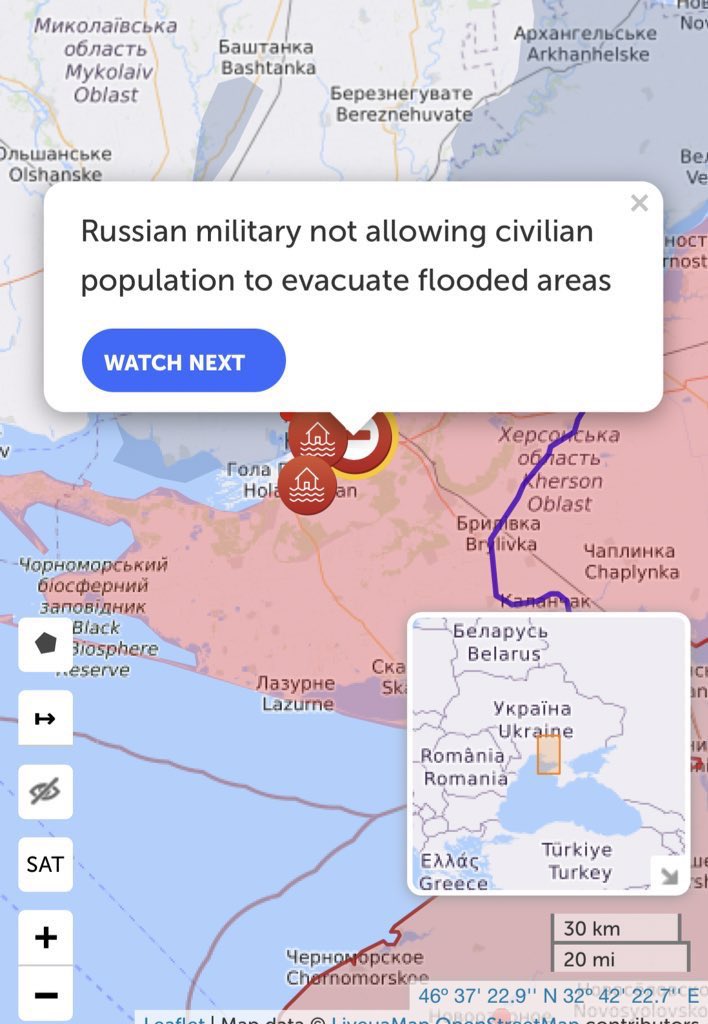
Ukraine has had to endure so many atrocities by the Russian invaders. Missiles strikes, artillery barrages, mass murders, children abductions, and now the floods of the destroyed Nova Kakhovka dam.
Not in a hundred years this will be forgiven.
#Ukraine
A good explanation that the destruction of the Nova Kakhovka dam will lead to dramatic changes in all Ukraine’s south and not only in Crimea. It is an ecological and economical disaster and might turn the south into an arid desert, as it was before 1950.
No military operation would have been worth to do this. Only when you consider scorched earth a military option then the destruction of the Nova Kakhovka dam makes sense, and only Russia, which is losing ground, has interest to commit such an atrocity, to collectively punish the Ukrainian population, as I said yesterday.
#Ukraine #Kherson #Crimea
@dntorres00@honey_simp@Tendar Too many countries memoryholed the invasion of Crimea in 2014, both governments and the public. Saying "Russia invaded Crimea in 2014" wouldn't gather enough support most likely.
@konductdisorder @BadBalticTakes It's more like Russia keeps saying "don't call for help or we will kill you" which makes every country close to them want to call for help.
Also Russia is also guilty of worsening energy deals with Ukraine in the 2000s when it got close to EU.
@Mibosah @KyivIndependent Never? Ukranians are just trying to get their territory back. and foreign countries are backing them on the condition that they do not invade Russia an escalate a pontential nuclear conflict.
A offensive stop after securing Crimea is the most likely.
@Hamzicevic @parkia11 Except the fact that child soldiers don't exist in UKR, and that Putin is still marginally better than Hitler this is all true.
Enjoy watching your humanitarian corridor bombing Czar retreating from all his Ukranian territories though.