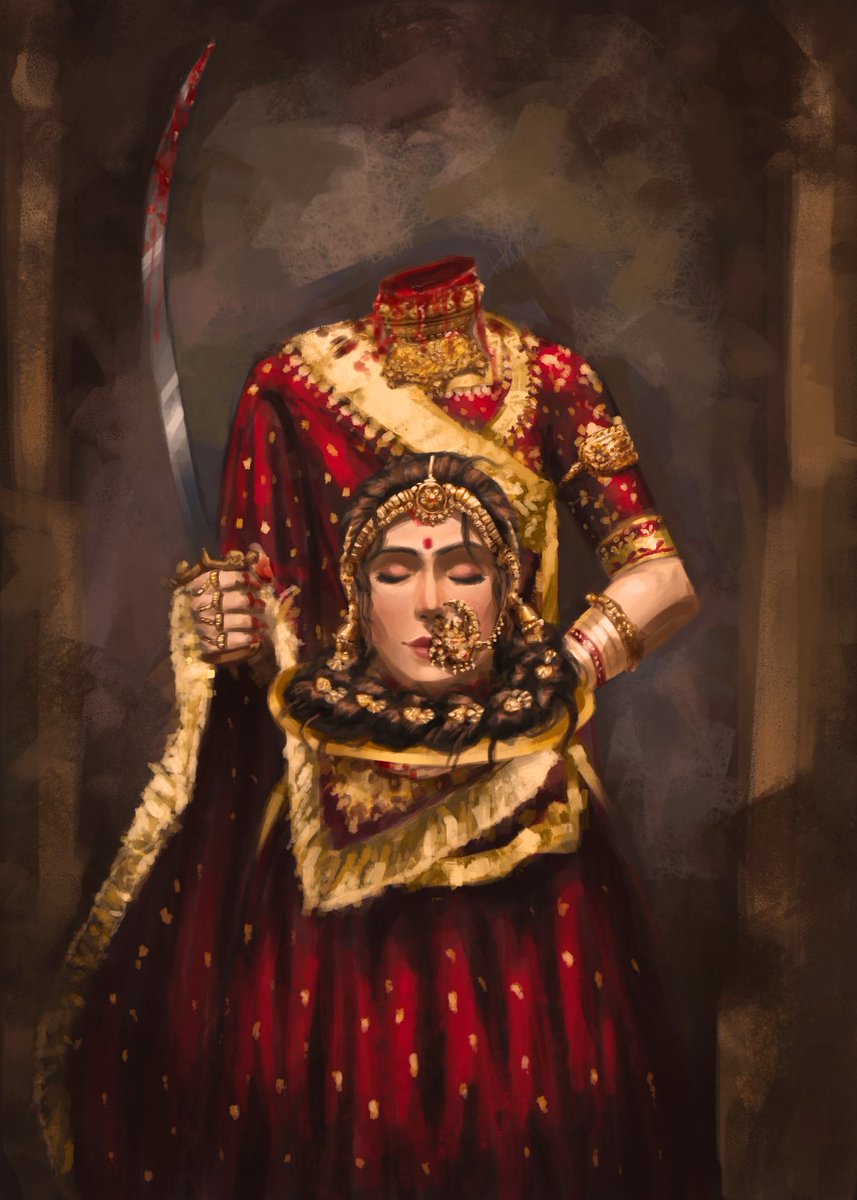
चुण्डावत मांगी सैनाणी ।
सिर काट दे दियो क्षत्राणी ।।
"Chundawat maangi senani,
sir kaat de diyo Kshatrani"
Translation: The Chundawat (Chief) had asked for a token, and the Kshatrani gave her head.
#HadiRani
Artwork by- ArsalanActual (Instagram)
The Hawa Mahal, Jaipur
Built in 1799, by Maharaja of Jaipur Sawai Pratap Singh, of the House of Kachhwaha, the 'Hawa Mahal' or Palace of Winds, is one of the major landmarks in the city of Jaipur.
Maharana was utilizing this period to organize his forces, collecting rations, and getting the support of the rulers of Sirohi, Idar, Jalore among others.
It was Vijaya Dashmi of the year 1582, when it all came to its climactic conclusion.
After a number of failed attempts at conquest after their defeat at Dewair, including one that Akbar himself commanded, the Mughals never returned to Mewar in Maharana Pratap's lifetime.
After the historic battle of Haldighati that ended in a stalemate, Akbar changed his strategy and started sending his soldiers through Mewar's North-Western borders namely, Mandal, Madaria, Mohi and most importantly Dewair.
Several garrisons were established in this region for exercising a better control. The forces of Maharana and Mughals contended against each other, through both symmetric and asymmetrical warfare.
About 2 kilometers south west of the village of Dewair, lies the topic of this buildup - the Battlefield called "Dewair ki Naal", loosely translated as the Horseshoe of Dewair, a local name of the Dewair Valley.
Dewair - Maharana Pratap's Unsung Battle
Towards the South East of the small town of Pali in Rajasthan, lies Dewair, a village enclosed in the hills of Aravali and between the pages of history, the latter often of an untold nature.
#MahaRanaPratapJayanti#स्वाभिमान_दिवस
And why just Mewar, Dewair due to its geographical location was an important access point to Marwar, Gujarat, and Malwa as well. The region's control was incomplete, and ineffective without the control over Dewair.
This however was not so till about four and a half centuries ago. Dewair was the gateway (read strategic) to the kingdom of Mewar and hence provided access to the supercluster of fortresses spread across the hills, valleys and ravines of the region.
"Ho! Neela Ghora re Sawar"
"Ho! Rider of the Blue Horse"
A voice pierces through the hobbled canter of a steed amidst sounds of rattling metal and rustling wilderness.
#MahaRanaPratapJayanti#महाराणा_प्रताप_जयंती
Artwork by- Arsalanactual (instagram)
Shakti Singh returns soon after, this time to rejoin his brother Pratap, in helping him retake all of Mewar back from the Mughals. As for the battle, and its comparison with Thermopylae, the war had only begun, and was far from reaching its last stand...
#End
"Ho! Neela Ghora re Sawar"
"Ho! Rider of the Blue Horse"
A voice pierces through the hobbled canter of a steed amidst sounds of rattling metal and rustling wilderness.
#MahaRanaPratapJayanti#महाराणा_प्रताप_जयंती
Artwork by- Arsalanactual (instagram)
The Raja later marries her, giving her the ornamentations that complemented her elegant and graceful features, stylized by Nihal Chand in his work.
These features later become synonymous with the Kishangarh School, in which Nihal Chand had a pioneering contribution.
#End
Bani Thani - The Decorated Lady
A miniature painting by Nihal Chand (b. Gautam Upadhyay 1710-1782) of the Kishangarh School of Art, the 'Bani Thani' is one of the most, if not the most famous paintings from India, and quite rightly so even called the "Mona Lisa of India".
The painting is believed to have been inspired by a lady in the courts, poetess, singer and later paramour of Raja Savant Singh of Kishangarh (r. 1748-1764) who was a poet, artist and a patron himself.