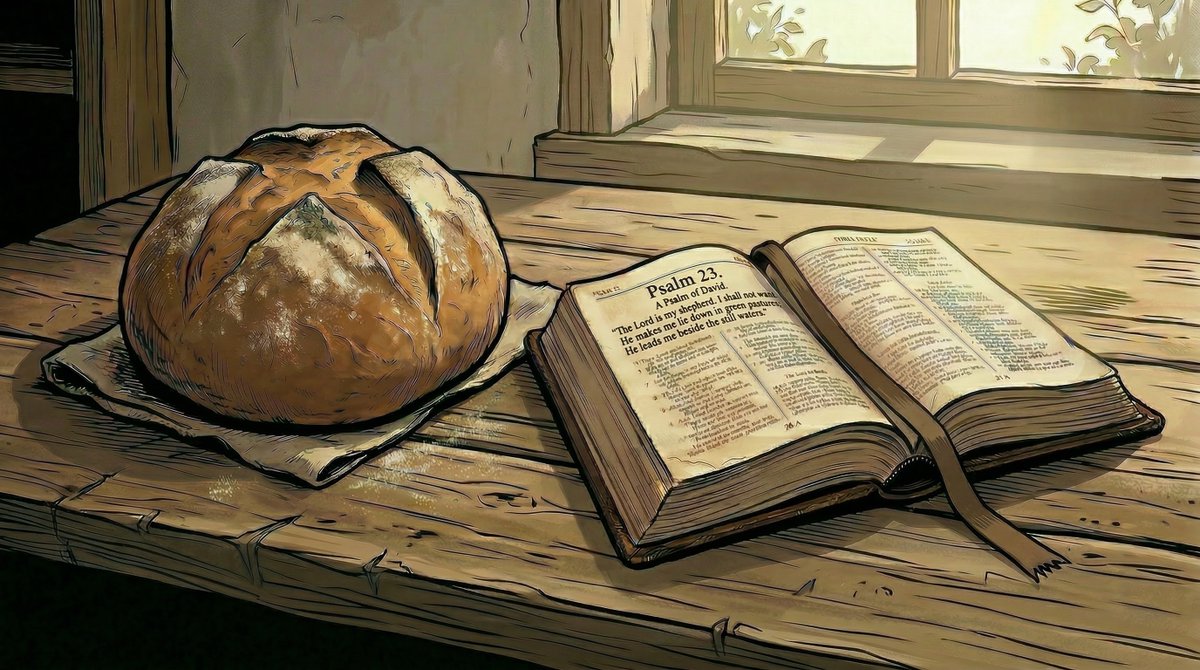
I walked away from faith young. Came back in 2018, got baptized, and since then I can't get enough of God's Word.
Slow Bread is the community I'm building here on X for anyone who wants to go deeper. Not surface reading. Real understanding. The history, the original language, the thing they didn't translate that changes everything.
One verse a day, four perspectives on that verse, one book at a time. In order, no skipping. No rush.
We're starting with Romans 1:1 this week.
If you've ever read a verse and thought "I know the words... but what do they actually mean?" — you're exactly who this is for. Believers, doubters, and everyone in between.
This is becoming something real. A community of people who want to actually sit with Scripture, not just scroll past it. More is coming.
Follow → 🔔 hit the bell → select "All Posts" and every verse lands straight on your phone.
Your daily bread. One verse at a time.
Paul needed the Romans as much as they needed him.
The apostle to the Gentiles. The man who wrote Romans, Galatians, Ephesians, Philippians.
He needed encouraging too.
So here's the question for today:
Who in your life is quietly carrying more than you know? Who has been showing up, serving, giving, teaching — and might need someone to sit with them and remind them that their faith matters to you?
Tag them. Or just go find them.
The mutual faith works both directions. Always has.
"that is, that I may be encouraged together with you by the mutual faith both of you and me." Romans 1:12 (NKJV)
I have been encouraged by people who had no idea they were doing it.
Someone's quiet faithfulness in a hard season. A conversation that landed at exactly the right moment. A brother who showed up and didn't say anything particularly profound but whose presence was enough.
Paul is describing that. The mutual faith. The thing that happens when two people who believe the same things about the same God sit together and something passes between them that neither of them manufactured.
That's not chemistry. That's the Spirit moving through the body the way He designed it to.
You were not meant to be encouraged only by books and sermons and podcasts. You were meant to be encouraged by people. Present, embodied, real people who share your faith.
Who are you sitting with?
"that is, that I may be encouraged together with you by the mutual faith both of you and me." Romans 1:12 (NKJV)
The most dangerous minister is the one who thinks he only gives and never needs.
Paul had every reason to position himself as the expert arriving to deposit truth into an empty vessel. Apostle. Church planter. Author of half the New Testament.
He didn't.
He said mutual. Both of you and me.
The minister who stops needing his congregation has stopped being part of the body and started performing for it. There's a difference. And the congregation always feels it eventually.
Paul modeled something the celebrity pastor culture has largely abandoned. Reciprocity. Genuine need. The admission that sitting with other believers does something for him that he cannot do for himself.
That's not weakness. That's ecclesiology.
"that is, that I may be encouraged together with you by the mutual faith both of you and me." Romans 1:12 (NKJV)
Paul just corrected himself in the middle of a sentence.
Read verses 11 and 12 together.
"I long to impart to you some spiritual gift so that you may be established — that is, that I may be encouraged together with you by the mutual faith both of you and me."
He starts with what he can give. Then catches himself. Expands the frame.
This isn't a one-way transaction. I need something from you too.
Douglas Moo notes this as a deliberate softening. Paul doesn't want to come across as the great apostle descending to dispense gifts to the needy Romans. He reframes the entire visit as mutual. Two people with the same faith, strengthening each other by being together.
That's not false modesty. That's a man who actually believes what he preaches about the body of Christ.
Romans 1:12. The verse where Paul remembered he wasn't the only one in the room.
"that is, that I may be encouraged together with you by the mutual faith both of you and me." Romans 1:12 (NKJV)
The manuscript evidence for the New Testament is unmatched in the ancient world. Over 5,800 Greek manuscripts. Nothing else comes close.
But the eyewitness claim needs one nuance. Luke was not an eyewitness. He says so himself in Luke 1:1-4. He investigated carefully and compiled from those who were. Paul did not walk with Jesus during His earthly ministry.
That doesn't weaken the case. It actually strengthens it. Luke's careful historical method and Paul's encounter with the risen Christ are their own category of evidence.
The foundation is solid. Just build it accurately.
This sounds encouraging. It isn't theology.
"God is doing a new thing in your life" lifted from Isaiah 43:19 and dropped into a motivational framework strips the verse of everything that makes it powerful.
Isaiah 43 is God speaking to a nation in exile. Not promising personal upgrade. Promising covenant faithfulness to a suffering people who had every reason to despair.
The comfort is real. But it's bigger and harder than a new day and a changed focus.
This is the borrowed capital problem.
The atheist who defends human dignity is spending currency from an account he doesn't believe exists. The value of human beings is not self-generating. It requires a source.
Christianity has one. Made in the image of God. Genesis 1:27. The dignity is derivative. It comes from somewhere.
Atheism has the conclusion without the foundation. And a conclusion without a foundation isn't a position.
It's a preference.
There is someone in your life you need to stop meaning to invest in.
Paul longed to get to Rome to impart something to people he had never met. He prayed for it. He planned for it. He wrote the longest letter in the New Testament to prepare the ground before he arrived.
All of that effort. For people he had never seen face to face.
You have people you have seen. People in your home. Your church. Your neighborhood.
People who need someone to long for them the way Paul longed for Rome.
Not to check in on them. Not to be available if needed.
To actually give something of yourself into them so that they are more established than they were before they knew you.
That's what Paul was heading to Rome to do.
What are you heading toward?
Romans 1:11 (NKJV) "For I long to see you, that I may impart to you some spiritual gift, so that you may be established."
"So that you may be established." That's the goal. Not the experience. The establishment.
We've built an entire Christian culture around the experience. The conference high. The worship moment. The emotional breakthrough.
Paul's aim was different. He wanted the Romans rooted. Stable. Immovable.
Not because experience is bad. But because experience without establishment produces Christians who need another hit every six months to remember why they believe.
D. Martyn Lloyd-Jones preached for decades on this exact distinction. Spiritual experience is real and necessary. But it is not the foundation. The Word is the foundation. Doctrine is the foundation. Establishment comes through truth that has been received, understood, and inhabited.
E.
Paul longed to see them so he could give them something that would hold when he was gone.
That's what faithful ministry builds toward. Not the moment. The permanence.
Romans 1:11 (NKJV) "For I long to see you, that I may impart to you some spiritual gift, so that you may be established."
Most ministry is about what you can get. Paul's was about what he could give.
"That I may impart to you some spiritual gift."
Impart. Not perform. Not demonstrate. Not build his brand in Rome.
Give something away. Transfer something of himself into them.
This is the posture Paul carries into every church he writes to. Not extraction. Investment. Not platform building. Establishment.
Keller drew this line clearly. The minister who is building his own kingdom and the minister who is building Christ's kingdom look identical from the outside in the good seasons. The difference only becomes visible when it costs something.
Paul's ministry cost him everything. And he longed to give more.
That's the diagnostic. What does your ministry long to give?
Romans 1:11 (NKJV) "For I long to see you, that I may impart to you some spiritual gift, so that you may be established."
Paul didn't want to visit Rome. He longed to.
There's a difference.
Want is manageable. Longing is something that sits in your chest and doesn't leave.
"For I long to see you." This is the apostle to the Gentiles, the man carrying the weight of the entire Gentile mission, and he is homesick for a church he has never visited.
Not for Rome the city. For the saints in it.
Douglas Moo notes that the Greek word here carries the sense of deep personal affection. Paul isn't fulfilling an obligation. He is expressing something that has been building for years.
This is what gospel ministry looks like from the inside. Not a job description. Not a platform strategy.
A longing.
Romans 1:11. The man who couldn't wait to give himself away.
Romans 1:11 (NKJV) "For I long to see you, that I may impart to you some spiritual gift, so that you may be established."
Romans 6:1 is Paul quoting his own critics.
He knew exactly what the objection would be because he'd heard it. And he didn't soften the gospel to avoid it. He answered it.
The answer wasn't less grace. It was more union. You died with Him. You were buried with Him. You were raised with Him.
A dead man doesn't go back to his old life. Not because he's trying hard not to. Because he's dead to it.
Grace doesn't produce lawlessness. It produces resurrection. And resurrection changes everything.
V2 is exactly the clue.
Psalm 17 is a prayer of vindication. David isn't making a general claim about his moral perfection. He's making a specific legal appeal to God in the context of being falsely accused by enemies.
"My feet have not stumbled" means: in this matter, before You, I am innocent. It's courtroom language. Not autobiography.
David knew his own sin better than anyone. He wrote Psalm 51. The same man. The same pen.
Context is everything.
God did isolate Moses. He did test Abraham. He did refine Joseph through the pit and the prison.
But every one of them was isolated for others. Not for themselves. Moses went back to Egypt. Abraham became the father of many nations. Joseph fed the brothers who sold him.
The isolation was never the destination. It was the preparation.
If your refining is producing contempt for the church rather than love for her, something has gone wrong in the theology.
John first. Then Romans.
John shows you who Christ is. Romans shows you what He accomplished and what that means for you.
Together they give a new believer the Person and the theology. The heart and the framework. You need both and you need them early.
Don't wait until you feel ready for Romans. You'll never feel ready. Jump in.
And if you need a hand, we're going through it on the feed right now. Every. single. verse.