The West keeps closing Russian companies. A7 is built to make closure temporary.
That's the more important lesson from the A7 network described by @nytimes. A7, a Moscow-based financial firm, helped Russian businesses move money and obtain restricted goods through shell companies, foreign bank accounts, cryptocurrency and falsified trade records. The Times identified 71 shell companies linked to the network and documented more than $500 million in prohibited transactions in just the first four months of 2025, including more than $130 million tied to products that could support Russia’s military-industrial base.
The significance isn’t the size of one company, it's that the function can survive the loss of any one company. When Kyrgyzstan shut parts of A7’s network, the operation shifted toward entities in Bahrain, the United Arab Emirates, Nigeria, Mongolia and elsewhere. The network was built to move.
That changes what a successful sanction looks like. Hitting a company can stop a transaction. Hitting a jurisdiction can close a route. But neither necessarily removes the underlying capacity to move money or disguise a shipment. The harder target is the function itself: cross-border settlement, foreign-currency access, trade documentation, and the ability to create a new legal entity when an old one becomes unusable.
The distinction matters because sanctions enforcement depends heavily on visibility; banks and regulators decide whether a transaction is permissible by examining the buyer, seller, commodity, paperwork and payment trail. A7’s falsified trade records attack that information layer as well as the financial one. The problem is no longer simply that a sanctioned actor found another bank, it's that the transaction can be redesigned to look like something else before the bank decides whether to process it.
This's why adaptation time matters; if one node can be closed quickly but the network can create a replacement just as quickly, enforcement becomes a sequence of temporary disruptions. The pressure is real. Trade becomes slower, riskier and more expensive, but the underlying flow can survive.
A7 therefore exposes a limit of entity-by-entity enforcement; a network with dozens of shell companies doesn’t need every node to survive, it needs enough nodes to keep the function running. Closing a company can become less important than identifying the relationships, financial channels, intermediaries and operational knowledge that allow the network to reproduce itself.
That's a different theory of economic coercion; the objective isn’t simply to disconnect Russia from the global financial system, it's to make reconnection expensive enough, slow enough and fragile enough that Russian firms cannot replace lost access faster than sanctions can remove it.
The contest is no longer only between sanctions and circumvention, it's between the speed of disruption and the speed of reassembly.
Sanctions can close a door; the strategic question is whether the network can build another one before the pressure reaches its destination.
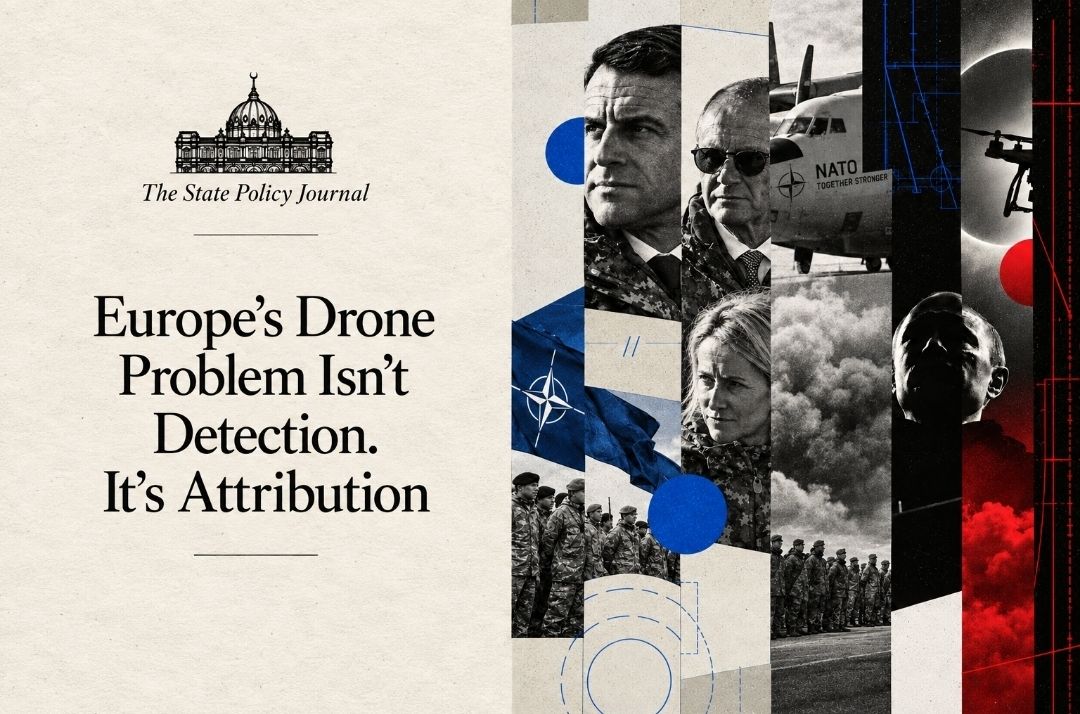
A year ago, reports of drones around Copenhagen Airport shut down air traffic and quickly became part of a wider European security story. Since then, the threat has become harder to dismiss. Denmark’s Defence Intelligence Service now assesses that Russia will intensify its hybrid attacks against Europe and NATO, while the risk of a limited military attack on one or more NATO countries remains low but is growing. At the same time, it still considers a full-scale Russian invasion highly unlikely.
That combination creates a problem that better sensors alone cannot solve. Europe has to determine what an ambiguous observation means before it decides what to do about it.
A light moving across an airport is an observation. Establishing that it was a drone is a classification. Establishing that the drone was hostile is another step. Attributing it to Russia is another. Each step adds a claim that requires evidence. When those steps collapse into one, an unidentified object can become a geopolitical accusation before anyone has established what was actually in the sky.
This matters more as the underlying threat becomes more credible. Denmark’s assessment says Moscow has moved from using hybrid attacks mainly to create fear and weaken support for Ukraine toward attempts to disrupt that support directly, including sabotage against defense companies and rail transport. A genuine threat therefore makes vigilance necessary. It also makes verification more important, because every ambiguous incident now arrives with a ready-made explanation.
The European drone panic showed how quickly that can happen. Reports spread across countries, while subsequent investigations in many cases couldn't establish that a drone had been present at all. Aircraft, helicopters, lights, and other objects entered the same information stream as genuine drone incidents. The result was a feedback loop: one reported drone encouraged more people to search the sky for drones, and new observations reinforced the original narrative.
The strategic cost is larger than wasted attention; misclassification can close an airport, trigger emergency deployments, accelerate purchases of counter-drone systems, or push officials toward an attribution that later proves unsupported. At Borris, Danish soldiers fired 43 rounds at what later analysis suggested may have been a passenger aircraft, not a drone. A mistaken identification can therefore turn surveillance into the use of force.
Technology doesn’t remove this problem; radar, radio-frequency sensors, cameras, and infrared systems can improve detection, but detection isn't identification, and identification isn't intent. A sensor can establish that something is there without establishing what it's, who controls it, or what it's trying to do.
Europe’s emerging counter-drone architecture therefore needs an evidentiary layer as much as a technological one. The relevant question isn't only how many objects a system can detect; it's how accurately those objects are classified, how often genuine threats are missed, and what evidence is required before an observation becomes an attribution.
That distinction has strategic value; because Russia may not need every alarm to be genuine for ambiguity to produce effects; fear can consume attention, distort threat assessments, and pressure governments to act before evidence catches up. That doesn't establish that Russia is manufacturing false alarms, it establishes why attribution must remain separate from detection.
Europe consequently faces two different failure modes. Missing a real drone creates a security vulnerability. Turning an unidentified object into a confirmed hostile operation creates a decision vulnerability; the first demands better sensors, the second demands better judgment.
As the Russian threat becomes more credible, Europe has less room for both complacency and premature certainty.
About us
The State Policy Journal aims to be an independent platform for serious discussion of global politics and international affairs, and to evolve into a multi-platform media organization that combines analysis, reporting, opinion, data, and other forms of publication that contribute to understanding international issues.
SPJ addresses issues of current international importance, and its coverage extends beyond politics to include history, economics, law, and other fields that help in understanding international relations and the balance of power. Maps, data, and illustrations are used when they add to understanding, while purely technical matters are left to specialized journals. The reader's interest and the usefulness of the published material remain paramount.
SPJ is independent and non-partisan, and doesn't endorse any particular cause or school of thought. It views differing opinions as part of its mission, not a flaw; it's required to be informed, accurate, serious, and persuasive, and to provide a platform for diverse ideas as long as they are worthy of discussion. The publication of any opinion in SPJ does not imply its endorsement of it. Its responsibility is to edit, select, verify, and attribute, and to provide space for free discussion, not to impose a consensus on reade rs.
Why follow?
Follow to get full access to the newsletter and publication archives.
Sudan has been at war since 2023 between the Sudanese Armed Forces and the Rapid Support Forces, two armed organizations competing for control of the state. On September 22, Washington made an unusually direct statement about what happens after the fighting: neither force, and neither of its leaders, represents legitimate constitutional government, and both leaders are “ineligible to govern.”
That changes the political equation more than another round of pressure would. A military faction can fight for territory, capture strategic ground, collect revenue, and still fail to convert battlefield control into the right to govern. Washington is now drawing that distinction explicitly. The objective isn't only to stop the war, it's to prevent military control from becoming constitutional authority.
Rejecting both the Sudanese Armed Forces and the Rapid Support Forces as legitimate constitutional government isn’t the same as naming a replacement government. The State Department demanded an immediate humanitarian truce from both sides, called for inclusive political dialogue leading to civilian government, and said it would raise the cost of continued fighting on all belligerents and the networks sustaining them. The stated political endpoint is civilian rule, not victory by a preferred armed faction.
A second distinction separates negotiability from governability; Washington says it's ready to work with anyone who is a serious partner for peace, while insisting that neither armed camp is eligible to govern. A faction can therefore remain a party to negotiations without becoming the political endpoint of those negotiations.
Wars often settle political questions indirectly. The actor that controls more territory gains bargaining power; the actor that survives longest acquires institutional advantages; and an interim military arrangement can become permanent simply; because everyone starts treating it as the only practical authority. Washington is now trying to break that conversion process.
By excluding both factions rather than one, Washington also avoids the simpler reading that it's backing one armed camp against the other. The message is broader: battlefield control by itself won't be treated as a sufficient claim to constitutional rule.
A reported visa dispute involving Sudan’s army chief Abdel Fattah al-Burhan shows how the principle could begin to acquire an operational form. @Reuters reported that U.S. authorities were withholding his visa for the UN General Assembly while sources said its issuance appeared linked to acceptance of a proposed 90-day ceasefire. The State Department hasn't publicly confirmed that condition. If such pressure is sustained, access to diplomatic forums becomes conditional on movement toward a political process rather than an automatic benefit of being Sudan’s de facto military ruler.
This creates a different kind of pressure. Sanctions can raise the cost of fighting; military pressure can change the battlefield, diplomatic exclusion can change the value of winning the battlefield in the first place.
This's where the strategy becomes consequential. If commanders know that military control won't by itself produce international acceptance as the constitutional government, battlefield gains become less convertible into political settlement. The war can still continue, but the payoff structure changes.
There's a limit to the strategy; denying legitimacy doesn’t create an alternative government, and excluding both armed camps doesn't by itself produce a civilian coalition capable of governing Sudan. The United States would still need a credible political process and enough external support to make civilian rule more than a diplomatic formula.
But the September 22 statement establishes a clear rule: military power may determine who can hold territory, but it won't, by itself, determine who gets to rule Sudan.
The battlefield and the constitutional order are now being treated as separate contests.
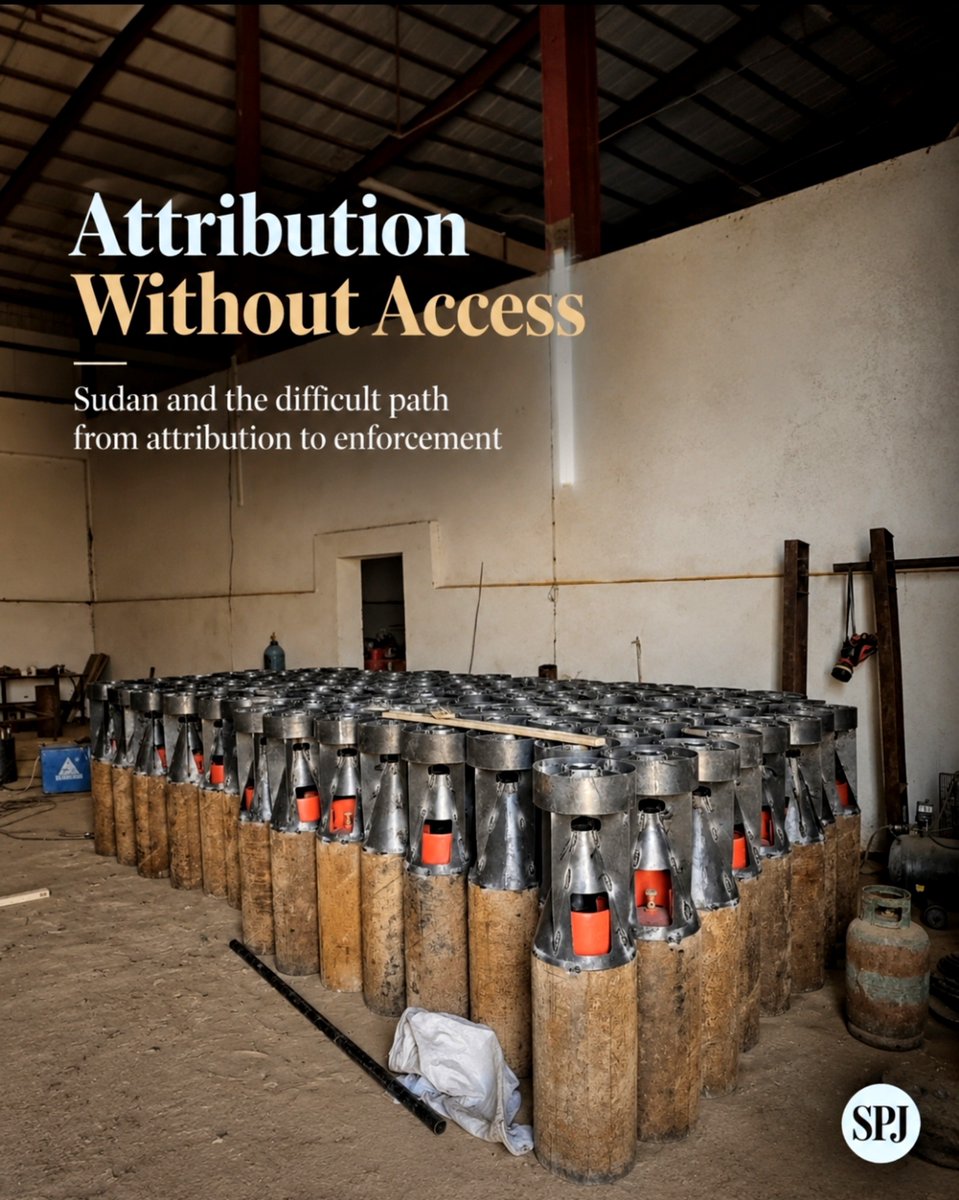
@washingtonpost & @nytimes dossier on #Sudan doesn't settle the chemical-weapons charge. It changes the form of the charge. Washington had already sanctioned Gen. Abdel Fattah al-Burhan without publishing its evidence. The Times file tries to supply the missing chain: designs, tests, procurement, claimed use, and an order to erase the program after American penalties. That is more than an allegation. It is still less than a finding.
The source is the first limit. The material was given to the paper by an unnamed Middle Eastern intelligence service and appears to come from the phones of senior Sudanese officers. American officials, the Times reports, saw some of the visuals when they assessed the file in early 2025. Experts who reviewed the images called a chemical effort plausible and added the decisive reservation: only an impartial investigation on the ground could confirm it. Attribution assembled from a foreign service and seized handsets can name people. It cannot substitute for sampling, chain of custody, or an OPCW inspection.
Chlorine makes that gap wider, not narrower. It is an industrial chemical, supplied in this war in part to keep water plants running against cholera. The convention is triggered by weaponization. The dossier alleges exactly that, munitions meant to combine blast with choking gas, cylinders taken from imports and from the al-Manara plant in Omdurman, tests in the desert, and messages claiming strikes. Sudan’s army calls the file baseless and notes that Khartoum is a party to the Chemical Weapons Convention. Those two facts can sit side by side because they answer different tests.
The weakest operational link in the published narrative is al-Jaili. The file places a September 2024 chlorine strike at the refinery then held by the Rapid Support Forces. The R.S.F. accused the army of firing “toxic” missiles. France 24 documented a chemical incident at the same facility but described large gas cylinders, not the smaller bombs attributed in the dossier to Brig. Gen. Tariq Hussain. The Times recorded the discrepancy and found no confirmed deaths. If rival forces remained on the site for months afterward, and if civilians held there were later recovered without a chemical-casualty pattern, the episode cannot carry the weight of a battlefield proof. It can support a program theory. It cannot close it.
The same caution applies to the names. The file does not lack a theory of responsibility. It attributes knowledge to al-Burhan and operational control to Hussain, and it notes that Hussain later appeared among advisers to the army’s own inquiry, the inquiry that then reported no trace of a program. That sequence is either concealment or a warning about using an intelligence dossier as a charge sheet. Authenticity is the issue, not the absence of an alleged link.
What remains is the institutional test. The United States has treated the intelligence as sufficient for sanctions and demands destruction under international verification. The Organisation for the Prohibition of Chemical Weapons says requests for clarification are ongoing. One is a national punishment. The other is the process the treaty system still requires when investigators cannot move freely on the battlefield.
Sudan is therefore not only a story about chlorine. It is a story about what counts as proof after Syria: a chain detailed enough to justify a great power’s penalty, and still short of a verdict the chemical-weapons regime will own. Intelligence can close the distance to a name. Until the chain leaves the custody of an unnamed service and survives independent examination, attribution has not become accountability.
Simply put: What Trump is doing in Iran is the same as what he is doing in Cuba, and the same as what he is doing in Venezuela.
Also, it's the same thing that Putin is doing in Ukraine, and that Netanyahu is doing in Gaza and the West Bank.
The difference for the Iranian theater is that Tehran has leverage it can use in negotiations, while the rest are vulnerable nations with no recourse.
Trying to portray Iran as a country that blackmails its negotiators to gain advantages is beyond the realm of reasonable perception in such cases.
Does all of this mean that if the United States stops striking Iran today, Iran will open the Strait? The answer is yes, absolutely.
Also, the attempt to portray Iran as a country with ambitions in the Middle East, to possess nuclear weapons, I think that, assuming this's true, isn't a shameful matter for the current international community. Israel is a nuclear state, and it has strong efforts to impose its influence in the Middle East, and even outside the Middle East, and it has intelligence hands in the homeland of everyone who reads this, in addition to the fact that the head of the effective authority in it's convicted by the International Criminal Court of committing one of the most heinous and atrocious war crimes of the twenty-first century. And no one dares to describe its efforts to dominate the Middle East, and its nuclear arsenal, as terrorist or blackmailing.
Incidentally, we're neither American, nor Russian, nor Ukrainian, nor Cuban, nor Venezuelan, nor Iranian, or Israeli; we're simply trying to provide a neutral analysis based on reality, far removed from speculation, exaggeration, and emotion.
The Strait of Hormuz is a narrow waterway between the Gulf and the Arabian Sea through which a large share of the world’s seaborne oil and gas normally passes. On Tuesday, @Reuters reported that a senior Iranian official said Tehran could reopen the strait within seven days if the United States eased military pressure and lifted its blockade on Iranian ports. Iran says its proposal to end hostilities was already sent to Washington through mediators on September 16. That's more than a threat to close a waterway, it's an attempt to put a political price on reopening it.
That changes the logic of the chokepoint. A chokepoint has two kinds of power; the first is negative: the ability to restrict movement, the second is positive: the ability to make restored movement conditional on something else. The second turns physical control into bargaining power. Iran is now presenting access through Hormuz as a variable that can change with the wider terms of the conflict.
Yet “reopening” isn’t the same as restoring normal commerce; Reuters reported that only two commodity vessels crossed Hormuz on Monday, compared with roughly 125 large commercial vessels a day before the conflict, while two ships were attacked during separate passages. Even if Iran ordered the waterway open, shipowners, insurers and crews would still have to believe that the route was safe enough to use. A political announcement can change a rule overnight. Commercial confidence takes longer.
Now there's a second clock; the political clock asks how quickly governments can agree to reopen the route, the operational clock asks how quickly private actors can trust that decision; the difference between the two is where credibility lives. A seven-day promise is therefore meaningful only if it can be translated into sustained, verifiable passage.
A deeper test concerns Iranian state capacity. Closing a chokepoint requires the ability to create disruption. Reopening it on agreed terms requires something different: the ability of the political center to make every force capable of threatening shipping obey the new arrangement. The relevant question is no longer only whether Iran can shut the route, it's whether Tehran can make a political commitment travel all the way down to the actors who control the physical risk.
Meanwhile, the bargaining environment is changing on the other side too. Saudi Arabia has restarted its East-West oil pipeline, which can reroute about four million barrels a day toward the Red Sea, although a full return to capacity could take six to eight weeks; That doesn’t make Hormuz irrelevant, it means Iran is bargaining over a system that's slowly acquiring alternatives. As alternative routes recover, the value of the chokepoint shifts from “can everything stop?” toward “how much does reopening, delaying or disrupting the route cost?”
Diplomatically, the issue is moving in the same direction. France is considering a UN Security Council resolution aimed at protecting commercial shipping through Hormuz, which would push the issue beyond a purely U.S.-Iranian dispute and toward an international maritime-security problem.
Its strategic value, then, is no longer measured only by Iran’s ability to close it, it's increasingly measured by Iran’s ability to make its reopening conditional, credible and enforceable.
In the end, a chokepoint becomes a bargaining asset when the way out of the chokepoint has a price.
The usual question about China is whether it can replace the United States as the dominant power. A more revealing question is whether Beijing needs to replace Washington at all. Its strategy can work through a different mechanism: reduce the number of countries, institutions, and crises in which American leadership remains the default solution.
For Beijing, that process starts beyond the traditional Western core. China has spent years offering developing and emerging states infrastructure, loans, diplomatic backing, and a language of sovereignty and non-interference. The immediate payoff is not control of those governments. It is a wider group of states willing to support Chinese positions, or at least resist Western pressure, inside institutions where votes shape rules, appointments, and legitimacy. That support can accumulate quietly.
Institutions matter because power doesn’t have to arrive as command. A state can accumulate enough support to change the coalition behind particular decisions. It doesn’t need to control the institution. It needs to change what the institution can plausibly do. Over time, influence that once looked diplomatic can become structural. The institution remains in place. The political environment inside it has shifted.
Taiwan operates through a different mechanism. Its importance isn’t only the island itself or the technology produced there, it's also what Chinese control of Taiwan would say about America’s ability to protect a partner at the center of the Western Pacific. If Washington couldn't prevent that change, governments across Asia and beyond would've to reassess the reliability of American security commitments.
Put the two mechanisms together and a larger strategy becomes visible in this account. Support accumulated across the developing world can give China greater diplomatic room. A major reversal in East Asia could simultaneously weaken confidence in the United States, especially among governments that depend on American security commitments while watching whether Washington can actually uphold them when the costs become extreme. China wouldn't need to assume every military, financial, and political burden that Washington carries today; it would need something less expensive: a world in which fewer actors automatically turn to Washington to organize the response.
That's why replacing a hegemon and displacing its centrality aren't the same project. Replacement requires inheriting the machinery of American power. Displacement requires making that machinery less indispensable.
Countries trying to compete with Beijing therefore face a different task. Matching ships, factories, or military budgets matters, but it's only one part of the contest. The other is keeping alternative political and institutional networks from becoming attractive enough that American influence is no longer the easiest way to solve a problem.
Ultimately, the contest isn't simply over who will lead the world; it's over how often the world still needs to be led by Washington.
Qatar’s response to @NewYorker Qatargate investigation changes the analytical question. The dispute is no longer only about whether foreign influence reached Netanyahu’s circle. It's also about the provenance of the information used to establish that claim.
First, there's the alleged influence itself. The New Yorker reports Qatari financing of Perception and payments involving private intermediaries who had access to Netanyahu’s political and media networks. It describes campaigns in which messages were allegedly presented as information from senior American officials, including a fabricated account of a meeting in Doha. Qatar denies the allegations. The evidence supports an investigation into a foreign-funded influence channel, not a claim that the Qatari government directly authored every tactic attributed to the intermediaries.
Second, there's the historical documentary record. Qatar’s September 21 statement says that documents cited in the New Yorker story are fabricated and that the outlet was given evidence of that before publication. It also says that elements of the extreme right in Israel had circulated or produced material intended to implicate Qatar. Those are serious claims, but they remain claims unless the underlying evidence is made independently testable. A dispute over the authenticity of historical documents doesn't, by itself, resolve the separate evidence concerning the contemporary Perception network.
Third, there's the provenance of the messages themselves. This's where the story becomes structurally interesting. The New Yorker’s account describes an alleged operation that derived credibility by obscuring where a message came from and giving it the appearance of official American knowledge. Qatar’s response now attacks the provenance of the evidence used to tell that story. One side says the message borrowed authority. The other says the documents borrowed authenticity.
Access is therefore only part of the mechanism. In the Rubio case, proximity to a decision-maker had value; because everyone could see whose signal was being transmitted. In Qatargate, the alleged mechanism runs in the opposite direction. The useful asset is access combined with concealed provenance. The recipient sees the authority attached to the message without seeing the foreign source behind it.
A similar pattern appears in Qatar’s earlier media responses. On March 3, after a @business report about Patriot interceptor stocks, the International Media Office said it was reviewing legal options over what it called false information. On June 12, after a @washingtonpost report about alleged coordination with Iran over energy production, it again accused the report of relying on false and unreliable material and said it would undermine Qatar’s mediation efforts. The September statement therefore follows an established institutional response pattern rather than appearing as an isolated escalation.
An evidentiary firewall must remain intact. A claim that some documents are fabricated does not establish that the entire Qatargate allegation is fabricated. A documented payment relationship doesn't establish that every message associated with it came directly from the Qatari state. And a genuine message doesn't prove that the attribution attached to it was genuine.
Ultimately, the deeper issue is therefore not simply who influenced whom, it's who controls the chain of provenance through which a message becomes believable in the first place.
@NewYorker’s account of Israel’s Qatargate scandal points to a form of foreign influence that doesn't require formal authority inside the state it's trying to affect. It requires access to people who already possess it, and a way to make privately generated messages appear to come from somewhere more authoritative.
What the reporting documents is more specific than the claim that Qatar simply issued instructions inside Israel. The article documents Qatari financing of Perception and payments to lobbyist Jay Footlik. But when Footlik and Perception’s George Einhorn began to plan the campaign described in the article, the specific tactics of manufacturing stories and attributing them to senior U.S. officials are presented as the work of private intermediaries. Qatar’s government has denied the allegations. The evidence therefore supports a more limited proposition: foreign funding can create an influence channel without establishing that the foreign state directly authored every message carried through it.
Access supplied the channel. Shaviv, the former Israeli official who advised Perception, described the firm as having been approached because of its access. Once that access existed, it became an asset that could be used to place claims inside networks where they might acquire the appearance of official knowledge. The campaign described by The New Yorker allegedly did this by presenting fabricated accounts as information from senior American officials, including a nonexistent meeting in Doha. The power didn't come from controlling those officials. It came from borrowing the credibility attached to them.
Set beside Rubio’s case, the distinction becomes clearer. Rubio’s proximity to Trump is politically consequential precisely because its provenance is visible. When Rubio translates Trump’s position for officials, allies, or the bureaucracy, everyone understands whose signal he is carrying. In the Qatargate account, the alleged influence works in the opposite direction: a foreign-funded network uses local access to obscure the origin of a message while preserving the appearance of authoritative provenance.
That changes the unit of analysis; the relevant asset isn't access alone, it’s access combined with attribution. A message becomes more powerful when the person receiving it can believe that it came from a source with institutional standing. The foreign sponsor doesn't need to exercise that authority directly if intermediaries can manufacture its appearance.
Seen this way, the deeper strategic problem is one of provenance. Formal institutions can preserve their legal boundaries while their information environment is populated by messages whose real origin is difficult to see. The boundary between lobbying, political consulting, journalism, and foreign influence becomes harder to police when the decisive act isn't giving an order, but creating a credible impression about who has spoken.
For an influence operation, the most consequential resource is therefore not command, it's the ability to borrow authority without visibly owning the message.
Ultimately, the operation didn't need to own authority, it needed to borrow its appearance.
On September 17, the strike occurred between 10:30 and 11:30 a.m. The school, which served girls and boys aged six to thirteen, was located approximately 72 meters from a Revolutionary Guard naval compound, behind a wall built between 2013 and 2016. It had its own entrance and had been operating as a school since around 2016. The strike was part of an attack on multiple targets within the adjacent compound. Images show seven points of impact at the school and the base, indicating that the school building was the intended target, not an accidental hit or collateral damage. In interviews with Iranian media, families and survivors described two strikes occurring in quick succession, with the second striking the upper floor after teachers had moved the children to the prayer room. An Iranian prosecutor estimated the final death toll at 156, including 120 students. The international fact-finding mission adds a figure of 157 from an unnamed source, including 123 children aged 13 or younger.
The question the law doesn't answer is: Who determines the time limits? ⤵️
Aug. 28: FinCEN targeted Banque Misr UAE over alleged Iranian illicit-finance risks, while explicitly excluding Banque Misr’s Egypt operations.
Sept. 15: Mohammed bin Salman arrived in Cairo for talks linking Gaza, Sudan, Gulf security and maritime routes.
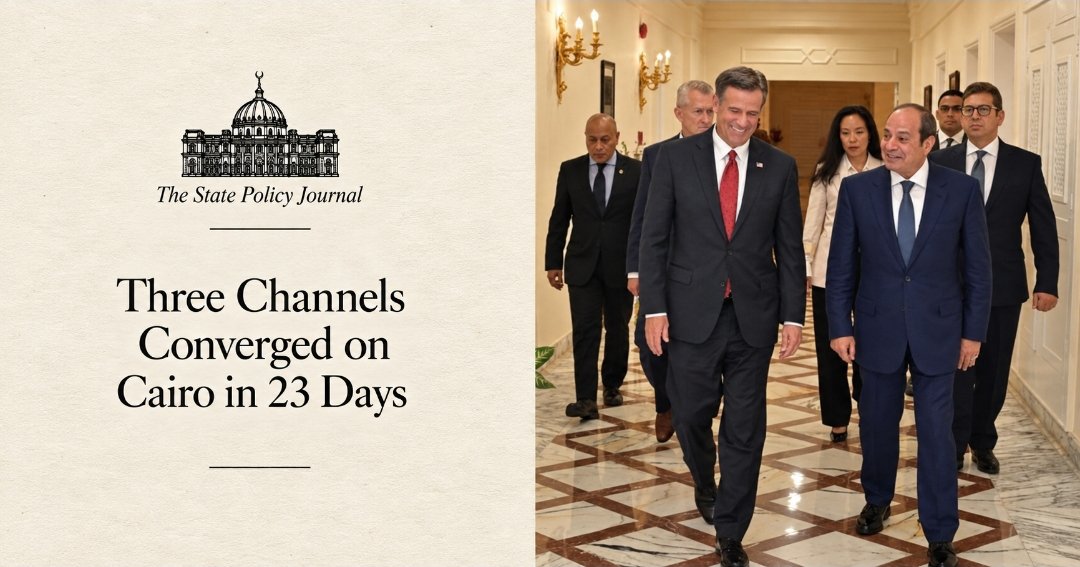
Sept. 20: CIA Director John Ratcliffe met Abdel Fattah el-Sisi, with the Egyptian readout again tying Iran, Gaza, Sudan, Somalia and maritime security to ongoing intelligence cooperation.
There’s no public evidence these episodes were coordinated; but they reveal something else.
Cairo is encountering the same regional crisis through three different institutional channels: finance, Arab security coordination, and intelligence.
Different instruments, different institutions, one strategic environment.
The important question isn't whether these moves were secretly synchronized; it's whether they're beginning to converge on the same decision center.
Coordination, convergence, or simply institutional simultaneity?