Another $350M+ lost.
There have been 20 bridge exploits in the past six months.
At some point, it's worth asking whether we're looking at isolated incidents or recurring architectural tradeoffs.
Every bridge is a vault with a middleman holding the keys.
Wire Network has no middleman. No vault. No keys to steal.
Wake up before you’re the next headline.
Infrastructure partnerships are strongest when they go beyond integrations.
By acquiring a Wire Network node, @ApeChainHUB is becoming part of the infrastructure itself, helping support the network while positioning its ecosystem for the next generation of multi-chain coordination.
As digital economies become increasingly connected, shared infrastructure won't just move transactions.
It'll coordinate them.
That's the future we're building toward.
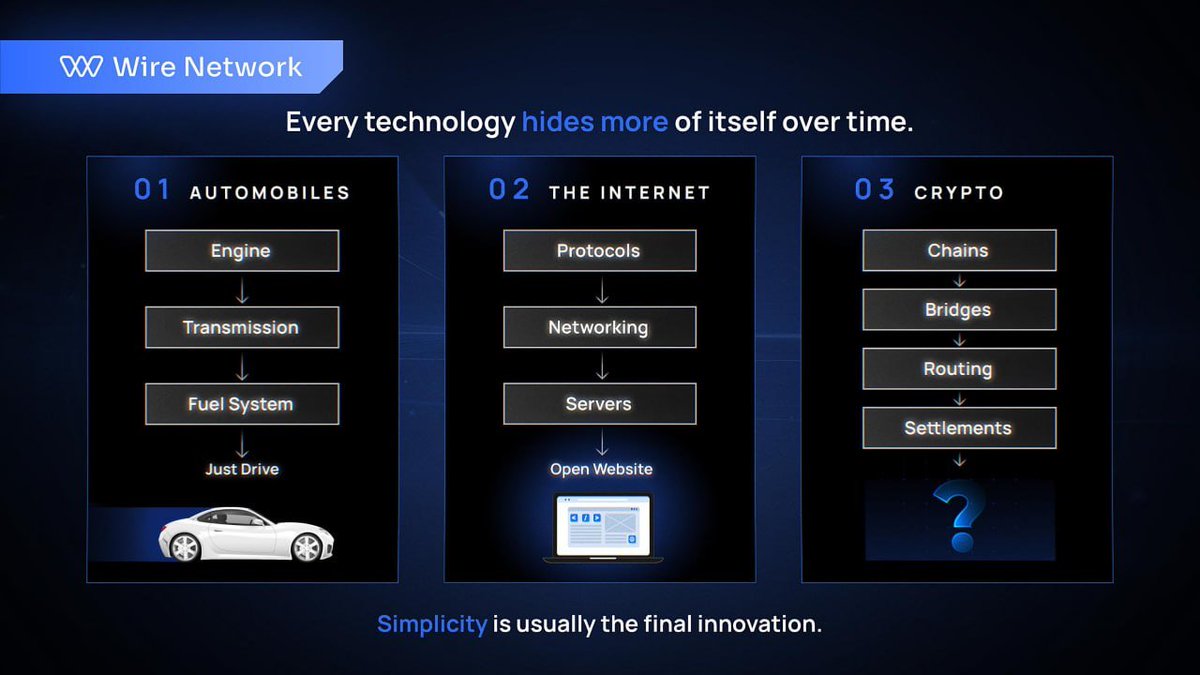
Technology becomes mainstream because it becomes simpler.
Cars didn't reach everyone because engines became more complicated.
The internet didn't reach billions because networking protocols became easier to understand.
Smartphones didn't win because people learned how mobile operating systems work.
Every major technology eventually hides its complexity behind a simpler experience.
Crypto won't be any different.
The long-term winners won't necessarily expose more infrastructure.
They'll expose less.
When people talk about blockchain infrastructure, they usually measure things like:
TPS.
Latency.
Gas.
Throughput.
Those are important.
But one of the largest costs rarely appears on a dashboard.
Coordination.
Every additional integration.
Every additional environment.
Every additional dependency.
Every additional workflow developers must rebuild.
Those costs compound quietly.
Because systems become harder to reason about.
Infrastructure isn't only measured by performance.
It's also measured by operational simplicity.
Another $7-8 Billion.
Not hacked. Repositioned.
The industry is starting to realize that security isn't just about better code.
It's about better architecture.
Every additional trust assumption has a cost.
Wire was built to remove them.
Today's applications often become infrastructure experts.
Not because they want to.
Because they have to.
Every new blockchain introduces different integration requirements.
Different coordination logic.
Different operational assumptions.
Wire shifts that model.
Applications integrate once with the Universal Transaction Layer and coordinate transactions across connected ecosystems without rebuilding that logic chain by chain.
Developers should spend more time building products.
Less time rebuilding infrastructure.
For years, blockchain infrastructure competed on execution.
Faster blocks.
Lower fees.
Higher throughput.
As ecosystems become increasingly interconnected, another capability is becoming just as important.
Coordination.
Not because execution matters less.
Because execution increasingly happens across multiple environments.
Wire was designed around that reality.
Ownership settles on Wire while assets remain native, creating a shared coordination layer for connected ecosystems instead of requiring every application to build that coordination independently.
Execution wins individual transactions.
Coordination scales entire ecosystems.
Every developer wants to spend more time building products.
Very few want to spend that time rebuilding coordination infrastructure.
Shared infrastructure changes that equation.
Instead of solving the same coordination problems independently across every new environment, applications can integrate once with Wire's Universal Transaction Layer and transact across connected chains while assets remain native.
The less time developers spend rebuilding infrastructure, the more time they spend creating experiences users actually notice.
The best infrastructure doesn't just improve transactions.
It creates more room for innovation.
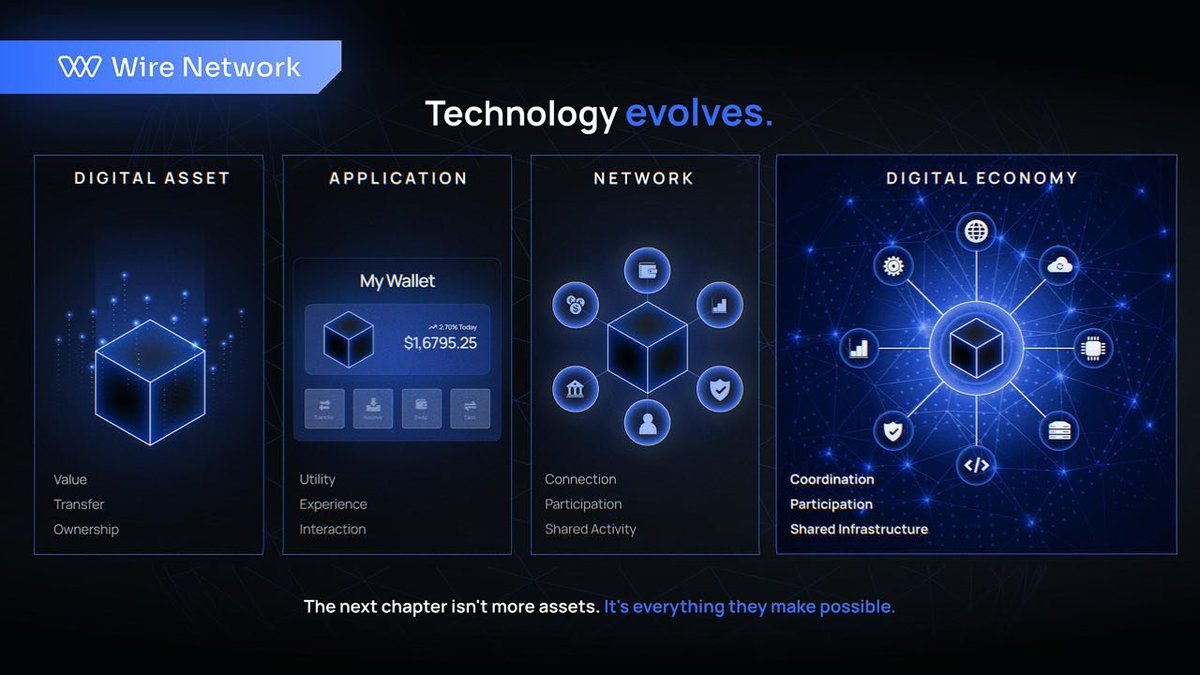
Crypto has spent years proving digital assets can exist.
The next challenge isn't creating more assets.
It's creating economies around them.
Economies where applications, institutions, autonomous systems, and users interact seamlessly across connected environments.
That requires infrastructure built for coordination rather than isolation.
Wire isn't being built for the first chapter of digital assets.
It's being built for what comes after.
The same bridge was exploited twice.
Nearly $20 million disappeared.
The Verus bridge was exploited after validating a transaction that released millions of dollars in assets despite the underlying value not matching the payout.
That's a reminder that validating a message isn't the same as validating the outcome.
At some point, it's worth asking whether intermediary bridge vaults are solving the right problem.
Every bridge is another system responsible for holding, verifying, and releasing value.
Wire Network has no bridge vault.
No intermediary custody.
No assets waiting to be unlocked.
Sometimes the safest architecture is the one that removes the vault altogether.
The Wire Network Liquidity Creation Offering (LCO) is your opportunity to participate in Wire before mainnet.
Participation is now open.
https://t.co/XIIvAJA4ix
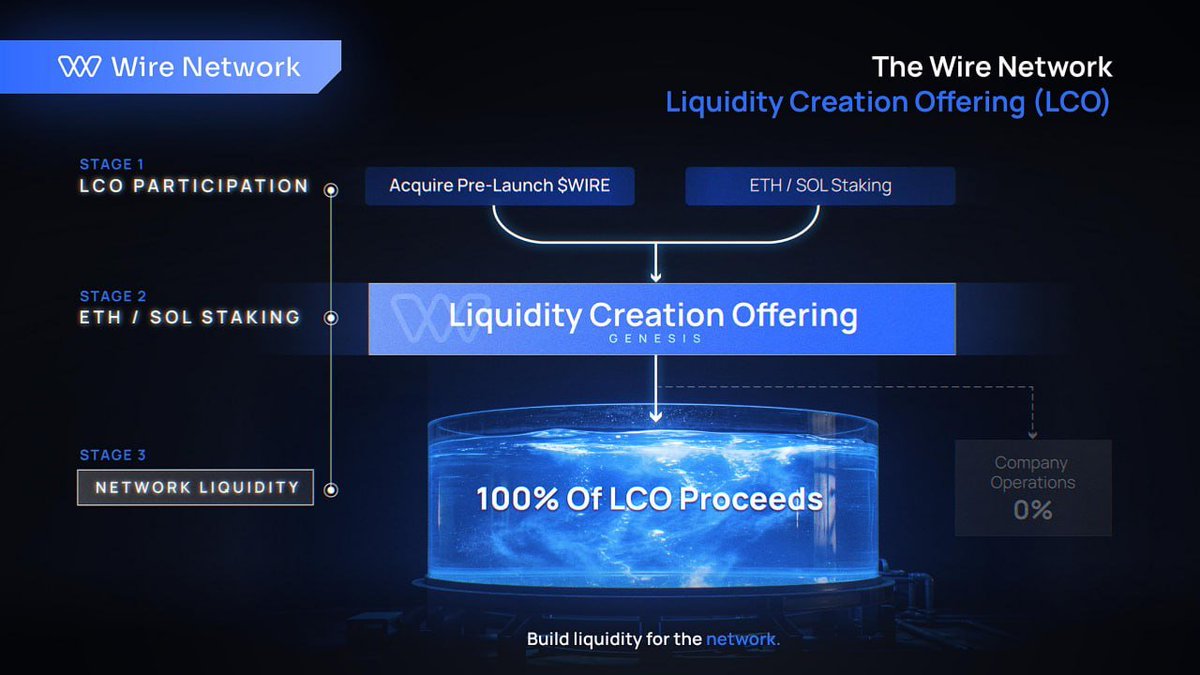
Through the LCO, eligible participants can acquire pre-launch $WIRE or participate through approved ETH and SOL staking pathways, depending on the participation option available.
Here's what makes the LCO different.
The proceeds aren't used to fund company operations.
They're used exclusively to build network liquidity.
Strong liquidity creates a stronger network from day one, supporting healthier markets and a more resilient ecosystem as Wire moves toward mainnet.
It's important to understand what you're participating in.
The LCO is not a yield product.
It's not an equity offering.
It's the Genesis phase of Wire Network, giving early participants the opportunity to help establish the liquidity that supports the network before mainnet goes live.
You're not just joining Wire early.
You're helping build the liquidity that powers the network from day one.
Every network needs liquidity.
The question is how that liquidity is created.
With the Wire Network Liquidity Creation Offering (LCO), eligible participants can acquire pre-launch $WIRE or participate through approved ETH and SOL staking pathways while helping establish the network liquidity that supports Wire before mainnet.
Unlike many token launches, the proceeds from the LCO aren't used to fund company operations.
They're used exclusively to build network liquidity.
Why does that matter?
Because deep, healthy liquidity is one of the foundations of a strong network.
It supports healthier markets, strengthens the ecosystem from day one, and helps ensure the network launches with the liquidity it needs.
When you participate in Genesis, you're not just accessing Wire before mainnet.
You're helping establish the liquidity that the network is built on.
That's the purpose of the Liquidity Creation Offering.
Not simply to launch a network.
But to launch one with the liquidity it needs from day one.
When people think about launching a blockchain, they usually picture a countdown.
But launching the technology is only part of the equation.
A network can be technically ready and still lack the liquidity needed for a healthy ecosystem.
That's why Wire is treating liquidity as part of the launch itself, not something to figure out afterward.
The Wire Network Liquidity Creation Offering (LCO) is designed around that idea.
Build the liquidity alongside the network.
So when mainnet arrives, the ecosystem has both.
The most expensive infrastructure decisions are often the ones labeled "temporary."
We'll bridge it.
We'll wrap it.
We'll route around it.
We'll support it off-chain.
One workaround becomes another.
Eventually, the workaround becomes the architecture.
Years later, everyone forgets it was ever supposed to be temporary.
The best infrastructure doesn't optimize the workaround.
It eliminates the need for it.
That’s what Wire Network is here to do.
One key controlled an entire bridge.
$4.4M lost. Think about that.
The underlying chains weren't compromised.
The bridge was.
Every bridge creates another place where trust becomes concentrated.
Wire Network removes that bridge altogether.
Assets remain native.
Ownership settles on Wire.
Good architecture removes problems before they become headlines.
For years, blockchain infrastructure competed on performance.
Lower fees.
Higher throughput.
Faster finality.
That race isn't over.
It's just no longer the only race.
As digital assets expand across more ecosystems, infrastructure is beginning to compete on something different:
How well independent systems work together.
Execution remains important.
But execution is increasingly happening across multiple environments.
That's where coordination becomes a competitive advantage.
We think the next decade of blockchain infrastructure will be defined less by individual chains becoming faster and more by ecosystems becoming easier to coordinate.
That's exactly where Wire is focused.
There's an old idea in architecture.
"If you notice the building more than the people inside it, something probably went wrong."
Infrastructure follows the same principle.
When users spend time thinking about networks, bridges, routing or settlement, they're thinking about the building instead of what they came there to do.
The best infrastructure quietly steps out of the way.
Not because it isn't important.
Because it's doing its job.
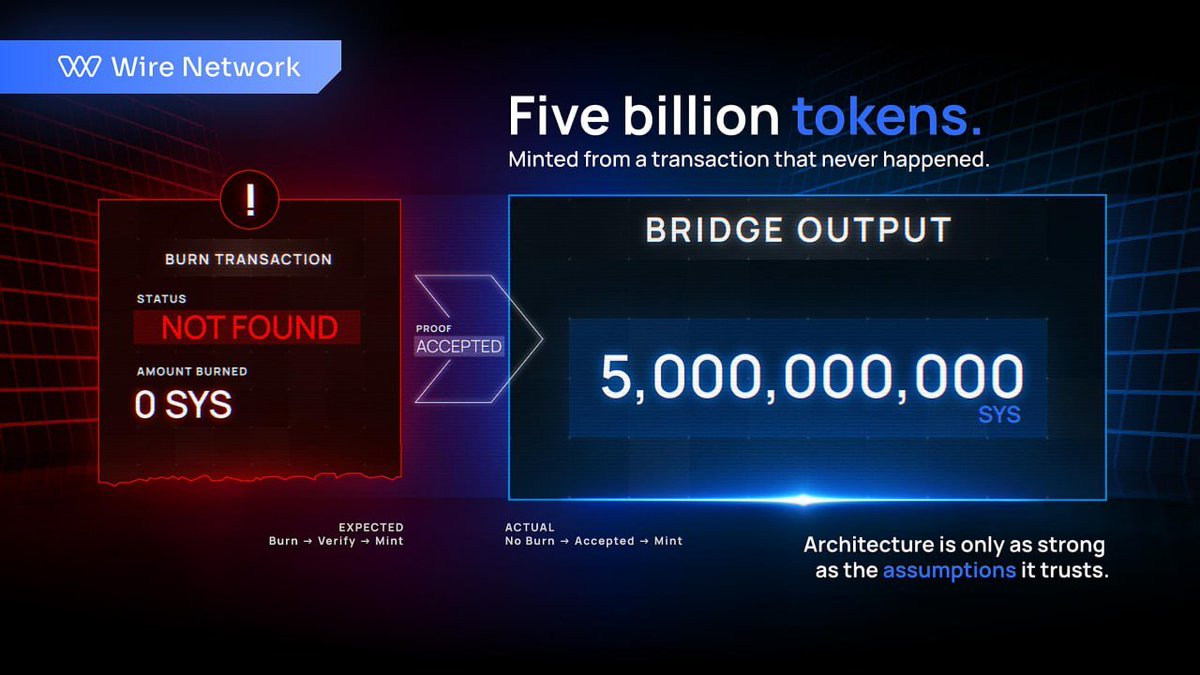
Five billion tokens.
Created from a transaction that never happened.
The Syscoin bridge reportedly accepted an invalid proof and minted assets that weren't backed by a corresponding burn.
No cryptography was broken.
The assumptions were.
Every wrapped asset depends on multiple systems agreeing on what's true.
When those assumptions fail, so does the representation.
Wire Network doesn't rely on wrapped representations moving between bridge vaults.
Assets remain native. Ownership is coordinated. Architecture matters.
Liquidity is one of the biggest challenges every network eventually has to solve.
We built the LCO to address it before mainnet.
Great conversation on why that matters, how Genesis works, and what we're building at Wire.
Bridges were never the endgame for multi-chain.
Wire Network is building the Universal Transaction Layer.
Now your assets stay native, execution stays coordinated, and fragmented systems operate like one.