617 Scholars, 13 Years, 1 Torah
I love the festival of #shavuot—not only for its more original agricultural aspects, but also for the way it highlights the centrality of Torah to Jewish life—even though I do not believe that any version of the Decalogue (the “Ten Commandments”) was given to Moses on Shavuot (or any other time).
Believing that the Sinai theophany is not historical does not diminish my love for the Torah reading for the holiday, Exodus 19, which contains several contradictory images of what revelation looked like, offering (alongside Exodus 24 and Deuteronomy 4–5) enough options to satisfy just about anyone.
Indeed, what makes the Sinai revelation narratives so powerful to me is precisely that they do not preserve a single, fixed picture of revelation, but multiple voices and perspectives struggling to describe an encounter with the divine.
Read Prof. Marc Brettler's reflections on 13 years
https://t.co/Yl3bwmwk1O
We can theoretically arrive at a 3rd century B.C.E. archetype of the Torah by using the conservative Masoretic Text (MT) as the default and comparing it with non-harmonistic variants in the Septuagint (LXX), Samaritan Pentateuch (SP), and Qumran fragments.
But textual criticism offers little help in understanding what the text of the Torah looked like at an earlier stage, or how and when it was composed.
https://t.co/WrXpuyzoyu
Why was Ezekiel’s vision of YHWH’s chariot considered so dangerous?
The answer lies in Ezekiel 1:27, where the prophet describes what appeared to be YHWH’s “loins” surrounded by fire and radiance.
In no other biblical depiction of the divine body is the gaze drawn so directly to God’s private parts. No wonder later rabbis warned against reading it publicly.
https://t.co/99dqdYkYry
On Shavuot night in the 1530s, R. Joseph Karo and R. Shlomo Alkabetz stay up learning Torah all night.
At midnight, a divine voice suddenly speaks through Karo itself.
The voice thanks them for “raising her from the dust” through their learning, warns them against materialism, and urges them to move to the Land of Israel. https://t.co/ffQdG3Q2Y4
On the road to Meron, where the Safed kabbalists believe Jesus is buried, R. Hayyim Vital (16th cent.) encounters a dangerous spirit, who overpowers him in a moment of spiritual weakness.
The spirit later tosses him in the air and exhausts him nearly to death, but Vital makes it to his master, the great R. Isaac Luria, the Arizal, who, fearing the spirit will kill Vital and thwart his plans to bring about the messianic age, exorcises it. https://t.co/43hKoiDkKv
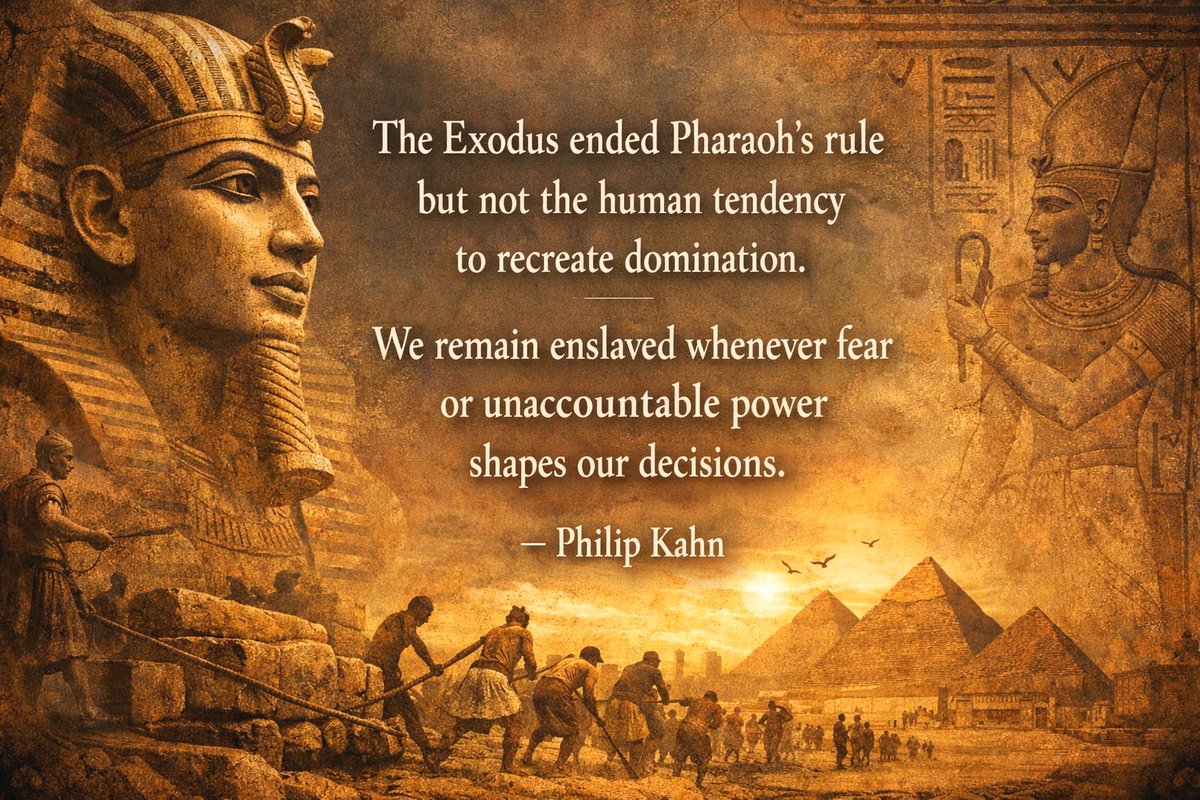
As a #Christian, the Exodus is my story of divine liberation and hope. As an #Egyptian, it casts my homeland as the oppressor of God’s people—forcing me to wrestle with faith and identity.
https://t.co/g4LmflPpzZ
“The Exodus ended Pharaoh’s rule but not the human tendency to recreate domination. We remain enslaved whenever fear or unaccountable power shapes our decisions.”
— Philip Kahn
In what ways are we still enslaved—and what would real freedom look like today, both personally and collectively? #Passover#Seder https://t.co/RWk6iMPOyr
Pig’s blood, crushed bird heads, animal fat, fine oils—ancient rituals marked doorways to keep danger out. The Torah takes that raw practice and turns it into a sign for YHWH on the night of the Exodus. Same ritual, new meaning—and maybe more beneath the surface. https://t.co/q0WJkwYSrn
Blame the Satan!😈
Why would God make righteous people suffer just to test their faithfulness? With Job, the Bible is explicit that it was in response to Satan’s challenge, but what about Abraham?
https://t.co/iMOy5KAII6
In 1891, Chaim Zelig Slonimski argued that the Chanukah oil miracle was never meant as history—invoking Maimonides. The backlash came from Hasidim, modernizers, and even Zionists.
https://t.co/oSYtb6cAlM
Job, overwhelmed by suffering, imagines the moments from womb to nursing in which he wishes he had died. His lament, however, preserves surprising evidence about how women once gave birth. https://t.co/dCT5ygpvFm
Jacob is renamed Israel after wrestling a divine being. The Torah then forbids eating the sciatic nerve—a law that rarely shaped Jewish identity. Yet in medieval China, the Kaifeng Jews made this obscure rule their defining name.
https://t.co/Sf2BWV4JNq