Disc L/S | TMT+Energy. ISO convexity. Factor aware. Path independence matters. Results never lie. NFA. Student of mkts and cos. Creator: CRAVE Thesis of GAI.
Equity Trading Through Counterparty Analysis and Edge
This presents a framework for successful discretionary long/short equity trading that centers on counterparty analysis rather than abstract valuation alone. A trader must constantly ask who is on the other side of the transaction and why they are willing to trade at the current price, linking execution to a test of a trader's edge. This perspective suggests that the most profitable trades occur when one is transacting against non-fundamental, forced flows driven by factors like benchmark constraints, indexing, or risk management.
AI TRADE NEGATIVE SIGNAL
• $AMBA (Ambarella, Inc.), FQ3 2027 call, reported 11/24/26
• Earnings call date: 11/24/26
• Speaker: Fermi Wang, management
• Topic: Semiconductor Supply and Demand
• Severity: 5/10
We attribute a sub-seasonal outlook to the unprecedented rise in memory prices as well as the scarcity of memory supply, which is causing our customers to different -- to different degrees to cancel, push out, or delay new orders.
Bears on: Customers cancelling, pushing out, or delaying new orders on unprecedented memory price increases and scarce memory supply, driving a sub-seasonal outlook.
AI TRADE CAUTIONARY SIGNAL
• $DELL (Dell Technologies Inc.), FQ3 2027 call, reported 11/24/26
• Earnings call date: 11/24/26
• Speaker: Jeff Clarke, management
• Topic: Semiconductor Supply and Demand
• Severity: 4/10
From a macro view, when we look at the supply picture and our supply outlook, there's nothing that suggests that we're going to see price declines in enterprise Nand and Dram for servers. The demand for those categories of memory continues to be way ahead of the supply, as more Dram wafer capacity is set forth for GPUs and specifically building HBM, it comes at the expense of all other types of memory. We think that crunch continues clearly into 27, and while the rate of inflation won't be the same as we saw in 26, we still believe the market is inflationary.
Bears on: Dell's COO stated there is nothing suggesting price declines in enterprise NAND and DRAM for servers, with memory demand way ahead of supply and HBM wafer capacity coming at the expense of all other memory types; he expects the crunch to continue clearly into 2027 with the market still inflationary, a persistent component-supply headwind for the AI server buildout.
https://t.co/CYB0vM0mmQ
TWENTY-FOUR HOURS IN THE JENSEN HUANG CASE FROM 8PM TO 8PM on 11/24/26
The case widened on every front in this window. Malaysia moved against the seven companies the United States listed the day before, and Reuters put a customer and a money figure at the centre of the Megaspeed network. California's attorney general opened a state investigation with a subpoena. The Attorney General of the United States spoke publicly in NVIDIA's defence while the President, in the same day, conceded the intelligence reporting to the Times, floated a pardon, and was reported by the Journal to have lobbied the board directly. Congress escalated on both sides of the Capitol, a former Commerce official narrowed what the Entity Listing actually blocks, and Jensen Huang addressed his staff for the first time since his reinstatement. The November 24 10-Q marker passed with no filing.
MALAYSIA MOVES AGAINST THE LISTED FIRMS
• Reuters reported on November 24, 2026 that Malaysia said it would advise every data centre in the country against hosting the seven companies added to the U.S. Entity List on November 23. The Reuters original was not read firsthand; this rests on detailed concordant summaries of the Reuters and Straits Times reporting.
• The customer at the centre of the arrangement, per that reporting, was Apex Enterprise Solutions, Alibaba's Singapore subsidiary, which had prepaid about $4.2 billion for computing power across Southeast Asia and, per a person familiar with the arrangement, paid Megaspeed and other providers. How much of the $4.2 billion went to Megaspeed is undisclosed. This figure has its own owner and window, Reuters, the Apex prepayment for Southeast Asia computing power, and is not merged with any other chip figure in the record.
• Speedmatrix, Megaspeed's Malaysian subsidiary, had pledged specified computer and network equipment, intellectual property and related rights to Apex under an agreement dated June 18, 2024, a pledge the Straits Times found still active in Malaysian corporate records on November 11, 2026. Speedmatrix is a tenant that brings its own servers and chips into data centres run by others. Malaysia's trade ministry announced no eviction or shutdown.
• In the same reporting thread, Singapore Prime Minister Lawrence Wong stated on November 24, 2026 that the NVIDIA chips bought by Megaspeed never entered Singapore, and that his government is still working with U.S. officials to determine the end users' locations. Alibaba disputed the listing, stating Apex never transferred high-end chips subject to U.S. export restrictions. Neither statement was read in its original release.
A STATE INVESTIGATION OPENS
• California Attorney General Rob Bonta served an investigative subpoena on NVIDIA on Thursday, November 19, 2026, and defended it on CNBC on the morning of November 24, 2026. The subpoena's existence and date are corroborated by multiple accounts in the window; the desk did not watch the CNBC segment.
• Bonta's office is asking whether NVIDIA's advanced chips or confidential information reached China and whether the company misled investors and the public about that risk, under California's corporate securities law. Bonta said on CNBC: "The conduct of Nvidia and its former CEO raises bright red flags" and "Companies cannot mislead their investors."
• Per the same account, on Friday the probe widened to possible criminal violations of state law if NVIDIA or Huang gave false information about sales of advanced chips to China, preliminary, with no conclusions and more subpoenas possible, and on Monday his office said Huang's reinstatement "does not diminish the need for a probe." No claim in the record previously recorded any state attorney general action; the record's investigation lanes until now were federal and congressional.
THE ATTORNEY GENERAL SPEAKS
• U.S. Attorney General Todd Blanche told reporters at the Justice Department on November 24, 2026 that he has "no reason to stand up here and say that Nvidia is anything other than a good corporate citizen," that NVIDIA is cooperative with the government on preventing chip diversion, and that if the company were the subject of a criminal investigation "the signal sent would be completely different." He was appearing at an anti-scam press conference and NVIDIA came up in questions; the desk did not watch the press conference.
• Blanche said President Trump was "exactly right" in saying Monday on CNBC that investigators "felt that he, himself, was exonerated." Asked whether Huang had been investigated, he pushed back, declined to discuss any specific investigation, noted "there are many investigations ongoing," and said reports that Trump assured NVIDIA no one would be prosecuted rest on "baked-in assumptions" from reporting and leaks. The Megaspeed probe the Justice Department leads was not closed. No claim in the record previously recorded a statement by the Attorney General on NVIDIA or Huang.
THE PRESIDENT, IN HIS OWN WORDS
• In a call with the New York Times on Monday, November 23, 2026, President Trump noticeably steered clear of his previous suggestions that the intelligence gathered by his government about Alice Huang and her activities was questionable, said his top advisers had been "studying" the issue since the Times reported last month that U.S. officials had concluded Ms. Huang was a Chinese intelligence asset and was involved in a close relationship with Mr. Huang, and told the Times of its reporting: "You really had it," adding, "Amazing." That characterization is the Times' reporting, carried in the originating reporter's own posts; the Times article is paywalled and was not read firsthand. No claim in the record previously recorded the President conceding to the originating outlet that its intelligence reporting was right.
• President Trump told the New York Post in an exclusive interview reported on November 24, 2026 that he is willing to pardon NVIDIA CEO Jensen Huang "if necessary," but believes Huang should be fine without one, and that he wants Huang to "tell the truth" to Congress next week instead of pleading the Fifth. Per the filed summary, he also said it is not too late for the U.S. to take a stake in NVIDIA. This is known only through summaries and relays of the Post interview, which was not read firsthand. No claim in the record previously recorded any pardon statement.
• The Wall Street Journal reported, as carried by WIRED's own account on November 24, 2026, that President Trump told the Journal he lobbied the NVIDIA board directly and through intermediaries for Huang's reinstatement, and that NVIDIA's falling share price helped his case, and that the board acted before its own investigation of Huang had concluded. Neither the Journal's nor WIRED's article was read firsthand. The direct lobbying and the price factor were already in the record from the Times and from Politico; the Journal is a new, independent major outlet chain, and the board acted before its probe concluded point is the Journal's own framing against the release's statement that the committee's investigation will proceed to conclusion.
CONGRESS ESCALATES
• Rep. Gregory W. Meeks, Ranking Member of the House Foreign Affairs Committee, issued a statement dated November 24, 2026, read in full from the official committee account: "Americans deserve answers to the profound questions that are continuing to emerge about NVIDIA and our national security. President Trump's intervention to reinstate Jensen Huang as NVIDIA's CEO raises even more concerning questions about the administration's own role, questions the American people deserve to hear answered in public." "The American people deserve to hear publicly from Mr. Huang about how potentially billions of dollars' worth of our most advanced technology wound up in the hands of our greatest competitor, and what role this administration played. A transcribed interview is critical to our oversight efforts but it should not replace a public hearing. Chairman Mast should convene one." No claim in the record previously recorded a demand that Huang also testify at a public hearing.
• The Ranking Members of four House committees, Frank Pallone, Jr. of Energy and Commerce, Jamie Raskin of Judiciary, Gregory W. Meeks of Foreign Affairs and Robert Garcia of Oversight and Government Reform, wrote to President Trump on November 24, 2026 demanding answers "as soon as possible, and no later than December 8." The letter itself was read in full firsthand. Its six questions ask when the President was first made aware of evidence Huang was in a relationship with a suspected agent of the Chinese government, who informed him, and each later occasion; what actions he took to limit the risks, with all documents; whether Huang is still a member of PCAST and, if so, what measures restrict his access, or when he was removed; whether Huang's relationship or his lobbying is under investigation, and if not, why not, and if so, why the President publicly said he "would not mind" his return before the reinstatement; how ignoring the concerns is consistent with winning the AI race against China; and all communications between the President, the Vice President, White House officials or senior administration officials and the NVIDIA Board of Directors between Huang's November 12 resignation and his November 23 reinstatement. The letter also states the President was warned about the risk immediately before his May 2026 trip to China and that Huang travelled with him on Air Force One and has apparently kept his PCAST seat. This creates a new dated checkpoint, December 8.
• Senator Mark Warner, the ranking Democrat on the Senate Intelligence Committee, told a reporter on November 24, 2026 that Gang of Eight staff are to receive a briefing "shortly" from the administration on Jensen Huang and NVIDIA, potentially as soon as today, and said: "I will be surprised if we don't actually have a pretty strong, bipartisan investigation this December." A single source chain, not corroborated by a second outlet in the window. No claim in the record previously recorded a Gang of Eight briefing on this matter.
WHAT THE LISTING DOES AND DOES NOT BLOCK
• Chris McGuire, a former Commerce Department official, clarified on November 24, 2026 his analysis of what the Megaspeed Entity Listing does and does not block. This is his analysis and characterization, filed as his opinion; the desk has not read the rule text firsthand. On his clarified reading, advanced AI chips were already blocked to Megaspeed before the listing by the separate country wide controls Commerce placed on Malaysia, Thailand, Singapore, Indonesia and Brazil the prior week, and the listing double captures those chips because the November 23 rule also modifies the regulations so the most advanced chips are blocked to any company on the Entity List even if the foreign direct product rule is not applied, so the listing changes nothing on that front.
• But without the foreign direct product rule, a large set of important AI chips and components made in Taiwan or Korea with U.S. technology remains legal to ship to Megaspeed, including less advanced AI chips such as NVIDIA's H20, high-bandwidth memory, networking equipment, server chips and other items Megaspeed needs to use the chips it already has. This refines, and in part narrows, his November 23 framing that the listing had zero effect: the omission stands, but on his clarified reading the most advanced chips are double blocked through other rules while the H20, memory and components channel remains open.
ENFORCEMENT PERSONNEL DIVERTED, AS REPORTED
• The Atlantic reported on November 24, 2026 that Commerce Secretary Howard Lutnick transferred Commerce Department agents who should have been fighting the smuggling of AI chips to his personal security detail. The Atlantic article is paywalled and was not read firsthand; this carries only what the reporters' own post states. No claim in the record previously recorded a diversion of export enforcement personnel to the Secretary's personal detail.
HUANG ADDRESSES HIS STAFF
• The Financial Times reported on November 24, 2026 that Jensen Huang, in his first all-hands meeting with staff since his reinstatement, said he still does not believe in NVIDIA succession planning. The FT article is paywalled and was not read firsthand. Multiple window summaries of the same all-hands report Huang told staff he "made some terrible mistakes," admitted unfaithfulness to his wife Lori, said he had hurt family and staff, and is in daily therapy of an hour to an hour and a half; a CNBC headlined carriage adds that he rejected claims of Trump intervention in his reinstatement. The desk did not obtain a transcript of the all-hands; the apology and therapy details rest on concordant summaries and are carried at the same grade. No claim in the record previously recorded any statement by Huang to staff after the reinstatement.
THE 10-Q MARKER PASSES
• The November 24 10-Q streak-break marker passed in this window with no 10-Q filed. The sweep's checkpoint searches for the filing returned no filing material, and the December 4 filing deadline stands.
THE CHECKPOINTS
• About November 25: Treasury Secretary Bessent's 10-day answer deadline, and the Entity List rule's formal Federal Register publication the same day.
• December 1: the Cantor document deadline, and Huang's transcribed interview.
• December 2: the Energy and Commerce briefing deadline, and general counsel Tim Teter's interview.
• December 3: the Kessler hearing.
• December 4: the 10-Q filing deadline, December 9 with a late notice.
• December 8: the President's answers to the four ranking members' letter are due.
• January 8, 2027: the Kistenmacher lead plaintiff deadline.
https://t.co/3g751TPQsR
$DELL KEY READ-THROUGHS FROM DELL TECHNOLOGIES’ Q3 FY2027 EARNINGS CALL
Dell’s results indicate that AI infrastructure spending is broadening beyond GPUs into CPU-based orchestration, conventional server memory, enterprise storage, networking, and physical infrastructure. The most consequential evidence is the combination of 235% traditional-server revenue growth, declining server units, richer configurations, persistent component inflation, and customers explicitly diverting budgets away from PCs. This favors suppliers that capture higher component content and scarce capacity, while creating demand and funding pressures elsewhere in the technology ecosystem. The strongest positive read-throughs concern server CPUs, memory, enterprise data infrastructure, and power and cooling equipment. The clearest negative implications concern PC demand and the working-capital requirements of hardware integrators. These are high-conviction directional business implications, not assertions that the information is unpriced or that peer earnings should increase proportionately to Dell’s results.
SEMICONDUCTORS
CPU COMPUTE IS BECOMING A COMPLEMENT TO AI ACCELERATORS, NOT SIMPLY A LEGACY REPLACEMENT MARKET (READ-THROUGH 1)
Affected companies: Advanced Micro Devices (AMD: United States) and Intel Corporation (INTC: United States).
Direction and magnitude: Positive, with high conviction for server-CPU demand and product mix. The fundamental significance is high for both server businesses. The consolidated benefit is less straightforward for Intel because PC weakness and foundry economics remain separate offsets.
Dell’s traditional-server and networking revenue reached $15.01 billion, up 235% year over year and approximately 43% sequentially. More importantly, management identified inference and agentic workloads as the fastest-growing component of that business. Clarke explained that container management, sandboxing, input/output, and workload orchestration are CPU tasks: “the harness and the work that the harness does is really a CPU task.” Servers supporting these workloads carry approximately twice the selling price of conventional enterprise servers.
The transmission mechanism is additional CPU infrastructure surrounding model execution. Agents require execution environments, tool calls, data access, scheduling, and verification, not just GPU inference. This expands the workload pool addressable by AMD EPYC and Intel Xeon beyond traditional enterprise refresh. Dell also explicitly highlighted its new AMD-based PowerEdge platforms, establishing a direct product relationship rather than merely thematic exposure.
The less obvious implication is that falling server units do not invalidate the CPU opportunity. Dell stated that “server units were down,” while CPU-core shipments and system capabilities increased. Higher-core-count processors and richer configurations can support semiconductor revenue despite fewer physical systems. However, the approximately 2-times system selling price must not be translated into a 2-times CPU selling price, because memory, storage, and other components contribute to the increase.
AMD’s November 3 results already identified strong EPYC demand, while Intel’s October 29 release emphasized efforts to expand supply against extraordinary Xeon demand. Dell provides downstream corroboration, not a new supplier order announcement. Near-term trading relevance lies in greater confidence in server demand and supply-conversion commentary during the next reporting cycle. The longer-duration implication is a broader CPU growth opportunity as agent deployment scales. The call does not establish AMD-versus-Intel market-share allocation, and competing CPU architectures prevent treating all incremental orchestration demand as an exclusive x86 opportunity.
MEMORY PRICING HAS SUPPORT BEYOND HBM, WHILE FEWER SYSTEMS CAN STILL CONSUME MORE MEMORY VALUE (READ-THROUGH 2)
Affected companies: Micron Technology (MU: United States) and SK hynix (000660: South Korea).
Direction and magnitude: Positive, with high conviction. The potential earnings significance is high because server DRAM, HBM, and enterprise NAND pricing and mix materially affect both companies’ profitability. The principal implication is greater durability of favorable conditions, not a quantified incremental shipment forecast.
Clarke stated that Dell sees nothing suggesting price declines in enterprise NAND and server DRAM, adding that demand remains substantially ahead of supply. Management expects inflation to continue into calendar 2027, although at a slower rate than in 2026. Dell also reported increasing DRAM and storage capacity per server, alongside growing demand for agent state, retrieval data, and key-value caching.
There are distinct transmission channels. Higher memory content supports demand per deployed system. Tight supply supports realized pricing and product allocation toward higher-value applications. For DRAM, Dell specifically identified HBM’s consumption of wafer capacity as a constraint on other memory categories. Enterprise NAND has separate manufacturing economics and should not be assumed to face an identical capacity-displacement mechanism.
The product exposure is independently supported. Micron’s September results described qualified high-speed server-memory products and enterprise SSD shipments for key-value-cache applications. SK hynix’s October results highlighted server DDR5 and enterprise SSD growth. Dell’s commentary therefore validates demand across the suppliers’ actual product portfolios without establishing a particular supplier allocation within Dell systems.
The actionable distinction is between slower inflation and falling prices. A deceleration in price increases can reduce reported growth rates while leaving earnings at elevated levels. Conversely, already-high profitability and existing customer agreements mean that favorable industry conditions do not automatically create an immediate earnings upgrade.
Micron’s December 17 earnings report is the nearest verified company-specific catalyst. Contract pricing, shipment mix, capacity additions, and customer commitments are more important than headline PC units. Over calendar 2027, the structural question is whether additional qualified supply catches up with increasing memory intensity. Across portfolios, the same pricing environment is favorable for memory producers but adverse for hardware buyers unable to pass through higher costs.
RUBIN BOOKINGS VALIDATE PLATFORM CONTINUITY, BUT SHOULD NOT BE DOUBLE-COUNTED AS NEW NVIDIA DEMAND (READ-THROUGH 3)
Affected company: NVIDIA Corporation (NVDA: United States).
Direction and magnitude: Positive, with high conviction for demand durability and platform adoption. Strategic significance is high; the incremental near-term earnings implication is more limited because NVIDIA had already reported its own results and begun Rubin shipments.
Dell booked $60.2 billion of AI orders, recognized $22.03 billion of AI revenue, and ended with $132.3 billion of backlog. Management stated that a majority of new orders were based on NVIDIA’s Vera Rubin NVL72 platform. This directly connects Dell’s demand evidence to NVIDIA’s platform rather than to an unspecified accelerator market.
The transmission mechanism is conversion of customer commitments into purchases of NVIDIA-based systems and associated platform components. The order mix reduces concern that customers are abandoning spending during the transition between architectures. Dell’s integration, testing, deployment, and support capabilities can also help customers put purchased infrastructure into productive operation.
NVIDIA’s November 17 release had already reported Rubin shipments and customer deployments. Dell’s call is therefore downstream validation of an existing ramp, not evidence that Rubin availability begins at a later date. Supplier revenue can precede Dell’s system revenue recognition, so Dell’s shipment growth cannot simply be added to NVIDIA’s disclosed demand.
The order trajectory also requires precision. Q3 bookings were slightly below Q2’s $60.9 billion. The positive signal is sustained exceptional demand and expanding backlog, not sequential acceleration in the absolute quarterly order total. Dell’s $132.3 billion backlog is system revenue containing multiple vendors’ components and services, not NVIDIA revenue.
Near-term trading relevance is stronger confidence in platform continuity and customer deployment plans. The longer-duration benefit is a broader installed ecosystem supporting follow-on infrastructure demand. The unresolved risks remain customer funding, site readiness, utilization, and eventual returns on AI investment. Dell’s statement that no customers had rescheduled business is reassuring, but does not eliminate those risks.
ENTERPRISE SYSTEMS AND DATA INFRASTRUCTURE
THE NON-GPU INFRASTRUCTURE BOOM IS INDUSTRY-WIDE, NOT JUST DELL TAKING SHARE (READ-THROUGH 4)
Affected companies: Hewlett Packard Enterprise (HPE: United States) and Lenovo Group (0992: China), listed in Hong Kong.
Direction and magnitude: Positive, with high conviction for infrastructure demand. The consolidated significance is high for HPE and material for Lenovo, whose device exposure creates an offset.
Dell’s traditional servers and storage generated approximately $19.94 billion of quarterly revenue, up approximately 136% year over year. Management described demand across existing enterprise customers, data-center consolidation, security requirements, and AI-supporting CPU workloads. Of the $10 billion increase in Dell’s annual revenue guidance, $6 billion was outside the AI-server category.
The transmission mechanism is broader enterprise spending on server and storage replacement, higher-value configurations, and infrastructure supporting new workloads. HPE and Lenovo participate directly in these markets. This is more relevant to their earnings than a generic assumption that all AI spending accrues to GPU-heavy systems.
Recent peer disclosures make the industry-wide interpretation considerably stronger. HPE’s November 23 results showed server revenue growth of 94.7% and storage growth of 33.8%. Lenovo’s November 19 release reported infrastructure revenue growth of 178%, enterprise and SMB growth of 200%, and materially higher infrastructure profitability. Dell’s results therefore corroborate growth already visible across competitors rather than establishing that its expansion is entirely share redistribution.
The magnitude cannot be transferred mechanically. Dell, HPE, and Lenovo have different product mixes, customer concentrations, financing activities, and segment definitions. Dell’s 17% ISG operating margin is not an appropriate universal margin assumption. Management’s expectation of share gains also means that strong industry demand does not guarantee identical competitive outcomes.
Both peers had reported before Dell’s call. The immediate catalyst is increased confidence in their forward infrastructure outlooks, not an upcoming release of the same completed quarter. The longer-duration implication is that enterprise infrastructure can provide an additional profit pool alongside large GPU deployments. Lenovo’s growing infrastructure business also makes it an inappropriate undifferentiated proxy for PC weakness.
PERSISTENT AGENT DATA CREATES A STORAGE OPPORTUNITY THAT IS NOT PROPORTIONAL TO GPU SHIPMENTS (READ-THROUGH 5)
Affected companies: NetApp (NTAP: United States) and Everpure, formerly Pure Storage (P: United States).
Direction and magnitude: Positive, with high conviction for enterprise-storage demand. Potential long-duration significance is high for these storage-focused businesses; near-term revenue and earnings implications are moderate because vendor share, product mix, and component costs remain decisive.
Dell reported 24% storage revenue growth, a record proprietary-product mix, and a 3rd consecutive quarter of triple-digit demand growth in unstructured storage. Management identified agent memory and state, logs, traces, generated artifacts, retrieval corpora, and multimodal data as incremental demand sources. Clarke emphasized storage growth driven “by the bytes that have to be retained.”
The mechanism differs from a simple GPU attach assumption. Compute processes a task, while retained data can accumulate across repeated tasks and remain after the original execution finishes. Production agents also require governed, current enterprise context and recoverable state. This supports performance storage, data management, protection, and integration across on-premises and cloud environments.
NetApp’s ONTAP-based platform and AI-oriented infrastructure address these requirements. Everpure’s flash and data-management portfolio provides another direct exposure; its November 18 release specifically described FlashBlade performance in checkpointing and key-value-cache workloads. Dell’s commentary supports the underlying use cases, not an undisclosed commercial relationship between Dell and either competitor.
The competitive caveat is important. Dell’s proprietary storage portfolio is gaining traction, and management expects share gains. Its strong performance validates the market but also raises the competitive hurdle. Furthermore, triple-digit unstructured-storage demand growth is not the growth rate of Dell’s entire storage business, which increased 24%, and Q4 guidance anticipates only low-teens storage growth.
NetApp’s December 1 report is the clearest near-term trading catalyst in this group. Its quarter ended October 30, aligning closely with Dell’s reporting period and making Dell’s evidence relevant to the same spending window. Everpure had already reported on November 18, so the read-through concerns durability and subsequent execution rather than a new inference about an unreported quarter.
Over a longer horizon, storage demand tied to persistent enterprise data should be less dependent on individual accelerator-generation transitions. Nevertheless, caching architecture, data reduction, retention policies, and procurement choices prevent a fixed conversion from token growth to storage revenue.
COMPONENT INFLATION AND COMPLEX DEPLOYMENTS RAISE THE CASH BURDEN FOR AI SERVER INTEGRATORS (READ-THROUGH 6)
Affected company: Super Micro Computer (SMCI: United States).
Direction and magnitude: Negative for working-capital requirements and the reliability of revenue-to-cash conversion, with high conviction regarding the exposure. Cash-flow significance is high; the call does not support a quantified earnings cut or an outright negative demand conclusion.
Dell described a widening gap between component supply and demand, continued memory inflation, and complex coordination among CPUs, memory, optical components, power, cooling, and customer facilities. Despite exceptional profitability, Dell generated $3.47 billion of conventional free cash flow against $6.07 billion of adjusted net income. Its inventory increased from approximately $10.44 billion at fiscal year-end to $29.44 billion.
The transmission mechanism for Supermicro is the need to procure and fund expensive components before complete systems can be delivered, accepted, and collected. A shortage of a relatively inexpensive component can delay monetization of a system containing much more expensive equipment. Inflation increases the cash committed to each build, while project timing can lengthen the interval between supplier payment and customer collection. Customer deposits and supplier terms can offset these effects, but those offsets must be demonstrated.
Supermicro’s November 3 results show that this risk is already economically relevant: $19.9 billion of revenue accompanied $434 million of operating cash outflow. GAAP gross margin declined sequentially from 17.5% to 12.7%, although non-GAAP gross margin improved year over year. The evidence therefore supports caution on cash conversion and margin consistency, not a blanket claim that execution or profitability is deteriorating.
The scale is meaningful. At approximately $20 billion of quarterly revenue, an additional 1% of sales absorbed into net working capital represents approximately $200 million of cash. This is a sensitivity, not a forecast.
Dell’s integration and deployment claims also increase competitive pressure to invest in full-system engineering and support. They do not prove that Supermicro is losing share or has inferior deployment performance. The near-term catalyst is Supermicro’s next disclosure of inventory, receivables, customer advances, gross margin, and cash conversion. The longer-duration implication is greater differentiation between integrators that can finance and execute growth efficiently and those whose revenue expansion requires disproportionate capital.
PERSONAL COMPUTING
AI INFRASTRUCTURE IS CROWDING OUT PC REFRESH, WHILE COMPONENT INFLATION CONCEALS UNIT WEAKNESS (READ-THROUGH 7)
Affected companies: HP Inc. (HPQ: United States) and Lenovo Group (0992: China).
Direction and magnitude: Negative, with high conviction for PC unit demand and cost pressure. The consolidated risk is more direct for HP; Lenovo’s infrastructure and services businesses materially offset its device exposure.
Dell stated that customers are prioritizing servers and storage and “electing to defer some PC-related refresh.” CSG revenue grew only approximately 3%, compared with the prior outlook for approximately 15% growth, while operating income declined 6%. Management expects the PC unit environment to remain soft next year.
The mechanism combines budget substitution with higher system costs. Infrastructure purchases compete with device refresh for enterprise capital budgets. Higher DRAM and NAND prices then raise the cost of maintaining equivalent PC specifications. Passing through those costs can suppress units; absorbing them can compress margins. A richer AI-PC mix can support revenue without resolving either problem.
HP’s November 24 results independently reinforce this interpretation. Personal Systems revenue increased 14%, but units declined 29%, and the segment operating margin was 3.0%. AI PCs represented nearly 60% of shipments. Those figures demonstrate why AI-PC penetration should not be confused with an expanding replacement market.
HP’s FY2027 adjusted EPS also requires an accounting qualification: the company will begin excluding stock-based compensation and restate comparative periods accordingly. Apparent earnings improvement against an unrevised historical baseline would overstate operational progress. Dell’s commentary strengthens the need to assess comparable margins, units, and free cash flow rather than headline adjusted EPS alone.
Lenovo is a less direct negative read-through. Its latest device segment maintained a 7.1% operating margin, while infrastructure revenue grew 178%. Dell’s weakness cannot be translated into an equivalent Lenovo profit decline or market-share loss.
The near-term catalyst is the market’s assessment of HP’s same-day results and FY2027 outlook, followed by evidence on component-price recovery and enterprise purchasing. The longer-duration risk is a deferred refresh cycle extending while infrastructure retains spending priority. An aging installed base creates eventual replacement demand, but does not establish its timing.
DATA-CENTER POWER AND THERMAL INFRASTRUCTURE
LIQUID COOLING IS EXPANDING BEYOND GPU RACKS, WHILE GEOGRAPHIC DIVERSIFICATION BROADENS PHYSICAL-INFRASTRUCTURE DEMAND (READ-THROUGH 8)
Affected companies: Vertiv Holdings (VRT: United States) and Eaton Corporation (ETN: Ireland).
Direction and magnitude: Positive, with high conviction for the addressable power and thermal infrastructure market. Consolidated significance is high for Vertiv and moderate to high for Eaton, whose broader industrial portfolio dilutes the exposure.
Dell reported shipment of a fully liquid-cooled networking rack and plans to add liquid-cooled storage racks. Management also described a backlog spread across nearly 100 sites, with roughly comparable numbers inside and outside the United States, and increasing demand for infrastructure designed around power, cooling, and deployment efficiency.
For Vertiv, the mechanism is broader use of liquid-cooling distribution, thermal management, heat exchange, and associated service capabilities across the data center rather than only at GPU processors. Increasing rack density and a wider liquid-cooled equipment footprint raise the importance of integrated thermal engineering. Liquid cooling moves heat; it does not eliminate the facility’s requirement to reject it.
For Eaton, the mechanism is electrical distribution and power-management equipment needed to bring additional data-center capacity into service. The geographic spread of Dell’s projects supports demand across multiple electrical markets rather than a narrowly concentrated US construction cycle.
The exposures are corroborated by the suppliers’ own results. Vertiv’s October 28 release reported organic orders growth above 100% and organic sales growth of 55%. Eaton’s Q3 release reported 46% growth in electrical backlog. Dell adds evidence from the equipment-deployment layer that the buildout is continuing; it does not identify either company as the awarded supplier on particular Dell projects.
Timing is critical. Power-distribution equipment and some cooling systems are ordered before servers arrive. Dell’s backlog can therefore validate infrastructure orders already booked rather than create wholly new orders. The near-term catalysts are backlog conversion, capacity expansion, and 2027 shipment outlooks. The longer-duration shift is a larger role for integrated power and thermal engineering as liquid cooling extends across compute, networking, and storage.
The call does not justify multiplying management’s more-than-200-GW pipeline reference by a vendor’s revenue-per-MW estimate. Project completion, architecture, awarded content, geography, and recognition schedules are undisclosed. The high-conviction conclusion is stronger demand durability and a broader technical scope, not a quantified allocation of the entire pipeline to listed suppliers.
https://t.co/DrLGfxIj3m
GAI DATA CENTER DEVELOPMENT DAILY DIGEST, TUESDAY, NOVEMBER 24, 2026
LEAD ITEMS
• - Johnson Creek, Wisconsin: the Village Board tabled the RadiusDC Connectivity Hub vote (site plan and development agreement) to January 11, 2027, to gather more information.
• - Aurora, Colorado: Vantage Data Centers withdrew its proposed 500 MW Trident campus the same night the city council passed a geographically limited moratorium through September 30, 2027.
NEW LAUNCHES
• + Changwon, South Korea: Hanwha Aerospace disclosed at an on-site briefing a dedicated defense AI data center on about 43,000 sq m next to its Changwon plant, at a final scale of 180 MW, first-phase investment 10 trillion won, partial operation targeted July 2028; the site is already a construction site per the reporting (confirmed, three Korean outlets reporting the operator briefing).
• + Amata City Chonburi, Thailand: Amata B.Grimm Power and NTT Global Data Centers (Thailand) signed an MoU on November 19, 2026 to study a 400 MW hyperscale campus inside the Amata City Chonburi Industrial Estate, expected investment over THB 113 billion; a feasibility-study MoU only, with no schedule or tenants announced (confirmed).
PROJECT EVOLUTIONS
• + Harwood, North Dakota: Applied Digital completed base-build commissioning for the first 75 MW of the initial 150 MW building at Polaris Forge 2, and the first 25 MW data hall achieved Ready for Service on schedule (confirmed, operator release).
• - Aurora, Colorado: Vantage withdrew the Trident campus planned at 860,000 sq ft and 500 MW gross (334 MW IT), saying it will no longer pursue the current site and is examining alternative sites; the project had already been approved, so the withdrawal is the operator's own decision (confirmed).
• + Shippingport, Pennsylvania: Trumbull Corporation began mass excavation on November 2, 2026 at Aligned's 2 GW Project Phoenix campus; the same source dates the groundbreaking to September 10, 2026, so the stage evidence needs reconciliation (single-source).
• + Bundey, South Australia: IREN purchased a former school site to house workers for its 800 MW Bundey data centre campus; no capacity or schedule change was stated (single-source).
• - Brighton, Colorado: Alberta Development Partners withdrew its rezoning application for a 2.5M sq ft, eight-building campus, and the city reports no indication of resubmission; a cancellation is not established on primary documents (single-source).
• - Concord Township, Hancock County, Iowa: the Mission Critical North Iowa project is reported withdrawn in October 2026 on the cancelled projects tracker; the primary record was not read, and a cancellation is not established on primary documents (single-source).
BLOCKERS
• - Porter County, Indiana: at today's special meeting on the NIPSCO super-load route for the AWS Hobart campus, NIPSCO said it still lacks state approval for the U.S. 30 Salt Creek bridge the October 27 approved route depends on, and the posted meeting video ends before any motion or vote; a social media headline claiming a pass is not verified, and the November 17 denial of the revised route stands (single-source).
REGULATORY RESTRICTIONS
• - Aurora, Colorado: Resolution R2026-146 pauses new primary-use data center applications west and south of the I-70 and Powhaton Road area through September 30, 2027; pending applications and the existing QTS campus are exempt (confirmed).
• - Beverly, Massachusetts: final passage of Order 250, 8-0, bars the city from accepting or approving any data center application until November 30, 2027 (single-source).
• - Salem, Oregon: the council voted unanimously at first reading to advance interim code amendments with a 1,000 ft separation from sensitive uses and a size cap amended 7-2 to 60,000 sq ft (single-source).
• - Quincy, Illinois: a 90-day moratorium on data center applications passed while a restrictive ordinance is drafted; no official proposal is on file (single-source).
• + Minneapolis, Minnesota: the council's override of the mayor's veto failed 7-5 on November 20, 2026, the moratorium lapsed November 21, 2026, and permits are again available under existing zoning; a compromise vote is set for December 17, 2026 (confirmed).
• - San Jose, California: a unanimous temporary moratorium enacted November 17, 2026 pauses land-use approvals for data centers and other large energy-use projects, including the 12 projects under review, until new standards are adopted (confirmed).
• - Oregon, Pacific Power territory: today was the deadline under Order 26-443 for PacifiCorp to file final Schedule 401 tariff sheets; the docket entry is listed on the utility's filings page, but no source confirms a filing dated today, which is a retrieval status, not a missed-filing finding (single-source).
• + Texas: TCEQ resumed normal data center permit review after the governor's office notice of November 13, 2026 and issued an air permit on November 16, 2026 (corroborated).
• - Texas: ERCOT approvals to energize new loads of 75 MW and up remain paused until the ERCOT audit wraps up, with reports due December 10, 2026 (corroborated).
COMMUNITY ISSUES
• - Joliet, Illinois: after the October 19, 2026 Will County dismissal, the nonprofit group is seeking to file a new lawsuit alleging 46 residents would suffer parcel-specific injury from the 795-acre Joliet Technology Center (single-source).
• - Piedmont, Oklahoma: the petition organizer reports the Ordinance 2026-012 citizen petitions were uncontested and proceed to a public ballot vote, with a special council meeting set for December 3, 2026; the council's votes on the Open Sky PUD and the Drake Trust rezoning were not found in any searched source (lead).
• - Loudoun County, Virginia: Quantum Park LLC sued the county for at least $184M over the denial of its two-building application, seeking invalidation of the denial; the suit was filed November 19, 2026 (single-source).
• - Ypsilanti Township, Michigan: after the Regents voted to proceed with the University of Michigan and Los Alamos computing center, the township said it will use every legal means to stop the project and rejected the state's $5M community benefits offer (single-source).
PERMITTING ISSUES
• - Johnson Creek, Wisconsin: the Village Board tabled the RadiusDC site plan and development agreement vote to January 11, 2027 (confirmed).
• + Stokes County, North Carolina: commissioners voted 3-2 on November 23, 2026 for a 15-year development agreement exempting the 1,849-acre Project Delta from future moratoriums; a residents' rezoning lawsuit remains pending (corroborated).
• - Augusta, Georgia: the Planning Commission voted 6-4 to recommend denying the Nixon Technology Campus rezoning; the Augusta Commission decides December 1, 2026 (single-source).
• - Stafford County, Virginia: the Planning Commission voted 4-3 on November 19, 2026 to recommend denying all 11 zoning applications for the 1,400-acre Kings Corridor proposals (confirmed).
• + Pike County, Ohio: Ohio EPA issued two construction stormwater permits on November 2 and 4, 2026 for the SB Energy PORTS campus, and satellite imagery shows land clearing near the first two building footprints (single-source).
TIMELINE RISK
No timeline slips tonight.
FINANCING ITEMS
• + Boyce, Louisiana: Applied Digital closed a $300 million senior secured bridge facility (364-day, SOFR plus 300 bp) to fund construction of Delta Forge 1, with remaining project finance guided to Q1 2027 (confirmed, operator release).
• + Sandersville, Georgia: CleanSpark stated in its November 24, 2026 results release that the 20-year, $6.6 billion Sandersville lease is executed, the project is fully funded through $2.276 billion of notes due 2031, all material permits are obtained, and the first data hall is on track for November 2027 (confirmed, operator release).
$NVDA $MU $SNDK $LITE I��m very close to tuning out all research except our own internal work and direct communications from management, whether through earnings calls, other event interactions, or direct conversations with senior industry executives.
$DELL $NVDA $MU $SNDK $LITE Virtually the only thing GAI infrastructure companies can do at this point to drive share price are a massive volume of buybacks. The story is still not believed.
(Bloomberg) -- Dell Technologies boosted its AI-optimized servers revenue guidance for the full year; the guidance beat the average analyst estimate.
2027 YEAR FORECAST
Sees AI-optimized servers revenue $78 billion, saw $74 billion, estimate $74.89 billion (Bloomberg Consensus)
Sees adj EPS $29.68, saw $25.5 at midpoint, est. $25.88
Sees rev. $202b, saw $192b at midpoint, est. $193.5b
FOURTH QUARTER FORECAST
Sees revenue $56.3 billion, estimate $53.47 billion
Sees adjusted EPS $8.40, estimate $7.49
THIRD QUARTER RESULTS
Total net revenue $54.94 billion vs. $27.01 billion y/y, estimate $49.33 billion
Adjusted EPS $9.45 vs. $2.59 y/y, estimate $6.60
AI server backlog $132.3 billion, estimate $117.3 billion
Infrastructure Solutions Group net revenue $41.97 billion vs. $14.11 billion y/y, estimate $34.8 billionAI-optimized servers revenue $22.03 billion vs. $5.64 billion y/y, estimate $19.3 billion
Traditional servers and networking revenue $15.01 billion vs. $4.48 billion y/y, estimate $10.85 billion
Storage revenue $4.93 billion, +24% y/y, estimate $4.84 billion
Client Solutions Group net revenue $12.89 billion, +3.3% y/y, estimate $14.4 billionCommercial revenue $11.30 billion, +6.4% y/y, estimate $12.59 billion
Consumer revenue $1.59 billion, -15% y/y
Adjusted gross margin 21.2% vs. 21.1% y/y, estimate 19.3%
Adjusted operating margin 14.2% vs. 9.3% y/y, estimate 11.2%
Adjusted operating income $7.83 billion vs. $2.50 billion y/y, estimate $5.58 billion
COMMENTARY AND CONTEXT
3Q AI server orders $60.2b
Board approved a $25 billion increase to repurchase authorization
“Demand continues to accelerate and broaden globally, with more than 7,500 customers deploying Dell AI Factories, ” Dell COO Jeff Clarke said
“We are now a different company, with Infrastructure Solutions Group (ISG) driving the vast majority of our profit and growth, “ Clarke said
“We’ve generated record year-to-date cash flow from operations of $10.8 billion, “ CFO David Kennedy said
October 28 results independently showed organic orders increasing more than 100% and organic revenue increasing 55%. HPE therefore provides customer-side corroboration of the infrastructure bottleneck, not the first evidence of the cycle. This distinction reduces the justification for treating the call as a standalone near-term earnings upgrade.
The timing implication is more nuanced than simply moving every supplier forecast into HPE’s second half. Some power and cooling equipment must be delivered before IT systems are installed; commissioning can occur later. HPE’s schedule confirms dependency on facility completion but does not establish Vertiv’s project-specific order or revenue dates.
Near-term catalyst: Backlog conversion, installation progress, commissioning, and customer site-readiness disclosures are more actionable than aggregate AI-order announcements. Delayed facilities can defer IT revenue even when underlying demand remains intact.
Longer-duration implication: Rising rack density and more complex liquid-cooled infrastructure support higher engineering and service requirements. However, liquid cooling transfers heat rather than eliminating it, and specific chiller, heat-exchanger, or fluid-distribution content depends on architecture. The high-conviction read-through is sustained demand for critical infrastructure, not an undisclosed HPE design win or a universal increase in every cooling component.
https://t.co/P9h1oifqjI
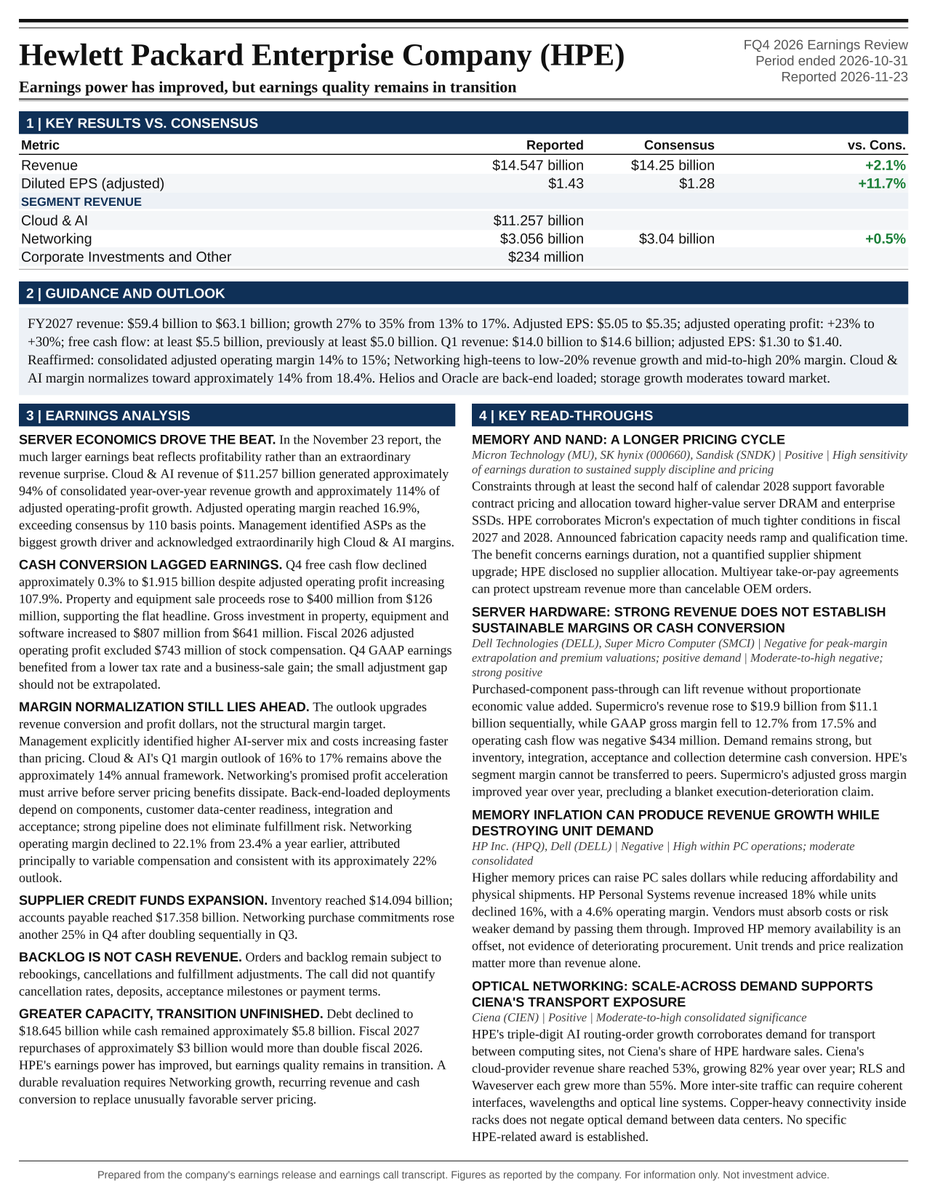
$HPE KEY READ-THROUGHS FROM HEWLETT PACKARD ENTERPRISE’S Q4 FISCAL 2026 EARNINGS CALL
Hewlett Packard Enterprise’s results reinforce a powerful infrastructure investment cycle, but also reveal increasing divergence between revenue growth, economic value captured, and cash generation. Orders increased 88%, server revenue increased 95%, and management raised fiscal 2027 revenue-growth expectations to 27% to 35%. However, Cloud & AI operating margin is expected to fall from 18.4% in Q4 to approximately 14%, with management explicitly identifying “costs increasing faster than pricing.” The strongest cross-market conclusion is therefore not simply that AI demand remains strong. It is that scarce components and differentiated networking technologies can capture attractive economics while system vendors and downstream equipment buyers absorb greater pricing, inventory, and financing risk. Enterprise networking and storage demand also appears broader than a hyperscaler-only spending cycle. The highest-conviction implications follow below; magnitude assessments refer to fundamental exposure, not predicted share-price movements.
SERVER HARDWARE: STRONG REVENUE DOES NOT ESTABLISH SUSTAINABLE MARGINS OR CASH CONVERSION (READ-THROUGH 1)
Affected companies: Dell Technologies (DELL: US) and Super Micro Computer (SMCI: US).
Directional impact and magnitude: Strong positive demand read-through, but a moderate-to-high negative read-through for extrapolating peak margins and assigning premium valuations to hardware revenue growth. Cash-conversion risk is particularly important for accelerator-intensive system suppliers.
HPE’s Cloud & AI orders increased 107%, server revenue increased approximately 95%, and AI systems orders reached $4.5 billion against $2.5 billion of quarterly revenue. These figures argue against an abrupt deterioration in infrastructure purchasing. Nevertheless, Myers stated that “the biggest growth driver has frankly been ASPs,” while Neri acknowledged that “the cloud and AI margin has been extraordinarily high.” The expected decline to approximately 14% segment margin makes the distinction between demand strength and earnings durability explicit.
The transmission mechanism is purchased-component pass-through. More expensive memory and accelerators increase system selling prices, but do not necessarily increase the OEM’s economic value added proportionately. Revenue can rise rapidly while gross-margin percentages decline. If higher component costs reach the income statement before customer pricing fully adjusts, gross-profit dollars can also disappoint. Large rack deployments additionally require inventory, integration, acceptance, and collection before accounting earnings become cash.
Supermicro’s November 3 results independently demonstrate this distinction. Revenue increased from $11.1 billion in the preceding quarter to $19.9 billion, while GAAP gross margin declined from 17.5% to 12.7%. Operating cash flow was negative $434 million despite substantial reported profit. Its adjusted gross margin improved year over year, so the evidence does not support a blanket assertion of deteriorating execution. It does support concern that extraordinary shipment growth can coexist with sequential margin compression and working-capital consumption.
HPE’s own Q4 free cash flow was essentially unchanged year over year despite adjusted operating profit more than doubling. The relevant peer questions are therefore component-price protection, customer deposits, inventory commitments, acceptance schedules, and cash conversion, rather than backlog alone. HPE’s 14% Cloud & AI margin should not be transferred directly to Dell or Supermicro because segment composition and accounting differ materially.
Near-term catalyst: Dell’s fiscal Q3 2027 earnings call is scheduled for November 24 at 4:30 p.m. ET. HPE raises the probability of strong revenue and order commentary, but makes the margin and cash-flow outlook more important than the headline beat. Supermicro has already reported its September quarter; HPE corroborates the industry dynamics rather than creating a new completed-quarter catalyst.
Longer-duration implication: System suppliers remain beneficiaries of infrastructure growth, but sustainable valuation depends increasingly on services, software, proprietary engineering, networking content, and disciplined financing. Assembly volume alone is a weaker source of durable shareholder value.
PERSONAL COMPUTERS: MEMORY INFLATION CAN PRODUCE REVENUE GROWTH WHILE DESTROYING UNIT DEMAND (READ-THROUGH 2)
Affected companies: HP Inc. (HPQ: US) and Dell Technologies (DELL: US), specifically their PC businesses.
Directional impact and magnitude: Negative for unit demand and margin resilience. The exposure is high within PC operations and moderate at the consolidated-company level, where printing, servers, storage, and services provide offsets.
HPE expects memory, NAND, and other critical components to remain constrained through at least the second half of calendar 2028. Management also acknowledged that fiscal 2027 margins would face pressure from input costs increasing faster than selling prices. These are relevant warnings for PC vendors, whose customers generally have more flexibility to delay purchases, reduce specifications, or extend replacement cycles than customers building strategic AI infrastructure.
The mechanism differs from the server opportunity. A constrained memory market can support the dollar value of PC sales through higher prices while reducing affordability and physical shipments. OEMs then face a choice between accepting lower margins or passing through costs and risking weaker demand. Premium product mix can cushion the effect but does not eliminate it.
HP’s August 26 results provide direct evidence that this is already occurring. Personal Systems revenue increased 18%, while total units declined 16%; segment operating margin was 4.6%. Those figures are inconsistent with interpreting revenue growth as an equally strong replacement cycle. HP also reported improved memory availability and fulfillment, which is an important offset: HPE’s warning does not establish that HP’s procurement execution has deteriorated.
The earnings sensitivity is significant because PC margins are relatively thin. Illustratively, an unrecovered cost increase equal to 100 basis points of Personal Systems revenue would absorb approximately 22% of operating profit at a 4.6% margin, before mitigating actions. This is a sensitivity, not an earnings forecast.
Near-term catalyst: HP’s fiscal Q4 2026 earnings call is scheduled for November 24 at 5:00 p.m. ET. The most informative disclosures are unit trends, price realization, memory coverage, and fiscal 2027 margin assumptions. Dell’s same-day results offer a parallel test through Client Solutions.
Longer-duration implication: AI infrastructure spending can create an adverse input-cost spillover into consumer and commercial computing. A portfolio broadly long “AI hardware” can therefore contain exposures with opposing economic interests: memory producers benefit from scarcity, while PC assemblers and buyers bear the cost.
MEMORY AND NAND: CUSTOMER-SIDE CONFIRMATION SUPPORTS A LONGER PRICING CYCLE (READ-THROUGH 3)
Affected companies: Micron Technology (MU: US), SK hynix (000660: South Korea), and Sandisk (SNDK: US).
Directional impact and magnitude: Positive, with high sensitivity of earnings duration to sustained supply discipline and pricing. The incremental information is stronger for the persistence of favorable conditions than for an immediate shipment-volume upgrade.
Neri’s expectation that memory and NAND constraints persist through at least the second half of calendar 2028 is the clearest positive upstream read-through. HPE also reported higher-cost strategic inventory purchases, supply-constrained server units, and increased purchasing commitments. These statements come from a major infrastructure buyer rather than from memory manufacturers describing their own market.
The transmission mechanism is favorable contract pricing and product allocation. When available supply remains below required configurations, suppliers can prioritize higher-value server DRAM, enterprise SSDs, and other differentiated products. Higher prices can support profitability even if bit shipments or system units increase more slowly. HPE’s experience demonstrates why strong memory earnings need not depend on equally strong growth in server chassis shipments.
The message independently corroborates Micron’s September 30 expectation that memory and storage supply-demand conditions would be “much tighter in fiscal 2027 and 2028 than they were in 2026.” Micron also described new manufacturing output arriving across calendar 2027 and 2028, followed by additional ramp time. Announced fabrication capacity is therefore not equivalent to immediately available qualified supply.
SK hynix’s latest results similarly identified strong server DDR5 demand, expanding enterprise SSD sales, and supply limitations. Sandisk provides more concentrated exposure to the NAND side of HPE’s warning. The call is consequently broader than an HBM-only signal: traditional server memory and enterprise storage also benefit from constrained supply and richer configurations.
The important asymmetry is contractual. Micron has described multiyear take-or-pay customer agreements, while HPE’s order disclosures allow for cancellations, rebookings, and fulfillment adjustments. This does not establish the terms of any particular HPE procurement contract. It does illustrate how upstream suppliers can obtain stronger revenue protection than downstream OEMs receive from their own customers.
Near-term catalyst: Subsequent memory pricing, allocation, and customer-agreement disclosures should test whether the prolonged constraint period translates into realized pricing. HPE’s call is corroboration, not a new supplier order or a quantified increase to any manufacturer’s guidance.
Longer-duration implication: The strongest benefit is reduced confidence in a rapid supply-driven normalization of memory earnings. Nevertheless, powerful supplier results and existing management guidance mean that favorable fundamentals should not be confused with an automatically unpriced investment opportunity. No HPE supplier allocation among these companies was disclosed.
AI ACCELERATORS: HELIOS PROVIDES A CONCRETE COMMERCIAL VALIDATION FOR AMD (READ-THROUGH 4)
Affected company: Advanced Micro Devices (AMD: US).
Directional impact and magnitude: Positive. Strategically meaningful for AMD’s rack-scale accelerator ecosystem, with moderate potential consolidated earnings relevance; the exact contribution remains undisclosed.
HPE stated that its fiscal 2027 outlook includes Helios and emphasized the ability to combine rack-scale compute, liquid cooling, and Ethernet scale-up networking. The call also highlighted the billion-dollar-plus Vultr win. The original September 30 announcement specifies a $1.2 billion order for systems containing 72 AMD Instinct MI455X GPUs per rack, alongside AMD CPUs, networking components, and software.
The transmission mechanism is direct semiconductor content in an identified commercial system. This is stronger evidence than a general statement that customers want alternative accelerators. HPE supplies system engineering, cooling, deployment capabilities, and customer support around AMD’s platform, reducing the integration burden associated with adopting a different rack-scale architecture.
The significance extends beyond the initial customer. Successful deployment can establish a repeatable configuration and operational reference for subsequent buyers. HPE’s ability to sell complete systems or networking trays to other rack-scale suppliers potentially broadens the routes through which the architecture reaches customers. The economic benefit to AMD depends on production shipments, system qualification, software readiness, and repeat orders, rather than on the announcement value alone.
Several boundaries are essential. The $1.2 billion order is HPE system revenue, not AMD revenue. It includes components and services outside AMD’s economic share. It was announced in September and should not be counted as a new November award or added again to guidance. HPE also described contributions as back-end loaded in fiscal 2027.
Near-term catalyst: Evidence of qualification, deployment readiness, shipment schedules, and additional named customers is more informative than another repetition of the original order. Supplier revenue can precede HPE’s final system recognition, so the timing cannot be transferred mechanically between companies.
Longer-duration implication: The call supports a more credible commercial ecosystem for heterogeneous accelerator platforms. It does not establish that incumbent GPU demand is weakening; HPE simultaneously reported strong demand for other AI systems and Private Cloud AI.
AI NETWORKING SEMICONDUCTORS: BROADCOM CAPTURES CONTENT WITHOUT NEEDING TO WIN THE GPU (READ-THROUGH 5)
Affected company: Broadcom (AVGO: US).
Directional impact and magnitude: Positive for AI switching silicon. Potentially meaningful within the networking semiconductor business, but a smaller and currently unquantified contribution to consolidated earnings.
Neri stated, “We can also offer our Helios scale-up networking trays to other AI rack-scale server providers.” This creates a semiconductor exposure that is less dependent on which OEM supplies the complete rack. HPE’s announced Helios configuration contains 6 QFX5252 scale-up trays per rack.
October technical inspection of the demonstrated QFX5252 hardware identified 2 Broadcom Tomahawk 6 switching ASICs per tray. Combined with the announced tray count, that implies 12 switching ASICs per rack in the demonstrated configuration. Chip pricing, shipment volumes, and production-configuration consistency were not disclosed, so a reliable dollar-revenue estimate cannot be constructed.
The precise mechanism is additional switching content inside the accelerator rack, alongside the separate opportunity in scale-out fabrics. Broadcom can participate in AMD-based infrastructure expansion through networking even though it does not supply the AMD accelerators. HPE’s ability to distribute networking trays to other system vendors potentially increases that opportunity beyond HPE-branded rack shipments.
The call also provides an important restraint on extrapolation. The $7.5 billion to $8.0 billion Networks for AI order target is cumulative. Against $3.4 billion accumulated through fiscal 2026, it implies approximately $4.1 billion to $4.6 billion of incremental fiscal 2027 orders. The resulting quarterly average is below Q4’s $1.2 billion. This still represents strong annual growth, but it is not evidence of uninterrupted sequential order acceleration.
Nor does all HPE networking growth flow to Broadcom. Neri explicitly described PTX and MX routing products as using HPE’s own purpose-built silicon. Routing order growth and Ethernet switching silicon content must therefore be modeled separately.
Near-term catalyst: Production confirmation and component shipments associated with the fiscal 2027 Helios ramp are the relevant milestones. The HPE call improves confidence in commercialization but does not establish a new Broadcom order value.
Longer-duration implication: Merchant Ethernet silicon benefits from architectural diversification and a broader set of rack suppliers. This is a more defensible exposure than assigning the full value of a system order, or all networking backlog, to a semiconductor vendor.
ENTERPRISE NETWORKING: THE CAMPUS REFRESH IS REAL AND BROADER THAN HYPERSCALER AI (READ-THROUGH 6)
Affected companies: Cisco Systems (CSCO: US) and Extreme Networks (EXTR: US).
Directional impact and magnitude: Positive for demand. Moderate consolidated relevance for Cisco and greater proportional relevance for Extreme because of its concentration in enterprise networking. The call does not establish market-share gains for either company.
HPE’s Campus & Branch revenue increased 17%, enterprise networking revenue increased 16%, and Networking orders increased 56%. Management attributed campus strength to Wi-Fi 7, increasing device density, and modernization. Approximately 64% of HPE Networking’s year-over-year revenue increase came from Campus & Branch, rather than from the more heavily discussed AI data-center categories.
The transmission mechanism is a refresh of wireless access, switching, management, and associated support. Higher-performance access networks can require upgraded uplinks, power delivery, security policies, and operational software. The spending opportunity consequently extends beyond replacing access points.
This is independently corroborated by Cisco’s November 12 commentary: campus networking product orders increased 14%, and management described the refresh cycle as early-stage. Extreme’s October results also showed stronger recurring software demand and improved profitability. Its management specifically discussed taking targeted pricing actions while offsetting supply-chain costs. HPE therefore confirms a broader market opportunity rather than providing the only evidence of recovery.
The competitive qualification is significant. Integrated Aruba and Juniper products, common hardware support, and stronger AIOps capabilities make HPE a more comprehensive rival. Industry growth can coexist with difficult individual account competition. Strong HPE bookings should not be translated automatically into equivalent bookings for Cisco or Extreme, and differing shipment availability can create quarterly divergence.
Near-term catalyst: Subsequent channel, backlog-conversion, and order disclosures matter more than an immediate reaction to HPE alone, because both peers have already reported recent quarters. The incremental signal is demand breadth and persistence.
Longer-duration implication: Campus modernization offers an enterprise infrastructure cycle that is related to, but not wholly dependent on, hyperscaler accelerator spending. It can diversify the revenue sources within a networking portfolio, although it does not eliminate common enterprise-budget and component-supply risks.
OPTICAL NETWORKING: SCALE-ACROSS DEMAND SUPPORTS Ciena’S TRANSPORT EXPOSURE (READ-THROUGH 7)
Affected company: Ciena (CIEN: US).
Directional impact and magnitude: Positive, with potentially high relevance to the exposed optical-transport business and moderate-to-high consolidated significance given Ciena’s cloud-provider exposure. No specific HPE-related award is established.
HPE reported triple-digit growth in routing orders associated with AI and highlighted demand for data-center interconnect and scale-across networking. Networks for AI backlog reached $1.7 billion. Management also expects Oracle-related networking contributions to increase as fiscal 2027 progresses.
The transmission mechanism is the requirement to move more data between physically separated computing sites. Routing operates at a different layer from coherent optical transport, but additional inter-site traffic can require higher-capacity wavelengths, coherent interfaces, optical line systems, and network upgrades. Ciena’s exposure is to that transport requirement, not to HPE’s switch or router revenue itself.
Ciena’s September presentation provides direct evidence that this demand channel is already material. Cloud providers represented 53% of revenue and grew 82% year over year; RLS and Waveserver revenue each grew more than 55%. HPE’s routing-order commentary therefore corroborates an established customer-spending pattern rather than requiring a speculative new use case.
An important architectural distinction is that copper-heavy scale-up connectivity inside a Helios rack does not negate optical demand between data centers. Intra-rack, intra-campus, and inter-site links have different reach, latency, power, and cost constraints. Treating every AI networking development as either universally positive or universally negative for optics would miss these differences.
Near-term catalyst: Ciena’s subsequent orders, cloud-provider spending commentary, and conversion outlook can establish whether HPE’s signal is translating into transport purchases. HPE’s back-end-loaded deliveries do not determine Ciena’s recognition schedule, because transport equipment may be ordered or installed at different stages.
Longer-duration implication: Distributed AI infrastructure broadens networking investment beyond the immediate accelerator cluster. The key limit is competitive allocation: HPE’s customer wins validate bandwidth requirements, not Ciena’s share of the associated optical spending.
ENTERPRISE STORAGE: INFERENCE IS EXPANDING THE BUDGET, BUT HPE’S 34% GROWTH IS NOT A PEER FORECAST (READ-THROUGH 8)
Affected companies: NetApp (NTAP: US) and Everpure, formerly Pure Storage (PSTG: US).
Directional impact and magnitude: Positive for enterprise storage demand and software attachment. Moderate earnings relevance, with higher conviction in opportunity expansion than in any specific quarterly estimate increase.
HPE storage revenue increased 34%, storage orders remained strong, and Alletra MP exceeded a $1 billion annual revenue run rate. Neri emphasized rapidly growing unstructured-data requirements and stated that enterprise AI requires “more storage and more services.” HPE also identified strong demand for its X10000 file-and-object platform.
The mechanism is increased need to make enterprise data accessible, governed, protected, and usable by inference applications. Spending can include higher-performance file and object storage, data-management software, resilience, and integration services. This creates revenue opportunities outside accelerator procurement and challenges the assumption that AI budgets necessarily crowd out all conventional enterprise infrastructure spending.
NetApp’s ONTAP-based data platform and AI-oriented infrastructure address these requirements. Everpure’s FlashBlade combines file and object services and has NVIDIA-certified configurations for AI workloads. These product roles provide a direct commercial route to the demand described by HPE, rather than a purely thematic association.
The limits are equally important. HPE attributed part of Q4 storage growth to large public-sector and enterprise deals and suggested that fiscal 2027 growth should be more consistent with the market. Storage revenue also includes software and GreenLake Flex. The 34% figure therefore cannot be treated as a clean market-growth estimate or evidence that competitors gained share.
NAND inflation creates an additional distinction between demand and profit. Higher hardware prices can increase reported storage revenue while pressuring margins unless vendor pricing, software content, and procurement terms compensate. HPE’s integrated compute-storage offering also creates direct competition for standalone storage suppliers.
Near-term catalyst: NetApp’s fiscal Q2 2027 results are scheduled for December 1. HPE’s October-quarter data support attention to enterprise bookings, AI-related product adoption, and customer-budget breadth, but do not establish a NetApp beat.
Longer-duration implication: The strongest opportunity is a larger enterprise data-infrastructure budget and sustained software and services attachment. The appropriate conclusion is expanding addressable demand, not automatic persistence of HPE’s latest growth rate across the industry.
DATA-CENTER POWER AND COOLING: FACILITY READINESS IS A REVENUE GATE, AND LIQUID COOLING EXTENDS BEYOND GPUs (READ-THROUGH 9)
Affected company: Vertiv Holdings (VRT: US).
Directional impact and magnitude: Positive for thermal-management, power-infrastructure, and deployment-service demand. Moderate incremental confirmation from this call, with potentially substantial longer-duration business relevance. No specific Vertiv supply allocation to HPE was disclosed.
HPE repeatedly linked fiscal 2027 AI revenue conversion to customer data-center readiness. Management also emphasized liquid-cooled rack-scale systems and fully liquid-cooled high-performance networking. Myers stated that major Helios and Oracle contributions would be “much more back-end loaded.”
The mechanism is that accelerators and networking systems cannot generate useful capacity until facilities provide adequate electrical distribution, cooling, fluid management, controls, and commissioning. Additional network-device heat loads broaden the thermal-management requirement beyond accelerator cold plates alone. This supports demand for facility-level equipment and services even where the server OEM engineers substantial portions of the rack cooling.
Vertiv’s
https://t.co/ESwYzLpGNH
$NVDA $MU $SNDK $LITE Our GAI Data Center Tracker is built from tens of thousands of documents worldwide: regulatory filings, environmental and permitting reports, press releases, community and zoning records, earnings calls, and financial and analyst research.
What that record shows is activity slowing on the margin, mostly through delays. Nothing in it corroborates a selloff of this size, the multiples the GAI infrastructure companies now trade at, or the broad negative sentiment around the group.
Delays are real. A collapse in the buildout is not in the documents.
https://t.co/UTYaDV1GzT
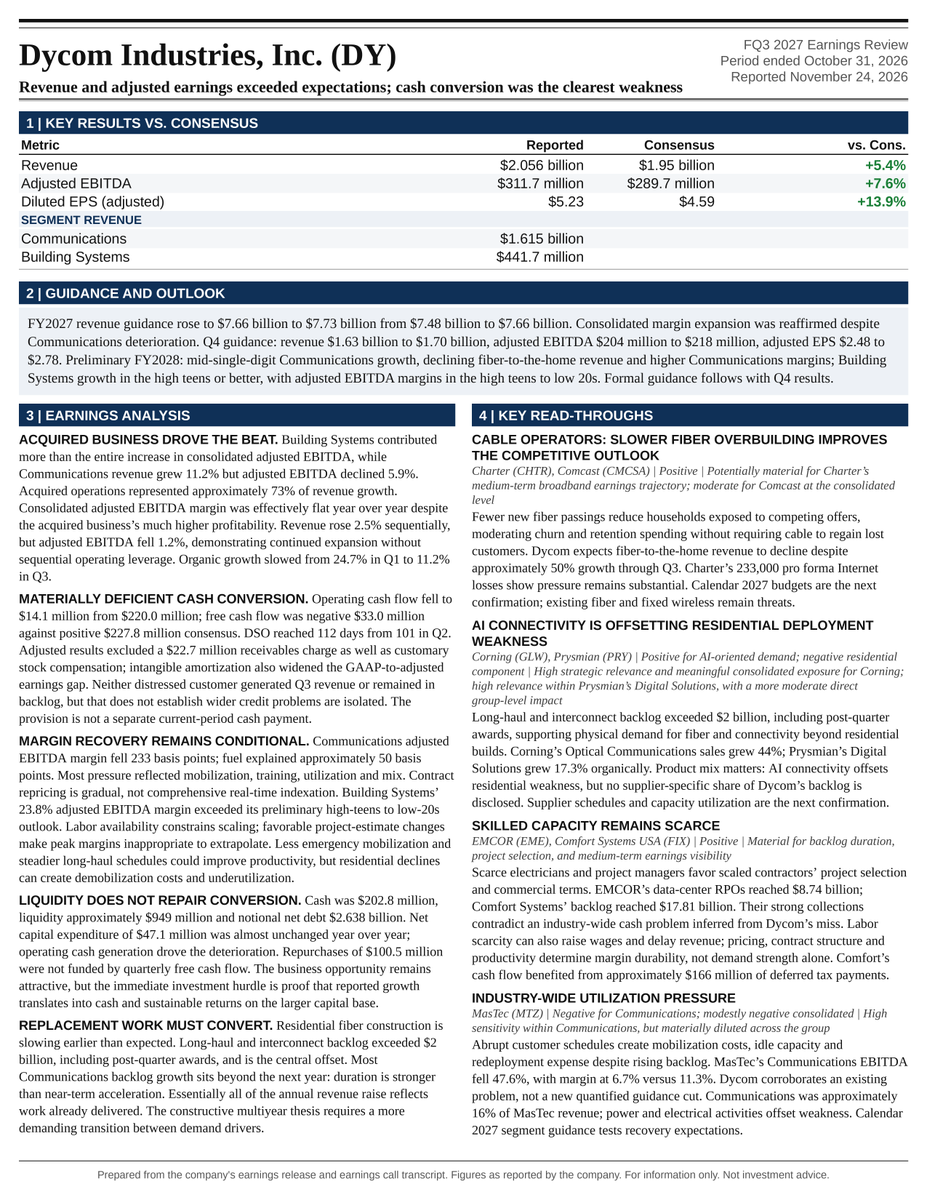
$DY KEY READ-THROUGHS FROM DYCOM INDUSTRIES’ FISCAL Q3 2027 EARNINGS CALL
Dycom’s November 24 call points to a divergence within infrastructure spending, not a broad investment downturn. Residential fiber construction is slowing earlier than expected as financially constrained overbuilders retreat and larger operators reassess deployment schedules. At the same time, long-haul connectivity, data-center interconnect, electrical construction, and structured cabling continue to expand. The most differentiated implications are positive for incumbent cable operators facing fewer new fiber competitors, positive for suppliers exposed to AI-network infrastructure, and negative for businesses dependent on incremental residential fiber deployments. Dycom’s cash-flow disappointment should also be separated from the strength of its data-center demand: customer credit quality, payment terms, and working-capital management are becoming more important differentiators across contractors. The assessments below distinguish high-conviction operating transmission mechanisms from uncertain earnings magnitudes. Dycom’s fiscal 2028 outlook applies predominantly to calendar 2027.
CABLE OPERATORS: SLOWER FIBER OVERBUILDING IMPROVES THE COMPETITIVE OUTLOOK (READ-THROUGH 1)
Affected companies: Charter Communications (CHTR: United States) and Comcast Corporation (CMCSA: United States). Direction: Positive. Magnitude: Potentially material for Charter’s medium-term broadband earnings trajectory; moderate for Comcast at the consolidated level, given its broader business mix.
The critical evidence is management’s explanation that the fiber slowdown reflects reduced competitive urgency rather than simply construction bottlenecks. Peyovich stated, “In many cases the overbuilders have stopped,” and, “What’s really changed is just the competitive pressure.” Dycom expects fiber-to-the-home revenue to decline in fiscal 2028 despite approximately 50% growth through Q3 this year. Management also emphasized that the slowdown arrived earlier than anticipated.
The transmission mechanism favors incumbent cable networks. Fewer newly constructed fiber passings mean fewer households encounter a new competing high-speed network. That reduces the incremental pool of customers exposed to fiber introductory offers, switching campaigns, and converged mobile-broadband bundles. It can moderate churn, reduce retention spending, and preserve revenue on cable infrastructure whose fixed costs are already largely established. The benefit does not require cable to win back customers already lost to fiber; slower erosion of the existing base is economically valuable.
Charter is particularly sensitive because broadband is central to its earnings and its enlarged post-Cox footprint increases the absolute customer base exposed to competitive deployment decisions. Its November 6 results reported 233,000 pro forma Internet customer losses during Q3, including 156,000 at legacy Charter and 77,000 at legacy Cox. Comcast reported 144,000 domestic residential broadband losses in Q3. These figures establish that competitive pressure remains substantial. Dycom’s commentary supports a less adverse future competitive environment, not a claim that customer trends have already stabilized.
The near-term trading catalyst is confirmation in operators’ calendar 2027 construction budgets and commentary on competitive intensity. The operating benefit should emerge over subsequent quarters as fewer competing networks become commercially available. Existing fiber networks will continue marketing aggressively, and fixed wireless remains a separate competitive threat. Consequently, this is a positive change in the rate of competitive deterioration, not evidence that cable’s structural challenges have disappeared.
The cross-portfolio implication is important: weaker fiber-construction spending can be negative for contractors and access-equipment vendors while simultaneously improving the earnings outlook of cable incumbents. Treating all broadband-related equities as having the same directional exposure would miss that transfer of economic benefit.
FIXED-LINE TELECOM: COPPER RETIREMENT IS MOVING FROM STRATEGIC INTENT TO EXECUTION (READ-THROUGH 2)
Affected company: AT&T (T: United States). Direction: Positive. Magnitude: Meaningful within legacy-network economics and moderately positive for consolidated cash generation over multiple years; the call does not support a quantified near-term EPS increase.
Dycom expects copper reclamation to become a meaningful contributor beginning in fiscal 2028. Management described customers obtaining regulatory approvals and reaching sufficient fiber coverage to remove legacy infrastructure. Peyovich stated that “there’s enough fiber in place that they can actually go start pulling out a lot of this copper.” Management also indicated that salvage proceeds at current copper prices can offset decommissioning costs.
AT&T is a directly relevant operator rather than a thematic proxy. Dycom’s quarterly presentation identifies AT&T as a customer exceeding 10% of revenue. Separately, AT&T’s October 19 network-modernization update reiterated its objective to exit copper across the majority of its footprint by the end of 2029. It reported discontinuing copper services in more than 500 communities covering more than 1.3 million locations across 18 states, with upgrades planned across another 1,500 communities over the following year.
The economic mechanism has distinct components. Copper salvage can lower the net cash cost of removing retired infrastructure. Migration to fiber or wireless can reduce repair intensity, exposure to copper theft, and the burden of operating parallel networks. Physical retirement then makes those simplification benefits more durable than subscriber migration alone. Dycom’s investment in specialized equipment and training is evidence that execution capacity is developing alongside the operator’s stated retirement plan.
The accounting distinction matters. Salvage proceeds are not automatically recurring EBITDA, and offsetting decommissioning expenditure is not equivalent to generating an equal amount of incremental profit. The strongest read-through concerns cash efficiency and the removal of legacy operating complexity. It does not establish that every dollar of contractor reclamation revenue produces an equivalent AT&T cost saving.
The near-term catalyst is evidence of accelerating retirement activity and disclosed cash costs during calendar 2027. The larger fundamental benefit extends through AT&T’s 2029 target and potentially beyond. Regulatory permission, customer migration, and regional execution remain gating factors.
Importantly, copper removal need not stop simply because new fiber construction slows. Previously migrated locations can support reclamation activity independently of the latest passing targets. That makes network simplification a potentially more resilient source of operator cash improvement than relying exclusively on continued acceleration in new fiber builds.
OPTICAL FIBER AND CABLING: AI CONNECTIVITY IS OFFSETTING RESIDENTIAL DEPLOYMENT WEAKNESS (READ-THROUGH 3)
Affected companies: Corning Incorporated (GLW: United States) and Prysmian (PRY: Italy). Direction: Positive for AI-oriented fiber and connectivity demand, despite a negative residential-fiber component. Magnitude: High strategic relevance for Corning and meaningful consolidated exposure; high relevance within Prysmian’s Digital Solutions business, with a more moderate direct group-level impact.
Dycom reported that contracted long-haul and data-center interconnect backlog had more than doubled from the previous quarter and exceeded $2 billion, including contracts executed after quarter-end. These activities are expected to be the leading Communications growth driver next year. Separately, structured-cabling operations have expanded into 19 states, demonstrating demand both between data centers and inside facilities.
The transmission mechanism is physical rather than purely sentiment-driven. Long-haul routes require optical fiber and cable; inside-facility deployments require high-density connectivity, termination, and cabling systems. The location and architecture of AI workloads therefore create demand that is not dependent on residential passing growth. A slowdown in fiber-to-the-home construction should not be extrapolated into an equivalent slowdown across all optical products.
Corning’s October 27 results provide strong company-specific corroboration. Optical Communications sales increased 44% to $2.38 billion, representing approximately 47% of core company sales. Enterprise Networks revenue increased 84%, and Gen AI product sales more than doubled. Corning also disclosed new multiyear, multibillion-dollar customer agreements, including with AT&T and Verizon. Dycom’s expanding infrastructure workload supports the durability of the end-market demand behind those disclosures, although it does not identify which suppliers serve individual Dycom projects.
Prysmian’s October results showed 17.3% organic growth in Digital Solutions and €134 million of segment adjusted EBITDA, approximately 16% of group adjusted EBITDA. Its July agreement with Molex, worth up to €5.5 billion over up to 10 years, specifically concerns optical cable deployed inside data centers. Planned capacity expansion will more than double its U.S. fiber capacity. This creates exposure to both the interconnect opportunity described by Dycom and the separate inside-data-center build cycle.
The near-term catalyst is supplier commentary on customer schedules, capacity utilization, and the balance between residential and data-center demand in calendar 2027. The longer-duration benefit is improved visibility supporting capacity investment and manufacturing utilization. Prysmian’s larger expansion extends toward 2031, so its full contribution should not be pulled into near-term forecasts.
The principal investment distinction is product and customer mix. Corning and Prysmian retain residential-fiber exposure, but their AI-connectivity businesses provide a substantial offset. The high-conviction conclusion is that broad selling of optical-fiber suppliers solely because Dycom’s residential work is slowing would ignore the strongest incremental demand signal in the call. No supplier-specific share of Dycom’s $2 billion backlog can be quantified from the disclosed information.
COHERENT OPTICAL NETWORKING: CONSTRUCTION AWARDS EXTEND THE EQUIPMENT DEMAND PIPELINE (READ-THROUGH 4)
Affected company: Ciena Corporation (CIEN: United States). Direction: Positive. Magnitude: High strategic relevance and potentially material over multiple years, but insufficient evidence for a specific near-term revenue or EPS increase.
Dycom’s long-haul and data-center interconnect backlog expansion is particularly relevant to coherent optical systems. Management reported awards across multiple customers and large geographic areas, with customers discussing construction requirements extending beyond a decade. Peyovich characterized long-haul deployment as “a much more structured, much more regular tempo” than residential fiber construction.
The transmission mechanism differs from the passive-cabling opportunity. New routes and additional interconnection capacity create locations and fiber infrastructure on which optical transport systems can be deployed. Monetizing that infrastructure requires transmitting growing volumes of data between facilities, supporting demand for coherent optical systems, interconnect products, and related network capabilities. Ciena is directly exposed to this equipment category.
Ciena’s September 3 results already demonstrated strong demand: fiscal Q3 revenue increased 37% to $1.67 billion, and management described AI as driving successive waves of network investment. Dycom therefore supplies an additional physical-construction indicator supporting an established demand trend. It is not the first evidence of an optical recovery, nor proof that this information is absent from valuation.
The important nuance is timing. Construction backlog is upstream of operational network capacity, but equipment orders, shipments, and revenue recognition do not follow a fixed delay. Some equipment may be ordered before route completion; some installed fiber may remain unlit. Permitting, power availability, customer architecture, and network acceptance influence the conversion schedule. Dycom’s construction revenue cannot be translated into a constant percentage of Ciena equipment revenue.
The clearest near-term catalyst is Ciena’s scheduled December 10 fiscal Q4 and year-end results, particularly its fiscal 2027 outlook and discussion of service-provider and cloud interconnect demand. Contracts Dycom executed after October 31 are primarily evidence for the forward pipeline, not grounds for mechanically increasing expectations for an already-completed Ciena quarter.
The longer-duration implication is that physical network expansion can support optical-equipment demand beyond upgrades to existing links. That potentially broadens the growth opportunity from bandwidth replacement toward new-route deployment. However, Dycom did not identify Ciena as a supplier on these projects, and the call does not establish specific design wins or market-share gains.
BROADBAND ACCESS PLATFORMS: RESIDENTIAL BUILD SLOWDOWNS AND BEAD TIMING LIMIT NEAR-TERM UPSIDE (READ-THROUGH 5)
Affected company: Calix (CALX: United States). Direction: Negative for deployment-linked equipment demand and the timing value assigned to BEAD opportunities. Magnitude: Meaningful for the hardware growth outlook; moderate and unquantified at the consolidated earnings level because installed-base monetization and software adoption provide offsets.
The relevant evidence combines residential-fiber weakness with incomplete subsidy conversion. Dycom expects fiber-to-the-home revenue to decline in fiscal 2028, while only “Very, very small amounts” of BEAD-related work were in backlog. The previously discussed approximately $500 million of verbal awards had increased, but management did not provide a revised amount or a firm conversion schedule.
For access-platform suppliers, fewer or delayed network deployments reduce the pace at which operators require new access equipment and subscriber-connectivity products. Budget constraints can also cause operators to purchase closer to deployment dates rather than build inventory. BEAD-related opportunity therefore has to pass through several stages before becoming supplier revenue: funding and customer commitments, executable construction plans, equipment procurement, and actual deployment.
Calix’s November 2 shareholder letter establishes substantial exposure to the relevant geography. U.S. revenue represented 95% of Q3 sales. Software and service revenue was $51.9 million against total revenue of $301.7 million, approximately 17%. Although the platform business provides important resilience, the revenue mix does not support treating Calix as an insulated recurring-software company. Moreover, the software and service category itself includes both ratable and delivery-based revenue.
The counterevidence prevents an indiscriminate bearish conclusion. Calix reported 14% total revenue growth, 19% software and service growth, and record remaining performance obligations. Its platform can support customer acquisition, penetration of existing network footprints, service upgrades, and operating efficiency without requiring equivalent growth in newly constructed passings. Dycom’s disclosure does not demonstrate that Calix’s existing guidance has become unattainable.
The high-conviction negative read-through is narrower: aggressive expectations for calendar 2027 greenfield equipment acceleration or an immediate BEAD step-change deserve less confidence. A rise in verbal construction awards is not the same as a funded, scheduled equipment purchase.
The near-term catalyst is Calix’s next outlook and disclosure of deployment-linked customer orders, inventory, and actual BEAD shipments. The longer-duration issue is a more uneven expansion cycle in which subscriber penetration and software monetization become more important relative to network construction. No connection has been established between Dycom’s financially distressed customers and Calix, so a supplier-specific credit-loss inference would be unsupported.
ELECTRICAL AND MECHANICAL CONTRACTING: SKILLED CAPACITY REMAINS SCARCE, AND DYCOM’S CASH MISS IS NOT AN INDUSTRY DEMAND SIGNAL (READ-THROUGH 6)
Affected companies: EMCOR Group (EME: United States) and Comfort Systems USA (FIX: United States). Direction: Positive. Magnitude: Material for backlog duration, project selection, and medium-term earnings visibility; no justification for transferring Dycom’s precise margins to either peer.
Dycom’s Building Systems segment generated $441.7 million of revenue at a 23.8% adjusted EBITDA margin. Management expects revenue growth in the high teens or better next year, reported awards extending visibility beyond calendar 2028, and stated that it had not observed material changes in customer behavior or project scope from recent policy and permitting uncertainty. The identified constraint was execution capacity: “electricians and the management teams to lead those groups are in short supply overall.”
The mechanism favors scaled contractors with established craft labor, project supervision, prefabrication capability, and customer relationships. When customers cannot readily substitute qualified capacity, contractors can be more selective about projects, schedules, commercial terms, and risk allocation. Demand visibility also reduces the probability that newly hired or trained employees become idle immediately after mobilization.
EMCOR’s October results independently support this interpretation. Data-center remaining performance obligations reached $8.74 billion, more than double the prior-year level and approximately 47% of total RPOs. Its electrical and mechanical businesses both reported substantial data-center growth. Comfort Systems reported $17.81 billion of backlog, up approximately 90% year over year, and described customers committing earlier and for larger scopes because qualified capacity was scarce.
The cash-flow comparison is particularly important. Dycom produced only $14.1 million of Q3 operating cash flow and attributed collection delays partly to telecom customer consolidation. EMCOR reported approximately $797 million of operating cash flow, while Comfort Systems reported approximately $1.01 billion. Comfort’s result benefited from favorable payment terms and collections, as well as approximately $166 million of deferred tax payments, so it should not be treated as a fully normalized run rate. Nevertheless, the evidence contradicts a claim that Dycom’s cash shortfall demonstrates a general inability to collect from data-center customers.
The near-term trading implication is to distinguish any sympathy-driven weakness from a genuine deterioration in peer fundamentals. Their upcoming reporting periods should be evaluated through new awards, project margins, customer funding, and cash conversion rather than Dycom’s consolidated free-cash-flow result alone.
The longer-duration positive is scarce execution capacity and an expanding contracted workload. The offset is that labor scarcity can also raise wages and delay revenue. Margin durability depends on pricing, contract structure, and productivity, not simply demand strength. Geographic diversification also matters: Dycom’s electrical exposure is concentrated in the Washington, D.C., Maryland, and Virginia region, while its structured-cabling expansion demonstrates broader demand across 19 states.
COMMUNICATIONS CONSTRUCTION: INDUSTRY-WIDE UTILIZATION PRESSURE IS MORE IMPORTANT THAN HEADLINE BACKLOG GROWTH (READ-THROUGH 7)
Affected company: MasTec (MTZ: United States). Direction: Negative for Communications; modestly negative at the consolidated level, with substantial offsets from power and other infrastructure activities. Magnitude: High sensitivity within the Communications segment, but materially diluted across the group.
Dycom’s Communications revenue increased 11.2%, yet adjusted EBITDA declined 5.9% and margin contracted 233 basis points. Higher fuel prices explained approximately 50 basis points, leaving most of the contraction associated with other operating factors. Management described inefficient rapid mobilization for customer requests and subsequently disclosed an earlier-than-expected residential-fiber slowdown.
The transmission mechanism is contractor utilization. A large workforce and equipment base can become inefficient when customer schedules change abruptly, even when total multiyear demand remains attractive. Rapid accelerations create travel, overtime, supervision, and mobilization costs; subsequent slowdowns can create idle capacity or redeployment expense. Growing backlog does not remove these costs when the work is not immediately executable in the locations where resources are available.
MasTec’s October 29 results show that the issue is not confined to Dycom. Communications revenue declined 11.8% to $806.9 million, segment EBITDA declined 47.6% to $54.0 million, and margin fell to 6.7% from 11.3%. Management had already cited customer spending deferrals and announced efforts to streamline operations and exit underperforming markets.
Dycom therefore corroborates an already-disclosed industry problem and adds a forward warning: a clean calendar 2027 residential-construction rebound is less certain than long-term passing commitments might imply. The call does not create a new quantified MasTec guidance cut. It reduces confidence in assuming that delayed work automatically returns quickly and at historical margins.
The exposure is meaningful but bounded. Communications represented approximately 16% of MasTec’s Q3 revenue. At the reported segment revenue level, 100 basis points of margin is approximately $8 million of quarterly EBITDA, roughly 15% of segment EBITDA but less than 2% of consolidated adjusted EBITDA. MasTec’s strong Power Delivery results and its acquisition of electrical contractor The Superior Group provide exposure to the healthier side of the infrastructure cycle.
The near-term catalyst is MasTec’s calendar 2027 segment outlook, including customer budgets, backlog conversion, and the financial effects of its restructuring actions. The longer-duration competitive effect could favor national contractors as operators consolidate vendors. However, Dycom’s experience demonstrates that share gains and scale do not guarantee immediate profit growth.
The appropriate cross-portfolio distinction is between residential construction exposure and power or data-center execution capacity, not between infrastructure beneficiaries and nonbeneficiaries. MasTec participates in both. Its Communications risk should be reflected in segment assumptions without extrapolating that weakness into a uniformly bearish view of the entire company.
procurement event. The high-conviction conclusion is narrower: wireless equipment has a less favorable combination of growth and input-cost pressure than AI optical infrastructure.
Near-term trading significance lies in distinguishing wireless weakness from data-center strength after ADI’s release. The fundamental test extends into 2027 as Ericsson attempts to offset component costs through pricing, portfolio actions, and efficiency. This supports relative caution toward RAN earnings quality, not a thesis of an imminent wireless demand collapse.
CROSS-PORTFOLIO RISK: MORE AI SUPPLIERS DO NOT NECESSARILY PROVIDE MORE DIVERSIFICATION (READ-THROUGH 11)
Affected companies: Analog Devices (ADI: US), Monolithic Power Systems (MPWR: US), Teradyne (TER: US), Coherent (COHR: US), Lumentum Holdings (LITE: US), and Vertiv Holdings (VRT: US). Direction: negative for diversification assumptions, despite the positive operating outlook. Magnitude: potentially high for portfolios holding several of these exposures.
ADI’s direct data-center revenue represented approximately 13% of sales, but management grouped data center, ATE, and aerospace and defense into a larger approximately 30% revenue pool benefiting from unusually strong demand. Additional AI-linked demand appears in energy, power infrastructure, and automation. Consequently, direct data-center reporting understates some companies’ economic sensitivity to the infrastructure investment cycle.
The transmission mechanism is a shared final spending driver across different supply-chain stages. Hyperscaler and accelerator-platform investment supports optical connectivity, power semiconductors, semiconductor test, and cooling infrastructure. These businesses have different products, customers, and shipment timing, but a change in deployment schedules or infrastructure budgets can propagate through several holdings simultaneously.
ADI’s statement that more than 2/3 of fiscal 2026 growth came from non-AI-centric opportunities remains an important offset. ADI is not a pure-play AI supplier, and the affected companies should not be treated as having identical sensitivities. Nevertheless, product diversification and numerous SKUs do not establish independence from the same ultimate capital-spending decisions.
The near-term risk is correlated trading during semiconductor and AI-infrastructure de-risking, even when individual earnings releases remain strong. The longer-duration risk is that supply-chain orders, inventory buffers, and capacity expansions amplify a subsequent change in final demand. The portfolio implication is to aggregate these exposures by underlying infrastructure spending and cash-flow dependence, rather than treating analog chips, optical components, test equipment, and cooling systems as fully separate risk categories.
https://t.co/dHpJhUx5hA
$ADI KEY READ-THROUGHS FROM ANALOG DEVICES’ Q4 FISCAL 2026 EARNINGS CALL
Analog Devices’ results support a differentiated conclusion for the broader market: demand remains strong across AI infrastructure, semiconductor test, and recovering industrial applications, but the benefits are increasingly constrained by supply availability, investment requirements, and customer-specific content exposure. The communications revenue miss was concentrated in wireless, not data center, making indiscriminate weakness in optical and AI-power suppliers difficult to justify fundamentally. Conversely, record semiconductor margins should not be equated with accelerating free cash flow, and strong component demand should not be extrapolated into stronger vehicle production or a broad telecom capital-spending recovery. The highest-conviction implications favor suppliers addressing physical bottlenecks and manufacturers with available capacity, while highlighting weaker earnings conversion at capacity builders and cost pressure in slower-growing equipment markets. Magnitude assessments below describe business sensitivity, not predicted share-price movements. Country labels identify the listing market of the ticker shown.
OPTICAL NETWORKING: THE COMMUNICATIONS MISS WAS NOT AN AI DEMAND MISS (READ-THROUGH 1)
Affected companies: Coherent (COHR: US) and Lumentum Holdings (LITE: US). Direction: positive. Magnitude: high relevance to their data-center businesses and material relevance to consolidated growth; the incremental earnings uplift attributable specifically to ADI’s disclosure cannot be quantified.
ADI’s communications revenue of approximately $707 million missed the $725 million consensus estimate, but management explicitly attributed the shortfall to wireless. Data center represented 83% of communications revenue, grew more than 100% year-over-year, and increased slightly more than 10% sequentially. Management further stated, “Optical did grow a bit faster than power.” The important distinction is that a disappointing aggregate communications result concealed continued strength in the economically larger AI infrastructure business.
The transmission mechanism is increased deployment of high-bandwidth optical connections combined with more demanding laser control, tuning, monitoring, and power requirements. ADI participates in the control functions surrounding optical systems; Coherent and Lumentum supply complementary photonic components, modules, and optical subsystems. Greater optical complexity can therefore support demand across several parts of the same architecture without requiring identical supplier growth rates.
This interpretation is corroborated by already-published peer results. Coherent’s 11/04/26 release described the transition from copper to optical connectivity as a growth driver and projected fiscal 2027 pro forma revenue growth exceeding 60%. Lumentum’s 11/02/26 release identified optical circuit switches among its leading growth contributors and disclosed another major near-package/co-packaged optics win supported by purchase commitments exceeding $5 billion. ADI’s call provides additional corroboration, not a new award to either company.
Near-term significance centers on the 11/24 semiconductor selloff and subsequent differentiation between wireless weakness and optical strength. The longer-duration benefit is higher optical content as bandwidth and architectural complexity increase. ADI’s results do not establish that every optical implementation benefits equally, nor do they identify supplier allocations within particular hyperscaler systems. They nevertheless provide strong evidence against treating the communications miss as an early warning of weakening AI optical demand.
POWER SEMICONDUCTORS: CONTENT GROWTH IS BROADENING, BUT PROFITS WILL NOT BE UNCONTESTED (READ-THROUGH 2)
Affected companies: Monolithic Power Systems (MPWR: US) and Infineon Technologies (IFX: Germany). Direction: positive for demand, with a negative longer-duration competitive implication. Magnitude: high for Monolithic Power’s AI-related businesses; meaningful but more diluted across Infineon’s broader portfolio.
ADI identified efficient power delivery as a fundamental constraint on AI scaling and expects significant fiscal 2027 growth in both data-center power and optical products. Management also characterized its data-center portfolio as “an above corporate average gross margin business.” This supports the proposition that increasingly difficult power problems can generate differentiated semiconductor economics rather than merely larger volumes of commoditized components.
The transmission mechanism is increasing semiconductor content across power conversion, regulation, protection, telemetry, and processor-level delivery. Higher processor currents and faster load transients increase the value of efficiency, response time, density, and reliability. Monolithic Power participates directly in server and accelerator power management, while Infineon has exposure across data-center power supplies and higher-voltage conversion stages.
The demand implication is supported by peer disclosures. Monolithic Power’s Q3 enterprise-data revenue increased 164.6% year-over-year to $506.7 million and represented 42.1% of total revenue. Its communications business also benefited from power solutions for optical modules and switches. Infineon’s fiscal 2026 results identified data-center power supplies and energy infrastructure as important fiscal 2027 growth drivers. ADI’s commentary therefore corroborates an industry-wide expansion rather than an isolated supplier success.
The negative implication concerns competitive intensity. ADI’s Empower acquisition adds integrated voltage-regulation and silicon-capacitor capabilities closer to the processor, expanding the territory over which established power suppliers compete. This is high-confidence evidence of a strengthening competitor, but not evidence that Monolithic Power or Infineon has lost a named socket. Rising market demand can outweigh competitive pressure for an extended period.
Near-term earnings implications remain positive as existing programs ramp. The competitive impact is more likely to emerge through 2027-2028 design selections and later production ramps. The appropriate distinction is between confidence in expanding power-semiconductor demand and confidence in any supplier maintaining an unchanged share of the associated profit pool.
DATA-CENTER ELECTRICAL AND THERMAL INFRASTRUCTURE: LIQUID COOLING IS BECOMING REQUIRED EQUIPMENT (READ-THROUGH 3)
Affected companies: Vertiv Holdings (VRT: US) and Eaton (ETN: US). Direction: positive. Magnitude: high for Vertiv’s core business; moderate-to-high for Eaton’s electrical and thermal operations, with a smaller proportional impact on its diversified consolidated earnings.
ADI stated that “liquid cooling is shifting from an option to a requirement” and described new demand for temperature, flow, leakage, and coolant-health monitoring. The significance is that the semiconductor control layer is reflecting the same architectural transition being monetized by cooling-equipment suppliers. This provides corroboration beyond statements from the infrastructure vendors themselves.
The transmission mechanism is higher rack density and increasingly demanding thermal management. More liquid-cooled installations require coolant distribution, heat exchange, fluid control, monitoring, commissioning, and service. Vertiv can participate through integrated power and thermal systems. Eaton participates through electrical distribution and, following its acquisition of Boyd Thermal, through a broader thermal-management offering.
The peer evidence is already strong. Vertiv’s 10/28/26 results reported organic orders growth exceeding 100% and organic revenue growth of 55%. Eaton’s Q3 release reported 22% organic growth in Electrical Americas and a 39% increase in its rolling annual organic orders. Eaton also identified Boyd Thermal’s contribution within Electrical Global. These results establish existing commercial exposure; ADI’s call strengthens confidence in the underlying engineering requirement rather than creating a new equipment order.
Near-term catalysts are conversion of existing orders into shipments and evidence that capacity additions can sustain delivery without eroding margins. The longer-duration shift is toward more integrated electrical, thermal, and service content per installation.
The principal limitation is physical and financial: greater rack density does not automatically mean greater heat per megawatt, and liquid cooling does not eliminate facility-level heat rejection. Equipment content depends on architecture. Power-availability constraints can also delay project commissioning even when component orders are strong. The positive read-through is therefore strongest for technically differentiated infrastructure content, not for an assumption that every announced data-center project becomes revenue on schedule.
SEMICONDUCTOR TEST: COMPLEXITY SUPPORTS TEST SPENDING BEYOND SIMPLE CHIP-UNIT GROWTH (READ-THROUGH 4)
Affected companies: Advantest (6857: Japan) and Teradyne (TER: US). Direction: positive. Magnitude: high for Advantest and Teradyne’s semiconductor-test operations; material at consolidated level.
ADI reported record ATE revenue and record design activity, citing increasingly demanding test requirements across AI compute, memory, networking, and power systems. The mechanism is more important than the record itself: higher performance requirements increase the need for measurement precision, bandwidth, power delivery, and test coverage.
For test-equipment suppliers, revenue depends on more than semiconductor unit production. More test insertions, longer or more demanding test sequences, and higher-performance instrumentation can increase required equipment capacity per device. Some productivity improvements offset that requirement, so greater complexity should not be translated mechanically into proportional tester spending. Nevertheless, ADI’s evidence supports a structural increase in test content.
Advantest’s 10/28/26 presentation independently described increasing test content and test insertions with successive semiconductor generations, alongside growth across GPUs, custom ASICs, CPUs, and high-performance memory. Teradyne’s Q3 results reported $1.072 billion of semiconductor-test revenue out of $1.306 billion of total revenue and described demand extending across the AI value chain.
The near-term implication is support for late-2026 and early-2027 shipment expectations and resistance to treating the ADI EPS-guidance miss as a semiconductor-equipment demand warning. The longer-duration implication is a larger test opportunity as device complexity rises, even if semiconductor unit growth eventually moderates.
This is a shared-demand read-through, not an assertion that ADI’s incremental ATE revenue maps directly into a specific customer’s equipment sales. ADI components can be purchased before final test-system delivery, and customer qualification or production schedules can shift revenue timing. The strongest conclusion is that both major tester suppliers face a favorable underlying demand environment, not that ADI establishes a new market-share winner between them.
ELECTRONIC MEASUREMENT AND DEFENSE ELECTRONICS: DESIGN COMPLEXITY SUPPORTS VALIDATION SPENDING (READ-THROUGH 5)
Affected company: Keysight Technologies (KEYS: US). Direction: positive. Magnitude: moderate at consolidated level, with stronger relevance to high-speed communications, semiconductor measurement, and aerospace-and-defense applications.
ADI reported record electronic test-and-measurement revenue alongside record aerospace-and-defense results. Management emphasized higher-bandwidth measurement, precision signal processing, radar complexity, secure communications, and autonomous systems. These applications require extensive design validation and calibration before volume deployment.
The transmission mechanism differs from production ATE. Keysight monetizes engineering, characterization, validation, and measurement requirements across the development cycle. Faster interconnects, more demanding RF systems, and increasingly complex power architectures can expand measurement needs even before customers commit to large production-equipment installations.
The application overlap is supported by a documented relationship rather than inferred solely from sector labels. ADI and Keysight announced a phased-array collaboration in 2022 combining ADI platforms with Keysight test and calibration capabilities. That historical collaboration is not a new order, but it establishes a concrete link between ADI’s beamforming and sensing opportunity and Keysight’s measurement role.
Keysight had already reported its fiscal Q4 results on 11/19/26. Electronic Industrial Solutions revenue increased 16%, while aerospace, defense, and government revenue within Communications Solutions increased 7%. Consequently, ADI’s call is corroboration of already-visible demand, not an advance signal for an unreported Keysight quarter.
Near-term significance lies in confidence around the newly issued fiscal Q1 outlook and order conversion. Longer-duration support comes from engineering intensity across optical networking, advanced semiconductors, radar, and communications. ADI’s record defense results should not be transferred into an equivalent Keysight defense growth rate because program mix, delivery schedules, and customer exposure differ.
SEMICONDUCTOR PACKAGING AND TEST: THE BOTTLENECK EXTENDS BEYOND LEADING-EDGE AI PACKAGES (READ-THROUGH 6)
Affected companies: ASE Technology Holding (3711: Taiwan) and Amkor Technology (AMKR: US). Direction: positive for exposed packaging and test operations. Magnitude: moderate at consolidated level, potentially larger within relevant capacity pools.
Management identified packaging and assembly as the principal constraint over approximately the preceding 6 months and described tightness across internal fabs, external foundries, back-end operations, and outsourced assembly and test. The differentiated insight is that capacity pressure is appearing in diversified analog supply chains, not only in the most visible advanced AI packaging architectures.
The transmission mechanism is higher utilization of qualified packaging and test capacity, additional customer commitments, and increased value attached to reliable delivery. These conditions can improve fixed-cost absorption and commercial positioning. They do not automatically establish industry-wide pricing increases because package types, qualification requirements, and available capacity differ.
Amkor’s Q3 results provide relevant corroboration. Computing and automotive-and-industrial revenue reached records; those markets represented approximately 26% and 22% of sales, respectively. Gross margin increased to 18.3% from 14.3% a year earlier despite approximately flat consolidated revenue. ASE’s Q3 disclosure showed packaging and testing representing approximately 61% of consolidated revenue, with improved consolidated gross and operating margins.
The near-term implication is favorable demand and utilization support through the current shipment cycle. The longer-duration implication is stronger justification for qualified capacity expansion and geographically diversified supply. However, ADI did not disclose the allocation of its outsourced work, so no specific incremental ADI contract or revenue contribution can be assigned to either company.
There is also an important limit to the capital-spending read-through. ADI’s $1.6 billion-$1.9 billion plan includes internal clean rooms and back-end equipment; it is not a purchase commitment to outsourced packaging providers. Internal expansion can alter outsourcing allocation. The positive sector signal comes from broad capacity scarcity and persistent demand, not from treating ADI’s entire capital budget as OSAT revenue.
INDUSTRIAL AND ANALOG SEMICONDUCTORS: AVAILABLE CAPACITY IS BECOMING A COMPETITIVE ASSET (READ-THROUGH 7)
Affected companies: Texas Instruments (TXN: US) and Microchip Technology (MCHP: US). Direction: positive. Magnitude: moderate-to-high relevance to their industrial and analog businesses; moderate incremental significance for consolidated estimates because both companies had already reported strong recoveries.
ADI’s industrial revenue increased 55% year-over-year, book-to-bill remained above 1 across almost all end markets, and management reported continued broad-market volume and order growth. It also stated, “we don’t see any evidence yet of any material restocking across our customer portfolio.” This supports a recovery based on ongoing consumption and new demand rather than solely on customers rebuilding inventories.
The more differentiated transmission mechanism is supply availability. ADI expects major new capacity to begin contributing as early as Q1 fiscal 2028, while shortages are present today. Manufacturers with qualified inventory and expandable existing facilities can potentially satisfy orders that capacity-constrained competitors cannot fulfill on the required schedule.
Texas Instruments’ October call described customers requesting help in industrial, automotive, and data-center markets and highlighted the value of inventory and existing clean-room capacity. Microchip’s 11/05/26 release reported strong bookings, lengthening supply-chain lead times, and the ability to grow using its existing manufacturing footprint with modest incremental capital investment.
Near-term benefits arise through shipment fulfillment and customer retention. Longer-duration benefits can emerge through new designs and qualified alternative-source positions. Analog qualification requirements are a major constraint: Texas Instruments cannot automatically replace an ADI device in an existing system, and the call does not establish immediate share transfers.
The evidence is strongest for a continuing recovery and increased commercial value of available supply. It is not sufficient to apply ADI’s 55% industrial growth rate to either peer. Product mix, starting inventory, direct AI exposure, and prior-cycle revenue declines remain different.
SEMICONDUCTOR CAPITAL ALLOCATION: STRONG DEMAND CAN COEXIST WITH WEAKER CASH RETURNS (READ-THROUGH 8)
Affected companies: Analog Devices (ADI: US), Amkor Technology (AMKR: US), Texas Instruments (TXN: US), and Microchip Technology (MCHP: US). Direction: negative for near-term cash-flow assumptions at incremental capacity builders; relatively favorable for businesses able to monetize existing capacity. Magnitude: high for free-cash-flow sensitivity, but not an automatic negative earnings read-through.
ADI plans to increase capital spending from approximately $733 million to $1.6 billion-$1.9 billion. Before offsetting operating cash growth or incentives, the additional spending represents approximately 16%-21% of fiscal 2026 free cash flow. The major capacity benefit begins in fiscal 2028, creating a timing gap between cash expenditure and productive returns.
The broader transmission mechanism is straightforward: capacity scarcity supports revenue and pricing opportunities, but capturing those opportunities can require substantial reinvestment. Higher adjusted EPS can therefore coexist with lower distributable cash or a more demanding return-on-capital hurdle. Amkor’s approximately $2.5 billion fiscal 2026 capital plan illustrates why packaging demand strength must be evaluated alongside its own investment burden.
The relative implication favors careful differentiation rather than a blanket preference for either outsourced or internally manufactured semiconductors. Microchip’s statement that its existing footprint can support growth with modest incremental investment is favorable. Texas Instruments’ installed manufacturing infrastructure is strategically valuable, but its fiscal 2027 capital budget remained undisclosed, with further discussion expected in February. ADI’s announcement does not prove that Texas Instruments will raise its budget.
Cash-flow definitions also matter. Texas Instruments reported a 40.6% trailing free-cash-flow margin, but its calculation included $1.104 billion of separately added CHIPS Act proceeds. Removing those proceeds reduces the margin to approximately 35.2%; operating cash flow still includes additional tax-credit benefits. The headline therefore should not be compared mechanically with ADI’s approximately 36% fiscal 2026 margin.
The near-term catalyst is valuation differentiation as investors separate operating-profit growth from cash available after reinvestment. The longer-duration test is whether new capacity earns adequate returns after commissioning. The negative implication is strongest for investment cases that assume both sustained peak-like margins and minimal incremental capital requirements.
AUTOMOTIVE SEMICONDUCTORS: CONTENT GROWTH IS STRONGER THAN THE VEHICLE-UNIT SIGNAL (READ-THROUGH 9)
Affected companies: NXP Semiconductors (NXPI: US) and Infineon Technologies (IFX: Germany). Direction: positive for exposed semiconductor applications, but not a bullish signal for global vehicle production. Magnitude: moderate at consolidated level.
ADI’s automotive revenue increased 21% year-over-year despite management’s description of lower vehicle production. Connectivity, audio processing, functionally safe power, and recovering battery-management demand supported the result. Management also highlighted content and share gains in Chinese EV applications.
The transmission mechanism is semiconductor content per vehicle. More cameras and sensors, higher-bandwidth links, software-defined architectures, and increasingly sophisticated power distribution can increase chip revenue even when vehicle units are flat or declining. NXP participates in vehicle processing, networking, radar, and related control applications. Infineon participates in automotive power, microcontrollers, and electrification.
Peer disclosures support the application-level conclusion. NXP’s 10/27/26 release identified automotive growth drivers and software-defined vehicles as important contributors. Infineon reported higher automotive revenue driven by software-defined vehicles, electromobility, and broader automotive products.
The near-term implication is support for automotive semiconductor demand through the current reporting cycle, not an automatic upward revision to every supplier. ADI’s gains may include company-specific share capture, and its product mix differs from peers’ exposure to traction inverters, general-purpose microcontrollers, or vehicle processors.
The longer-duration positive is increasing electronic content. The principal cross-portfolio caution is geographic: strong semiconductor demand associated with Chinese EV manufacturers does not necessarily benefit incumbent Western vehicle manufacturers. The call supports selective exposure to enabling semiconductor content, not a broad inference that the global automotive industry is experiencing stronger unit demand or improving OEM profitability.
WIRELESS NETWORK EQUIPMENT: INPUT-COST PRESSURE IS MORE CONVINCING THAN A NEW DEMAND ACCELERATION (READ-THROUGH 10)
Affected company: Ericsson (ERIC B: Sweden). Direction: negative for the near-term margin-risk balance and expectations of an accelerating wireless recovery. Magnitude: moderate business relevance, but insufficient evidence for a numerical earnings reduction.
ADI attributed the communications shortfall to sequential softness in wireless while data-center revenue performed as expected. Wireless still grew at least 10% year-over-year for the 5th consecutive quarter, so the evidence does not indicate a collapse. It does indicate that wireless demand is less consistently strong than the AI optical business with which it shares ADI’s current reporting category.
The negative transmission mechanism combines a limited end-market growth backdrop with semiconductor input pressure. ADI described broad supply tightness and increasing ASPs on legacy products. Equipment vendors facing slower customer spending have less room to absorb component inflation without pricing action, procurement changes, or cost reductions.
Ericsson’s 10/15/26 release provides direct company-specific corroboration. Although organic sales increased 7%, management described the RAN market as flat and explicitly identified component costs as a gross-margin headwind for the following year. ADI’s call reinforces that cost-risk environment rather than proving a new deterioration in Ericsson’s orders.
No specific ADI price increase or supply disruption to Ericsson was disclosed, and the read-through should not be presented as a verified bilateral
OPTICAL NETWORKING DAILY DIGEST, TUESDAY, NOVEMBER 24, 2026
OPTICAL DEALS
• Adtran: Comsol Networks selected a managed optical fiber network (MOFN) solution from Adtran and NEC XON to support the next phase of its 5G expansion in South Africa, per the Adtran release of November 24, 2026 (Business Wire, published November 24, 2026 at 13:00 UTC, 08:00 ET). The deployment leverages Adtran's FSP 3000 optical transport technology in a MOFN solution delivered by NEC XON, which provides engineering support, day-to-day operations and lifecycle management. Comsol Networks, a South African fixed wireless access and private networks provider, is strengthening its data center interconnect (DCI) infrastructure; the architecture provides a direct progression from 100 Gbit/s to 400 Gbit/s and 800 Gbit/s. No dollar figure disclosed. A named customer selection and deployment, from the vendor release.
https://t.co/c5PbwByicy
• Applied Optoelectronics: AOI (Applied Optoelectronics, NASDAQ: AAOI) signed a multiyear long-term agreement (LTA) with an existing Tier-1 hyperscale datacenter customer, per the PR Newswire release datelined Sugar Land, Texas, November 24, 2026, published November 24, 2026 at 12:00 UTC (07:00 ET). AOI will supply 800G transceiver products and laser diodes over the four years from December 2026 through December 2030. The customer committed to minimum purchases of approximately $1.5 billion of 800G transceivers in 2027 and approximately $0.7 billion of laser diodes between 2028 and 2029, approximately $2.2 billion of minimum purchase commitments in total. AOI will contribute a $2 million one-time expense to accelerate qualification; the customer made no capital commitment. Some laser diodes are expected to be used to power CPO architectures starting in 2028, and AOI committed to ship an agreed quantity of US-made products starting in the first quarter of 2027. The release states the customer's forecast demand exceeds $10 billion over the LTA term but is not guaranteed and is not a purchase order or revenue guidance. A supply agreement with disclosed minimum commitments, from the issuer's wire release. The customer is unnamed in the release.
https://t.co/RWBJcFhyu5
• Nokia: Nokia placed several repeat orders for AIXTRON G10-AsP MOCVD systems, with deliveries scheduled throughout 2027, per the AIXTRON SE release (EQS News, datelined Herzogenrath, November 24, 2026, 08:30 CET, 02:30 ET). The orders follow installation of Nokia's first G10-AsP system last year, after Nokia acquired Infinera in February 2025, and expand Nokia's manufacturing capacity for indium phosphide (InP) photonic integrated circuits (PICs) for next-generation coherent optics and AI data center photonics. The G10-AsP processes 150 mm InP wafers with automated cassette-to-cassette handling and on-wafer uniformity improved by up to a factor of four. Nokia VP of Operation and Engineering Hery Djie is quoted confirming the expansion. No dollar figure disclosed. Purchase orders for optical manufacturing equipment by a tracked company, from the counterparty issuer's primary release.
https://t.co/TPlhgnRX03
FINANCING
• Avicena: Avicena raised over $100 million in Series C funding to accelerate commercialization of its LightBundle microLED optical interconnect platform for AI infrastructure, per the Business Wire release of November 24, 2026, published November 24, 2026 at 11:00 UTC (06:00 ET). The round included InterVest, Tiger Global, Cerberus Capital Management, SK hynix Ventures, Samsung Catalyst Fund, AMD Ventures, Prosperity7 Ventures, Diamond Edge Ventures (Mitsubishi Chemical Corporation) and Hitachi Ventures; InterVest led the round per its director's statement in the release, and InterVest Director John Dongwoo Ha joins the board. In connection with the financing, Kevin Pope succeeds Marco Chisari as CEO. The financing follows Avicena's August 2026 announcement that it had begun shipping 1 Tbps LightBundle evaluation kits and its September 2026 connectorized version announcement. No valuation disclosed. Corporate-level financing by a tracked optical company itself, from the issuer's wire release.
https://t.co/slAxHz2nwE
https://t.co/DL36Im76Zl
AI CONFERENCES AND INVESTOR DAYS, TUESDAY, NOVEMBER 24, 2026
TODAY
GLOBAL UNICHIP CORP CONFERENCE PRESENTATION
Tue Nov 24, 09:30 Europe/Berlin, München, Germany
TSMC 2026 Europe OIP Ecosystem Forum
Webcast: TBD
Setup: Global Unichip, TSMC's advanced ASIC design partner, closes the November leg of the TSMC 2026 OIP Ecosystem Forum series in Europe on Tuesday, November 24, at Hilton Munich Airport, Terminalstrasse Mitte 20, Munich, Germany. The workshop runs 9:30 AM to 5:00 PM CET, with registration and the Ecosystem Pavilion from 8:30 AM. The forum theme is Expanding AI with Leadership Ecosystem, covering A14, A16 and N2 design flows, 3DFabric packaging including CoWoS and SoIC, COUPE co-packaged optics, and agentic AI design workflows, in HPC and 3DIC, Mobile, and Automotive, IoT and RF tracks. TSMC counts the OIP series at 225 plus technical talks, 6,000 plus attendance and 750 plus companies.
The number: GUC's October 2026 revenue was NT$8,433M, a fourth consecutive monthly record, up 127.0% year on year and 18.0% month on month. Third quarter mix was 89% turnkey shipments, cloud customers were 86% of revenue, and gross margin compressed to 20.6%.
Why it matters: GUC is the listed read on custom AI silicon demand inside the TSMC ecosystem. Its advanced ASIC services, HBM, UCIe and die to die interconnect IP, and CoWoS packaging work sit directly in the AI accelerator supply chain, and Munich is the last of its four November OIP stops after Japan, Taiwan and China.
Debates: Whether record turnkey volume keeps overwhelming higher margin NRE and IP revenue, and how European design demand for AI, automotive and IoT work holds up on advanced nodes.
Watch: Partner sessions on HBM, UCIe and 3D stacking, any commentary on CoWoS capacity, and whether session recordings are posted after the workshop. No public webcast was published as of this note. Event page: https://t.co/gFhwgln7WI
TOMORROW
No tracked events tomorrow.
REMAINING THIS WEEK
No tracked events remaining this week.
LATER
NVIDIA GTC WASHINGTON DC CONFERENCE PRESENTATION
Mon Nov 30, Washington, United States
NVIDIA GTC Washington, D.C. 2026, November 30-December 3, 2026, Ronald Reagan Building and International Trade Center, 1300 Pennsylvania Ave NW, Washington, DC. NVIDIA's Washington edition of GTC: AI, accelerated computing, and public sector. Dates and venue per NVIDIA's GTC DC 2026 travel page.
Webcast: TBD
METHODE ELECTRONICS INC INVESTOR DAY
Thu Dec 17, 08:30, New York, United States
Investor Day
Webcast: https://t.co/gqv9ynDZYi
ONTO INNOVATION INC MARKET DAY
Thu Dec 17, 09:00, New York, United States
Capital Markets Day
Webcast: TBD
https://t.co/HzX01uFiIp INC CONFERENCE PRESENTATION
Wed Dec 30, 02:00
AI IMPACT SUMMIT 2026: Aligning AI Governance Across the Technology Stack
Webcast: https://t.co/tuhylMGzAo
SPIE PHOTONICS WEST 2027 CONFERENCE PRESENTATION
Sat Jan 30, San Francisco, United States
SPIE Photonics West 2027, January 30-February 4, 2027, Moscone Center, San Francisco, CA. Conferences and courses January 30-February 4; BiOS Expo January 30-31; Photonics West Exhibition February 2-4. Dates and venue per the official SPIE Photonics West page.
Register: https://t.co/dv8WjddjgK
DESIGNCON 2027 CONFERENCE PRESENTATION
Tue Feb 2, Santa Clara, United States
DesignCon 2027, February 2-4, 2027, Santa Clara Convention Center, Santa Clara, CA. Conference and expo for chip, board, and systems design engineers, covering high-speed communications and system design. Dates and venue per the official DesignCon site.
Register: https://t.co/rH05BxCygz
AI CITIES ZARAGOZA CONFERENCE PRESENTATION
Wed Feb 3, Zaragoza, Spain
AI Cities Zaragoza (DatacenterDynamics), February 3-4, 2027, Zaragoza. Part of the AI Cities series.
Webcast: TBD
OFC 2027 CONFERENCE PRESENTATION
Sun Mar 7, Los Angeles, United States
OFC 2027, March 7-11, 2027 (technical conference March 7-11, exhibition March 9-11), Los Angeles Convention Center, 1201 South Figueroa Street, Los Angeles, CA. The Optical Fiber Communication Conference and Exhibition. Dates and venue per the OFC 2026 wrap announcement.
Webcast: TBD
NVIDIA GTC SAN JOSE CONFERENCE PRESENTATION
Mon Mar 15, San Jose, United States
NVIDIA GTC 2027, March 15-18, 2027 (pre-conference workshops from March 14), San Jose McEnery Convention Center, 150 W. San Carlos St., San Jose, CA. NVIDIA's flagship AI conference, hybrid in-person and virtual. Dates per NVIDIA GTC 2027 pages: the FAQ lists March 14-18 including workshops, the homepage lists the main conference as March 15-18.
Webcast: TBD
ISPD (INTERNATIONAL SYMPOSIUM ON PHYSICAL DESIGN) 2027 CONFERENCE PRESENTATION
Tue Mar 30, Taipei, Taiwan
ISPD 2027 (36th International Symposium on Physical Design), March 30-April 2, 2027, Howard Civil Service International House, Taipei, Taiwan. ACM symposium on physical design of integrated circuits. Dates per the official ISPD 2027 call for papers and important dates list (the site header displays March 31-April 2).
Register: https://t.co/9rVqagIS1x
SEMICON WEST 2027 CONFERENCE PRESENTATION
Tue Mar 30, Phoenix, United States
SEMICON West 2027, March 30-April 1, 2027, Phoenix Convention Center, Phoenix, AZ. SEMI flagship semiconductor equipment and materials expo. Per the SEMI announcement of July 30, 2026, SEMICON West moves permanently to Phoenix on a spring schedule starting in 2027.
Webcast: TBD
DCD CONNECT SOUTHERN EUROPE CONFERENCE PRESENTATION
Wed May 5, Madrid, Spain
DCD Connect Southern Europe (DatacenterDynamics), May 5-6, 2027, Palacio Municipal IFEMA Madrid, Madrid. Part of the DCD Connect series.
Webcast: TBD
DCD INVESTMENT FORUM SOUTHERN EUROPE CONFERENCE PRESENTATION
Wed May 5, Madrid, Spain
DCD Investment Forum Southern Europe (DatacenterDynamics), May 5, 2027, Palacio Municipal IFEMA Madrid, Madrid. Co-located with DCD Connect Southern Europe. Part of the DCD Investment series.
Webcast: TBD
DCD CONNECT NEW YORK CONFERENCE PRESENTATION
Mon May 17, New York, United States
DCD Connect New York (DatacenterDynamics), May 17-18, 2027, Marriott Marquis Times Square, New York. Part of the DCD Connect series.
Webcast: TBD
XCELERATED COMPUTE SHOW NEW YORK CONFERENCE PRESENTATION
Mon May 17, New York, United States
Xcelerated Compute Show New York (DatacenterDynamics), May 17-18, 2027, Marriott Marquis Times Square, New York. Co-located with DCD Connect New York. Part of the Xcelerated Compute series.
Webcast: TBD
DCD INVESTMENT FORUM NEW YORK CONFERENCE PRESENTATION
Tue May 18, New York, United States
DCD Investment Forum New York (DatacenterDynamics), May 18, 2027, Marriott Marquis Times Square, New York. Co-located with DCD Connect New York. Part of the DCD Investment series.
Webcast: TBD
AI CITIES RIO DE JANEIRO CONFERENCE PRESENTATION
Wed May 19, Rio de Janeiro, Brazil
AI Cities Rio de Janeiro (DatacenterDynamics), May 19-20, 2027, Sheraton Grand Rio Hotel & Resort, Rio de Janeiro. Part of the AI Cities series.
Webcast: TBD
DATA CENTER WORLD 2027 CONFERENCE PRESENTATION
Mon May 24, Nashville, United States
Data Center World 2027, May 24-27, 2027, Nashville, TN. Informa and AFCOM flagship data center conference. Dates and city per Data Center World (Informa) announcements; trade listings name the Music City Center as the venue.
Webcast: TBD
COMPUTEX TAIPEI 2027 CONFERENCE PRESENTATION
Tue Jun 1, Taipei, Taiwan
COMPUTEX Taipei 2027, held with InnoVEX. June 1-4, 2027, Taipei, Taiwan. Official site: https://t.co/ApPcybClya . X: computex_taipei. Venue, agenda, speakers, keynotes, and webcast details unpublished as of addition.
Register: https://t.co/ApPcybClya
DATACLOUD GLOBAL CONGRESS 2027 CONFERENCE PRESENTATION
Wed Jun 2, Cannes, France
Datacloud Global Congress 2027, June 2-4, 2027 (pre-event activities June 1), Palais des Festivals et des Congres, 1 Bd de la Croisette, Cannes, France. Global data centre, AI infrastructure and power deal-making congress. Dates and venue per the official Datacloud Global Congress site.
Webcast: TBD
DCD CONNECT APAC CONFERENCE PRESENTATION
Tue Jun 8
DCD Connect APAC (DatacenterDynamics), June 8-10, 2027. Venue and city for 2027 not yet announced by DCD; the event has historically been held in Bali, Indonesia. Part of the DCD Connect series.
Webcast: TBD
VLSI SYMPOSIUM 2027 CONFERENCE PRESENTATION
Sun Jun 20, Kyoto, Japan
VLSI Symposium 2027 (2027 Symposium on VLSI Technology and Circuits), June 20-24, 2027, Rihga Royal Hotel Kyoto, Kyoto, Japan. IEEE/JSAP international conference on semiconductor technology and circuits. Dates and venue per the official VLSI Symposium 2027 greeting page.
Register: https://t.co/Vj36ei6Ag9
DAC (DESIGN AUTOMATION CONFERENCE) 2027 CONFERENCE PRESENTATION
Sun Jul 11, San Jose, United States
DAC 2027 (Design Automation Conference), July 11-14, 2027, San Jose Convention Center, San Jose, CA. The Chips to Systems Conference for chip design, EDA, AI hardware, and electronic system design. Dates and venue per the official DAC 2027 event page.
Register: https://t.co/sk5G9h7TeT
FMS (FUTURE OF MEMORY AND STORAGE) 2027 CONFERENCE PRESENTATION
Tue Jul 27, Santa Clara, United States
FMS 2027 (Future of Memory and Storage), July 27-29, 2027, Santa Clara Convention Center, Santa Clara, CA. The memory and storage industry flagship technical conference and exhibition (formerly the Flash Memory Summit), organized by Terrapinn. Dates and venue per the official FMS site (Terrapinn).
Register: https://t.co/JbjMgLQYub
HOT CHIPS 2027 (DATES TBA) CONFERENCE PRESENTATION
Sun Aug 1, Stanford, United States
Hot Chips 2027 (HC39). HC39 dates not yet officially announced as of 2026-10-28; https://t.co/0XBiA1fztC still shows only the concluded 2026 edition (August 23-25, 2026, Memorial Auditorium, Stanford). Expected late August 2027 at Stanford per the series pattern. The stored date, 2027-08-01, is a tracking placeholder that places the row in the expected month only; it is NOT a confirmed or projected conference date. This row is to be corrected when the official dates publish.
Register: https://t.co/YH57PNwuNo
https://t.co/pyQWVI7Gq8
EARNINGS TODAY, TUESDAY, NOVEMBER 24, 2026
5 companies report today.
BEFORE THE OPEN
• ADI (Analog Devices, Inc.)
• DY (Dycom Industries, Inc.)
AFTER THE CLOSE
• AMBA (Ambarella, Inc.)
• CLSK (CleanSpark, Inc.)
• DELL (Dell Technologies Inc.)
https://t.co/9SmsUAKqc8
$SMTC KEY READ-THROUGHS FROM SEMTECH’S Q3 FISCAL 2027 EARNINGS CALL
Semtech’s results strengthen the demand outlook for AI connectivity, but the more consequential cross-market implication is a redistribution of semiconductor content within that growing market. Data center revenue increased 45% sequentially to $145 million, with approximately $203 million implied for Q4 and management expecting more than $1 billion in fiscal 2028. Simultaneously, a new hyperscaler design win demonstrated that linear equalizers can replace retimers in selected applications, while NPO adoption creates additional opportunities for analog electronics, lasers, and optical packaging. These developments favor qualified optical manufacturing capacity and differentiated physical-layer components, while challenging assumptions of universally rising DSP and retimer content. Outside AI infrastructure, LoRa provides a selective positive signal for industrial connectivity, whereas memory constraints remain a negative for handset production. The implications below distinguish product-level effects from consolidated earnings effects; country labels identify operational headquarters rather than legal incorporation.
HIGH-SPEED COPPER AND RETIMERS
LINEAR EQUALIZERS CREATE A CREDIBLE COMPETITIVE CHALLENGE TO RETIMER ATTACH RATES (READ-THROUGH 1)
Affected company: Credo Technology Group (CRDO: United States). Direction: negative for the longer-term opportunity in overlapping Ethernet retimers and short-reach active electrical cables. Magnitude: potentially material within contested applications, but insufficient evidence for a near-term consolidated earnings reduction.
The key disclosure was not simply another active copper cable win. Semtech secured an onboard linear equalizer design win at a 2nd hyperscaler for a major inference platform, with deployment expected in the first half of fiscal 2028, approximately February through July 2027. Management said the solution achieved signal integrity “on par with an onboard retimer,” while “reducing power consumption by 90% and eliminating added latency.” Separately, the initial hyperscaler awarded Semtech 2 additional ACC platform wins.
The transmission mechanism is a reduction in retimer attachment where channel conditions permit a lower-power analog implementation. Credo sells Ethernet retimers and AECs, so successful qualification of linear alternatives creates a competing route to solving some of the same signal-integrity problems. Customers gain an alternative that can reduce component power, latency, and potentially system cost. Even without immediate displacement, credible alternatives can constrain future pricing and reduce the proportion of high-speed links that investors should assume require full retiming.
The distinction between applications is critical. The new onboard win is not evidence that Credo lost an AEC socket, and Semtech did not identify the displaced supplier. Semtech described production ACC reach of approximately 2.5 meters at 1.6T, while Credo has described an AEC opportunity spanning approximately 1 to 7 meters. The overlap is therefore partial. Retimers retain advantages in regeneration, reach, diagnostics, and difficult channel conditions. This evidence also should not be extrapolated automatically to PCIe retimers.
The near-term trading catalyst is Credo’s December 1, 2026 earnings call, particularly commentary on 1.6T adoption, Ethernet retimer attachment, and competition at large customers. The fundamental impact belongs mainly to calendar 2027 and subsequent platform generations, rather than the already-completed October quarter. Credo’s expanding optical transceiver, DSP, silicon-photonics, and interconnect portfolio provides substantial offsets. The actionable negative is to the assumption of protected retimer and AEC economics across every short-reach link, not to aggregate connectivity demand or Credo’s entire business.
OPTICAL CONNECTIVITY SEMICONDUCTORS
RISING OPTICAL BANDWIDTH DOES NOT GUARANTEE RISING STANDALONE DSP CONTENT (READ-THROUGH 2)
Affected company: Marvell Technology (MRVL: United States). Direction: negative for long-duration standalone direct-detect optical DSP attachment and content assumptions. Magnitude: meaningful at the exposed product level; the consolidated effect is moderated by Marvell’s analog, coherent, silicon-photonics, custom-silicon, and other connectivity businesses.
Semtech expects half-retimed optical architectures to gain adoption later in fiscal 2028 and initial NPO revenue in the second half of that fiscal year, approximately August 2027 through January 2028. Management explained that linearized architectures expand Semtech’s opportunity from TIA content to “TIA plus driver at least,” with potential laser content. This identifies where value can migrate as some signal-processing functions are removed from the module or handled elsewhere in the system.
The precise transmission mechanism is lower standalone DSP content per link in architectures that eliminate or simplify module-level retiming. Optical bandwidth and module shipments can grow strongly while DSP revenue grows more slowly if DSP attachment, complexity, or realized content declines. That distinction matters for terminal-value assumptions: extrapolating transceiver bandwidth growth directly into discrete DSP revenue can overstate the opportunity.
This is not a claim that every NPO design eliminates DSPs, nor that coherent DSP demand disappears. Coherent and direct-detect applications solve different reach and performance problems. Semtech itself continues to benefit from fully retimed 1.6T architectures and expects pluggable modules to remain important for several years. The negative is therefore a gradual architectural content shift, not an immediate collapse in existing DSP demand.
Marvell is also not a passive incumbent. Its publicly disclosed portfolio includes ACC linear equalizers, a 1.6T silicon-photonics light engine, analog drivers and TIAs, and transmit-retimed solutions. Its March 2026 product commentary specifically highlighted lower-power linear optics. These capabilities provide alternative ways to capture spending that migrates away from conventional DSP-intensive implementations.
Marvell’s December 1 earnings call is the near-term catalyst for distinguishing robust current connectivity demand from future content migration. Semtech’s stronger optical shipments support the demand environment for current products, while its architectural commentary warrants greater scrutiny of revenue per link beyond calendar 2027. The highest-conviction implication is that Marvell should be valued on its combined connectivity portfolio and ability to replace displaced content, rather than on an assumption that conventional optical DSP economics remain unchanged indefinitely.
SPECIALTY FOUNDRIES
TOWER HAS A DIRECTLY IDENTIFIED ROUTE INTO THE 1.6T RAMP (READ-THROUGH 3)
Affected company: Tower Semiconductor (TSEM: Israel). Direction: positive. Magnitude: moderate incremental company-level support from Semtech’s ramp, with high strategic relevance to Tower’s broader optical-connectivity franchise; the specific revenue contribution is undisclosed.
Semtech explicitly identified its GN1834D TIA as being built on Tower’s process. This is a verified supplier relationship, unlike a generic inference that every foundry benefits equally from AI spending. The call also disclosed accelerating 1.6T shipments, improving market share, and continued data center growth. Management stated, “At this point of time, the foundry capacity is not a limitation.”
The transmission mechanism is straightforward: increased shipments of Tower-manufactured TIAs require qualified wafer output, supporting foundry revenue and utilization. Product qualification and process-specific analog performance increase the difficulty of switching manufacturing platforms during a major ramp. The benefit is tied to actual electrical-component production, rather than merely to announcements of future data center investment.
The non-consensus distinction is that available capacity is not necessarily bearish for Tower. In a market where customers prioritize delivery assurance, having qualified capacity can help a fabless customer capture share and turn the foundry’s earlier investment into shipments. Conversely, Semtech’s statement does not establish unlimited capacity across the entire optical supply chain; test equipment, packaging, photonics, and other components can remain constrained.
Tower’s November results already guided Q4 revenue to $600 million, plus or minus 5%, following $526 million in Q3. Semtech’s call therefore corroborates an established growth trajectory rather than creating an entirely new demand forecast. Tower also disclosed strong silicon-photonics expansion, but that business must be kept separate from the specific TIA manufacturing relationship. Semtech’s total data center revenue cannot be assigned to Tower, and a TIA process win does not establish Tower’s allocation across every Semtech product.
The near-term catalyst is shipment and utilization performance through the December quarter and Tower’s subsequent outlook. The longer-duration opportunity is continued 200G-per-lane adoption and additional qualified optical-electronics programs. Wafer production generally precedes component shipment, so the earnings timing should not be assumed to coincide exactly with Semtech’s reported revenue. Overall, Tower represents a more directly evidenced positive read-through than a broad semiconductor-equipment or leading-edge-foundry basket.
OPTICAL MODULES AND PRECISION MANUFACTURING
PLUGGABLE LONGEVITY AND NPO SERVICEABILITY SUPPORT FABRINET’S MANUFACTURING RUNWAY (READ-THROUGH 4)
Affected company: Fabrinet (FN: Thailand). Direction: positive. Magnitude: high relevance to the optical manufacturing franchise and moderate incremental support for consolidated expectations; no specific new Fabrinet program was identified.
Semtech stated that “pluggable modules will remain the workhorse of scale-out networks for the next few years.” Management also described NPO as easier and faster to adopt because it leverages the existing ecosystem and improves serviceability. Against concerns about downstream assembly interruptions and DSP shortages, Semtech said it had “not experienced any pushout or cancellation on our components.”
The transmission mechanism is continued demand for precision optical assembly, packaging, alignment, and testing. A longer period of pluggable deployment preserves established manufacturing flows while 1.6T introduces greater technical complexity. NPO can extend demand for optical-engine manufacturing without requiring the immediate disappearance of the external module ecosystem. Fabrinet’s verified role in advanced optical packaging and contract manufacturing provides exposure to these activities.
The important insight is that architectural change need not eliminate the manufacturing layer when it changes the semiconductor content. A linear module may use less DSP silicon while still requiring complex optical assembly and stringent testing. For Fabrinet, the relevant variables are program allocation, manufacturing value added, yield, and throughput, not simply the dollar value of every semiconductor placed in a module.
Fabrinet had already reported $1.475 billion of quarterly revenue and guided the December quarter to $1.60 billion to $1.65 billion. Semtech’s call is therefore an additional confirmation of demand and architectural durability, not evidence of an undisclosed order or a separate forecast increase. It also does not prove that every Fabrinet facility is insulated from Thai flooding or component shortages. The geographic concentration of manufacturing remains an operational risk, and the absence of Semtech cancellations cannot establish that downstream production is entirely unaffected.
The near-term catalyst is December-quarter shipment execution and any subsequent guidance revision. The longer-duration positive is a potentially extended period in which pluggables and serviceable optical engines coexist with more integrated architectures. NPO engagements are opportunities, not awarded Fabrinet revenue. The most defensible conclusion is that this call weakens an abrupt-obsolescence thesis for optical contract manufacturing while supporting continued investment in qualified production capability.
LASERS AND COMPOUND-SEMICONDUCTOR PHOTONICS
LASER DEMAND IS MORE ARCHITECTURALLY RESILIENT THAN DISCRETE RETIMING CONTENT (READ-THROUGH 5)
Affected companies: Lumentum Holdings (LITE: United States) and Coherent (COHR: United States). Direction: positive for optical-source demand across pluggables, silicon photonics, NPO, and CPO. Magnitude: high strategic relevance and potentially material multiyear earnings exposure, although Semtech’s call does not establish incremental orders for either company.
Semtech described commercial momentum in gain chips, coherent-lite lasers, and high-power sources for silicon-photonics applications. Its VHP lasers reportedly deliver 250 milliwatts at 50 degrees Celsius, while development targets 400-milliwatt UHP devices for future CPO applications. Management emphasized that an 8-lane modulator can be driven by a VHP source and stated that, within the open CPO ecosystem, its opportunity is principally in lasers.
The transmission mechanism is retention of the optical light-source requirement even as electronics migrate toward the switch or accelerator. Moving from pluggables to NPO or CPO changes where lasers are located, their output requirements, packaging, and coupling architecture. It does not remove the need for optical power. Suppliers with qualified high-power, efficient, low-noise sources therefore have a more architecture-resilient opportunity than suppliers dependent exclusively on a discrete retiming function.
This product overlap is independently established. Coherent previously disclosed 400-milliwatt CW lasers for CPO and silicon-photonics applications. Lumentum’s November results disclosed a 2nd major NPO/CPO win backed by purchase commitments exceeding $5 billion. Semtech’s commentary reinforces the direction of those markets; it is not evidence that either company’s existing commitments increased on November 23.
The important negative qualification is that demand resilience does not guarantee persistent scarcity pricing. Semtech plans successive 3x to 4x photonics capacity expansions and described an initial capacity level capable of supporting approximately $25 million of quarterly revenue. Additional qualified supply can eventually improve customer bargaining power. Furthermore, a high-power source serving multiple lanes means that laser unit growth need not match lane growth. Revenue depends on power class, architecture, pricing, yield, and supplier share.
The near-term positive is sustained demand for existing optical components and modules. The longer-duration opportunity is qualified NPO and CPO source revenue from calendar 2027 onward, with some CPO applications later. The key catalysts are production qualifications, conversion of purchase commitments into shipments, and margins as capacity expands. The strongest conclusion favors laser demand durability, while rejecting a simplistic assumption that all optical suppliers will preserve peak scarcity margins throughout the cycle.
SMARTPHONE SEMICONDUCTORS
SEMTECH’S CONTENT GAINS SHOULD NOT BE MISTAKEN FOR A HANDSET UNIT RECOVERY (READ-THROUGH 6)
Affected company: Qualcomm (QCOM: United States). Direction: negative for the handset-volume recovery thesis. Magnitude: moderate at the handset business level but limited incremental impact on consolidated expectations because Qualcomm has already incorporated a subdued market outlook and has substantial non-handset growth drivers.
Semtech reported high-end consumer revenue of $39.2 million, flat sequentially and down 6% year over year. Management explicitly cited “memory supply constraints weighing on the broader smartphone industry.” It attributed relative TVS resilience to content gains and its position at an unnamed premium handset manufacturer. Q4 consumer revenue is expected to decline approximately 10% sequentially despite some benefit from the additional fiscal week.
The transmission mechanism is that limited or expensive memory can constrain OEM production, consume more of the device bill of materials, and reduce the volume available to application-processor, modem, and associated semiconductor suppliers. Semtech can offset weak units through higher protection and sensing content per handset. That offset does not automatically transfer to Qualcomm’s chipset shipments or handset-related licensing revenue.
This is principally corroboration rather than a new downgrade catalyst. Qualcomm’s November 4 call already assumed global handset units would be flat to down in calendar 2027 and discussed the effect of memory pricing. Qualcomm also described sequential improvement in its China Android business. Semtech’s commentary therefore supports continued caution on aggregate units, but does not invalidate Qualcomm’s company-specific recovery or establish a fresh deterioration.
The near-term catalyst is whether December-quarter OEM production and component orders remain consistent with existing guidance. A stronger negative would require additional evidence of production cuts, reduced chipset orders, or weaker sell-through. The longer-duration issue is whether memory availability and cost prevent AI-related handset features from generating a meaningful replacement cycle.
The actionable cross-portfolio distinction is between suppliers gaining content and suppliers relying on unit growth. Resilience in protection components is not sufficient evidence to increase broad handset volume assumptions. Equally, the call does not support a quantified positive earnings revision for memory manufacturers: it identifies a constraint but provides no memory pricing, allocation, or supplier-level data.
INDUSTRIAL AND LOW-POWER WIRELESS CONNECTIVITY
LORA STRENGTH SUPPORTS ST’S WIRELESS MCU OPPORTUNITY, NOT AN AUTOMATIC INDUSTRIAL-CYCLE UPGRADE (READ-THROUGH 7)
Affected company: STMicroelectronics (STM: Switzerland). Direction: positive for LoRa-enabled wireless microcontrollers and associated design activity. Magnitude: modest at the consolidated company level, with greater relevance to the specific embedded-connectivity franchise.
Semtech’s LoRa revenue reached $68 million, increasing 18% sequentially and 69% year over year. Management expects a similar sequential growth rate in Q4, implying approximately $80 million. The call described expanding applications in industrial sensing, tracking, security, smart buildings, and consumer networks, alongside broader protocol support and increased throughput.
The relationship is technically direct rather than purely thematic. ST’s STM32WL5x and STM32WLEx product families incorporate Semtech SX126x radio technology, and LoRa-capable variants address industrial IoT, utilities, logistics, buildings, and related applications. Increasing deployment of LoRa endpoints enlarges the market for integrated MCU-plus-radio solutions. ST can monetize this through semiconductor unit shipments and embedded-processing content where its devices are selected.
The precise inference is growth in a relevant addressable product market, not a claim that ST receives a fixed proportion of Semtech’s LoRa revenue. Semtech’s 69% growth cannot be transferred to ST’s wireless MCU sales. Nor does the older SX126x-based relationship establish that ST participates in every newer LoRa Plus design or Amazon Sidewalk deployment. Supplier selection, integration choices, and product generations remain important.
ST had already reported improving demand and stronger bookings in its October results. Semtech’s call supplies a more specific application-level confirmation, rather than proof that the entire industrial semiconductor cycle has improved again. At ST’s scale, LoRa alone is unlikely to justify a substantial consolidated earnings revision.
The near-term effect is supportive evidence for design activity and demand visibility in embedded connectivity. The longer-duration benefit depends on those designs reaching volume production across a wider range of applications. The highest-conviction conclusion is selective support for LoRa-enabled processing, while avoiding an indiscriminate extrapolation into automotive, industrial power, or the broader analog semiconductor market.