Value investor. Engineer. Beating the S&P since 2023. Full portfolio shared publicly. Fundamentals only — no noise.
Not financial advice. Do your own research.
$145k portfolio. +100% return since inception in August 2023.
Doubled in under 3 years, while the S&P returned 73%.
I'm an engineer by training, investor by obsession. I analyze stocks the way I'd stress-test a system. Fundamentals first, no noise.
I show my work. All of it. Position updates, stock breakdowns, sizing decisions, and the mistakes.
If that's interesting to you, follow along.
$GOOG joined the Dow Jones Industrial Average today. Everyone is celebrating.
Let me tell you about the curse of the DOW.
In five of the last seven times a stock was added to the Dow since 2015, the stock that got removed outperformed the new addition over the next 12 months. They call it the Curse of the Dow.
Index inclusion does not change a business. It changes who is forced to buy the stock.
What actually matters for $GOOG right now. Cloud revenue up 63% last quarter. Search revenue up 19%. A $462 billion backlog of contracted commitments. Those are the numbers that move the needle over the next five years. Not which 130 year old price-weighted index the stock happens to sit in.
The Dow is weighted by share price, not market cap or earnings. It is a relic from 1896. Verizon got removed because its stock price was too low. That is not fundamental analysis. That is arithmetic.
I own $GOOG because of the cloud trajectory and the AI monetization story. The Dow inclusion is noise.
Follow @TheValuEngineer. I share every position, every thesis, every mistake.
My $AMD position is up over 400%. That does not mean I know what the next 5x is.
Gavin Baker says $MU is no longer a commodity cyclical. He might be right. But it’s worth engaging with his actual argument rather than just the track record attached to it.
His case rests on two things. First, HBM is too complex to flood. Samsung can’t just ramp supply the way they could with commodity DRAM. Their HBM4 yields are currently below 60%. SK Hynix is at 80%. The manufacturing gap is real and it takes years to close.
Second, Micron has locked in contracts at floor prices already above previous cycle margin peaks. That’s a structural buffer that didn’t exist in prior cycles.
Both points are legitimate. Here is where I’d push back.
Samsung just announced the largest single-year semiconductor investment in history. $73 billion in 2026 alone. SK Hynix has a new fab coming online in mid-2027. Samsung’s own new fab arrives in 2028.
Baker is right about today. The question is what happens when that capacity all hits at once in 2027 and 2028. AI demand has to stay ahead of a simultaneous capacity wave from all three players at the same time.
Maybe it does. The AI inference demand curve is unlike anything the memory industry has faced before.
But the market is pricing $MU at a forward PE of 10x and a PEG of 0.16. Either the market is wrong about the cycle being broken, or it’s the cheapest infrastructure play on the board right now.
I don’t own $MU. But I’m watching that question closely.
Follow @TheValuEngineer. I share every position, every thesis, every mistake.
$1T in revenue is the headline. The real story is what’s inside it.
AWS and advertising are a small slice of total revenue. They generate the majority of operating income. Every year that mix shifts a little higher, the earnings power of the business grows faster than the revenue does.
The revenue chart is impressive. The margin chart is why I own $AMZN.
The promise of AI was that it would make everything cheaper and more efficient.
Right now, it is making laptops, phones, tablets, and gaming consoles more expensive for everyone who doesn't own a data center.
AI is printing money upstream. It is raising prices downstream. Those two things cannot coexist forever without something giving.
Follow @TheValuEngineer. I share every position, every thesis, every mistake.
$AAPL just raised MacBook prices 20% overnight. Same laptop, $200 more.
Most people think this is a consumer electronics story.
It's actually a rate cut story. And it's not good news.
Consumer sentiment is already near historic lows. PCE inflation is at 4.1%. The Fed has no room to cut.
Now add a multi-year memory shortage that Micron's CEO says won't resolve until 2028.
Every new source of inflation reduces the probability of rate relief. Higher rates for longer compress multiples on growth stocks. That matters if you own $NOW, $META, or $UBER.
This is the feedback loop worth watching.
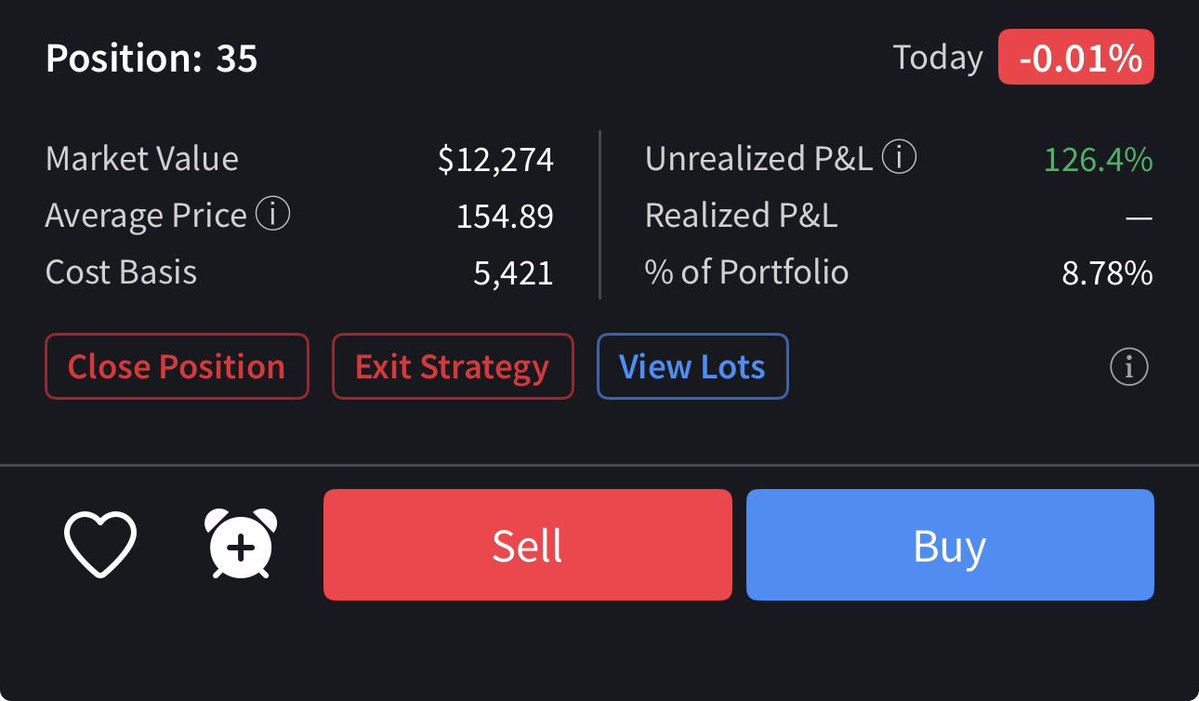
432% return. $47,000 in unrealized gains. And I just sold some.
Trimmed 20 shares of $AMD today. Not because my thesis changed. Because it had become my largest position by a wide margin and concentration that high carries risk regardless of conviction.
The proceeds are going into $NOW, $UBER, and $META, where I'm undersized.
Trimming a winner isn't doubt. It's discipline.
Still holding 88 shares. Still long.
Follow @TheValuEngineer. I share every position, every thesis, every mistake.
$4 trillion company. Fourth most valuable in America. Losing money.
That's what a Tesla-SpaceX merger would create today. $SPCX lost $5 billion last year. $TSLA earnings are a third of what they were in 2023.
Size isn't the same as quality. I'll take the boring profitable business every time.
Prediction markets put the odds of a Tesla-SpaceX merger near 50% before May 2027.
Here's the part nobody's tweeting. Combine the two and you get a $4 trillion company. Fourth biggest in America.
With negative combined profits.
$SPCX lost nearly $5 billion last year. $TSLA earnings are down 77% from 2023. A bigger number on a press release doesn't fix that math.
No positions in either, but a number that definitely catches your eye.
Most people don't buy $GOOG. They buy a stock chart that says $GOOG.
Those are different things. One pays out cash flow, builds moats, and compounds over a decade. The other goes up and down because of headlines.
Try to remember which one you actually own.
@joecarlsonshow Your dividend videos back in the day got me into investing, and changed the way I managed and now think about money. Will always be grateful for the value you provide every week.
@qualtrim Ads aren’t replacing Netflix’s subscription business, they’re stacked on top of it. Same content, same users, new revenue layer with almost no added cost. That’s the kind of growth that shows up straight in margins. $NFLX
The part people miss here. Netflix isn’t pivoting to ads because the core business is slowing.
Subscriptions are still growing. Ads are layered on top, on the same content, the same engagement, the same platform they already built.
That’s not a new business. That’s a new monetization layer on an existing one. Highest margin dollars they’ll ever add.
$NFLX
Netflix is growing advertising by 100% YoY.
As per analysts, Netflix will surpass the ad revenue that of Disney before 2030.
Analyst Projections:
- Goldman Sachs: 36% CAGR
- Seapoint: 48% CAGR
$NFLX
$NOW for me. Both stocks are down big but the businesses are headed in opposite directions potentially.
NOW’s subscription growth just accelerated to 22%, up from 19.5% last quarter. $ADBE grew 11%, and management is guiding that lower on purpose for the back half of the year.
ADBE is also replacing its CEO and just lost its CFO. NOW has stable leadership and growth that’s speeding up while the stock craters.
I still hold $ADBE, but new money is going to $NOW.
One business is decelerating by design. The other just sped up while the stock got cut in half. That’s the gap I’m buying.
Peter Lynch ran Magellan Fund from 1977 to 1990. Average return was 29% a year. Best track record in mutual fund history. However, the average investor in his own fund made only about 7%. How?
They panicked on the way down and bought back on the way up. The strategy never failed. The behavior did.
Same fund. Same manager. Completely different result. The reason is investor behavior. People didn’t buy into Magellan once and hold. They piled in after the fund had a hot run (buying high), got scared and sold during the dips (selling low), then bought back in once it recovered. Each one of those moves shaved off return. The fund never underperformed. The people trading in and out of it did.
Good thread, but I think the $PYPL comparison is being tested on the wrong variable.
PYPL’s multiple didn’t collapse from cash burn. It’s been FCF positive the whole time and ran roughly $6B in annual buybacks while the stock fell. The real driver was take rate and margin compression from Apple Pay, Block, and Stripe eroding the moat while growth stalled. The buybacks didn’t stop the de-rating because they were never the issue.
That’s actually the more dangerous parallel for $ADBE , just not the one being debated. Adobe repurchased 8.5M shares last quarter with $27B in remaining authorization. That looks exactly like PYPL’s playbook. The real question isn’t whether Adobe burns cash like a hyperscaler. It’s whether buybacks are masking the same kind of organic deceleration PYPL dealt with, just from Canva and AI-native tools instead of fintech competitors.
Also worth noting, “can’t ramp R&D fast enough to burn the cash” cuts both ways. It can mean discipline. It can also mean the org isn’t moving with enough urgency, especially with no permanent CEO and the CFO who just left.
The rent vs own compute point is fair. But Adobe’s threat isn’t an infrastructure problem. It’s whether Firefly converts users who no longer need a $60/month seat. AI-first ARR tripling to $500M+ is the one real proof point. Whether that’s fast enough is the actual debate.