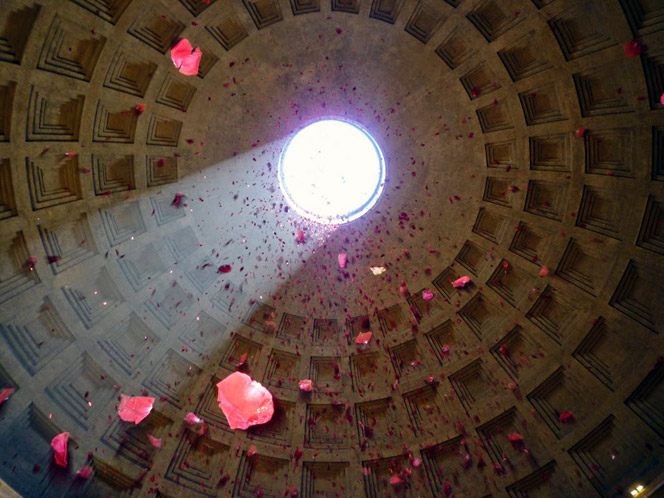
1/10 🏛️ Today we travel back in time to Ancient Rome! Get ready to learn about the fascinating life of one of its most iconic figures: Gaius Julius Caesar. From his birth to a turning point that would change history. Join me!
Lightning is an incredibly common and powerful natural phenomenon. Across the globe, millions of strikes occur each day, fueled by thousands of active thunderstorms at any given time. Tropical regions, where warm air and moisture are abundant, tend to see the most frequent lightning activity. For example, Lake Maracaibo in Venezuela experiences such intense and regular lightning that it's known for a phenomenon called Catatumbo Lightning, with storms lighting up the sky hundreds of nights each year.
Beyond its dramatic visual impact, lightning also plays a role in the Earth’s ecosystem. It helps convert atmospheric nitrogen into compounds that plants can use, making it an important part of the nitrogen cycle. Despite its natural benefits, lightning remains dangerous, responsible for property damage, forest fires, and even loss of life—highlighting the raw power of nature in every flash.
Her Royal Highness Princess Anne competed in the 1972 Summer Olympics in Munich as a member of the British equestrian team.
She rode a horse named Doublet, a thoroughbred-cross gelding bred by her mother, Queen Elizabeth II. Princess Anne participated in the three-day eventing competition (also called eventing or horse trials), which includes dressage, cross-country, and show jumping.
Princess Anne was the first member of the British royal family to compete in the Olympic Games. While she did not win a medal, her participation was historic and widely recognized.
@AMAZlNGNATURE The blue whale’s heart is so big it can weigh over 180 kg (400 lbs)—about the size of a small piano—and its heartbeat can be heard from over 2 miles (3 km) away underwater! 🐋💓
The “proto-wing” structures in theropod dinosaurs represent a key evolutionary stage in the origin of flight. Initially not for powered flight, these feathered limbs likely served functions such as thermoregulation, mating displays, and controlled descent. Fossil evidence (e.g., Microraptor, Anchiornis) shows asymmetrical feathers and wing-like forelimbs emerging well before true avian flight. Over time, selective pressures favored improved aerodynamic control and muscle development. This gradual refinement led to flapping capability and ultimately powered flight—illustrating that flight evolved not in a single leap, but through functional transitions.
One of the most fascinating and often overlooked events in Imperial China’s long history is the reign of Empress Wu Zetian, the only woman to ever officially rule China as emperor in her own name. Rising to power during the Tang dynasty (which lasted from 618 to 907 CE), Wu Zetian broke nearly every convention of her time, navigating a treacherous court, outmaneuvering rivals, and using a blend of intelligence, strategic marriages, and sheer political will to rise from concubine to empress regnant.
Originally a low-ranking concubine of Emperor Taizong, Wu entered the palace at a young age. After his death, she was expected to live out her life in a Buddhist convent, as was customary. But in a move that shocked the court, she returned and eventually became the favored consort—and later wife—of his successor, Emperor Gaozong. After his debilitating stroke, Wu began handling state affairs, and when he died, she declared herself emperor in 690 CE, founding the Zhou Dynasty (interrupting the Tang) and ruling until 705 CE.
Her reign was marked by ambitious reforms and an assertive centralization of power. She improved agricultural production, opened up government positions to talented individuals through the expansion of the civil service exams, and promoted Buddhism to legitimize her rule. While critics—often Confucian scholars—painted her as ruthless, citing her purges and alleged cruelty, modern historians recognize that her tactics were not unusual for the time, and her rule was relatively stable and prosperous.
Wu Zetian’s reign challenges many assumptions about gender and power in ancient China. Despite living in a deeply patriarchal society, she not only seized power but held it effectively for decades. Her story remains a testament to political ingenuity and the complexities of leadership in a male-dominated imperial system.
Ronaldinho, born Ronaldo de Assis Moreira on March 21, 1980, in Porto Alegre, Brazil, is one of football’s most iconic and beloved figures, known for combining creativity, flair, and technical mastery in a way few players ever have. Nicknamed "Ronaldinho" to distinguish him from Ronaldo Nazário, he rose to prominence in the early 2000s with a style that blended street football with elite-level vision and skill. After starting his professional career at Grêmio, he moved to Paris Saint-Germain, but it was at FC Barcelona where he achieved global superstardom. From 2003 to 2008, Ronaldinho dazzled the world with incredible dribbles, elasticos, backheel passes, and overhead kicks, winning two La Liga titles and the 2006 UEFA Champions League. He was awarded the Ballon d’Or in 2005, cementing his status as the best in the world. Ronaldinho was more than a player; he was a performer who played with a smile, inspiring joy both on and off the pitch. Internationally, he won the 2002 FIFA World Cup with Brazil, famously scoring a looping free kick over David Seaman. Though his peak was relatively short, his impact was profound, influencing a generation of players and fans alike. He later played for AC Milan, Flamengo, Atlético Mineiro, and even clubs in Mexico and Brazil before retiring. His legacy is that of a footballing artist—one who played not just to win, but to enchant.
Empires have risen and fallen throughout history due to a combination of internal weaknesses and external pressures. The Roman Empire declined over centuries due to administrative corruption, military overexpansion, reliance on slave labor, economic instability, and pressure from migrating tribes. The Spanish Empire, dominant in the 16th and 17th centuries, was weakened by constant warfare, inflation caused by the influx of silver from the Americas, and the failure to develop a productive domestic economy. The Ottoman Empire stagnated due to military defeats, administrative inefficiency, and nationalist uprisings. The British Empire, the largest in history, gradually dissolved in the 20th century after two world wars drained resources and sparked independence movements across its colonies. In all cases, overextension, economic strain, and challenges to centralized authority contributed to imperial decline.
Neil Armstrong was an American astronaut, aeronautical engineer, and test pilot best known for being the first human to walk on the Moon. On July 20, 1969, during NASA’s Apollo 11 mission, Armstrong stepped onto the lunar surface and spoke the iconic words: “That's one small step for [a] man, one giant leap for mankind.” His historic moonwalk, along with fellow astronaut Buzz Aldrin, marked a defining moment in space exploration and human history. Before Apollo 11, Armstrong flew on the Gemini 8 mission in 1966, where he performed the first successful docking of two spacecraft in orbit. Beyond his missions, Armstrong was also a naval aviator, flying 78 combat missions during the Korean War. After retiring from NASA, he taught aerospace engineering and served on various space-related commissions. Reserved and humble, Armstrong consistently emphasized the collective effort of thousands of people behind the success of the space program.
Napoleon Bonaparte: Hero or Tyrant? 🇫🇷
Napoleon remains one of France's most polarizing figures. A 2023 YouGov poll reveals that 34% of French adults view him favorably, while 21% hold an unfavorable opinion. The remainder are neutral or undecided.
Supporters highlight his establishment of the Napoleonic Code, which abolished feudal privileges and laid the foundation for modern civil law. He also reformed education, centralized administration, and promoted religious tolerance.
However, critics point to his authoritarian rule, reinstatement of slavery in 1802, and the devastating wars that led to millions of deaths across Europe.
Even President Macron's 2021 tribute sparked controversy, reflecting the ongoing debate over Napoleon's complex legacy.
What’s your take?
#Napoleon #HistoryDebate #France
During the early 1700s, Nassau, on the island of New Providence in the Bahamas, became one of the most infamous pirate havens in the Atlantic. After being repeatedly attacked and abandoned by colonial powers, it was essentially taken over by a loose confederation of pirates who turned it into the so-called “Pirate Republic.”
With no functioning government, Nassau became a lawless, chaotic port where men like Blackbeard (Edward Teach), Charles Vane, and Benjamin Hornigold ruled not by any king’s decree, but by the pirate code. They attacked Spanish treasure fleets, raided coastal settlements, and built a short-lived but legendary pirate stronghold.
Spain, along with Britain and France, saw Nassau as a threat to trade and empire. The colonial powers eventually cracked down — but for a few wild years, Nassau stood as a pirate utopia, where gold flowed, loyalty was to the crew, and no empire’s flag flew above the harbor.
🏴☠️⚓ #PirateHistory #GoldenAgeOfPiracy
Spain's stance on Israel has shifted significantly since October 2023, reflecting both political and public pressure to distance itself from Israel's military actions in Gaza.
In June 2025, Spain canceled a €287.5 million arms deal with Israel for 1,680 Spike LR2 anti-tank missiles and 168 launchers. This decision is part of a broader "technological decoupling" strategy aimed at reducing dependence on Israeli military technology, especially amid accusations of crimes against humanity against Israel.
The Spanish government has also revoked a €6.6 million contract for 15 million bullets intended for the Guardia Civil, following internal coalition tensions and public outcry.
Despite official statements asserting a halt to arms sales to Israel since October 2023, reports indicate that some transactions continued under existing contracts. For instance, in November 2023, Spain exported €987,000 worth of ammunition to Israel, raising questions about the consistency of the embargo.
Public sentiment in Spain has been strongly against arms trade with Israel, with over 375 NGOs protesting and calling for a complete cessation of such dealings.
In summary, Spain is actively working to sever military ties with Israel, aligning its policies with domestic and international calls for accountability over the conflict in Gaza.
In the early 1400s, before Columbus or Magellan, China sent Admiral Zheng He on seven epic voyages across the Indian Ocean. With over 300 ships—some longer than football fields—and nearly 30,000 men, these expeditions reached as far as East Africa, Arabia, and India.
Zheng He’s “Treasure Fleet” wasn’t about conquest—it was diplomacy backed by unmatched naval power. Giraffes were brought back to Beijing, and China became a global maritime superpower.
But by 1433, the voyages stopped. China turned inward, burned the ships, and erased much of the record. What if they hadn't? The world map—and history—might look very different today.
Battle of Verdun (Feb–Dec 1916): One of WWI’s deadliest battles. Germany launched a massive offensive to break French morale by targeting Verdun, a fortress city symbolically and strategically vital. Their goal: inflict maximum casualties and force France to collapse (“bleed France white”). France, under General Pétain, mounted a fierce defense. The motto “Ils ne passeront pas!” (“They shall not pass!”) became legendary. The battle lasted 302 days, with around 700,000 total casualties. No ground was significantly gained, but Verdun became a symbol of French resilience and the brutal futility of trench warfare. #WWI
In the early 1400s, before Columbus or Magellan, China sent Admiral Zheng He on seven epic voyages across the Indian Ocean. With over 300 ships—some longer than football fields—and nearly 30,000 men, these expeditions reached as far as East Africa, Arabia, and India.
Zheng He’s “Treasure Fleet” wasn’t about conquest—it was diplomacy backed by unmatched naval power. Giraffes were brought back to Beijing, and China became a global maritime superpower.
But by 1433, the voyages stopped. China turned inward, burned the ships, and erased much of the record. What if they hadn't? The world map—and history—might look very different today.
Summary: A new long-term study following nearly 50,000 women over 30 years found that those who regularly drank caffeinated coffee in middle age were more likely to age healthily, both physically and mentally. In contrast, other sources of caffeine like tea, decaf coffee, or soda did not show the same benefits—with soda even linked to worse aging outcomes.
Key findings:
The ideal amount: 2 to 3 cups per day (~315 mg of caffeine) was associated with the greatest benefits.
Each extra cup added up to a 5% increase in the chances of aging well, though benefits plateaued after about 2.5 cups.
The benefits may come from unique compounds in coffee, not just caffeine.
Lifestyle matters: these effects are most beneficial when paired with healthy habits like a good diet, exercise, and avoiding smoking.
Dr. Sara Mahdavi from Harvard and the University of Toronto emphasized moderation and long-term consistency as keys to better aging.
In short, enjoying your daily cup of coffee might do more than wake you up—it may support your health for years to come.