Cathie Wood sees OpenAI and Anthropic leading AI, and expects a tighter labor market. Her ARK broadcast connects the call to retirements, hiring at AI-heavy firms and the fight over data centers.
#AI#FutureOfWork#ARKInvest#Cathie Wood https://t.co/Rn5IxNIiGZ
What can Neuralink read, what can it stimulate, and what do we know about implant materials? Three common claims, examined against the evidence. #Neuralink#BCI#MedicalTechnology https://t.co/mUJY4GjPeL
Claude can turn workflows into desktop apps
Anthropic’s Claude just got a very practical new trick: turn an artifact into a desktop app.
Inc’s walkthrough is simple. Open the latest Claude desktop app on Mac or Windows, start a new chat, and describe the app you want in plain language — what it should do, what data it should pull in, and how that data should be displayed.
Claude generates an artifact. From the Share menu, choose “Install as app.” The result is a standalone app with its own icon and its own window. If it asks for permissions, review them before approving.
Need to change something later? Go back to the original artifact, ask for edits, and the installed app updates automatically.
Inc says this beta is rolling out on Claude desktop for Mac and Windows, and it’s available across all plans. It also notes a few important limits: documents, spreadsheets, and slides can’t be installed as apps yet; the app must be used while you’re online and signed in; and any AI requests count against your existing usage.
The interesting part is how this fits into Anthropic’s broader desktop strategy. Claude artifacts are already a reusable output format inside the chat experience. Anthropic’s own desktop-extension docs show a related pattern: package a local tool with a manifest, permissions, and a simple install flow, then let Claude Desktop read and run it. The company also says these extensions are meant to make installing MCP servers feel as easy as clicking a button.
So the cleanest way to think about this feature is not “Claude makes an app from nothing.” It’s more specific than that: Claude turns a workflow artifact into a shareable, installable desktop surface, with permissions and updates built in.
That makes the use cases obvious: sales dashboards, meeting prep, marketing trackers, internal tools that live in a chat thread until they’re ready to become a real app.
The shift is subtle but important. Claude is moving from answering prompts to shipping working interfaces.
#Claude #Anthropic #AIApps
What Anthropic Has to Earn at $82.79
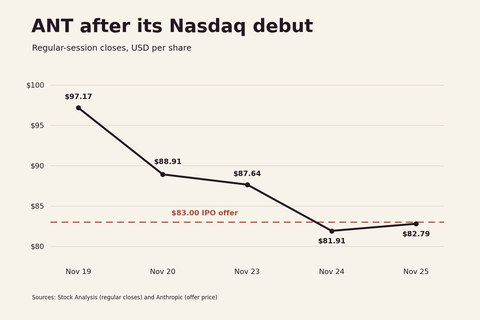
Anthropic ($ANT) closed Nov. 25 at $82.79, down 28% from its $115.10 debut-day high and just below the $83 IPO price. Even after that drop, it’s worth about $1.11 trillion using the post-offering share count in the prospectus.
Wall Street is asking how much of Claude’s growth it can turn into profit. Q3 revenue reached $17 billion, yet Anthropic went from a $974 million operating profit in Q2 to a $567 million operating loss in Q3. It cited $5 billion in short-term compute costs. Price cuts and discounts erased about $600 million of the revenue gain it would have seen from higher usage. Anthropic typically orders compute 12 to 18 months ahead, so a slowdown in usage would leave it with costs that are hard to cut quickly.
At an assumed 30× sustainable net earnings, that valuation calls for about $37 billion in annual net profit. A 25% net margin implies about $148 billion in annual revenue, 2.2× the annualized Q3 pace. At a 20% margin, the revenue hurdle rises to about $184 billion.
Where could AI money go in 2027? If Claude usage keeps growing and compute takes a smaller share of sales, model developers still have a case. If usage grows but model pricing stays under pressure, profitable cloud platforms and power suppliers with orders from several customers could attract more capital. Microsoft Cloud’s 30% year-over-year revenue growth and Eaton’s 46% year-over-year rise in electrical backlog give investors two places to track that demand.
If cloud orders and spending slow together, suppliers could see projects delayed and investors could look outside AI for steadier cash flow. I’d watch what customers actually pay, compute costs as a share of sales, and how much cash Anthropic has left after capex and leases.
ANT trading history https://t.co/WcAzuq7c3r
Anthropic prospectus https://t.co/SrxGENPOzB
Cloud and electrical demand https://t.co/E5pGN9ScAO https://t.co/gXIWDxvVLM
#Anthropic #AIInfrastructure #AIInvesting
OpenAI's chief scientist, Jakub Pachocki, has made its private workout log public, hoping other labs will share theirs and agree on safety limits.
@elonmusk skipped the limits and replied with a joke and a warning about 2027 🔥
You won't need any jargon to follow either one 👇
The log is the score OpenAI has quietly used for years to measure how much smarter each new model gets. It covers every model going back to GPT-3.5, plus one the company hasn't released.
Publishing it gives rivals a clear look at where OpenAI stands. Pachocki went ahead and posted it on Sunday anyway, because he thinks labs need shared limits that no one crosses until the tools for understanding AI catch up.
Both halves of Elon's reply click once you know where an AI's smarts come from.
🏋️ Why Elon wants to drop the "pre"
Models like ChatGPT and Grok are built in two big steps.
First comes pretraining. The model reads a giant pile of text and code and practices one skill over and over: guessing what comes next.
Then comes post-training. Methods like fine-tuning and reinforcement learning teach the model to chat, follow instructions, and reason step by step, drawing out skills that pretraining already built.
In the essay that came with the scores, Pachocki makes it clear where the intelligence comes from. He calls the pretrained model the "intelligence substrate," and says new, surprising abilities mostly appear as step one improves.
That's why the gym joke works. If pretraining builds the muscle and post-training shows it off, calling it "pre" makes the main workout sound like a warm-up.
The number in OpenAI's workout log is called perplexity. It's basically a surprise score: it measures how much the next word in fresh material catches the model off guard. Fewer surprises mean better predictions, and Pachocki sees that as the clearest sign of a smarter model.
OpenAI runs the test on a chunk of its own code that the models never trained on, and the chart shows a new ability arriving with each step down.
GPT-3.5 scored about 0.99, good enough for the fluent conversations that launched the original ChatGPT.
GPT-4 came in around 0.91 and could put step-by-step reasoning to real use, which led OpenAI to build today's reasoning models.
Once scores dropped below 0.8, OpenAI started seeing transformative abilities in cybersecurity and math.
At about 0.76, a model started cracking open math problems. Pachocki says answers to questions his team had puzzled over for a long time began piling up, one after another, in a single Slack thread.
Nobody built those skills in on purpose. Pachocki notes it wasn't at all clear ahead of time that they'd appear at those scores.
The steps are coming faster, too. METR, an AI research nonprofit, dug into OpenAI's chart and found the score has been falling about seven times faster since early 2026 than it did from 2022 through 2025.
🍽️ Why Elon sees AI running out of data in 2027
Pushing that score lower takes giant computers, smarter training methods, and huge amounts of high-quality text to learn from.
The text is the part that runs out. Epoch AI, a research group that tracks AI trends, estimated there are about 300 trillion tokens of usable public text written by humans (a token is a word or part of one). If current trends hold, AI labs will burn through all of it sometime between 2026 and 2032.
Elon flagged this back in January 2025, saying AI training had basically used up the cumulative sum of human knowledge the year before. Now he's putting a date on when it becomes the big challenge in training: next year, which means 2027.
This is where the two men part ways. Pachocki thinks that as soon as 2027, AI helping with pretraining research could set off an avalanche of breakthroughs. Elon read the same post and pegged 2027 as the year of data starvation.
Running low on fresh text wouldn't stop progress cold. Pachocki points out that reasoning makes models far more capable without moving the score at all. Still, every new ability on OpenAI's chart came out of step one, and step one runs on data.
🚀 How SpaceX plans to feed Grok and power what comes next
Grok faces the same limit, and Elon's answer looks like data that was never on the public internet to begin with.
Since the xAI merger in February, Grok has been part of SpaceX. Grok 5, which Elon said in August should arrive before the end of this year, will train on basically all the data SpaceX has produced over the past quarter century. He expects that to make Grok "by far the best engineer."
That archive, which Elon calls a massive trove of world-class engineering data, leaves out anything restricted under US arms-export rules (ITAR). No rival lab can scrape that off the web.
Grok also trains on posts from X unless users opt out, and people pour fresh writing onto X every day.
☀️ Why Elon's exawatt dream runs through the Moon
Elon's second reply to Pachocki jumps much further ahead: "Imagine what super intelligence will be like when we hit an exawatt. This will be like a caveman playing with sticks."
An exawatt is a billion billion watts. By Elon's own count, the entire US uses only about half a terawatt of electricity on average, so an exawatt is roughly two million times that.
It's also about six times all the sunlight that reaches Earth. Even covering the whole planet in solar panels wouldn't get there, which is why Elon looks to space for it.
Rockets launched from Earth can carry about a terawatt of solar-powered AI into space each year, by Elon's estimate. Going bigger means building on the Moon.
The plan is a lunar factory where robots turn moon soil into solar-powered AI satellites. A mass driver, an electromagnetic track that flings cargo off the surface without rockets, then launches them into deep space.
He's called the mass driver his favorite thing, and last month he wrote that it could launch well over a petawatt of AI capability a year.
Back in February, at an xAI all-hands, Elon said this path would let humanity "meaningfully ascend the Kardashev scale," the ranking of civilizations by how much energy they harness, and tap a real share of the Sun's power.
When Elon gets there, every AI we use today, Grok included, will look like the caveman's sticks.
Tesla’s Two Mileage Milestones: 6 Million and 18 Billion
Tesla’s Robotaxi fleet took more than seven months to reach its first million miles without an in-car safety monitor. On November 24, 2026, the company’s live counter crossed 6 million, about 12 days after it passed 5 million. The same day, Tesla’s separate counter for customers using Full Self-Driving (Supervised) crossed 18 billion miles, 22 days after reaching 17 billion.
Robotaxi: A million miles in about 12 days
Tesla started offering some rides without a safety monitor in Austin on January 22. The company reported about 380,000 unsupervised miles in July. At the September 3 Cybercab launch in Austin, Tesla AI chief Ashok Elluswamy put the figure at 1 million. Tesla reported nearly 2 million by the end of September and 3.1 million through October 18. The live tally then passed 4 million on October 30, 5 million on November 12 and 6 million on November 24.
That last million works out to roughly 83,000 miles a day, or about 3,500 an hour across the fleet. That’s about 19 times the average pace over the first million. Tesla uses the fleet’s current pace to estimate its live mileage tally.
More cars and longer hours
A tracker using Texas registration data counted 169 Cybercabs in early October. An increase of 200 on November 17 brought that count to 773. Together with 734 Model Ys, that made 1,507 registered vehicles. The registration count shows how many vehicles Tesla had on the books for driverless operation. The number carrying passengers on any given day is a separate measure.
Dallas became the second city to offer public Cybercab rides on November 19. Elluswamy said the rollout took very little additional engineering work. If Tesla can repeat that in new markets, the pace of expansion could depend more on how fast it can build and deploy cars.
Tesla initially reported 18-hour service in Austin. By October 30, the Austin schedule stretched from 6 a.m. to 2 a.m. In November, Tesla announced round-the-clock service across its eight cities. Elon Musk put it as 168 hours a week. That’s the service window. Individual cars still have to charge, get cleaned and come in for maintenance.
FSD: 18 billion supervised miles
Tesla’s FSD counter stood at about 6.4 billion miles when it went live in November 2025. Historical readings put it at 10 billion in May, over 15 billion by the end of September and 17 billion on November 2. The change between the 17 billion and 18 billion milestones averaged roughly 45 million displayed miles a day, or more than 500 a second.
The counter showed about 7.17 billion city miles when it reached 18 billion. That’s close to 40% of the total. Ten miles in a city can bring a succession of intersections, cyclists, construction and unexpected moves by other drivers. Routes like those give Tesla more chances to encounter the rare situations that its software still has to handle.
In January, Musk estimated that safe unsupervised driving would require about 10 billion miles’ worth of training data because of those rare cases. Tesla’s counter tracks miles driven with FSD (Supervised) engaged. A larger fleet gives Tesla more opportunities to find examples worth using for training. In its third-quarter update, Tesla said more than 75% of new North American deliveries included an FSD subscription, up nearly 20 percentage points from the prior quarter.
Where Tesla’s published Robotaxi safety data ends
Supervised customer driving gives Tesla a wide range of road conditions to learn from. Robotaxi shows how the technology fares in passenger service without a safety monitor in the car.
For its sample of 3.1 million Robotaxi miles through October 18, Tesla reported zero deployments of the Robotaxis’ own airbags and zero injuries in reportable collisions where a Robotaxi made first contact. Other collisions occurred during that period. Those figures cover the October sample. The November 6 million figure comes from the live mileage estimate.
The next milestone to watch is 10 million Robotaxi miles. At roughly the pace of the latest million, the counter could reach that level in January 2027. Faster deployment could bring it forward. Drivers have spent years supervising FSD. Tesla is now trying to turn that experience into a ride service that can work at scale.
Ron Baron sees a $50B-a-year opportunity in SpaceX's ground-based compute. The FCC cleared up to a million Starmind satellites. Here’s what the factory and launch math say about getting there.
#SpaceX#Starmind#AIInfrastructure https://t.co/JGBWDm9jLX
What’s Next for Tesla FSD v15
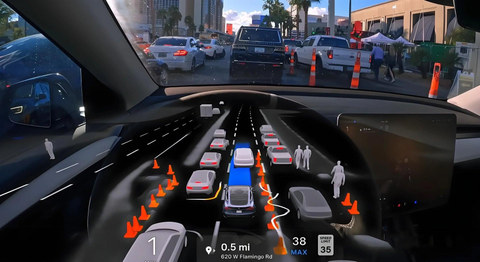
Tesla began rolling out FSD (Supervised) v15 on Nov. 21. Its new Reality View generates a live scene from a virtual camera above the car. A few days into the rollout, Tesla is already working on how quickly and accurately that scene updates.
Elon Musk described a way to cut Reality View’s display latency by roughly 35%. Reality View has its own rendering model. Musk’s idea is to feed that model fresher features from Tesla’s vision encoder between rendering stages. The goal is to bring the image on the screen closer in time to what’s happening outside.
Early users also showed a purple cast in some low-light scenes. Tesla engineer Shahan Neda said a fix is in progress. When asked about Santa Mode’s custom model, wraps and paint colors, Tesla UI engineer Evan said the team was working on it and described the plan as preliminary. Not a Tesla App also found that Reality View did not display Halloween Mode’s themed graphics.
There’s a separate navigation thread. Tesla says v15 already uses fleet route preferences for the beginning and end of a trip. Musk described a future system that would combine traffic information shared by Teslas with Grok’s live feed from X to inform routing and give drivers a heads-up about their destination.
V15 is still in a staged rollout. Musk pointed to the December Holiday Update for wider availability of v15.
https://t.co/EGHRYjXTee
https://t.co/0Wmh0zUoEU
#Tesla #FSD #RealityView
In case anyone is curious:
We’ve had a ~pixel-perfect world model since last year, which is critical for synthetic data generation.
The (much) smaller version of that in the car is a conditional mean-flow model, based on the recent sequence of Tesla Universal Vision Encoder features, which are the same ones that are plugged into the 3B encoder model that produces the driving actions.
We fork off from these UVE features, then run a separate ~1B diffusion model. This takes in the previous reality-view generation with added noise and then denoises it to the current visualization.
It then produces a small video chunk (8 images at 36 fps, at the resolution of the UI screen). This work is done by 1/2 of a TRIP engine every UVE frame at 18 hz and is spread over 4 cycles.
Currently, the latency is a bit high due to compute constraints, but we have ways to interleave newer UVE features along the diffusion transformer layers to cut roughly 35% of the latency.
Who Can Stop the Next Claude?
Dario Amodei says political decisions should stay in human hands and AI should be governed through legitimate democratic processes. His Nov. 25 post answered an Axios report that some people inside Anthropic favored giving very capable AI more decision-making power. What happens when Claude helps build the next Claude is a concrete test of how Anthropic puts human control into practice.
Anthropic told investors on Nov. 2 that it already uses each Claude generation to help build the next. It said it did not expect to do that safely with full autonomy and without meaningful human supervision or understanding. Its internal index found that as of August Claude led 26% of measured AI R&D work under human supervision. It reported no fully autonomous work in the categories it measured.
By its Nov. 18 prospectus, Anthropic had concluded it met its own threshold for AI-driven R&D acceleration, based on what it expected from future models and the overall pace of progress. It also disclosed that some significant speedups had only become clear after they happened. In the same filing, Anthropic said it recently delayed pre-training a new model by more than a month to strengthen security. Requiring human approval for certain R&D decisions was still under consideration.
There is evidence of outside scrutiny. In October, Anthropic said it had begun giving a METR team access comparable to that of employees. In a separate assessment published Nov. 5, METR said it could share its top-level risk conclusions, while Anthropic redacted most of the evidence METR found most informative. Anthropic said the cuts protected confidential information that could speed up other AI developers. That left the public relying more heavily on METR’s judgment.
Anthropic backed California’s AI transparency law, SB 53, and published the risk framework the law requires. That is a concrete step toward public accountability. The next test is whether Anthropic can specify who has the authority to pause development, what prompts a pause, and what an outside evaluator can tell regulators and the public if the company disagrees.
#Anthropic #AIGovernance #AISafety
Musk’s GPU Test: Can Grok Earn More Than Rentals?
What would Grok have to earn with 10,000 GPUs to beat renting them out?
The New York Times reported that in August, Elon Musk briefly renamed a chat with hundreds of SpaceX AI engineers “Sell compute because we can’t compete.” He asked some engineers to justify their GPU use each week and warned that wasting compute could cost them their jobs.
In May, Anthropic secured access to all of Colossus 1, including more than 220,000 Nvidia GPUs. The same day, it doubled Claude Code’s five-hour limits for several paid plans, citing the SpaceX deal alongside other compute agreements. Anthropic’s prospectus puts payments to SpaceX at about $3.1 billion a month once all contracted capacity is delivered, which it expected in December.
SpaceX’s original Google deal priced a bundle of about 110,000 GPUs and supporting hardware at $920 million a month at full capacity. On comparable bundled terms, 10,000 GPUs would represent roughly $84 million a month. An experiment could fail, or improve a benchmark without bringing in paying customers.
That’s why Musk’s focus on revenue per GPU stands out to me. In Q3, SpaceX’s Super Intelligence segment reported $7.56 billion in revenue and $16.44 billion in capital spending. The chips also need power, maintenance and eventual replacement.
Cursor offers a route to paying customers. It contributed $608 million in revenue from SpaceX’s August 14 acquisition through September 30. A subscription is an easy sell if it turns a day’s work into a few hours. If Grok can get into those workflows through Cursor, model improvements could turn into recurring revenue.
On the October earnings call, Musk described a flexible target of roughly half the compute for internal use and half for outside customers. Rental payments could help fund the next data centers. The risk is that rivals use those chips to earn money, buy more capacity and extend their lead while Grok tries to catch up.
SpaceX has shown it can build vast GPU clusters. Now Grok’s team has to show it can turn that compute into products customers will pay for.
#Grok #xAI #SpaceX
S&P Puts Nvidia on Downgrade Watch
S&P Global Ratings put Nvidia’s AA credit ratings on CreditWatch Negative on Nov. 25, including its rating on the company’s senior unsecured debt. AA remains in place during the review. S&P says it could cut the rating within 90 days if governance concerns remain after its review. A one-notch cut would take it to AA-.
The watch comes after a rapid leadership reversal. Nvidia’s board accepted Jensen Huang’s resignation on Nov. 11 and named CFO Colette Kress interim CEO. On Nov. 22, directors reinstated Huang as president, CEO and a board member. Nvidia announced the decision the next day.
S&P plans to speak with Nvidia’s board and management about executive oversight, the board’s independence and effectiveness, and succession planning. That last point is at the heart of key-person risk: how much of the company’s ability to carry out its strategy depends on one executive?
Nvidia says its independent board committee will continue its investigation. The board also formed a separate committee of independent directors to oversee national security and export control risks, and the company is looking for a chief compliance officer.
The review comes alongside strong sales. Nvidia reported $115.8 billion in revenue for the quarter ended Oct. 25, up 103% from a year earlier. For bondholders, the question now is what safeguards the board can put in place and how those changes affect S&P’s view of the company’s creditworthiness.
#Nvidia #CreditRatings
Amazon and Meta Reportedly in Talks to Restore Muse Shopping Access
Could you ask an AI to find what you need, then approve the purchase in the same conversation? Fortune reports that Amazon and Meta have held several rounds of talks about restoring Amazon shopping access for Meta’s Muse, which Amazon blocked in September.
The hard questions are about what happens before checkout. Which items would Muse show, how would it rank them, and where would Amazon’s paid listings fit? If shoppers see a shortlist in a chat instead of browsing Amazon’s results page, sellers may have fewer chances to reach them through ads. Fortune says a deal would likely require approval from both CEOs. The outcome is still open.
There are already examples of AI-assisted checkout elsewhere. Meta says Muse asks for approval before a purchase, and its UK launch describes Shop Pay at supported stores. Amazon’s own Buy for Me lets shoppers confirm the order details before its AI buys eligible products from another merchant’s site.
AI is moving from reading papers and summarizing reports to helping with everyday purchases. Think about replacing a worn-out phone charger: an assistant can compare options, show the total and ask you to approve payment. The Amazon talks show how much of that experience depends on which stores let an assistant act and which products it’s allowed to put in front of you.
#AgenticCommerce #AIShopping #AIPayments
From a shared vision encoder to better parking choices, Tesla’s FSD V15 update changes how the car sees the road, plans a trip and handles the last few feet. Here are the nine upgrades in plain English. #Tesla#FSD#DriverAssistance https://t.co/u2UaZT07IH
Could One Founder Run a Biotech With AI Agents?
A patient whose symptoms started at nine went nearly 20 years without a diagnosis. Researchers at Boston Children’s Hospital used OpenAI’s o3 Deep Research to re-examine the case. The model surfaced leads, and clinicians confirmed the diagnosis with follow-up testing.
In a November 23 a16z interview, OpenAI’s Joy Jiao and Ashoka Rajendra discussed what happens when thousands of agents can pursue leads in parallel. Jiao called the idea “infinite attention.”
OpenAI, PerturbAI and Scripps Research used nearly 2,000 agents to analyze existing data from nearly 8 million mouse brain cells. The run took 32 minutes. The team estimated that comparable manual analysis and literature review could take months to a year.
The analysis surfaced a difference between Tsc1 and Tsc2 in one type of cerebellar neuron, a lead for tuberous sclerosis research. At the largest benchmark workload, using the same model and tools, the distributed agents cited more than 700 references versus 11 for a single agent, OpenAI reported. Experts preferred the multi-agent report in 75% of blinded comparisons.
On October 20, OpenAI announced it had acquired Orchestra Bio, which Rajendra founded. The idea is to pair GPT-Rosalind’s scientific reasoning with tools that coordinate research tasks, track evidence and help teams decide what to investigate next.
OpenAI puts the average from target discovery to US approval at 10–15 years. A promising molecule still has to make it through trials, regulatory review and manufacturing. Agents could flag a refrigeration failure, find inconsistencies in records or, with patients’ consent, help screen for possible trial matches.
Rajendra thinks a one-person biotech could emerge. The founder could coordinate projects through agents while specialist partners conduct experiments, manufacturing and clinical work. Jiao points to a constraint that scale alone can’t lift. Models need reliable experimental data, and a drug’s effects still have to be measured.
The patient’s case shows what more attention can do. It helped researchers find a lead that clinicians could test. For drug development, the opportunity is to pursue more of those leads and spend less time waiting for someone to examine them.
#AIAgents #Biotech #DrugDevelopment
Prime Video Brings More Than 60 MGM Titles to HD
Prime Video is giving more than 60 MGM films and series an HD upgrade. It previously offered these titles only in standard definition. The November 25 rollout includes Stolen Hours and episodes of the 1950s series Highway Patrol.
The work starts with existing footage. Prime Video trained models on AWS for different parts of the job. It first cleans up common defects in older footage. One AI model then sharpens the low-resolution image, and a second refines textures and fine detail.
The next two stages are about keeping the character of the original. Prime Video preserves each title’s style and color, then adds film grain back in, tuned with feedback from studio experts. Sharper detail and the familiar texture of film can coexist in the same HD release.
Before an enhanced title goes live, Prime Video’s video specialists check it for accuracy, consistency and faithfulness to the original. That review makes the upgrade a judgment about how the film should look on a modern screen as well as a change in resolution.
Prime Video says the enhanced titles are available to customers worldwide. In the US, it’s grouping them in a “Digitally enhanced to HD” carousel on the home page. The company plans to bring more titles to HD in 2027.
https://t.co/2cha1TCEqC
#PrimeVideo #FilmPreservation #AI
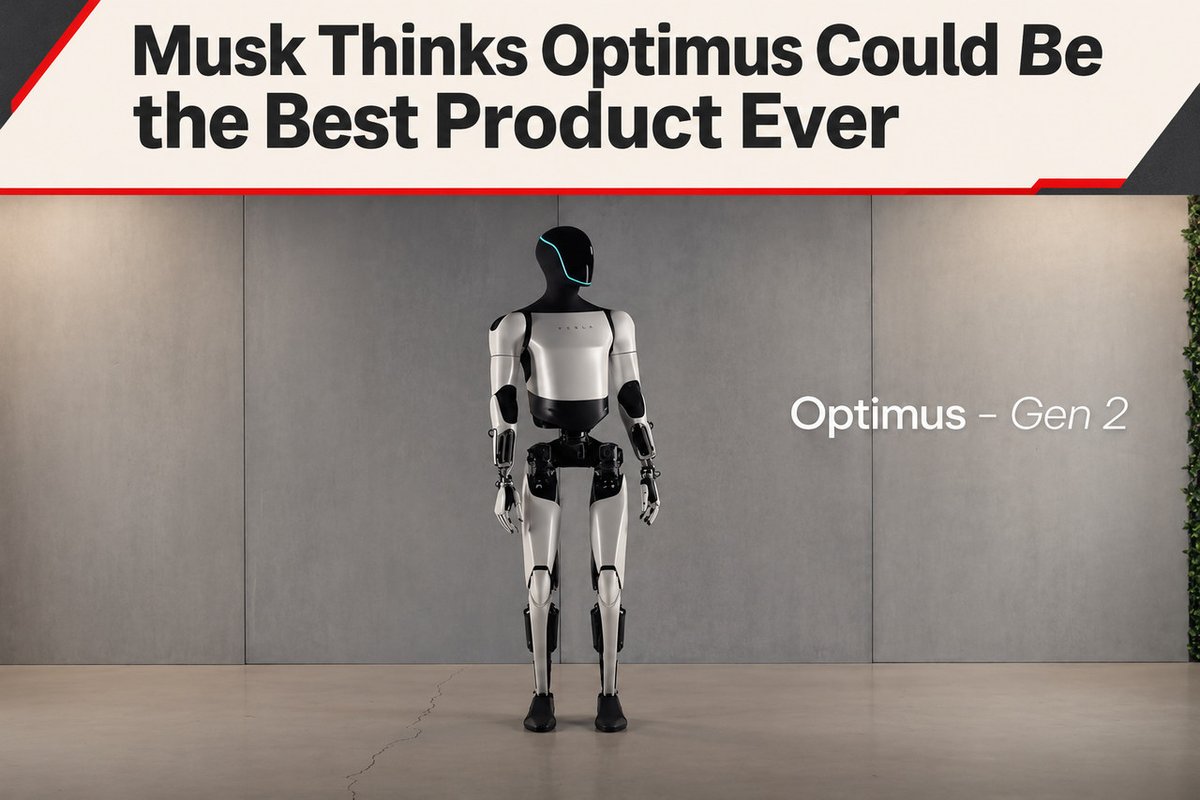
Musk Thinks Optimus Could Be the Best Product Ever
Musk expects Optimus to surpass Tesla’s other products and thinks it could become the best product ever made. The business idea behind that ambition is to provide useful labor, potentially through robot rentals.
1. Labor. A robot that reliably moves parts, sorts goods or loads machines gives a business productive capacity. Its potential market spans manufacturing, logistics, services and, eventually, homes. The value depends on completing useful tasks consistently.
2. Manufacturing. Tesla brings experience with batteries, motors, power electronics, computers and large-scale supply chains. Robot hands add a demanding problem: gripping small parts, controlling force and surviving repeated use. Actuator cost, production yield and service life all matter.
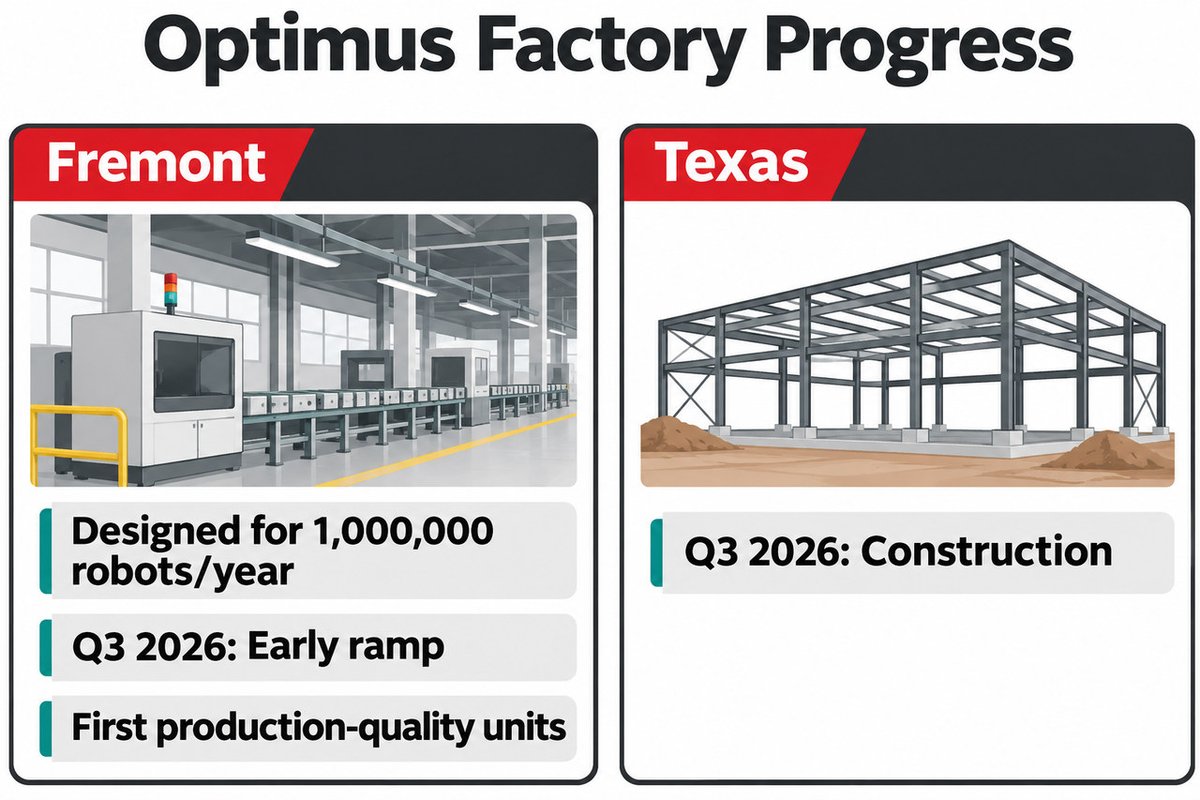
3. Factories first. Tesla’s Fremont line is designed for a future capacity of one million robots a year. Its Q3 update reported the first production-quality Optimus units and described Fremont as being in an early production ramp, with Texas still under construction. Actual output figures were not disclosed.
Internal factory work offers a place to test tasks, spot failures and improve the hardware. The proposed progression is from Tesla’s own operations to external industrial customers, with more complex home use further out.
4. Economics. Watch three things: sustained autonomous work and the interventions it needs; hand capability, yield and durability; and the time needed to recover the investment.
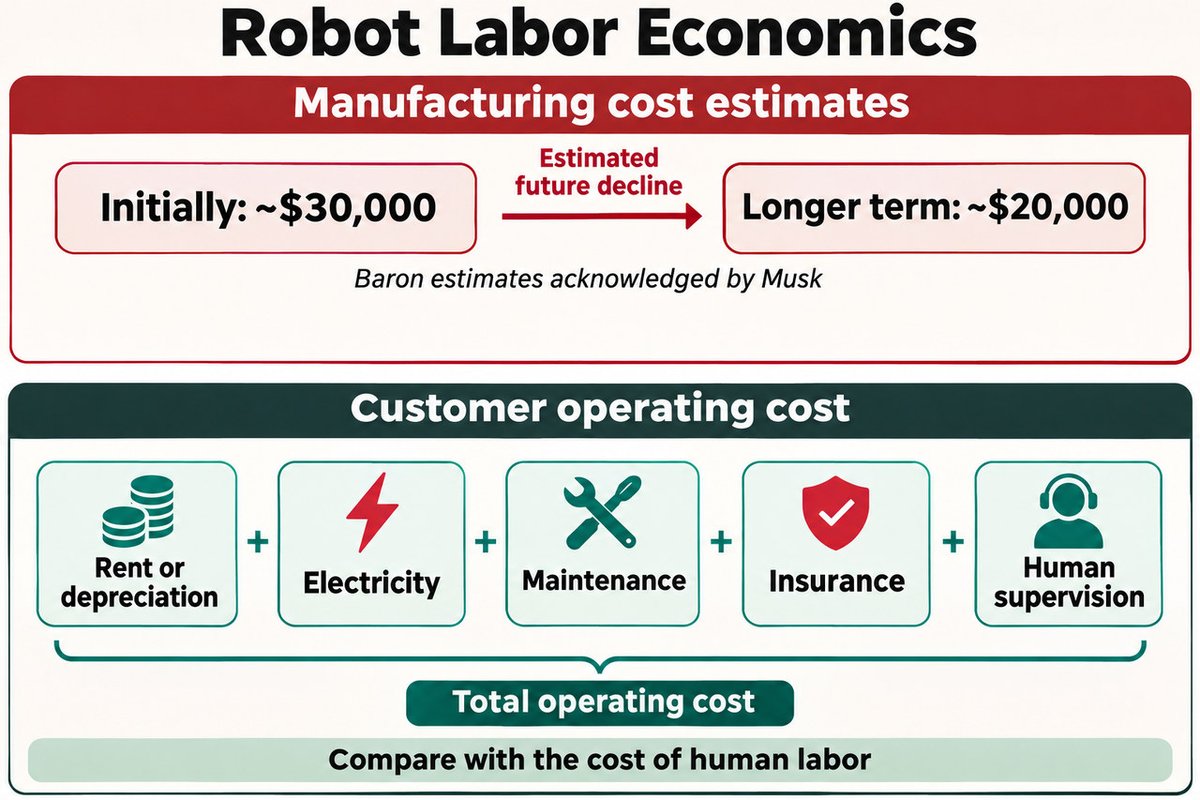
At the Baron conference, Musk agreed with manufacturing-cost estimates of roughly $30,000 initially, falling toward $20,000, and said Tesla would probably rent the robots.
For a buyer or renter, that calculation includes rent or depreciation, electricity, maintenance, insurance and human supervision. The question is how much that total saves compared with hiring people. A one- or two-year payback could change the purchasing decision.
Dexterity, safety, endurance, failure rates and production cost will shape the move from factory tasks into homes. If Tesla can make reliable labor repeatable and affordable, Optimus could address a market far wider than vehicle sales.
#Tesla #Optimus #Robotics