Dal numero e dalla varietà delle risposte ho provocato l'effetto sperato e raggiunto la risposta ovvia:
Non c'è una definizione univoca.
Per quale motivo secondo voi?
L'italia e gli italiani sono costrutti politici novecenteschi creati per sostenere e giustificare il progetto dello "stato nazionale" che tentó di unificare (ed azzerare) delle gens estremamente diverse tra loro, insieme agli usi, costumi, lingue, identità, dietro alla monarchia savoiarda, o meglio, alle compagini di portatori di interessi attivi nel paese.
L'idea di "italia" e "italiani" circolava da molto prima, vero, tuttavia indicava un insieme di Popoli ben distinti, dato che, tra fiorentini e veneziani ad esempio, vi erano, e rimangono, immense differenze.
Gli "Italiani" non sono quindi un ethnos, ma un insieme di ethnos diversi. Come lo sono gli "Europei".
La penisola italiana è divisa in conglomerati ben distinti da ogni punto di vista: Storico, culturale, sociale, etnico, politico, ed è questa diversità interna ad aver reso il paese un'espressione identitaria superiore a qualsiasi altra nel mondo.
Parlare di "italia agli italiani", e remigrazione è quindi riduttivo ed inefficace se non si mette al centro l'essenza reale che costituisce la penisola.
Quindi, chi sono l'italia e chi sono gli italiani? Verrebbe da dire i diversi Popoli nativi della penisola.
Ora, la reale domanda diventa: Chi è 'nativo'?
La risposta è la seguente: Nessuno.
O meglio, nessuno ha il "diritto" di definirsi nativo.
Partendo dalla base, in natura non esistono diritti, esiste solo la forza. Quindi un animale ha "diritto" al suo territorio solamente fino al momento in cui arriva un altro animale più forte di lui a reclamare tale "diritto" dallo stesso.
Per noi umani è esattamente la stessa cosa.
Un Popolo ha "diritto" a vivere in un territorio fino a quando arriva un altro Popolo più forte a reclamarne lo spazio.
Quindi, un Popolo rimane nativo di un luogo se nei secoli ne difende i confini dalle incursioni di altri, evitando la remissione dello stesso diritto.
Esistono Popoli conquistatori e Popoli conquistati, e questa è una realtà storica incontestabile.
Noi Europei tracciamo, in modo differenziato, una parte della nostra linea genetica fino ai Popoli che conquistarono il continente sui carri millenni fa, esercitando la loro superiore forza sui Popoli "nativi", lo stesso vale per gli italiani.
Oggi la forza è monopolizzata dallo stato, che la esercita attraverso le leggi, le quali sono espressione della politica che è espressione della cultura dominante e della volontà popolare, tuttavia le leggi naturali non si negano: L'invasione, a mezzo di immigrazione massiva, sta avvenendo, lentamente certo, ma l'esito è il medesimo di una reale.
Ci siamo sempre difesi ed abbiamo sempre combattuto, rinnovando con le battaglie il nostro diritto a chiamarci "nativi" nei secoli.
Ma, questa volta, a differenza del passato, è l'animale stesso ad invitare la sottomissione.
Nella società molle, consumistica e falsa in cui ci troviamo, così distante dalla natura e dalle sue leggi, gli Europei si sono dimenticati del principio fondamentale della forza, lasciandosi travolgere da coloro i quali, invece, questo principio lo conoscono molto bene.
Stiamo lasciando volontariamente ed in maniera del tutto innaturale il nostro diritto alla nostra casa ad altri Popoli.
Anzi, peggio ancora, stiamo lasciando che OGNI nostro diritto naturale, compresa la sopravvivenza, semplicemente svanisca nel vento: Stiamo commettendo un suicidio.
Volete sopravvivere? dovete avere la forza e la volontà di reclamare ed esercitare il diritto alla sopravvivenza.
Volete permanere? dovete avere la forza e la volontà di reclamare ed esercitare il diritto all'esistenza.
Solo così rimarrete "nativi".
E la Remigrazione non è altro che un esercizio, a mezzo di forza dello stato, del diritto a sopravvivere e permanere nelle terre di cui si è rimasti nativi per secoli.
Europe divided into genetic clusters from K=2 to K=12 using ward agglomerative clustering on G25 coordinates (391 points used).
Cisalpine separates from italy as early as K=4 and forms its own cluster at K=9.
In medieval and early modern Europe, especially in commercially advanced regions like northern Italy, the Low Countries, England, and parts of Germany, success increasingly depended on literacy, numeracy, delayed gratification, planning, and participation in markets and bureaucracies.
Some historians and behavioral geneticists argue that over many generations, these conditions shifted population IQ through assortative mating and differential reproduction—a tradition which began in Milan before expanding outward.
This, in conjunction with a largely homogenized population living in a geographically protected area shielding from dilution due to migration or war, is why northern Italy has the highest IQ in modern day Europe.
An analysis of several datasets pertaining to regional discrepancies in IQ in Italy:
Table 1 shows 8 studies on the matter, study 1 (Galeazzi et al. 1979 gives a score of 95 for Genoa (North Italy), utilizing the Colored Progressives Matrices (CPM), (Tesi & Young 1962) conduct a study on 11-16 year olds in Florence (North Italy) utilizing the Standard Progressives Matrices (SPM) on a relatively large sample of 2462 individuals, finding a high score of 103, (Prunetti et al. 1985) uses the CPM to analyze the IQ scores of 6-11 year olds in Florence and concludes with an iq result of 99, (Buj, 1981) analyzes the Cattell culture fair intelligence test (CCF) and finds a high score of 102 for a sample of 1350 adults in Rome (Central Italy), likely explained by selection factors of intelligent people moving into major urban centers like Rome. (Pace & Sprini, 1998) analyze the IQs of Sicilian 18 year olds with a large sample of almost 5400 people on the CCF and find a very low score of 90, an even more recent study from (Bianchini et al. 2013) likewise find that Sicily scores the lowest of all Italian regions on the Wechsler intelligence test scaled for children (WISC-III) with a low score of 88 points, lastly, a very recent study (Smimi et al. 2020) reported an iq of 92 for 6-11 year old students in Sicily with the CPM on a sample of almost 1000 individuals.
On to the next dataset, PISA 2012 results are shown on picture 2 for all major regions of Italy, the highest scoring region being north Italy by far, especially the northeast. The PISA scores converted into IQ scores utilizing the convertible score of 100 points into 15 IQ points predictably follow a gradient of a reduction of about 5 points when moving downwards into central Italy and another reduction of about 5 points when moving downwards into southern Italy, the highest scoring region of northeastern Italy (South Tyrol, Friuli, Trentino) score an impressive approx. 100.5 averaged in dramatic contrast to the average of less than 90 in the south and about 88 in the most southern part, coalescing into an about 9-10 iq point difference between the north and the south of Italy, one of the largest IQ gaps of two native populations within the same country in the world, for reference point, there is close to a 10 iq point differential between the Middle East and sub Saharan Africa, Denmark and Bosnia, and Portugal and Iraq.
Methodology:
In table 1, the large number of studies increases reliability and inexorably indicates independent replication of similar results, not only through diverse methodologies, but south-north Italian results show similar discrepancies, whether the sample size is small or large, moreover the studies span over 60 years, indicating an intractable consistency across changing political and SES environments over half a century, and strong evidence for a non-environmental explanation of the results, as they remain similar over time, as opposed to fluctuations due to differing circumstances or malleability. Another strength is the utilization of a diverse set of IQ tests, indicating a generalized intelligence advantage (g factor), with the intelligence reflecting a general underlying ability in juxtaposition to potential specific abilities that aren’t generalizable to objective intelligence. On top of that, the main IQ tests utilized in these studies are culturally fair adjusted to a strong extent in which their design is intended for a measure of non-culturally loaded raw cognitive ability analysis of abilities, as there may exist cultural discrepancies that may undermine potential measurement invariance across cohorts. Pisa score reliability for the determination of innate raw cognitive abilities is very strong, as even though it’s a culturally loaded, it is found to correlate 0.92 with IQ (Lynn 2007), and with other tests (Rindermann 2007), adjusted for migration to north Italy from the global south and from south Italy will increase disparities as well
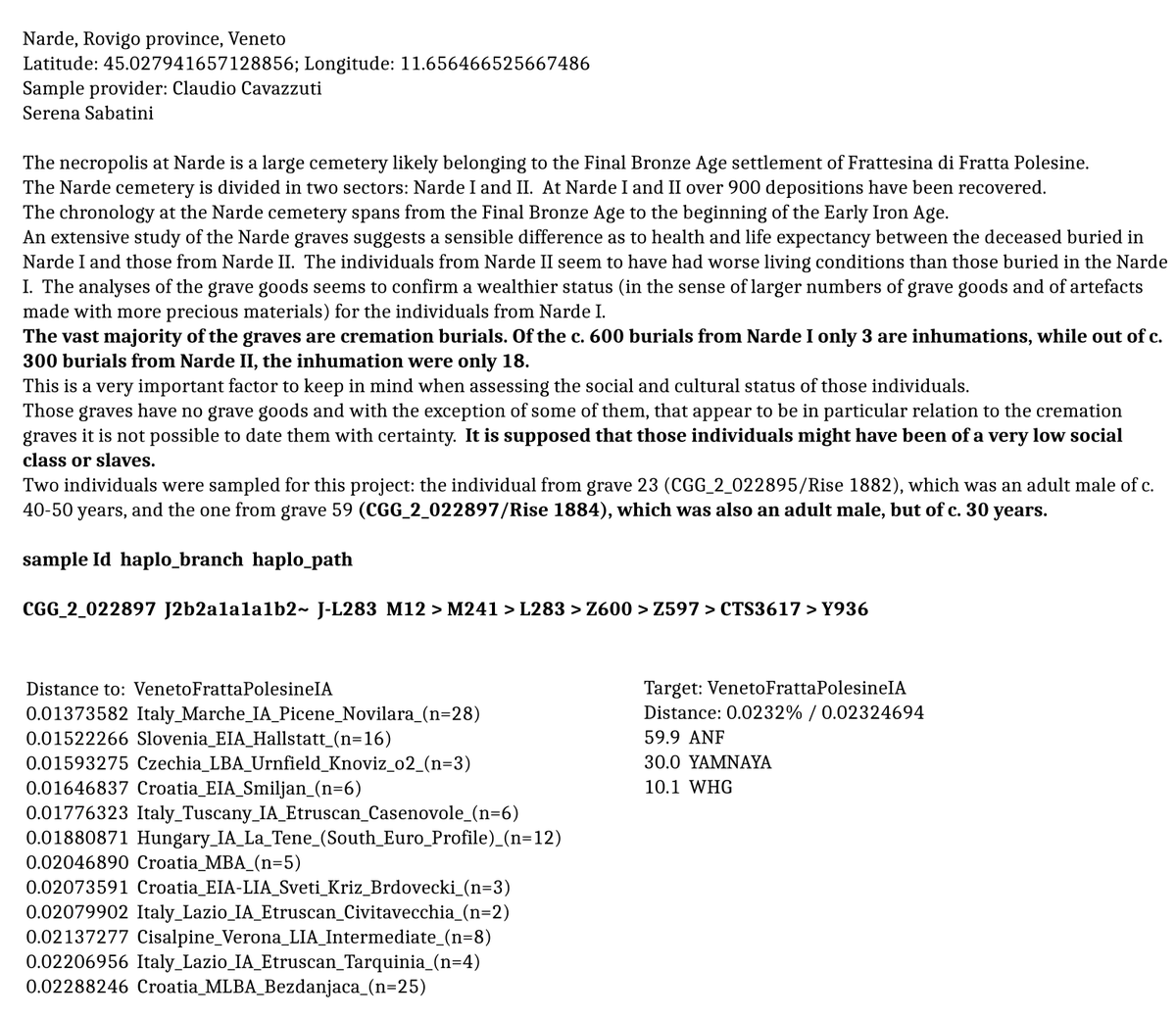
Possible Iron Age Venetian individual (CGG_2_022897 from "Ancient genomics support deep divergence between Eastern and Western Mediterranean Indo-European languages") dated to 2900 BP
G25 coordinates reconstructed from the IBD mixture modelling results.
Italy is the clearest example of how a rich country can slowly destroy itself through decades of bad management.
Since the late 1990s, Italy has had almost zero productivity growth.
Real wages have stagnated. And public debt is now around 137% of GDP, projected to move toward 139% overtaking Greece as the highest in the eurozone.
It is the result of 25 years of
1. Low innovation and very low adoption of new technologies
2. Family and insider succession in many companies, weakening meritocracy
3. Underdeveloped VC industry, startup ecosystem and R&D base
4. Political capture by lobbies and organised crime
5. Extreme administrative, judicial and business bureaucracy
6. Political fragmentation
7. Demographic collapse
No country can remain rich forever if productivity does not grow, debt keeps rising and politics only manages decline instead of reversing it.
The most salient insight of Italy's latest referendum is the persistence of a distinct Lombard-Venetian character - hostage to a heavily Southernized Italian state.
Lombards and Venetians could constitute a solid electoral platform - if their ethnic interests were promoted.
@Robkearney1981 The results highlighted both a city/rural divide, and a regional divide (Lombardy/Venetia voted No).
In other words, Southern Italians and urbanites blocked a reform that could have made Italy slightly less of a banana republic controlled by cliques of corrupt judges.
@stats_feed Most of these were invented/discovered in Northern Italy by Lombards, Venetians and Tuscans, yet Southern Italians seem very eager to claim credit for it.
"By the late thirteenth century, Venice was the most prosperous city in all of Europe. At the peak of its power and wealth, it had 36,000 sailors operating 3,300 ships."
The peoples of the West can either recognize this fact and vote accordingly, or face disenfranchisement as they lose their ability to effect change. 6/6
The recent election in Gorton and Denton (UK) is an example of how the democratic process adapts to an increasingly multiethnic, divided electorate.
The results are surprising at first glance - The Greens managed to swing a great percentage of the Labour vote. 🧵 1/6
Whether one approves or not, identity is becoming a central organising principle in Western politics.
Gorton and Denton's 2026 elections point to a paradigm shift: political competition is increasingly shaped by who voters are - rather than by ideology alone. 5/6