Sources tell @CBSSports that Georgia Tech is among the early teams to watch with Alberto Mendoza, who is entering the portal after serving as his brother Fernando’s backup at QB for Indiana this season
BREAKING: @RenderNetwork just enabled the impossible
Artist @MhxAlt completed a massive immersive project in 1 WEEK, instead of 2 YEARS on a local machine.
That’s 26 months of rendering compressed into 7 days.
This is why decentralized GPU power matters:
- Unlocks previously impossible creative projects
- Powers the spatial computing revolution (Vision Pro, VR, AR)
- $RENDER is becoming the backbone for next-gen 3D creation
Render Network is doing for graphics what cloud did for data.
Are you paying attention to $RENDER yet?
We’ve been selected as a finalist in the @beincrypto 100 awards as best DePIN project! The final stage is a public voting round. Help us win!
Vote now! https://t.co/Sm7edpmIXK
$RENDER 🔝2 DePIN project! ⭕️🤝🔥
Will take top spot, been that already!
DePIN sector could reach $3.5T by 2028👀 $Render will see substantial growth Anon, know what you hold! 🚀
#DePIN#AI#DePAI#GPUs $RENDER
Gm ☀️
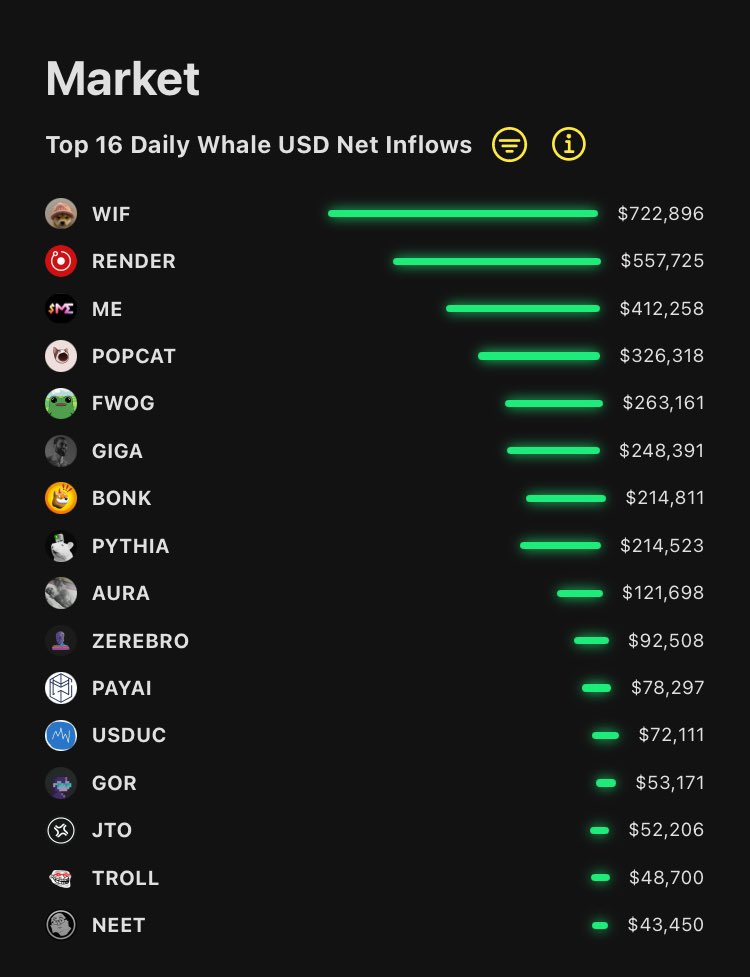
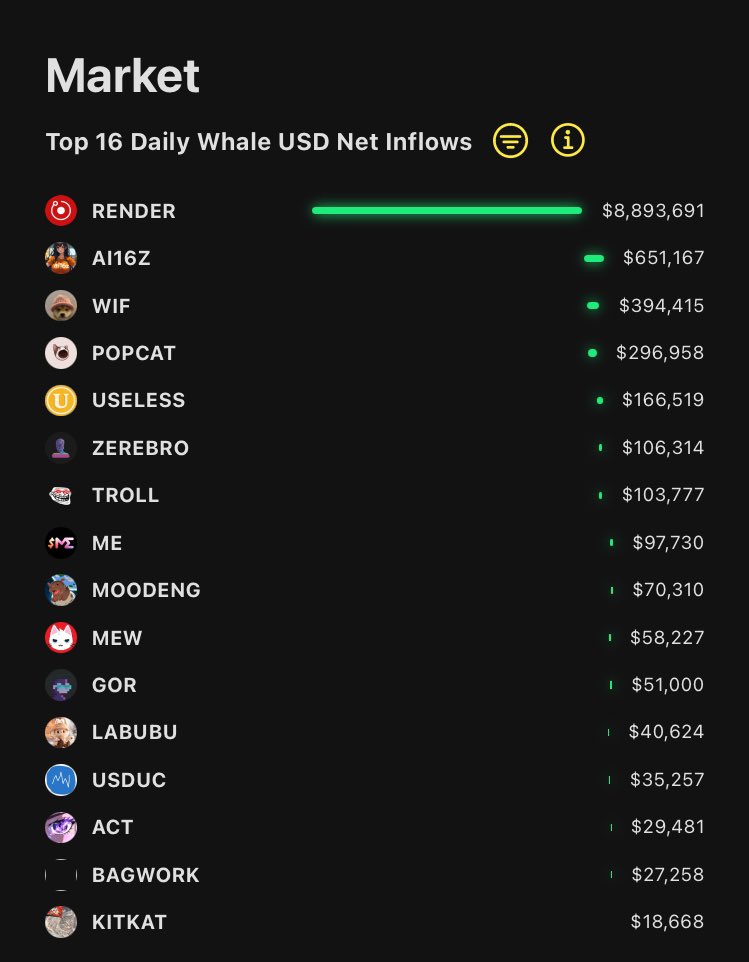
Yesterday’s Top 16 whale inflows were ⤵️
#1 $JELLYJELLY
#2 $WIF
#3 $SPX ( #SPX6900 )
#4 $USELESS
#5 $RENDER
Are you bidding any of these $SOL based tokens for November?
Jules Urbach via telegram / $RENDER
https://t.co/EQjE1qvy3l So excited by @Emostaque's brilliant vision for the future of AI. We spent the other togther day brainstorming the holodeck roadmap. World Models are going to go from struggling to run on a single B200 GPU today to full RT (w/ DLSS etc) on consumer GPUs over the coming 1-3 years (depending on complexity/visual context depth). Back about 3+ years ago when I was first showing off Neural Rendering in Octane (mostly NeRF driven then), the concept of world models seemed less probable. But the sophisitication of current frontier video models shows that the quality of generated worlds for offline rendering has already achieved parity with the equivalent traditional CG rendering apprach. With real time models evolving out of Emad's first release of stream diffusion, and our own real time neural actor rendering models that can run on consumer GPUs - to Genie 3 showing cloud GPU real time world models matching offline models, we can see that real time world models at peak fidelity that run on our DePin GPUs are just a matter of the GPU hardware cost/token becoming cheaper. This is likely to continue at an order of magniute step every half-decade (not accounting for specialized hardware). The goal of render is to lay down the base layer of this infra for this today, paired with the tools artists, creators and designers of tomorrow are migrating to as rendering evolves from raytraced screen pixels to neural rendered 8D splatted/holograhic primitives (see my first slide in every talk I have given). A 5090 today generates near frontier quality offline video at 1080p from frame by frame input - that same hardware that can also stream fast real time path traced rendered scenes with neural post processing at that resolution (thanks to NRC, DLSS and other neural speed ups). These real time streams can also contain GS4D scene data cached by offline generations. The convergence of these two rendering techniques on consumer GPUs already powering RN is a key short term path to the holodeck content pipeline, while neural rendering efficiencies coming in future GPU/TPU/Asic hardware generations and new, better optimized world models will combine the best of both approaches as we approach 2030.“
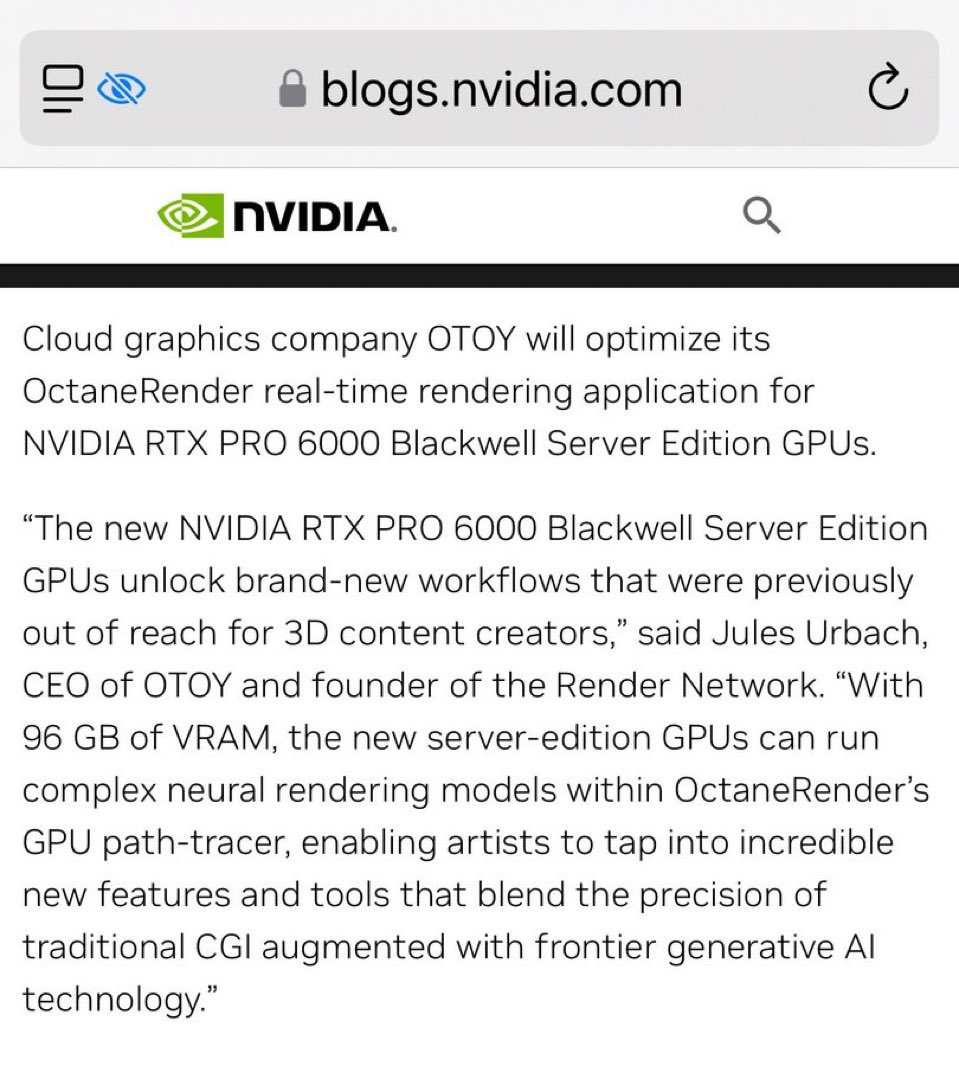
🚨 #NVIDIA + $UBER + $RENDER 🤔🤯🤝
Omniverse would definitely be used to enhance the autonomous fleets & $Render was a helping hand In that process for $NVDA 🤝
Connect the dots Anon $RENDER makes a whole lot of sense here! 👇🏾 👀
Apple Vision Pro users can explore the world of Star Trek with hundreds of locations and artifacts in miniature and real size.
Rendered with $RENDER X @OTOY