🚨QUANT FOUNDER GILBERT VERDIAN ON $QNT:
“Nothing will run unless you have the tokens.”
They’re putting mechanisms in place for MANDATORY minimum QNT holdings.
Quant just published a 25-page institutional blueprint.
The paper comes as tokenized commercial bank money moves from pilot programs into live infrastructure across the UK, U.S., Canada and Europe.
Quant highlights four major initiatives:
• Great British Tokenised Deposit in the UK, where 7 banks have completed live customer transactions on shared infrastructure built by Quant
• The Clearing House’s On-Chain Money Initiative in the U.S., with Quant selected for interoperability, orchestration and transaction management and launch to participating institutions targeted for H1 2027
• A joint tokenized deposit initiative involving Canada’s 6 largest banks
• Germany’s Commercial Bank Money Token initiative, now in pilot.
The central argument is that putting deposits on a ledger is only the beginning.
A ledger can record that money moved.
It does not inherently tell a bank:
• Why it moved
• Which obligation it satisfied
• Who authorized it
• What conditions had to be met
• What external systems it depended on
• When the obligation was actually complete
• What happens if part of the transaction fails
Quant calls this concept ‘economic intent.’
The paper separates institutional infrastructure into six responsibilities:
• Economic intent
• Institutional control
• Programmability
• Orchestration
• Money and posting model
• Execution and settlement
The first four sit above the ledger.
The final two relate to the underlying money and settlement infrastructure.
One example in the paper makes the distinction:
A customer asks a bank to pay a supplier £5 million after delivery is confirmed, with two approvals before a deadline.
To the customer, that is one obligation.
The infrastructure can generate 6 separate ledger entries, including a reservation, release, transfer, fee and status events.
The point:
Ledger activity measures the plumbing.
The bank still has to preserve the economic meaning of the transaction.
The paper also rejects the idea that one network will replace the existing financial system.
Instead, Quant describes a future where:
• Swift
• RTGS systems
• Domestic payment networks
• Tokenized deposit networks
• Asset platforms
• Public and private ledgers
all coexist.
A connection to one does not automatically provide access, settlement eligibility or common legal treatment across the others.
That makes orchestration a major part of the problem.
A single financial instruction may need to cross multiple networks with different operating hours, settlement models and points of finality.
Capital markets are where this becomes especially important.
Quant says tokenized assets have advanced faster than the cash used to settle them.
A bond can move on a ledger in seconds while the corresponding cash leg still settles through conventional infrastructure.
The proposed model is programmable delivery-versus-payment (DvP):
• Asset eligibility checked
• Cash availability confirmed
• Authority verified
• Both legs reserved
• Both execute together, or neither proceeds
The same framework extends to FX payment-versus-payment, repo and collateral.
Quant and Murex are already demonstrating this architecture.
At Sibos, the companies showed a USD repo against a tokenized U.S. Treasury, with the cash leg in tokenized deposits and the transaction operated through Murex MX.3.
One scenario completed through next-day recall.
Another was deliberately rejected mid-execution and rolled back with no change to the ledger, account or inventory state.
Finality remained with the designated settlement rail.
The UK project is also moving into capital markets.
Participating banks plan to issue 3 digital bonds in Q1 2027, traded and settled using tokenized deposits.
The bigger signal in Quant’s paper is that institutional tokenization is moving beyond the question of:
“Which blockchain will financial institutions use?”
The harder question is becoming:
How do banks coordinate money, securities, approvals, compliance and settlement across multiple systems without losing control of the transaction?
Quant’s thesis is that the ledger is only one layer.
The increasingly important infrastructure may be the stack sitting above it.
@FusionLayer25 | @quantnetwork | @gverdian
ethereum:0x4a220e6096b25eadb88358cb44068a3248254675
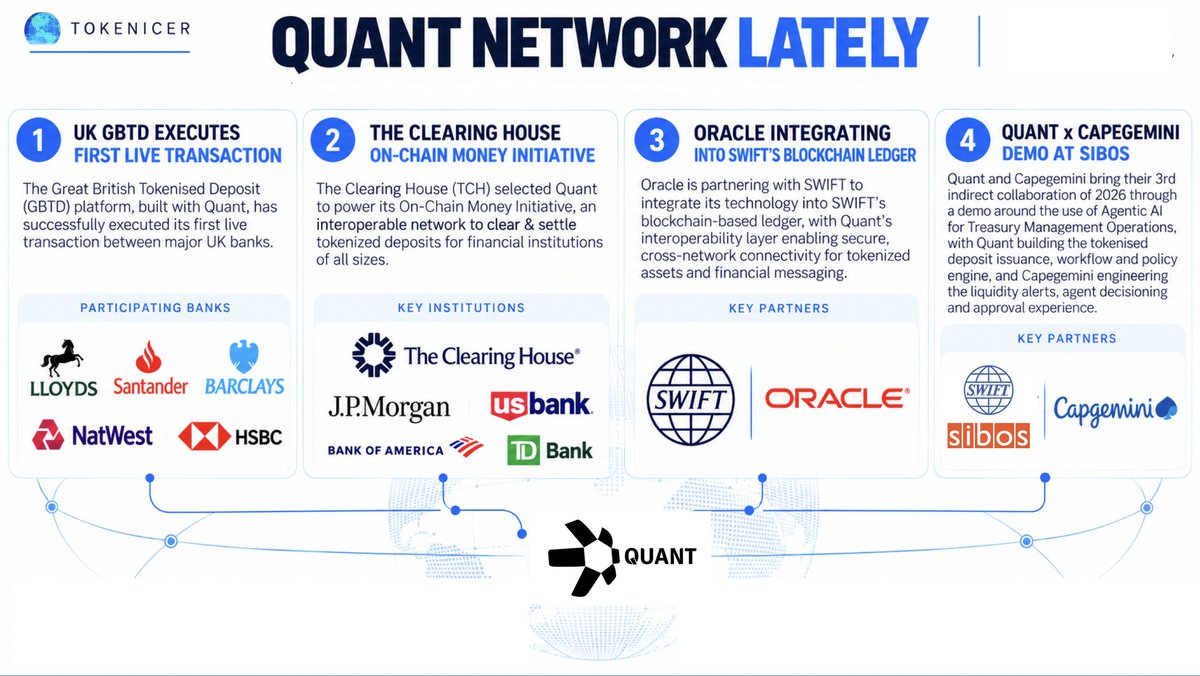
💤Wondering why the world's started waking up to $QNT lately?
Here you go
✅UK GBTD first live transaction
✅Clearing House partnership
✅Oracle x SWIFT integration
✅Capegemini collab at SIBOS
ALL of this has come in less than 7 days
All it took was a little patience
🔥The Clearing House x $QNT Video Breakdown
Been a minute since I've dropped a public YouTube video, but this collab deserves it
In this overview I go over...
• Quant's role in Tokenized Deposits
• How big The Clearing House is in TradFi
• What to expect moving forward
A few hours ago $QNT was the solution for the clearinghouse.
The price went up.
Now…
the price goes down.
It’s still the solution.
🤣
If you know you know…
I’m not selling my ethereum:0x4a220e6096b25eadb88358cb44068a3248254675 at $500.
Not at $1,000.
Not even at $5,000.
My target above $10,000 per QNT.
Limited supply. Growing utility. Long-term vision.
$QNT
He Called Bitcoin $BTC 13 Years Ago—Now He’s Bullish on Quant $QNT - This could get pretty wild for the top altcoins that fit into the INSTITUTIONAL bucket.