There are plenty of services across the Web3 space that claim decentralization.
When you dig in, you’ll find that the essential decryption keys effectively are held by either one entity or a small permissioned set of entities.
An important update for node operators just dropped, concerning a new phase of TACo's gradual migration to a new protocol.
(1) The 6-month deauthorization delay is universally and permanently discontinued. Future incentivized token lock mechanisms will be opt-in.
(2) For active nodes, rewards (Stable Yield) will remain the same or increase to a higher annual rate from September.
(3) Fee revenue will be distributed in early 2026.
(4) Handover protocol is now functional for maintaining the size of cohorts and persistent public encryption keys.
See announcements channel for details: https://t.co/UicikZ3mjO
New branding, new condition builder workspace demo, new JSON RPC (~oracle) functionality, & new opinions on where TACo fits in the programmable cryptography paradigm.
https://t.co/LIN3tNjG9G
🧵A few key points from the talk
Programmable vs. Decentralized Secrets Management by @arjunhassard from @buildwithtaco & @TheTNetwork.
Explore how TACo balances programmability & decentralization with conditions-based secrets management for use cases like cryptoinheritance & DRM.
Full video below 👇🧵
had a lovely conversation with the folks at TACo (@TheTNetwork and nuCypher). looking forward to seeing them lead their way into making Ethereum cypherpunk again :)
(definitely check this booth out if you’re looking for cypherpunk tooling and not the same L1, L2 shit)
I was so happy to connect with these two in person today at ETH Denver after 4 years of collaboration.
David Nuñez was the author of the first NuCypher research paper I used for BqETH, and is CTO of NuCypher. Derek Pierre is the hands-on Business Development Lead who has helped me a lot with integration of their best in top-notch technology.
Your app is built on a permissionless execution layer.
Your governance is on-chain.
Your storage/databases are distributed.
So why is your access control layer – which directly determines the trust model of your end-users' private data – still effectively centralized?
Today during @EthereumDenver at 2:10 PM, @arjunhassard explains how to fix one of Web3’s (and the wider Web's) weakest links:
Programmable vs. Decentralized Secrets Management
Sat, Mar 1st at | 2:10 PM
BUIDLSquad Stage
🛡️ Tech Stack Partner: TACo @buildwithtaco
Build uncensorable e2ee into your dApp
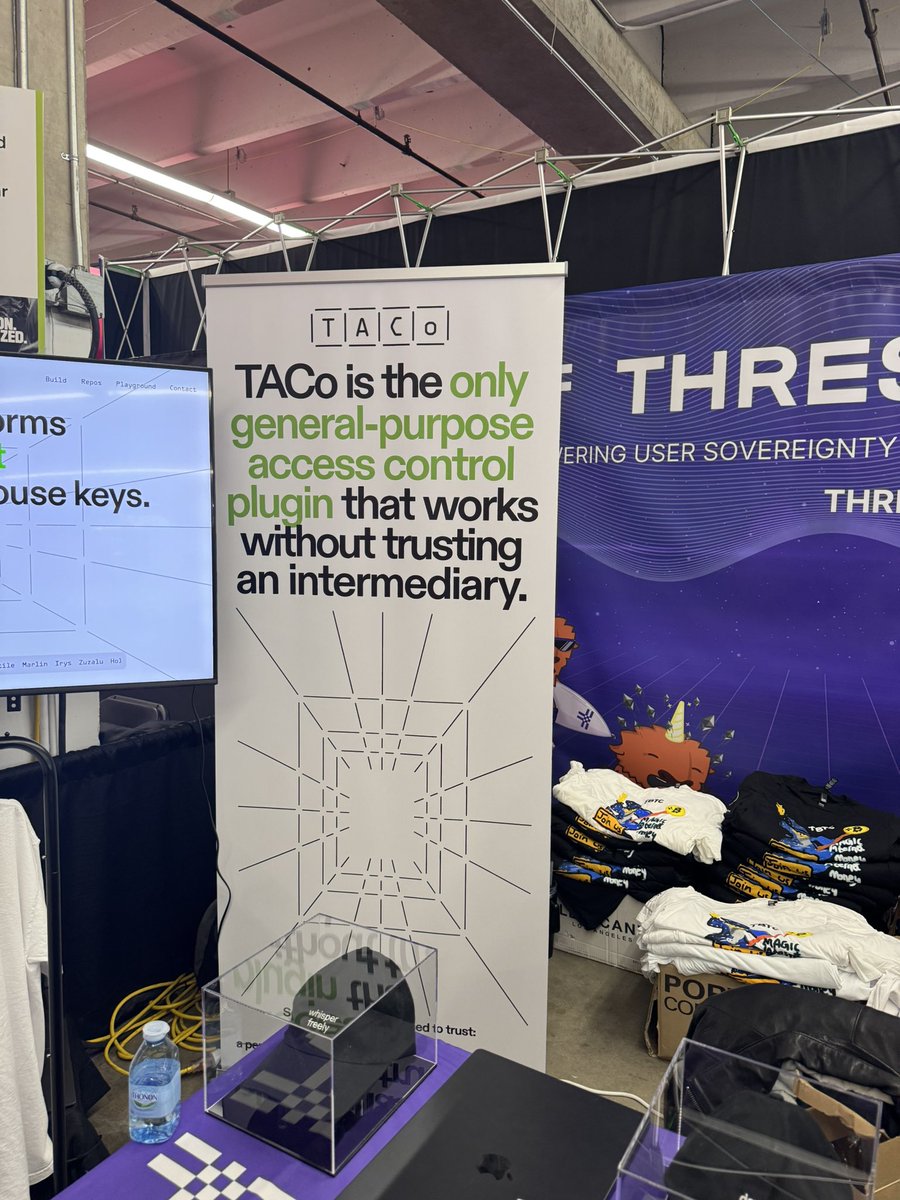
TACo is the only general-purpose access control plugin that works without trusting an intermediary. Win up to $3,000 in prizes by integrating TACo's encrypt/decrypt API into your hackathon project.
Join the workshop and check out End-to-End Encryption Modules in the hacker pack for ideas. And, just like the right to share data privately, TACo's 'taco truck' tacos are for everybody! 🌮
Incredibly, ETHDenver will have two kinds of tacos.
🌮The kind you eat while hacking.
🔐The kind that is a decentralized encrypt/decrypt API for all dApps handling non-public data.
We strongly recommend both. TACo is bringing the API and free tacos to the No Cap, All dApps hackathon alongside @Zuzalu_city
Win up to $3K for integrating TACo in your build.
Sign up here -> https://t.co/bZ4fCsyOlw
We’re excited to welcome @TheTNetwork as an official Block Sponsor for ETHDenver 2025!
ETHDenver is where innovation thrives and boundaries are broken.
Thank you to @TheTNetwork and all of our sponsors for making this possible!
Massive news as our longtime partners @3BoxLabs (Ceramic/OrbisDB/ComposeDB) and @Textileio (Tableland/Basin) are merging to build the first open agent-to-agent intelligence network. As mentioned in their AMA just now, intra-agent knowledge sharing & collaboration requires advanced access control. We're thinking complex condition logic + a genuinely decentralized cryptosystem. Excited to build on existing integrations (e.g. https://t.co/aP8QhTLTS6) and undergird the privacy/safety components of this multi-agent future.
Threshold Access Control x Marlin
Decentralized compute needs decentralized back-ups.
When TEEs go down, that could mean the irreversible loss of all data encrypted with its private keys – e.g. a model's training weights, an orderbook's unfulfilled trades, or sensitive end-user data.
From today, mainnet TACo nodes will independently enforce conditional access to TEE root keys, abiding by a 16-of-30 threshold.
This is a first-of-its-kind layering of distinct trust-minimizing technologies, combining enclaves + remote attestations + a battle-tested, cryptoeconomically-secured network of nodes executing cryptographic primitives.