Before 4 November 2026, every resident outside a metro should establish two specific facts: which local municipality governs their immediate area, and which district municipality provides its bulk infrastructure. Municipal financial health for both can be verified directly at https://t.co/V4od9RKlGR.
Where both tiers underperform and both avoid direct accountability, a documented record combined with an informed vote is the most effective available remedy.
#ThePeoplesPower #KnowYourMunicipality #MunicipalElections2026
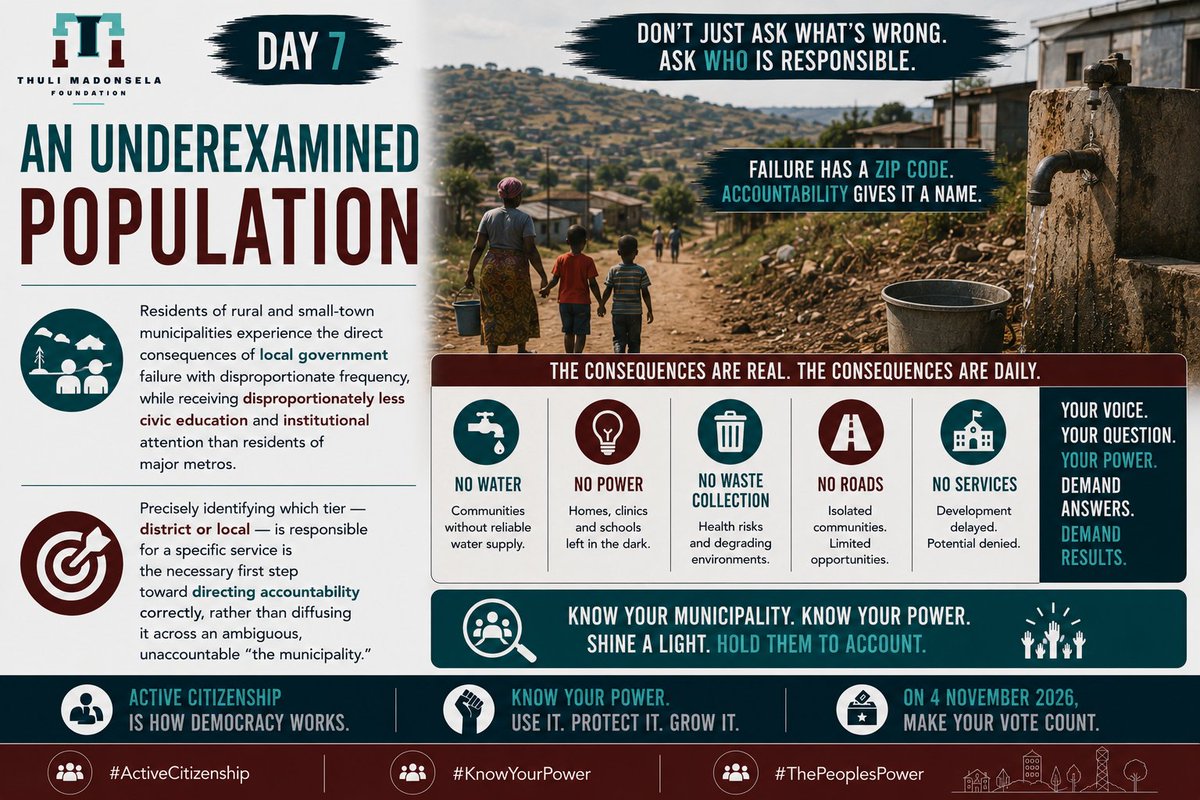
Residents of rural and small-town municipalities experience the direct consequences of local government failure with disproportionate frequency, while receiving disproportionately less civic education and institutional attention than residents of major metros.
Precisely identifying which tier, district or local, is responsible for a specific service is the necessary first step toward directing accountability correctly, rather than diffusing it across an ambiguous, unaccountable "the municipality."
#ActiveCitizenship #KnowYourPower #ThePeoplesPower
In the 2024–25 financial year, 98 municipalities recorded expenditure exceeding revenue, producing a combined deficit of R17.41 billion. Separately, the estimated national cost of rehabilitating South Africa's water and sanitation infrastructure exceeds R400 billion, with a substantial share of related projects delayed for years by planning and administrative capacity constraints.
These figures establish the fiscal scale underlying persistent service failures in district and local municipalities.
#ThePeoplesPower #DemocracyStartsLocal
For the majority of South Africans who live outside a metro, service delivery is governed by a two-tier division of labour: district municipalities provide bulk infrastructure, principally bulk water and electricity, while local municipalities manage distribution and day-to-day services.
When water supply fails, responsibility frequently sits at the boundary between these two institutions, and each is capable of attributing the failure to the other.
This is not a hypothetical governance risk; it is a documented, recurring pattern across rural water failures nationally.
#KnowYourMunicipality #ThePeoplesPower
The System Outside the Metros
Beyond South Africa's 8 metropolitan municipalities, local government operates on a two-tier structure encompassing 44 district municipalities and 205 local municipalities, together governing the roughly 43 million South Africans who live outside major urban centres.
The scale of distress within this system is significant: 62 municipalities are classified as being in severe financial distress, 174 lack sufficient cash to pay creditors, and 98 spent more than they generated in revenue in 2024–25.
None of these outcomes are structurally inevitable; each reflects a specific, traceable set of governance decisions.
#ThePeoplesPower #MunicipalElections2026
Affirmative action is a policy designed to increase educational and employment opportunities for historically marginalized or underrepresented groups. It uses measures like targeted outreach, scholarships, and equitable hiring practices to counter past discrimination and promote societal diversity. This is how Wikipedia describes AA. Based in this definition, can you express why you are against this?
Every one of South Africa's eight metros received a modified or qualified audit opinion for 2024–25; five received qualified opinions specifically, indicating material misstatements in financial statements that auditors could not resolve.
Auditor-General Tsakani Maluleke has attributed this pattern directly to weak leadership and a deteriorating accountability ecosystem, not to insufficient administrative capacity. The distinction matters: it shifts the analytical frame from a resourcing problem to a governance and ethics problem.
#ThePeoplesPower #MunicipalElections2026
Before 4 November 2026, residents of any metro should consult two publicly available sources: their metro's most recent annual report, and its corresponding audit outcome at https://t.co/f0dHeFPnTv.
The empirical record is unambiguous, all eight metros failed their 2024–25 audits despite commanding the largest resource bases in South African local government. That record demonstrates, conclusively, that financial capacity alone does not produce sound governance; sustained, competent leadership does.
#ThePeoplesPower #KnowYourMunicipality #MunicipalElections2026
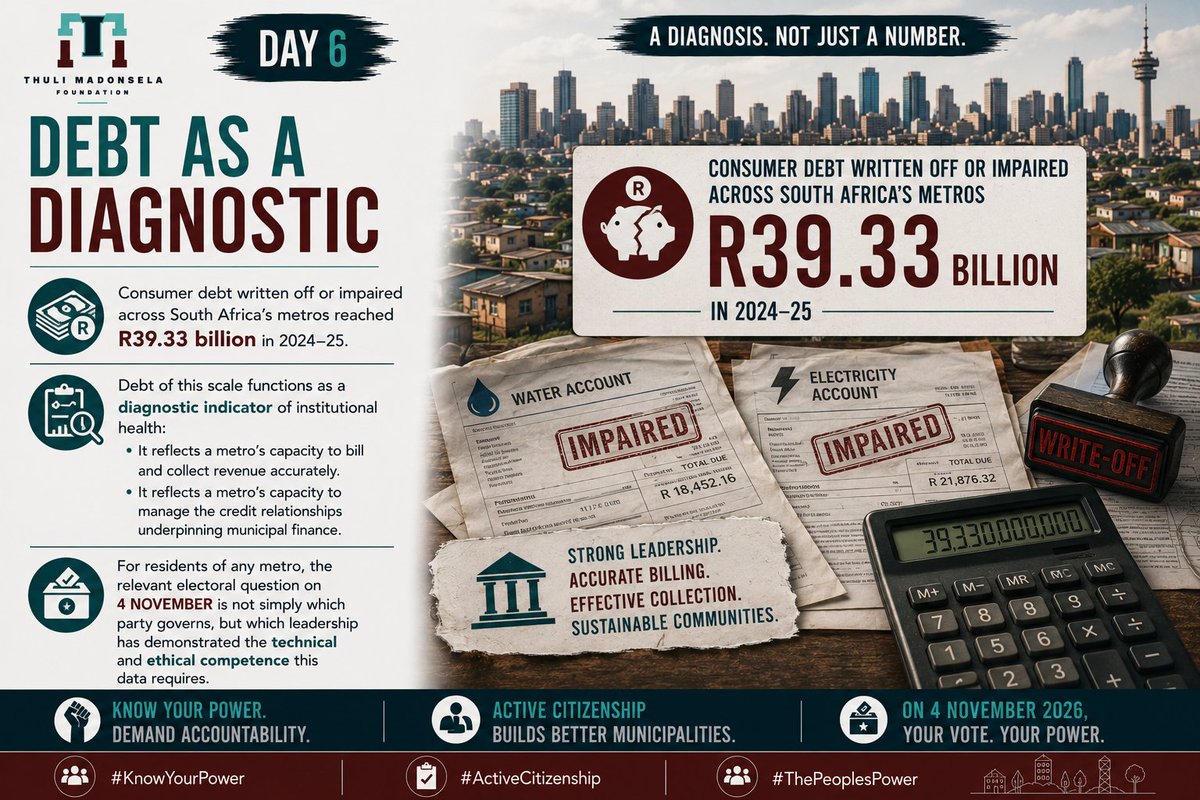
Consumer debt written off or impaired across South Africa's metros reached R39.33 billion in 2024–25. Debt of this scale functions as a diagnostic indicator of institutional health: it reflects both a metro's capacity to bill and collect revenue accurately, and its capacity to manage the credit relationships underpinning municipal finance.
For residents of any metro, the relevant electoral question on 4 November is not simply which party governs, but which leadership has demonstrated the technical and ethical competence this data requires.
#KnowYourPower #ActiveCitizenship #ThePeoplesPower
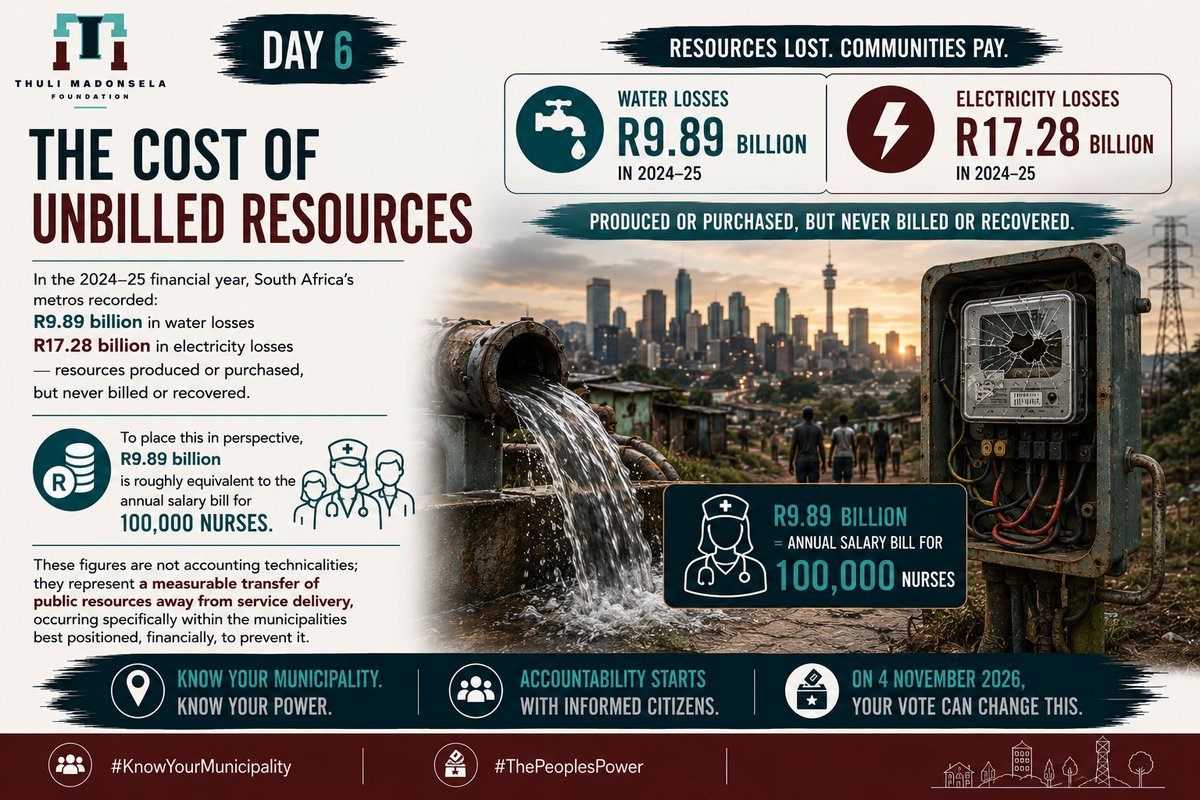
In the 2024–25 financial year, South Africa's metros recorded R9.89 billion in water losses and R17.28 billion in electricity losses, resources produced or purchased, but never billed or recovered.
To place this in perspective, R9.89 billion is roughly equivalent to the annual salary bill for 100,000 nurses. These figures are not accounting technicalities; they represent a measurable transfer of public resources away from service delivery, occurring specifically within the municipalities best positioned, financially, to prevent it.
#KnowYourMunicipality #ThePeoplesPower
South Africa's 8 metropolitan municipalities: Buffalo City, Cape Town, Ekurhuleni, eThekwini, Johannesburg, Mangaung, Nelson Mandela Bay, and Tshwane serve almost 25 million residents and administer more than half of all local government expenditure nationally. Despite this concentration of resources, all eight failed to achieve a clean audit in the 2024–25 financial year (Auditor-General of South Africa, 2025).
The metros stand as a rigorous empirical test of a widely held assumption: that governance quality scales with budget size. The data does not support that assumption.
#ThePeoplesPower #KnowYourPower #MunicipalElections2026
Only 39 of South Africa's 257 municipalities achieved clean audits in the 2024–25 financial year (Auditor-General of South Africa, 2025) a figure that should reframe how citizens interpret "local government" as a category. It is not a uniform system experiencing uniform outcomes; it is 257 distinct institutions, each with a specific, verifiable governance record.
Before 4 November 2026, establish precisely which of the three categories your municipality falls under, and confirm your ward via the IEC's online ward finder at https://t.co/j3rk4Kf2Q6.
Precision, here, is not pedantry. It is the basis of accountability.
#ThePeoplesPower #KnowYourMunicipality #MunicipalElections2026
The Municipal Demarcation Board finalised 4,488 wards ahead of the 2026 election an increase of 20 from the 2021 cycle, driven substantially by population growth and demographic movement concentrated in Gauteng and KwaZulu-Natal.
Ward boundaries are not static administrative lines; they shift in response to migration and growth, and with them, so do voting stations. Citizens who have not confirmed their registration since 2021 should treat this as a material risk to their franchise, not a procedural afterthought.
#KnowYourPower #ThePeoplesPower
Beyond the metros, local government operates on a two-tier structure: 44 district municipalities are responsible for bulk infrastructure, principally bulk water and electricity, while the 205 local municipalities within their boundaries manage direct service delivery.
This division, while constitutionally coherent, produces a persistent accountability problem in practice: when water fails in a rural town, responsibility is frequently distributed between two institutions, each capable of attributing failure to the other.
Of South Africa's 257 municipalities, 62 have been identified by the Auditor-General as being in severe financial distress, the majority of them local municipalities in predominantly rural provinces.
#DemocracyStartsLocal #ThePeoplesPower #MunicipalElections2026
South Africa's eight metropolitan municipalities: Buffalo City, Cape Town, Ekurhuleni, eThekwini, Johannesburg, Mangaung, Nelson Mandela Bay, and Tshwane, govern the country's largest urban populations and command, by a considerable margin, the greatest share of local government resources nationally.
Yet in the Auditor-General's 2024–25 findings, all eight failed to achieve a clean audit. This is a governance fact with real analytical weight: it demonstrates, empirically, that resource concentration and administrative competence are not the same variable, and that voters cannot infer one from the other.
#KnowYourMunicipality #ThePeoplesPower
Only 39 of South Africa's 257 municipalities achieved clean audits in the 2024–25 financial year (Auditor-General of South Africa, 2025), a figure that should reframe how citizens interpret "local government" as a category.
It is not a uniform system experiencing uniform outcomes; it is 257 distinct institutions, each with a specific, verifiable governance record. Before 4 November 2026, establish precisely which of the three categories your municipality falls under, and confirm your ward via the IEC's online ward finder at https://t.co/j3rk4Kf2Q6.
Precision, here, is not pedantry. It is the basis of accountability.
#ThePeoplesPower #KnowYourMunicipality #MunicipalElections2026
Only 39 of South Africa's 257 municipalities achieved clean audits in the 2024–25 financial year (Auditor-General of South Africa, 2025), a figure that should reframe how citizens interpret "local government" as a category.
It is not a uniform system experiencing uniform outcomes; it is 257 distinct institutions, each with a specific, verifiable governance record. Before 4 November 2026, establish precisely which of the three categories your municipality falls under, and confirm your ward via the IEC's online ward finder at https://t.co/j3rk4Kf2Q6.
Precision, here, is not pedantry. It is the basis of accountability.
#ThePeoplesPower #KnowYourMunicipality #MunicipalElections2026
Before 4 November 2026: find out both your local AND district municipality. Establish specifically which one is responsible for your water supply.
Then look up your district municipality's financial health at https://t.co/V4od9RKTwp.
If both tiers are failing and both are avoiding blame, an informed vote and a documented paper trail, is how you force the question of who answers first.
#ThePeoplesPower #KnowYourMunicipality #MunicipalElections2026
Before 4 November 2026: find out both your local AND district municipality. Establish specifically which one is responsible for your water supply.
Then look up your district municipality's financial health at https://t.co/V4od9RKlGR.
If both tiers are failing and both are avoiding blame, an informed vote and a documented paper trail, is how you force the question of who answers first.
#ThePeoplesPower #KnowYourMunicipality #MunicipalElections2026
Rural and small-town residents are the most directly affected by municipal failure and often the least reached by civic education campaigns.
Knowing precisely which municipality (local or district) governs which service is the essential first step to holding either accountable. Silence and confusion serve failure; clarity is where accountability begins.
#ActiveCitizenship #KnowYourPower #ThePeoplesPower