Antik Mısır’ın Rosetta Taşı…
Napolyon’un askerleri o karanlık kumlarda ona dokunduğunda, bir anahtar bulduklarını sandılar. Oysa kadim bir sandığı aralamışlardı. 🏺
İngilizler onu Londra’nın soğuk ve sisli gölgelerine hapsetti. Üç kadim dilde (Hieroglif, Demotik, Antik Yunanca) fısıldayan o taş, hâlâ kimsenin çözemediği, karanlık satırlar barındırıyor.
Belki de o satırların çevrilememesi bir başarısızlık değil, kadim bir korumadır. Çünkü bazı kapılar, insanlık uyanmadan sonsuza kadar kapalı kalmalıdır. 🌑🗝️👁️🗨️
Brock Purdy (26 years old) has officially become the youngest QB in 49ers history to reach 100 passing touchdowns passing Joe Montana, Steve Young and Jeff Garcia!
Both the 49ers and Raiders called Kezar Stadium home, in San Francisco’s Golden Gate Park, home in the past.
The Raiders also called Candlestick Park home in 1960-61. Cool touch: Kezar now has seats from Candlestick.
Nice spot to visit before tomorrow’s Bay throwback battle
The scale of the Universe.
Scientifically, the universe spans an enormous range of sizes: from the Planck length, about 1.6 x 10⁻³⁵ meters, which is the smallest scale where our current laws of physics may still apply, to the observable universe, about 9.2 x 10²⁶ meters across.
Why did ancient Egyptian sculptures depict such unusually elongated heads?
During the Amarna Period (c. 1353–1336 BCE), Egyptian art underwent a remarkable transformation under Pharaoh Akhenaten. Royal figures, including Akhenaten, Nefertiti and their daughters, were frequently portrayed with elongated skulls, slender necks, prominent facial features and distinctive body proportions.
But were these accurate representations of human anatomy or artistic imagination?
The unusual proportions are generally understood as part of the distinctive artistic conventions of the Amarna Period. Some theories have suggested medical explanations, but there is no conclusive evidence that Akhenaten actually had an elongated skull.
Interestingly, certain African sculptures and traditional hairstyles also feature elongated head shapes. Some African communities historically practised intentional cranial modification, while elaborate hairstyles could create a similar visual appearance.
The important distinction: Similar appearances do not necessarily indicate a shared origin, ancestry or direct historical connection.
Ancient art reminds us how differently cultures have represented the human form across time.
What if the ancient civilizations that spent thousands of years studying the heavens understood patterns we've barely begun to appreciate?
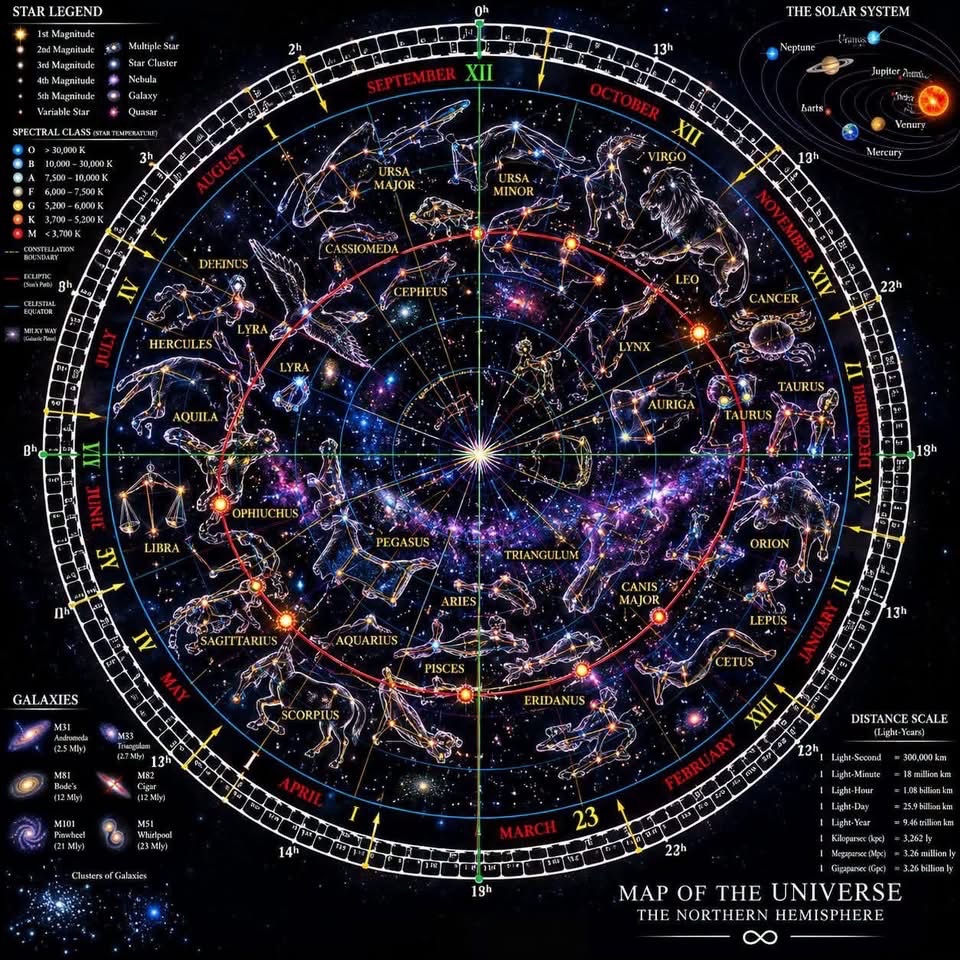
Today, while cleaning the house, I came across something that genuinely stopped me in my tracks. An extraordinary celestial chart known as the Map of the Universe, originally created by Tomás J. Filsinger and published by Celestial Arts in Berkeley, California, in 1981.
What makes this piece so fascinating isn't just its incredible artwork, but the history and astronomical knowledge incorporated into its design. Filsinger brought together centuries of celestial observations, constellation mythology, mathematical coordinates, and astronomical cycles into one enormous circular representation of the northern sky.
At the center sits the north celestial pole, with Polaris nearby, while the surrounding stars appear to trace circular paths across the heavens. Now here's where my curiosity really starts taking over. Long before modern telescopes, satellites, or computers existed, the ancient Babylonians, Egyptians, Greeks, and other civilizations were already studying the movements of the stars, documenting planetary cycles, and developing sophisticated systems of astronomy.
Many ancient cultures described the heavens as a celestial dome or firmament, something that continues to fascinate people exploring alternative interpretations of our world today. But what really caught my attention was discovering that Filsinger himself explained the deeper mathematics behind his work, including the approximately 26,000 year cycle of axial precession and the relationship between celestial movements and ancient calendar systems.
Think about that for a moment.
A single astronomical cycle lasting approximately 26,000 years, represented through geometry that connects modern observations with knowledge developed thousands of years ago. And the most intriguing question to me is how much of this could we independently measure with the instruments available to us today? Why does Polaris appear nearly stationary while the northern constellations rotate around it? Why do celestial observations change with latitude? And how can we mathematically distinguish between competing explanations of what we're seeing?
The established rotating Earth model explains these observations, but understanding the experimental evidence behind that explanation is far more interesting to me than simply accepting an answer without investigating it. This map doesn't prove a flat Earth or a physical dome overhead, but it demonstrates why the appearance of the heavens has inspired those questions throughout history.
When I think about Nikola Tesla, ancient astronomical knowledge, electromagnetic fields, resonance, and the extraordinary precision of celestial motion, I can't help but wonder what future discoveries are still waiting for us. The greatest discoveries don't come from refusing established knowledge or blindly following it. They come from having enough curiosity to question, enough discipline to experiment, and enough humility to follow the evidence wherever it leads.
This map is more than a beautiful piece of astronomical history to me. It's a reminder that humanity has been looking toward the heavens for thousands of years, trying to understand where we are, how everything moves, and what extraordinary mysteries might still remain beyond our understanding.
Never lose that curiosity.
✨🙌🏾💫