Hi @AsteadWH, do you feel like your tweet and your paraphrasing of @PeteButtigieg's quote is accurate, clarifying and/or charitable? You could have allowed @ZohranKMamdani to respond to the quote without providing your own summary. With any summary, you risk diluting the substance of it via simplification, generalisation or selectivity.
In effect, you asked Zohran to respond to your paraphrase rather than to Pete's quote. As to your paraphrase here and during the interview, you equate Pete's use of "ideology" to "substance", while taking the first half of Pete's proposition "message discipline" and depriving it of the necessary context of it's second half "on focusing what people care about." Do you have reason to believe that "substance" is different than "what people care about?" Do you think ideology and substance are inseparable? Do you think Zohran responded to the quote or to your paraphrase of it?
Pete does not separate substance from tactics in this proposition, however, your paraphrase of his quote does and implies that Pete's has when you ask "[D]o you think this is true? Like, when we get outside of New York, are we thinking that it's less about substance of campaign than tactics, or can we separate those things?" You reiterate this in your tweet, albeit with a qualification, saying "not necessarily substance."
Do you think it's possible that a campaign could be more or less successful because of it's tactics, ideology or substance, and that these would be transferable to other campaigns around the country to varying degrees? I'm concerned that your framing of these ideas and the individual's sharing them is contributing to a divisive discourse on the left, whereby readers and listeners are likely to unfairly contrast liberal or "neoliberal" with progressive or socialist.
I asked @ZohranKMamdani to respond to this quote from @PeteButtigieg -- which argues the true success of Mamdani's campaign was about tactics and strategy, not necessarily substance
Why engage in twitter disputes that consist of stating positions without justifications prior to your writing/thinking about ideas/working through your thoughts? You stated in your objection to @CathyYoung63's paraphrasing of your tweets that engaging in this way robs you of your time and energy and made you question whether you would finish your writing. Why should people assume that you are engaging in good faith on the occasion of reading your tweets when your expectation is that they have to wait until you've written a piece (which you may not ultimately write/publish) to be exposed to your avowedly good faith reasoning?
You implied in the former conversation that other figures are engaged in "hustling" culture and "fandom politics", why shouldn't people read your refusal to elaborate in conversations you start on twitter as the same behaviour you critique? Surely writing a piece and sharing your reasons in a conversation with @JerusalemDemsas on twitter are not mutually exclusive? Otherwise, it gives the impression that your positions are unfounded and your justifications are post-hoc.
1. You still haven’t provided any evidence for your claim that Europeans are paying less to Ukraine than Americans.
2. You haven’t read or engaged with any of the sources that I provided you. The @kielinstitute uses a single model to account for both the commitments and allocations of bilateral aid from “Anglosaxon countries,” “EU members and institutions,” Geographic Europe and “other donor countries.”
3. Since we’re comparing American and European aid, you have to either convert USD to Euros or Euros to USD. The @kielinstitute is German and it chooses to convert fourteen countries’ aid to Euros rather than convert 41 countries to USD.
4. You don’t care how much Europeans pay compared to Americans because you don’t think Americans should “have spent any in the first place.” Don’t hide behind arguments that aren’t relevant to your core beliefs.
5. If you had read page 24 of the OAR report I sent you in my second tweet, you would have already known that “Congress appropriated $174.19 billion through the five Ukraine supplemental appropriation acts enacted FY 2022 through FY 2024.” If you had continued reading, you would have learnt that the U.S. did not send $175 billion to Ukraine. The largest share of funds is $45.78bn appropriated to the Department of Defense to replenish their stocks of weapons and materials donated to Ukraine. The second largest share of funds appropriated is $44.85bn for U.S. European Command military activity in Europe and the European Deterrence Initiative, which "supports the forward deployment of U.S. military forces and prepositioned stocks in Eastern Europe to deter aggression against NATO allies." The U.S. also appropriated $33.2bn for the DoD to procure new weapons and material from industry for Ukraine through the Ukraine Security Assistance Initiative, however $21.73bn of that remains to be disbursed. $30.21bn has been disbursed for direct budget support to Ukraine. $96.62bn or more than half of the total appropriations remains to be disbursed, meaning $83.43bn has been disbursed as of FY 2025. So one sixth of appropriated aid has been direct assistance to Ukraine.
6. You claim that $20bn is “A load [sic] that is unlikely to be paid back” and yet you know nothing about who the trustee and administrator for distributing that loan is, how it will be paid back and by whom, because you didn’t read Page 34 of the OAR report I sent you. That $20bn loan is part of a $50 billion G7 initiative that will be repaid by future windfall proceeds from $300bn of immobilised Russian sovereign assets. It is not being repaid by Ukraine but by the EU, who holds most of the assets and will “collect and disburse the investment profits that those assets generate to pay back G7 members’ loans.”
IN FACT, all you had to do was read the paragraph above the graph that you screenshot which explains that the loan is to be "paid back with interest from frozen Russian assets." If you continued reading your source, you also would have found that it says "Europe has committed more aid to Ukraine than the United States has" because this report uses the @kielinstitute as one of it's sources, which is what I presented to you (and you balked at).
7. You make factual claims that aren’t supported by any evidence because you have a poor media diet which reinforces your ideological beliefs and political identity. You should have some intellectual humility by admitting when you don’t know something and qualifying your factual claims without evidence by stating where you think you heard or read something from but haven’t verified.
@Tiiimato @65rosesauthor @kielinstitute Don't know why you are citing American funds in Euros, but this is what I found. 175 billion in aid plus a load that is unlikely to be paid back of 20 billion. Nearly 1/5 of a trillion to a corrupt state perpetuating a war with a nuclear power that is not a threat to the US. Why?
The U.S. ranked 11th against EU countries, tied with Croatia, when EU aid shares are excluded. They rank
15th against EU countries when it isn't. They rank 17th globally. (IfW Kiel, Ukraine Support Tracker)
Be careful of determining the ranking of the U.S. globally based on a graph with only 9 random entries. It's also worth noting that this @StatistaCharts graph is reporting the "total bilateral allocations" as a % of 2021 GDP which doesn't include EU Member States "EU aid shares."
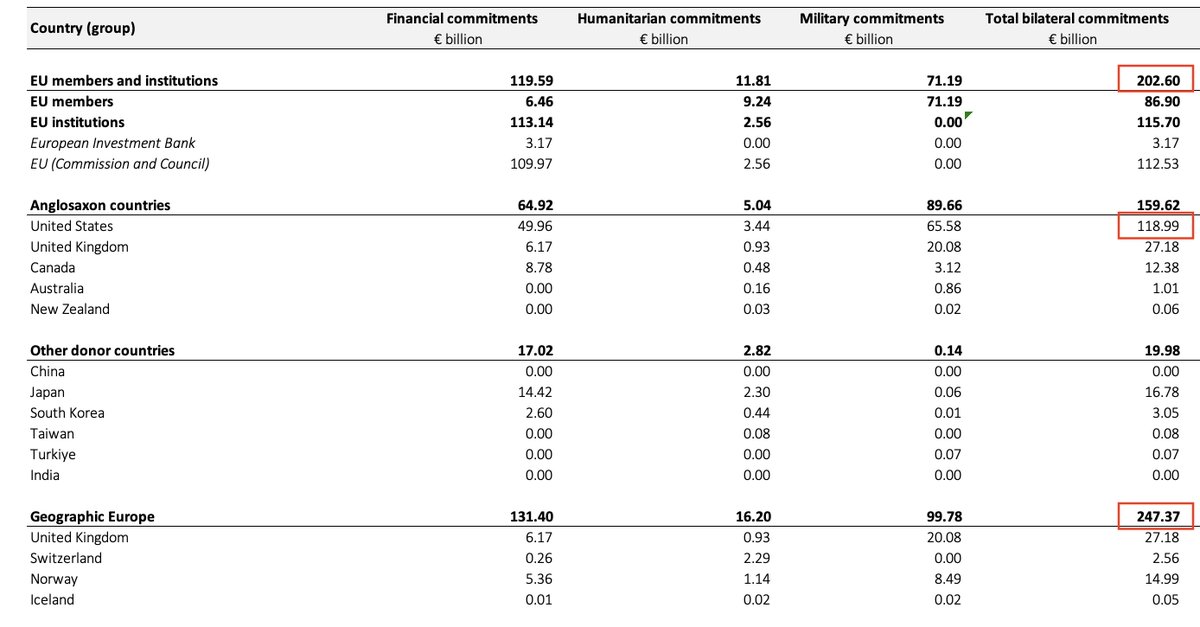
@65rosesauthor @Libertariman_@kielinstitute In terms of total bilateral commitments, EU Institutions and Members were €203bn, the U.S. was €119bn and Geographic Europe was €247bn.
The European Union has committed and disbursed more aid than the United States. The U.S. figure is based on the Special Inspector General for Operation Atlantic Resolve's congressional report and the EU figure is based on a publication by the Delegation of the EU to the U.S.
@Tiiimato Don't you think Europeans should pay at least equal if not more to support a country in conflict that is a more immediate threat geographically? If not, why?
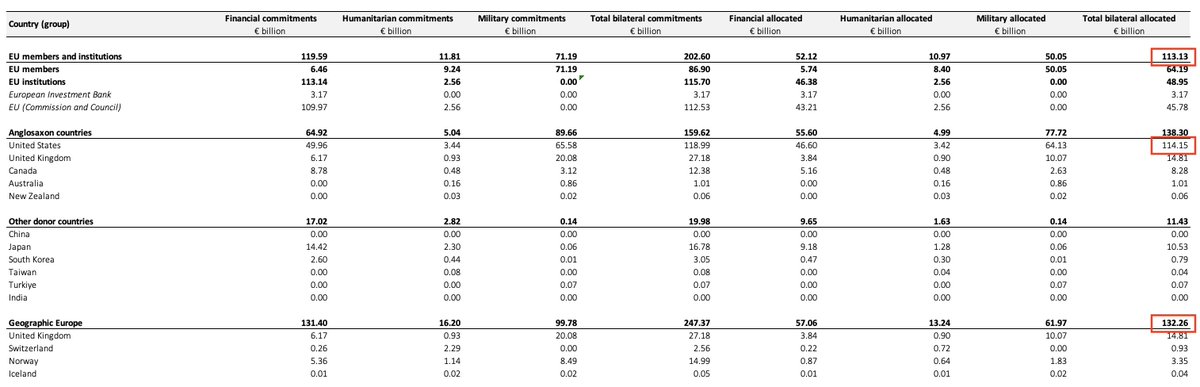
@65rosesauthor @Libertariman_ According to @kielinstitute as of the 31st Dec. 2024, EU Institutions and Members total bilateral allocations were €113bn, the U.S. totaled 114 and Geographic Europe (including Switzerland, Norway, Iceland and U.K.) totaled 132. EU's is higher now from $3.2bn disbursed in Jan.
@65rosesauthor @Libertariman_ The U.S. delivered or specified for delivery (allocated) more bilateral aid (government-to-government) than "EU institutions" which include the Commission and Council, MFA and EIB funds. However, this does not include bilateral aid from Member States.
@Tiiimato Committed and dispersed are two very different things man. Americans have spent more money and a bunch of politicians promised they will spend more money years down the line. No they are not the same and yes, we shouldn't have spent any in the first place.
Yes, they are different, which is why I said that Europeans have both committed AND disbursed more aid. I asked you to respond to the sources I gave you which prove those claims, yet you clearly did not read them because you falsely re-stated that Americans have spent more money.
@Tiiimato Committed and dispersed are two very different things man. Americans have spent more money and a bunch of politicians promised they will spend more money years down the line. No they are not the same and yes, we shouldn't have spent any in the first place.
If and when you decide to dignify my question to you by reading the evidence (I even cited both sentences), I will take that as a sign of good faith and we can continue. If you refuse to, you will be showcasing how libertarian media literacy is also an unparalleled embarrassment.
victory with more support, which is why they want to maintain the same levels. That would be a more reasonable inference to draw from these questions alone than the one you made, but your obsession with "owning the libs" or in this case, Europeans, causes you to tilt at windmills
Conservative media literacy is an unparalleled embarrassment. The first question does not ask the prescriptive question of whether Ukraine should receive more support, it asks a descriptive question of whether current support is sufficient to prevent a Russian victory.
maintaining the same levels of support or increasing it compared to the minority of people who want to reduce it, which is the position that @therabbithole and it's audience supports. It's possible that the majority of respondents don't believe it's possible to prevent Russia's