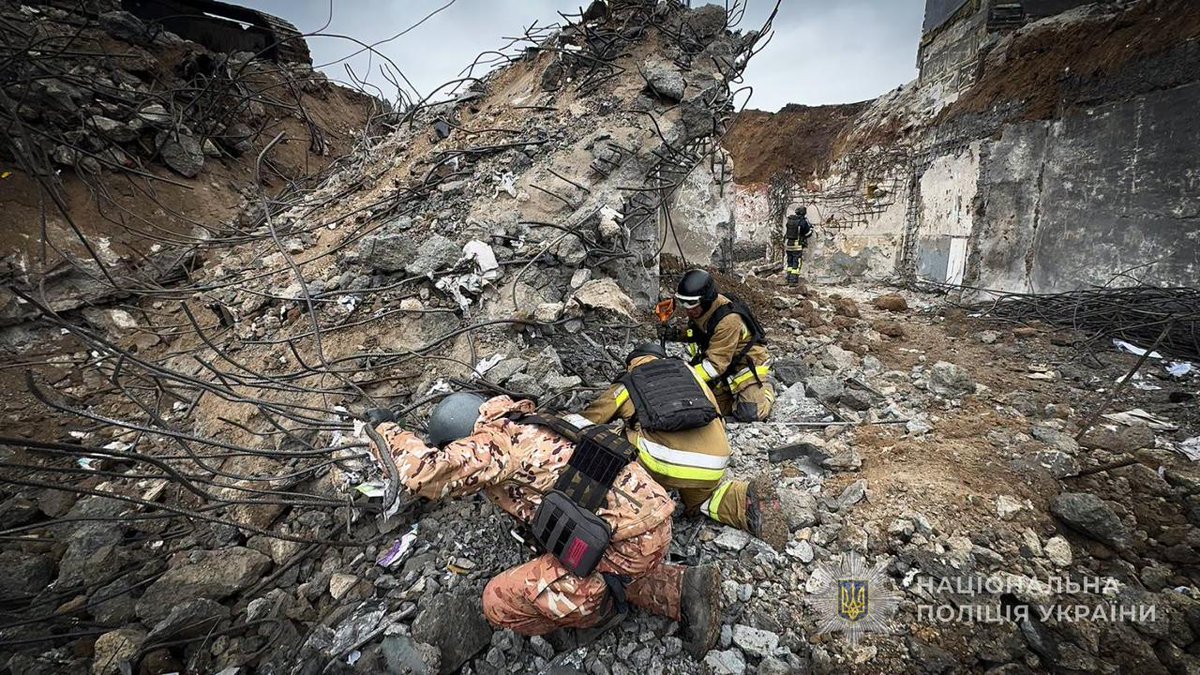
Unfortunately, our worst fears have been confirmed.
After two weeks of recovery operations to retrieve the bodies of those killed in the Russian strike on November 2 against a school building in the town of Komyshuvakha, where humanitarian aid was being distributed to local residents that day, the death toll has reached 72. Four more persons are missing.
This is one of the deadliest mass murders of Ukrainian civilians by Russian forces in this war for which a confirmed death toll is known.
The number of victims exceeds even that of the devastating Russian missile strike on Kramatorsk railway station on April 8, 2022 (61 killed), or the Russian strike on a cafe in the village of Hroza during a memorial gathering on October 5, 2023 (59 killed).
Does Putin feel more pressure to end his war today than yesterday?
Does he understand that he must abandon his ambitions for Ukraine and Europe? That every day of delay worsens his position? That time is against him and Europe’s resolve will not waver?
If the answer is anything less than an unequivocal yes, we have not made the most of the past 24 hours.
Time to make the next 24 count.
If Putin stops fighting, the war ends. If Zelensky stops fighting then his country will be occupied, leaders murdered, language banned, businesses stolen, children kidnapped. That's what happens in Russian-occupied Ukraine.
30 döda i rysk attack mot bussar i frontstaden Kramatorsk, som ryska invasionsstyrkor försöker erövra.
En femtedel av Ukraina är ockuperat. Där finns tortyrfängelser där du hamnar om du säger emot.
Frontlinjen utgör en skarp gräns mellan ett fritt samhälle och ett skräckvälde.
We have seen Russia’s dangerous recklessness at full display in the past 48 hours.
A Russian warship fired flares at a Danish helicopter.
NATO jets had to shoot down a drone over Lithuania.
Russia struck a passenger train near the border with Ukraine.
And Poland pulled a drone from its shores.
We need to be clear-eyed: those are not accidents.
They are calculated attempts by Russia to weaken our resolve.
Europe will not dial back its support for Ukraine.
My intervention in #EPlenary ↓
Russia wants us to be afraid.
Afraid of escalation. Afraid of provocations. Afraid of what might come next.
Fear is a weapon. And Moscow knows how to use it.
The best defence against fear is preparedness.
Stay calm. Stay united. Stay focused.
And keep supporting Ukraine.
Pour faire cesser l'escalade russe🇷🇺 en Europe🇪🇺, il faut que chaque agression ait une conséquence.
Une tentative d'attentat ? On fournit 50 missiles de croisière à l'Ukraine🇺🇦.
Un drone viole nos espaces aériens ? Des missiles Meteor pour les chasseurs ukrainiens.
Un sabotage dans nos usines d'armement ? 100.000 obus pour l'Ukraine.
Là ils arrêteront de nous menacer, là nous défendrons l'Ukraine et l'Europe, arrêtons de bavarder !
Extrait de ma vidéo, à voir en entier sur ma chaîne Youtube (1er commentaire sous ce post) 👇
För 65 år sedan lät DDR:s ledning uppföra Berlinmuren. I dag har Tyskland varit enat längre än det var delat. 🇩🇪
Lärdomen från muren kvarstår: frihet och demokrati är inte något som kan tas för givet.
Det som kallas ”human safari”. När ryska drönaroperatörer jagar civila ukrainare för nöjes skull, och för skräckens skull.
Detta pågår ständigt i frontstäderna. Den fullskaliga invasionen är inne på sitt femte år. De ryska invasionsstyrkorna kontrollerar en femtedel av Ukraina.
Dalia Grybauskaitė, former President of Lithuania:
I first met Putin in Helsinki in 2010. For us, the gas price from Russia was a huge question.
We fully depended on gas supplies from Russia. And we had been paying about 30–40% more than Germany was paying, for example.
For a neighboring country where the pipelines are some 2,000 km closer, we were paying so much.
During the meeting, Putin read me a list of what Lithuania was supposed to do, and it was clear to me that it was about obedience, about surrendering.
It was clear to me that with countries neighboring Russia, you either kneel or you are the enemy, and you have nothing in between.
Of course, I was not able to accept these requests. After this meeting, I understood that Lithuania needed to get rid of its dependency on energy from Russia.
We moved very quickly to build an LNG terminal. We were the first in Europe to do this at that time. By the end of 2014, we had an LNG terminal.
This allowed us to fully cut our dependency on Russian gas and Gazprom in Lithuania, and even to help our neighbors in Latvia and Estonia.
I’ve noticed that some in the West have taken to saying that Ukraine has already won the war.
I understand why they say it. But I think it’s a mistake.
First, it simply isn’t true. Yes, Russia is losing, but it has not yet lost. The war is still being fought, and Putin still believes he can win.
Second, it risks encouraging complacency at precisely the moment we should be urgently stepping up support for Ukraine and further increasing the cost of Russia’s aggression.
It’s not over until it’s over. Until then, we must not allow ourselves to rest on imaginary laurels.
Vad många det är till både vänster och höger som verkar tro på hånfullhet och idiotförklaringar av den andra sidan som ett bra sätt att vinna nya anhängare i valrörelsen.
If you want to measure the impact of a European leader, look at how much energy foreign adversaries spend trying to destroy their reputation.
The constant stream of pro-Russian and pro-China propaganda aimed at @kajakallas proves she is a formidable opponent to them, and while the exact powers of the EU High Representative position can potentially be reformed, Kallas has the ideal mindset to confront hostile autocrats.
European capitals have every right to analyze and potentially adjust the bureaucratic mandate of the High Representative for Foreign Affairs and Security Policy. Rethinking how the bloc coordinates its external actions is a standard part of institutional evolution, but any systemic flaws in the office cannot be blamed on Kallas.
The concentrated hostility directed at her from state media ecosystems in Russia and China (and some other enemies too) is an involuntary admission that her strategic clarity poses a major problem for them. Their fixation on Kallas confirms her status as a high-stakes obstacle.
She has a profound understanding of the psychological games autocrats play, and she refuses to grant them the passive diplomatic concessions they crave. Her clear, unyielding communication style helps insulate the European Union from the gaslighting tactics that hostile regimes use to manipulate Western policy.
The narrative attacks against her should therefore be viewed as validation of her approach. Discussions about reforming European diplomacy are healthy, but Kallas herself is not the issue, as her defiant attitude is exactly what is needed to face down modern authoritarian threats
Zelenskyy’s open letter to Putin will bring neither a meeting nor peace.
It is a shrewd information operation to which Putin has no good response other than continuing the war.
At this stage, however, that works more to Ukraine’s advantage than to Russia’s.
And Putin knows that if his authority collapses, he will fall with it, and Russia will be forced to abandon its imperial wars.
Zelenskyy’s letter should be a signal to all of Ukraine’s friends: now is the time to apply decisive pressure on Russia so that it recognizes the failure of its strategic objectives.
Ever since Putin’s 2022 blitzkrieg failed, his theory of victory has rested on a single assumption: that time was on its side, and that sooner or later the West would offer at the negotiating table what Moscow could not achieve on the battlefield.
Now, as that illusion fades, the Kremlin is escalating tensions with NATO in a last attempt to lure the West into a negotiation trap, fracture support for Ukraine, and divert us from our course.
We see this strategy for what it is. And our message remains: the only way to end the suffering is simple: end the aggression, withdraw behind Russia’s internationally recognized borders, and stay there.
After every Russian escalation into a NATO country we hear leaders repeating the mantra "We stand with..."
But we could do much more than standing around.
For example — we could create a European-Ukrainian defense union. Fund it with confiscated Russian frozen assets. Close the skies in Ukraine, making Ukraine and other frontline states safer.
These things are very possible and this work could start today.
Instead, I am sadly reminded of how Britain and France “stood with” Poland in 1939 while that country was being dismembered. It was called the Phony War, because mere declarations of “support” mean very little on the ground, and do nothing to prevent real war.
Actions always speak louder than words, and usually cost much less than inaction.