Trying to use 4 decades of financial market experience to good effect in my own investment performance. Where everything is forever until it is no more.
1.Get Some Real Asset Protection
2. Pricing Power Matters
3.Innovation is Difficult
4.Success is Often Oblique
5. Data Delivers Advantage
6. Skin in the Game Mitigates Risk
7. You Can’t Rely on Mean Reversion
8. Compounding is Powerful
9. Debt is Dangerous
10. Buy & Hold
Bubba expects 8% inflation, while the Fed’s 750 economists reckon 2.3%. The folk who fill their trucks with gasoline have a different view of inflation from those who read their models. One of them is going to be wrong, and by a margin that changes everything.
https://t.co/kNrarhq1GL
The UK’s last Northern PM was Harold Wilson, 50 years ago; he chose a man called Healey to be his Defence Secretary, who, a few years later, as Chancellor, was forced to turn to the IMF for a bailout. However, this ghost of British insolvency is no relation; we must hope that a reassuring Healey cancels out memories of a catastrophic one.
https://t.co/aNXAuvZyRk
The moderator of the Great Moderation, spent his last years working out how it had all gone so wrong. His successor has the rare chance to move backwards to move forward. Whether he is brave enough to try and clever enough to succeed will form Warsh's lasting epitaph.
Running on Empty
Friday closes the week with a familiar de-escalation hope and more than a hint of managed denial.
Oil is back above $107. Global bond yields are at one-year highs. The Trump-Xi summit wrapped up with YMCA playing at the state banquet, warm words about rose gardens, and Boeing getting 200 jets instead of the 500 markets expected. Boeing fell 4%. The gap between the theatre and substance is becoming a little too obvious for comfort. While Trump and Xi left the party with a balloon, it is hard to conclude that China’s wasn’t the bigger one.
Global oil inventories remain the story nobody wants to price. The IEA reports global stockpiles fell 250 million barrels in March and April, about 2.5 days of global use, gone. JPMorgan’s note, titled “The Illusion of Plenty,” puts OECD stocks at operational stress levels early next month and operational floor by September. Capital Economics is saying $130-140 a barrel if Hormuz stays shut, which is in the demand destruction zone. Supply is unlikely to recover in the next few weeks or months, even if the strait opens tomorrow. Mine clearance, infrastructure, and vessel redeployment all take time. The market appears to be pricing a reopening that hasn’t happened and a recovery that can’t happen fast, even when it does.
On cue, Cuba ran out of fuel oil and diesel this week. Havana neighbourhoods erupted, pots banging, garbage burning. Energy Minister said, “We have absolutely no fuel oil, we have absolutely no diesel.” Not even a pretence at political theatre, he would never make in Westminster or DC. This is the Hormuz crisis distilled on a serious human scale. The energy market canary, it turns out, was in Havana.
The UK delivered its much-watch daily soap opera, and the political psycho drama is getting surreal. Wes Streeting resigned. Andy Burnham, with that rare as rocking horse sh*t net-positive approval rating, announced his return to Parliament, the procedural prerequisite for a leadership bid. Sterling fell 0.9%, its worst single-day slide since February, extending losses further to $1.33 today. The 30-year gilt sits near 5.7%, well above every developed-world peer. Bloomberg Economics estimates the May yield move alone adds £2 billion to the debt interest bill by decade-end. Burnham has previously said the UK shouldn’t be “in hock to the bond markets”. Gilt investors don’t forget statements like that and, in a delicious irony, remain Keir Starmer’s only vocal supporters.
Zooming out, global bond markets are screaming. Currency pairs are jumping around like meme stocks on speed. Oil prices remain more volatile than Bitcoin, and Michael Green told Macro Voices the equity bid is unthinking, mindless, passive and relentless. So, the new all-time high for equities increasingly looks like the anomaly. Something is going to break soon.
As Jackson Browne told us in 1977:
I’m runnin’ on empty(Runnin’ on) runnin’ blind(Runnin’ on) runnin’ into the sun But I’m runnin’ behind
With that thought, have a good weekend.
Kevin’s First Day
Kevin Warsh spent years warning about inflation. But he’s spent the last few months arguing that AI-driven productivity gains would allow the Fed to cut rates without stoking inflation. The Senate confirmed him 54-45 yesterday by the narrowest margin since Senate approval became required in 1977. The setup is for the most consequential FOMC meeting on June 16th since Paul Volcker entered the room nearly 50 years ago.
PPI rose 6.0% year-on-year. The highest since December 2022. Core at 5.2%. Truck freight costs up 8.1%, the biggest jump since 2009. The easing bias he inherited is now history. CME FedWatch now prices 30% odds of a hike by year-end.
Welcome to the job, Kevin.
In Beijing, Xi told Trump that “when we cooperate, both sides benefit; when we confront each other, both sides suffer.” Trump called Xi “a great leader” and floated that this “may be the biggest summit ever.”
Xi reminded everyone that Taiwan is “the most important issue in U.S.-China relations,” mishandling it “could lead to conflict and an extremely dangerous situation,” and independence is “fundamentally incompatible with peace in the strait.” Trump, asked whether they’d discussed it, didn’t answer. The $14 billion arms package for Taipei remains unsigned on his desk.
In London, Wes Streeting walked into Downing Street, saying he intended to resign and formally trigger a Labour leadership challenge. In my book, that is a sackable offence, but as Kemi taunted the PM yesterday, Sir Keir is “in government but not in power.” I suspect we are about to find out that the ultimate power resides with the bond market.
In more positive local developments, UK March GDP surprised with a +0.3% gain. A constructive print that gilt traders ignored entirely while reaching for the short-pound playbook. A reaction that tells you what you need to know about confidence in official statistics.
The situation in Iran, meanwhile, continues its slow drift toward a normal that nobody wanted, except, of course, for the now “decimated IRCG.” Trump told reporters he has Iran “very much under control,” while Marco Rubio asked Beijing to lean on them. Beijing will say it is vital that it remains “independent” and will not lean on them. Unless, of course, there are major concessions on Taiwan, then ways could perhaps be found.
As usual, the market has chosen the AI thesis over all of this. Cisco’s 20% pop says the AI bid is intact.
Today’s retail sales print will tell us whether consumers are keeping up with the inflation tax, an important precursor to Kevin’s first FOMC meeting. Will he enter the room and turn the music down? First chair, first pivot, first test. A setup that makes it the biggest FOMC meeting since the cigar-chewing frame of Paul Volcker entered the room on August 14th 1979. The outcome of which was not pretty for the following few years. Buckle up.
"Strength through fairness" is pure Orwellian doublespeak. It is only possibly conceived by someone who has never read Animal Farm or 1984, or when they did thought they were reading How To books rather than warnings of collectivist dystopia.
“Strength Through Fairness” invokes Keir Starmer’s inner Fabian. A leftward lurch with a message aimed squarely at his own MPs.
So we are moving closer to Europe which is disappearing from view in a reordered geopolitics.
Meanwhile we are distancing ourselves from the fastest growing major economy with a resilient supply of energy that is embracing the AI driven future with confidence backed up by the biggest investment programme in history.
OK, no one cares for the current White House incumbent, but that should not blind us to the brighter future across the Atlantic than a across the Channel.
If the answer to our problems is Gordon Brown then someone is asking the wrong question. He not so much sold the UK’s gold reserves as gave them away. He arrogantly proclaimed he had ‘abolished boom and bust’ economics at a time when monetary and fiscal policymakers (him among them) were implementing the preconditions of the GFC.
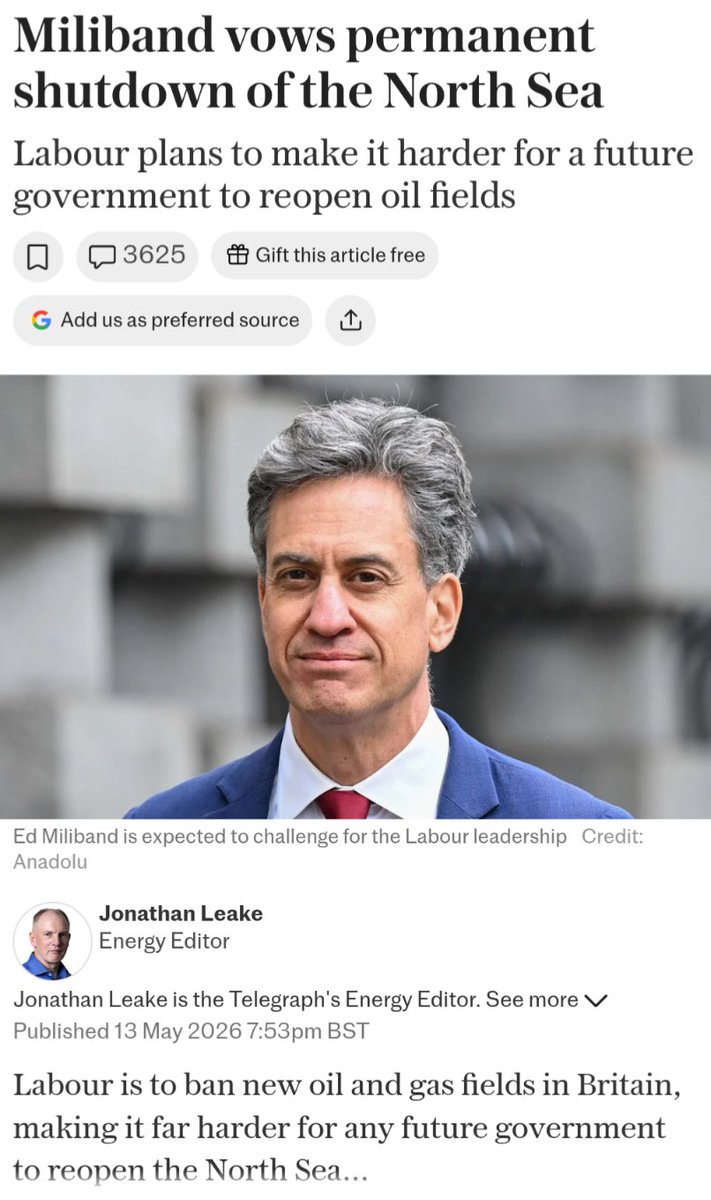
I wonder what got him the job; what his current advice is? Perhaps rather than giving away the Falkland Islands we should pay for the environmental liabilities of the approved oil exploration activities upfront? That would demonstrate real global ESG leadership, and it would be “the right thing to do” of course.
Chatted with @DoombergT this week about stuff like who won, the end of OPEC and the shape of the new world order. Normal stuff, axioms and mental models driven by first principles thinking through the energy lens.