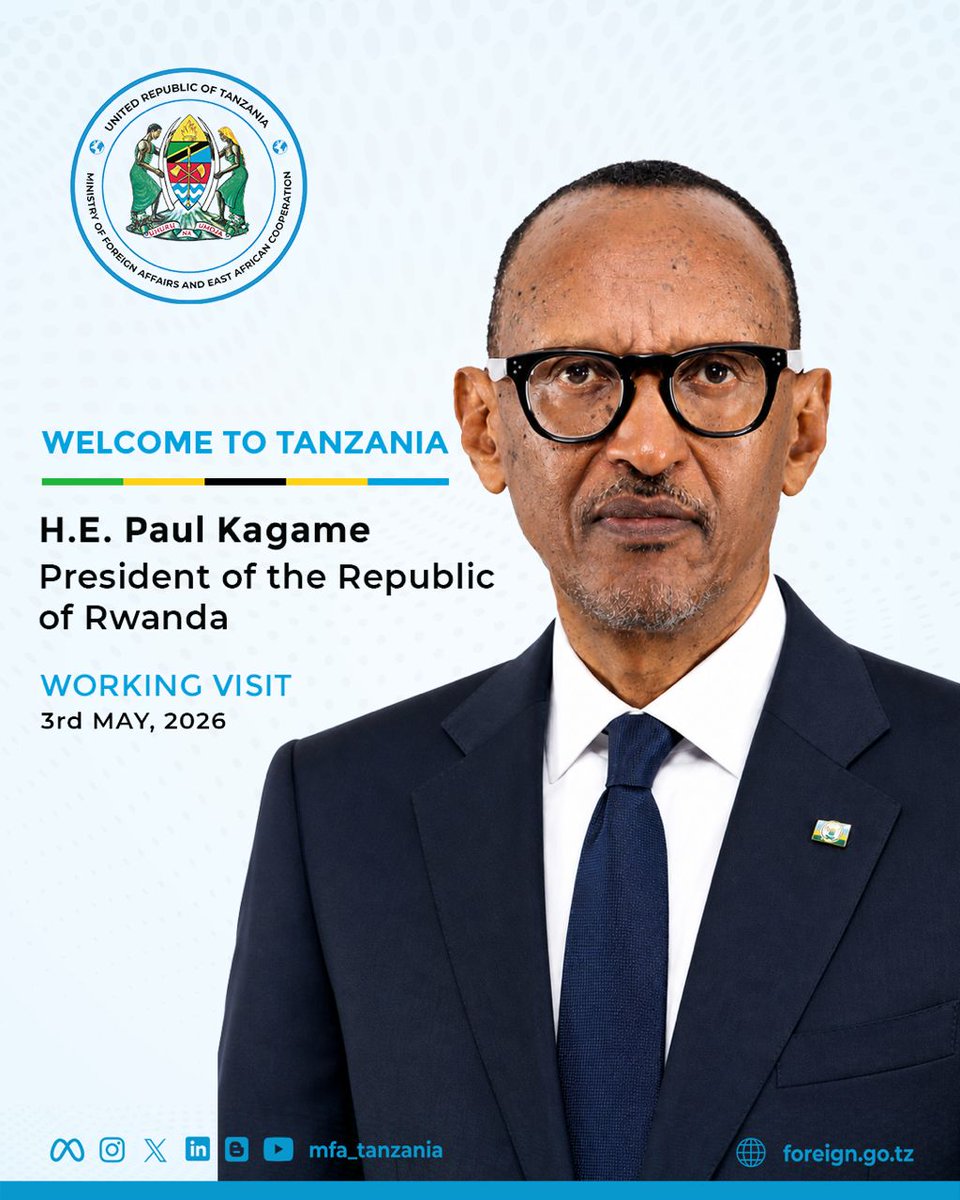
This afternoon at Urugwiro Village, President Kagame received a delegation of constitutional experts from the East African Community (EAC), together with officials from the EAC Secretariat led by Andrea Ariik Aguer, EAC Deputy Secretary-General. Discussions focused on the ongoing work towards the East African Political Confederation, including progress on drafting its Constitution and on the next steps to advance the region’s integration agenda.
“Do we really accept that, as black people, we are somehow less human and inferior?
Accepting it is not simply a matter of saying “yes.” No one will ask you that question directly. You can even say “no,” but if you behave in the very ways that brought us to the kind of history we have lived through, then, in reality, you have accepted it. You have diminished yourself. And your actions become the evidence. The evidence is in doing the very things that others did, or in trying to justify them with explanations that should never be accepted.
There are no two ways about it. Good politics and a good ideology produce positive outcomes. Bad outcomes come from bad ideas. You do not need any other evidence.
Many of you are still young. You go abroad to study. Under normal circumstances, there is nothing they know that you cannot also learn. But you can come back having absorbed ideas without questions, ideas that take you away from who you are and try to turn you into something else, something that is not yours.
Whether those ideas are good or bad, there is one illness I do not think we will cure anytime soon: when, in your own mind, you stop being yourself and begin wishing you were somebody else. Why would you want to become someone else? To achieve what? In our own history, with everything we have been through, that is exactly how we lost our way.
And then you wait for someone from outside to tell you, “This is wrong,” and you immediately agree, without realizing that what is being condemned is you. It is about stripping you of your identity, and you willingly accepting it.” President Kagame | Unity Club Meeting.
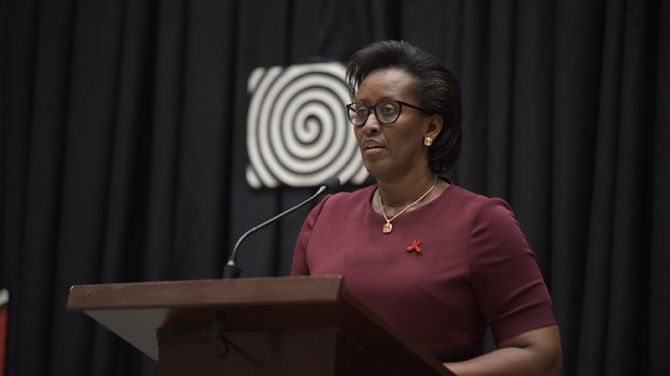
The First Lady of Rwanda, Jeannette Kagame, has been a longstanding advocate for a strong and sustainable AIDS response that is focused on people's needs.
Mrs Kagame was a co-founder of the Organisation of African First Ladies Against HIV/AIDS and served as its President from 2004-2006.
The First Lady has focused her efforts on the elimination of mother-to-child transmission of HIV and is also working to ensure young people can stay healthy and well as they transition into adulthood.
Read more: https://t.co/B7mSkZvMGL
This evening at Riyadh Air Metropolitano Stadium in Madrid, President Kagame attended the UEFA Champions League semi-final first leg between #VisitRwanda partners Arsenal Football Club @Arsenal and Atlético Madrid Football Club @Atleti, which ended in a 1–1 draw.
« Ce que les jeunes nous disent est très clair : ils ne veulent pas seulement être évoqués ; ils veulent voir des mesures concrètes mais également entreprendre, co-construire, être des architectes et non des spectateurs de nos sociétés. »
-@LMushikiwabo, Secrétaire générale de la #Francophonie
Navukiye mu #Rwanda, nkurira mu Rwanda, nize mu Rwanda, nababariye mu Rwanda none nishimiye u Rwanda! Ubwo ndi Umunyarwanda Kavukire! Mu 1961 nibwo bwa mbere nabonye Impiri irimo imisumari! ~ #RvDrAntoineRutayisire
@lydiemutesi @egidiebibio @mutesi_scovi @annemwiza
April 7th is coming up soon, a date of remembrance.
The plan for the genocide perpetrated against the Tutsi and its execution were established by international experts mandated at the very time of its execution in 1994, and was definitively confirmed by the Criminal Tribunal for Rwanda and the United Nations.
We in Rwanda and around the world are approaching the commemoration of the genocide perpetrated against the Tutsi, planned by the regime of General Habyarimana, committed thirty-two years ago, with the full knowledge of its preparation by the international community. On 23th December 2003, the UN designated April 7th of each year as the International Day of Reflection on this Genocide, and to remove any doubt, on 28 January 2018, the UN established that this day should be called the INTERNATIONAL DAY OF REFLECTION ON THE GENOCIDE COMMITTED AGAINST THE TUTSI IN RWANDA IN 1994, in order to remove any doubt and name the crime and its victims. This historical truth is inconvenient for the perpetrators of the genocide and their sympathizers, such as the son of former Rwandan President Major General Juvénal Habyarimana, the planner of this genocide.
Let us recall some legal facts to revisit the history of the planning and execution of this genocide:
From June 9 to 20, 1994, the Special Rapporteur of the United Nations Commission on Human Rights, René Degni Segui, conducted his investigations in Rwanda and published his first report establishing the facts and their analysis on June 28, 1994. He concluded unequivocally that a genocide was being committed against the Tutsi population in Rwanda, stating it in stark terms: “The classification of genocide must already be applied to the Tutsi. The international community is witnessing a human tragedy that appears to be well orchestrated. The massacres are all the more horrific and terrifying because they are presented as planned, systematic, and atrocious.”
On July 1, 1994, the United Nations Security Council established a commission of three international experts in its resolution 935 with the clear mandate to present findings “regarding the evidence concerning serious violations of international humanitarian law committed in the territory of Rwanda, including possible acts of genocide.”
The Commission conducted an investigation in Rwanda from August 29 to September 17, 1994, and issued its preliminary report on October 4, 1994, concluding that there was “overwhelming evidence that acts of genocide were committed against the Tutsi group by Hutu elements acting in a concerted, planned, systematic, and methodical manner.” The experts also concluded that it was necessary to establish an international criminal tribunal to try the perpetrators and accomplices. The final report was submitted to the Security Council on December 9, 1994, confirming the same findings.
On November 8, 1994, the Security Council took concrete action and adopted Resolution 955, establishing an international criminal tribunal to try those responsible for genocide and other serious violations of international humanitarian law committed in 1994 in Rwanda and in the territory of neighboring states. The Tribunal was established and operated for approximately twenty years. He issued several decisions, including judgments condemning 65 perpetrators of the genocide committed against the Tutsi, consecrating the agreement to commit genocide against Tutsi civilians and the perpetration of the same genocide.
Among other legal victories, on May 1, 1998, Jean Kambanda, Prime Minister of the genocidal government, pleaded guilty to eleven counts of genocide, conspiracy to commit genocide, direct and public incitement to commit genocide, crimes against humanity, and war crimes. He was sentenced to life imprisonment. In his guilty plea, Kambanda clearly stated that he led a government tasked with carrying out a genocide against the Tutsi that had been planned in advance by the previous regime of General Juvénal Habyarimana.
On September 2, 1998, the International Criminal Tribunal for Rwanda delivered its verdict against Jean-Paul Akayesu, former mayor of Taba Commune, who had not pleaded guilty. The tribunal established the facts of the genocide against the Tutsi in these terms: “It is now clear that the massacres that occurred in Rwanda in 1994 had a specific objective: to exterminate the Tutsis, specifically targeted because of their membership in the Tutsi ethnic group, and not because they were RPF fighters. This constitutes genocide, which was committed in Rwanda in 1994 against the Tutsi as a group.”
On June 16, 2006, the Appeals Chamber of the International Criminal Tribunal for Rwanda definitively established the judicial finding concluding that it was "a matter of public record that between April 6 and July 17, 1994, a genocide was committed in Rwanda against the Tutsi ethnic group."
On April 16, 2014, the United Nations Security Council, in Resolution 2150, recognized the international nature of the genocide perpetrated against the Tutsi, the obligation of all states to cooperate in the arrest and prosecution of its perpetrators, and to combat its denial. Here are some excerpts to remind deniers of this genocide:
- "Recalling that between April 6 and July 17, 1994, a genocide was committed in Rwanda against the Tutsi ethnic group, that more than one million people were killed in this genocide, and noting with concern any form of denial of this genocide;
- Emphasizes the importance of learning the lessons of the genocide perpetrated in 1994 against the Tutsi in Rwanda;
" - Unreservedly condemns any denial of this genocide and urges Member States to develop educational programs to instill the lessons of the genocide in the minds of future generations, with the aim of preventing future genocides;
- Welcomes the efforts made by Member States to investigate and prosecute all persons accused of this genocide;
- Calls upon all States to cooperate with the ICTR, the International Residual Mechanism for Criminal Tribunals, and the Rwandan Government to arrest and bring to justice the nine remaining fugitives indicted by the ICTR, and also calls upon States to investigate, arrest, prosecute, or extradite, in accordance with their international obligations, all other fugitives accused of genocide residing in their territory, including the leaders of the FDLR.
When deniers like @JLHaby, @haby_haby2, @gmbonyumutwa and all deniers persist in denying the undeniable, falsifying the unfalsifiable, defending the indefensible, and so on, in an attempt to exonerate the criminal regime of Juvénal Habyarimana, the planner of the genocide against the Tutsi, one is legitimately led to wonder what kind of heaven they think they're rising from. The commemoration of this genocide, unique in the world, the first in Africa, which the world will soon commemorate in just a few days, must truly serve as a reminder so that prevention finally becomes the ultimate goal envisioned by every human being and every state.