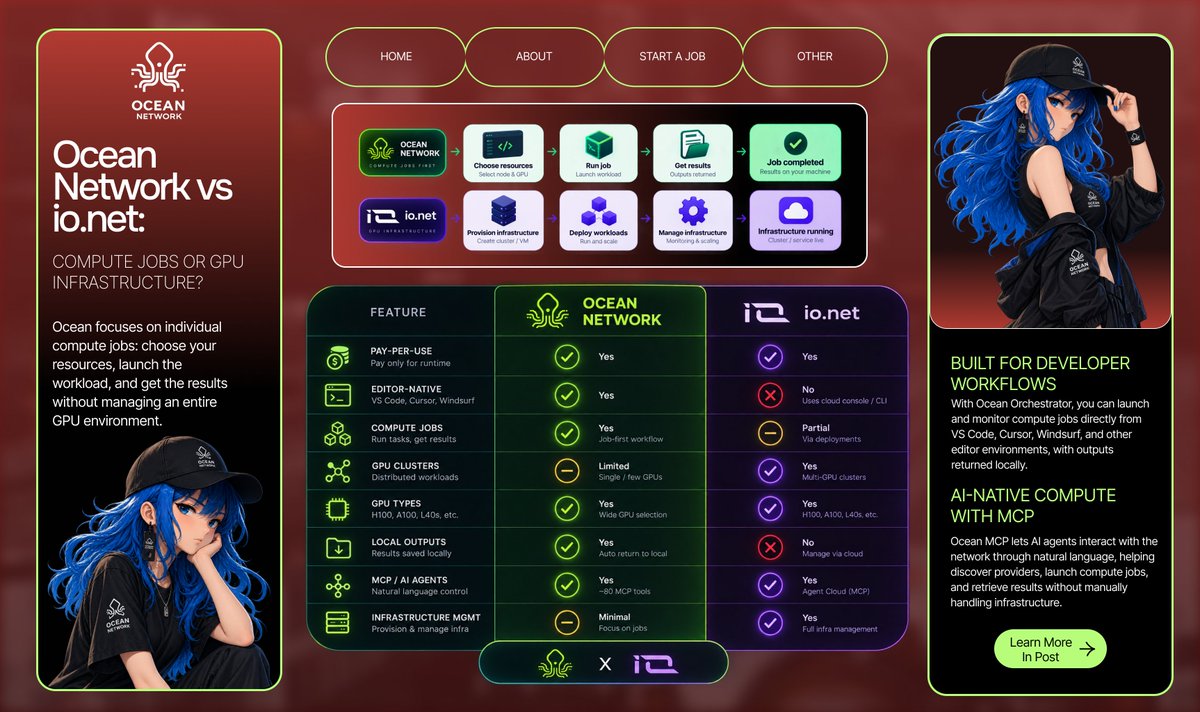
Ocean Network vs https://t.co/wFuMRxUJmr: Which Decentralized Compute Network Fits Better?
Hello, friends! Today I want to compare Ocean Network and https://t.co/wFuMRxUJmr.
In terms of their logic and purpose, these projects are very similar. They have a similar goal and vision. But the devil is in the details, right? So today, let's take a closer look at how they differ.
Ocean Network: Compute Jobs First
Ocean focuses on pay-per-use compute jobs.
The idea is simple: choose the resources you need, launch a workload, and get the results when the task is complete.
What I especially like is Ocean Orchestrator, which allows you to launch GPU jobs directly from VS Code, Cursor, Windsurf, and Antigravity.
Choose resources → Run a job → Get results.
This works well for AI inference, embeddings, batch processing, data preparation, and other individual workloads.
https://t.co/wFuMRxUJmr: GPU Infrastructure First
https://t.co/wFuMRxUJmr puts more emphasis on GPU infrastructure and cluster management.
IO Cloud allows users to create GPU clusters, VM deployments, and CaaS workloads. This makes it interesting for distributed workloads and more persistent AI applications.
So, roughly:
Ocean: Run a compute job → Get the output
https://t.co/wFuMRxUJmr: Provision infrastructure → Run and manage workloads
What About MCP?
Both projects are moving toward AI agents.
Ocean MCP provides around 80 tools that let AI agents interact with Ocean Network, find providers, launch jobs, and retrieve results.
https://t.co/wFuMRxUJmr also has Agent Cloud, built around MCP, allowing AI agents to find hardware, create deployments, and manage GPU infrastructure.
The workflows are slightly different:
Ocean MCP:
AI agent → find compute → run job → get result
https://t.co/wFuMRxUJmr Agent Cloud:
AI agent → provision infrastructure → manage deployment
For me, Ocean's approach is especially interesting when you need to solve a specific compute task without managing an entire infrastructure.
So, Which One Is Better?
I wouldn't say one is simply better. They are optimized for different workflows.
Ocean Network
→ compute jobs
→ pay-per-use
→ AI workloads
→ batch & data processing
→ editor-native workflow
→ AI-agent orchestration
https://t.co/fFURWRUH5t
→ GPU infrastructure
→ GPU clusters
→ distributed AI workloads
→ VM & CaaS deployments
→ infrastructure management
If you need to run a specific compute job and get the result, Ocean looks particularly attractive.
If you need to build and scale persistent GPU infrastructure, https://t.co/wFuMRxUJmr offers a more infrastructure-oriented approach.
Found a new one theory about bitcoin:native
" For the past few weeks, the market sentiment has been that another decline is on the horizon. Dozens of videos with patterns confirming this have been circulating on Twitter. This made sense, as we'd been in a downtrend for a long time, our highs were steadily getting lower, and there was generally no demand from the bulls.
What's happening now? It looks like we've broken the downward trend that began in 2025. After all, this growth and demand isn't just about shaving the bears "
I even don't know, everything looks like a fake for me, but I want to be wrong... so let's see
What do u think, guys ?
I just saw and heard this thought...
"Bitcoin has reacted to the zones that always lead to new highs.
The purple "All-In" level on the Rainbow Chart has worked again. In previous major cycles, this zone's range coincided with the formation of the final bottom- in 2015, 2019, and 2023."
Do you think this is the beginning of a new rally or is it preparation for the final dump?
bitcoin:native
Don't skip your next FOMO
@fomo is a crypto trading app where you can trade and see what other traders are doing.
Think of it like:
Trading app + social network.
You can:
-Buy and sell crypto.
-See what successful traders are buying or selling.
-Follow traders you find interesting.
-Get notifications when they make moves.
-Use their activity as an extra signal when making your own trades.
So instead of only looking at a chart and thinking “Should I buy?”, FOMO also lets you see “What are other traders doing right now?”
In one sentence:
FOMO helps you trade crypto while staying connected to what other traders are doing.
Let's vouch guys
we have 3 days for farming
Top 1,000 get the airdrop.
Split pro rata by score.
The more people who vouch for you, the bigger the airdrop.
Why @mezzanine_fi Is Built for More Than Simple Vaults
Tranching a simple vault isn't that difficult. The interesting part starts when strategies get more complex.
Mezzanine is designed to handle things like leveraged loops, market-neutral strategies, basis trades, arbitrage, fixed-duration positions, and multi-protocol strategies across different chains.
Each strategy behaves differently, so they can't all be managed the same way.
And that's where tranching becomes interesting.
A strategy can be optimized for higher yield, then split into Junior for more upside and Senior for a loss buffer.
Another vault could automatically move capital between lending markets, capture short-term rate opportunities, and exit when risk parameters change.
Different strategies. Same infrastructure.
The goal is to launch 2–3 new vaults every month without rebuilding the protocol from scratch each time.
The infrastructure is already built and audited, allowing new strategies to be added on top.
And there's another important part: isolation.
An isolated vault isn't automatically safer than a pool. It simply gives users more control.
You choose the strategy, evaluate its risks, and select the tranche that fits your risk appetite.
If something goes wrong, the loss stays within that strategy's accounting and loss waterfall.
Diversification becomes your decision - not the protocol's.